
Time-weighted return measures investment performance while minimizing the effect of the size and timing of external contributions and withdrawals.
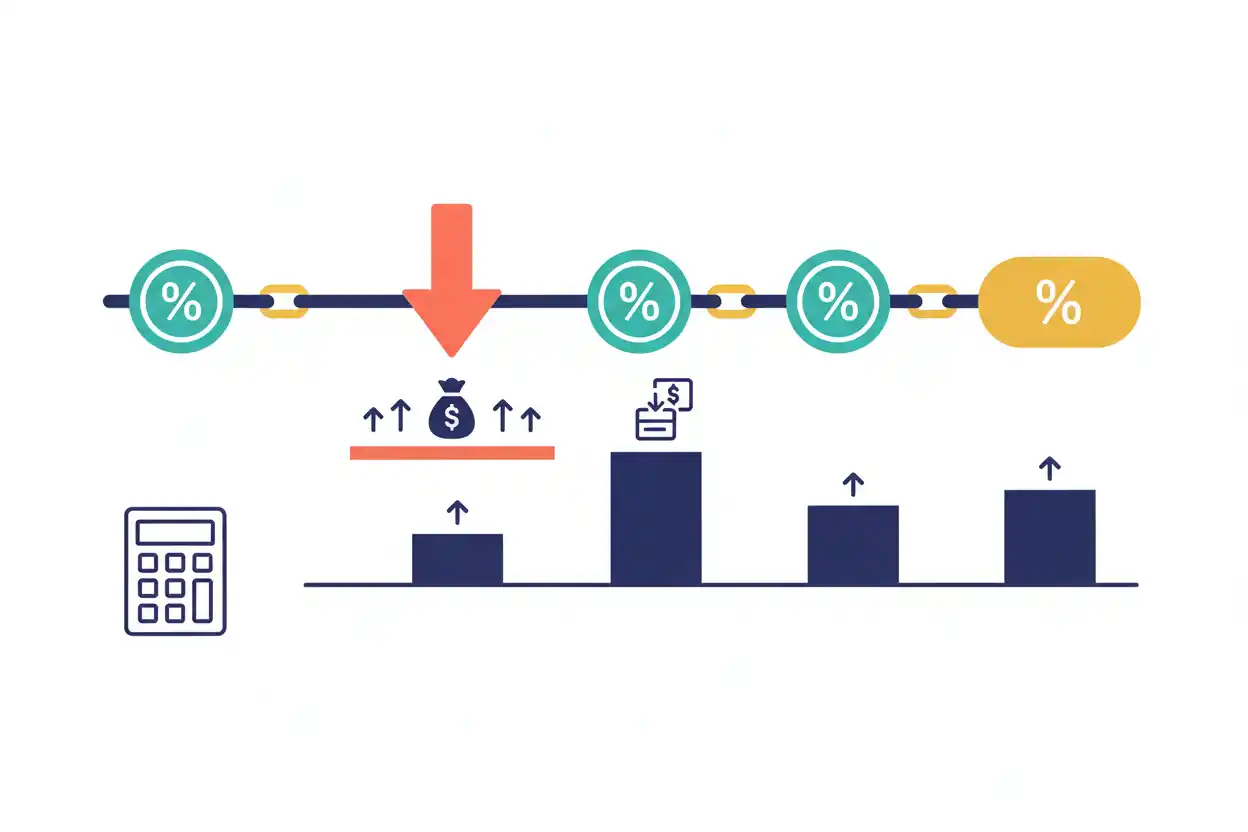
The method divides the measurement period into subperiods whenever an external cash flow occurs, calculates the return for each subperiod, and then geometrically links those returns.
Suppose a $100,000 portfolio grows to $110,000. The investor then contributes $50,000, bringing the portfolio to $160,000. The portfolio subsequently grows to $168,000.
The two investment returns are 10% and 5%.
Time-weighted return is:
(1.10 × 1.05) − 1 = 15.5%
The $50,000 contribution increases account value, but it is not treated as investment performance.
What Is Time-Weighted Return?
Time-weighted return, commonly abbreviated TWR, attempts to isolate the return produced by an investment strategy from external investor cash flows.
External cash flows can include:
- contributions;
- withdrawals;
- transfers into the portfolio;
- transfers out of the portfolio.
Without adjustment, those cash flows can make account-value growth look much better or worse than actual investment performance.
Why Account Growth Is Not the Same as Return
Suppose:
- beginning balance = $100,000;
- contribution = $50,000;
- ending balance = $168,000.
A naive account-growth calculation gives:
($168,000 − $100,000) ÷ $100,000
= 68%
But $50,000 of that increase came from the investor.
It was not earned.
Even subtracting the contribution directly:
($168,000 − $100,000 − $50,000) ÷ $100,000
= 18%
still does not correctly capture performance when the contribution occurred partway through the period.
Time-Weighted Return Formula
If the period contains subperiod returns:
TWR = [(1 + R₁)(1 + R₂)…(1 + Rₙ)] − 1
Where each subperiod is separated by an external cash flow.
For two periods:
TWR = (1 + R₁)(1 + R₂) − 1
Time-Weighted Return Example
Suppose:
Beginning
Portfolio = $100,000
Before any external cash flow, it grows to:
$110,000
Subperiod 1 return:
R₁ = ($110,000 − $100,000) ÷ $100,000
R₁ = 10%
Add the External Contribution
Investor contributes:
$50,000
Portfolio immediately after contribution:
$110,000 + $50,000 = $160,000
That $160,000 becomes the starting value for the next performance subperiod.
Calculate Subperiod 2
Ending portfolio:
$168,000
Subperiod 2 return:
R₂ = ($168,000 − $160,000) ÷ $160,000
R₂ = 5%
Chain-Link the Returns
TWR = (1 + 0.10)(1 + 0.05) − 1
TWR = 1.10 × 1.05 − 1
TWR = 1.155 − 1
TWR = 15.5%
The time-weighted return is 15.5%.
Why the Result Is Not 15%
Simply adding:
10% + 5% = 15%
ignores compounding.
The second 5% return occurs after the first 10% growth factor.
Correct chain-linking:
1.10 × 1.05 = 1.155
produces 15.5%.
Withdrawal Example
Suppose:
- portfolio starts at $200,000;
- rises to $220,000;
- investor withdraws $40,000;
- new starting balance = $180,000;
- portfolio later rises to $189,000.
First subperiod:
$220,000 ÷ $200,000 − 1 = 10%
Second subperiod:
$189,000 ÷ $180,000 − 1 = 5%
TWR:
1.10 × 1.05 − 1
= 15.5%
The withdrawal does not create a negative investment return because the subperiod is reset around the external cash flow.
TWR With Three Subperiods
Suppose:
- Subperiod 1 = +12%;
- Subperiod 2 = −8%;
- Subperiod 3 = +8%.
Then:
TWR = 1.12 × 0.92 × 1.08 − 1
TWR = 1.112832 − 1
TWR = 11.2832%
The cumulative time-weighted return is approximately 11.28%.
Annualizing Time-Weighted Return
If the 11.2832% cumulative TWR occurred across three years:
Annualized TWR = (1 + Cumulative TWR)^(1 ÷ Years) − 1
Annualized TWR = 1.112832^(1/3) − 1
Annualized TWR ≈ 3.63%
The annualized return is not:
11.2832% ÷ 3
unless returns happen to behave in a way that makes the approximation acceptable.
TWR vs Total Return
Total return commonly measures the investment’s complete gain or loss over a period, including income and price changes.
Time-weighted return becomes particularly important when external cash flows occur during the measurement period.
If there are no external contributions or withdrawals, a properly calculated total holding-period return and cumulative TWR can be equivalent.
TWR vs Money-Weighted Return
Money-weighted return gives more influence to periods when more investor money is invested.
Time-weighted return gives each investment subperiod its own geometric role regardless of how much capital the investor added.
This distinction makes TWR useful for evaluating a portfolio manager when the manager does not control investor contribution timing.
Money-weighted return can be more representative of the investor’s actual dollar experience.
Why Contributions Can Distort Simple Return
Suppose a portfolio performs badly for most of a year but receives a huge contribution near year-end.
Ending account value can be much higher than beginning value despite poor investment performance.
TWR separates the contribution from the return.
Without that adjustment, deposits can be mistaken for profits.
Why Withdrawals Can Distort Simple Return
A portfolio can perform well but end with a lower account balance because the investor withdrew substantial money.
For example:
- starting account = $100,000;
- ending account = $80,000;
- withdrawals = $40,000.
The lower ending balance does not necessarily indicate a −20% investment return.
Cash-flow timing must be separated from performance.
Time-Weighted Return and Time Value of Money
Time value of money evaluates cash flows based on both amount and timing.
TWR has a different objective.
It intentionally reduces the impact of external cash-flow size when measuring investment performance.
That is why TWR and money-weighted calculations can produce different results from the same account history.
Time-Weighted Return and Stock-Bond Allocation
A stock-bond allocation strategy can be evaluated using TWR.
Suppose investors add or withdraw money throughout the year.
TWR can help measure how the allocation itself performed without allowing a large deposit to dominate the return number.
Rebalancing trades inside the portfolio are not generally treated the same as external cash flows because they move money between portfolio holdings rather than into or out of the portfolio.
Time-Weighted Return and Standard Deviation
The standard deviation of returns can be calculated from a series of periodic portfolio returns.
Those periodic returns may themselves be time-weighted when external cash flows exist.
This makes consistent performance measurement important before volatility statistics are calculated.
Bad return data produce bad risk metrics.
Time-Weighted Return and Treynor Ratio
The Treynor ratio compares excess investment return with beta.
If TWR is used as the portfolio-performance input, the return period and beta period should be consistent.
A risk-adjusted ratio cannot fix inconsistent underlying return measurement.
Handling Dividends and Interest
Dividends and interest generated by portfolio holdings are investment returns, not external investor cash flows.
If they remain inside the portfolio, they are reflected in portfolio value.
If distributed as investment income, the performance calculation should account for them appropriately rather than treating them as investor withdrawals that erase the investment return.
Internal Transfers Are Not External Cash Flows
Suppose $20,000 is sold from stocks and invested in bonds inside the same portfolio.
Total portfolio assets do not leave the account.
That is an allocation change, not an external contribution or withdrawal.
TWR subperiod breaks are designed around external cash flows.
Fees
If investment-management fees are deducted from the portfolio, return can be reported:
- gross of fees;
- net of fees.
A net TWR will generally be lower.
When comparing managers or funds, check whether the returns use the same fee convention.
Taxes
Personal tax payments generally are not treated as investment-manager performance.
However, after-tax portfolio analysis can require different treatment.
A TWR reported before investor taxes and a personal after-tax wealth return answer different questions.
Daily Valuation Improves Accuracy
When significant cash flows occur, exact TWR measurement benefits from knowing portfolio value immediately before or around each flow.
If only monthly account values are available, approximations may be necessary.
Modern portfolio systems often use daily valuations to improve precision.
Modified Dietz vs Exact TWR
When valuations are not available at every external cash flow, approximation methods such as Modified Dietz can estimate performance using weighted cash flows.
That is not exactly the same as geometrically linking precisely valued subperiods.
Methodology should be disclosed when precision matters.
Time-Weighted Return Does Not Show Dollar Profit
Suppose:
- Investor A has $10,000;
- Investor B has $1 million.
Both earn:
TWR = 10%
Investor A’s approximate dollar gain:
$1,000
Investor B’s:
$100,000
TWR measures percentage performance, not absolute wealth gained.
TWR Does Not Eliminate Investment Risk
A portfolio can report strong TWR and still experience:
- high volatility;
- severe drawdowns;
- concentration risk.
Return measurement and risk measurement are separate.
Common Time-Weighted Return Mistakes
One mistake is treating deposits as investment profits.
Another is subtracting contributions from ending value without accounting for when the contribution occurred.
People may also add subperiod returns instead of geometrically linking them.
A further mistake is confusing time-weighted return with the investor’s personal dollar-weighted experience.
Frequently Asked Questions
What is time-weighted return?
It is a performance measure designed to reduce the effect of external contribution and withdrawal timing.
What is the formula?
TWR = [(1 + R₁)(1 + R₂)…(1 + Rₙ)] − 1
Why split the period around external cash flows?
Because deposits and withdrawals change account value without representing investment performance.
Is a contribution a return?
No.
Is dividend income an external cash flow?
No. It is investment income generated by the portfolio.
Why not simply add subperiod returns?
Because investment returns compound geometrically.
How is TWR different from money-weighted return?
TWR neutralizes external cash-flow timing; money-weighted return reflects the timing and size of investor cash flows.
When are TWR and total return similar?
When there are no external cash flows during the period and both are calculated consistently.
Can TWR be annualized?
Yes, using a geometric annualization formula.
Does TWR measure dollar profit?
No.
Do fees affect TWR?
Yes, depending on whether performance is reported gross or net of fees.
Why use time-weighted return?
It helps isolate investment-strategy performance from investor-controlled cash flows within broader Savings & Investing analysis.