The time value of money is the principle that money available today and the same nominal amount received in the future are not economically identical.
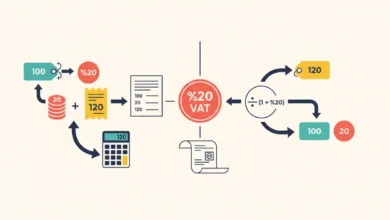
If $10,000 can earn 6% annually, it grows to approximately $13,382.26 after five years.
Conversely, $13,382.26 received five years from now has a present value of $10,000 when discounted at the same 6% rate.
The core time value of money variables are:
- present value;
- future value;
- payment;
- interest or discount rate;
- number of periods.
Most loan, savings, annuity, bond, and investment calculations are combinations of these variables.
What Is the Time Value of Money?
The principle can be summarized as:
Money Today Can Earn a Return Before Money Received Later Arrives
If you can invest $1,000 today at 5%:
One-Year Future Value = $1,000 × 1.05
= $1,050
Therefore, $1,000 today and $1,000 one year from now are not economically equivalent under a positive 5% opportunity rate.
The Five Core TVM Variables
Present Value — PV
The amount measured today.
Future Value — FV
The amount measured at a future date.
Payment — PMT
A recurring periodic cash flow.
Rate — r
The interest, growth, or discount rate per period.
Number of Periods — n
The number of compounding or payment periods.
If four variables are known, the fifth can often be solved.
Future Value Formula
For one lump sum:
FV = PV × (1 + r)^n
Suppose:
- PV = $10,000;
- annual rate = 6%;
- n = 5 years.
Then:
FV = $10,000 × 1.06⁵
FV ≈ $13,382.26
The future value is approximately $13,382.26.
Present Value Formula
Reverse the calculation:
PV = FV ÷ (1 + r)^n
Suppose:
- FV = $13,382.26;
- rate = 6%;
- time = 5 years.
Then:
PV = $13,382.26 ÷ 1.06⁵
PV ≈ $10,000
The two formulas are mathematical inverses.
Why Compounding Matters
With simple multiplication:
$10,000 × 6% × 5 = $3,000
But annual compound growth produces:
$13,382.26 − $10,000
= $3,382.26
The extra:
$382.26
comes from earning returns on previous returns.
Present Value vs Future Value
Future value moves money forward:
PV → FV
Present value discounts money backward:
FV → PV
A comparison between two cash flows is meaningful only when they are expressed at the same point in time.
Solve for the Rate
If PV, FV, and n are known:
r = (FV ÷ PV)^(1/n) − 1
Suppose:
- PV = $20,000;
- FV = $30,000;
- n = 8 years.
Then:
r = ($30,000 ÷ $20,000)^(1/8) − 1
r = 1.5^(1/8) − 1
r ≈ 5.20%
A compounded annual rate of approximately 5.20% connects the two amounts.
Solve for Time
If PV, FV, and rate are known:
n = ln(FV ÷ PV) ÷ ln(1 + r)
Suppose $10,000 must double at 7%.
n = ln(2) ÷ ln(1.07)
n ≈ 10.24 years
This is the exact form behind common doubling-time shortcuts.
Recurring Payments
Many financial problems contain not one cash flow but a series of equal payments.
Examples include:
- monthly savings deposits;
- loan payments;
- pension payments;
- annuity cash flows.
When payments occur at the end of each period, ordinary-annuity formulas can be used.
Future Value of Recurring Deposits
For equal end-of-period deposits:
FV = PMT × [((1 + r)^n − 1) ÷ r]
Suppose:
- PMT = $500 per month;
- nominal annual rate = 6%;
- monthly rate = 0.5%;
- time = 10 years;
- n = 120.
Then:
FV = $500 × [(1.005)^120 − 1] ÷ 0.005
FV ≈ $81,939.67
Total deposits:
$500 × 120 = $60,000
Modeled growth:
$81,939.67 − $60,000
≈ $21,939.67
Present Value of Recurring Payments
For equal end-of-period payments:
PV = PMT × [1 − (1 + r)^−n] ÷ r
This determines the value today of a finite future payment stream.
It is the mathematical foundation of many fixed-payment loan and annuity calculations.
Payment Formula
If present value, rate, and number of periods are known:
PMT = PV × r ÷ [1 − (1 + r)^−n]
Suppose:
- amount financed = $25,000;
- nominal annual rate = 7%;
- monthly payments;
- term = 60 months.
Monthly rate:
r = 0.07 ÷ 12
Then:
PMT ≈ $495.03 per month
The payment is calculated so that the present value of all scheduled payments equals the amount financed under the stated assumptions.
Rate and Period Must Match
This is one of the most important TVM rules.
Monthly payments require:
Monthly Rate + Number of Months
Annual cash flows require:
Annual Rate + Number of Years
If a nominal annual rate is 6% and cash flows are monthly:
Monthly Rate = 6% ÷ 12
= 0.5%
Using 6% as the monthly rate would create a major error.
Nominal vs Effective Rates
A 6% nominal annual rate compounded monthly has an effective annual rate of:
EAR = (1 + 0.06 ÷ 12)^12 − 1
≈ 6.1678%
Rate labels matter.
A nominal annual rate and an effective annual rate should not be treated as interchangeable.
Beginning-of-Period Payments
When payments occur at the beginning of each period rather than the end, every payment receives or avoids one additional period of discounting.
For an annuity due:
Value Due = Ordinary Annuity Value × (1 + r)
Payment timing therefore changes value even when every payment amount is identical.
Time Value of Money and Stock-Bond Allocation
A stock-bond allocation affects the return and risk assumptions used in long-term projections.
A TVM spreadsheet can project a portfolio using 8%, but the formula itself cannot tell you whether 8% is a reasonable expectation for the chosen allocation.
Mathematical precision does not replace realistic assumptions.
Time Value of Money and Standard Deviation
Standard deviation of returns highlights another limitation of smooth TVM projections.
A model may assume:
6%, 6%, 6%, 6%, 6%
while real market returns might be:
12%, −8%, 20%, 3%, 5%
The same average-looking rate can hide very different volatility and sequence effects.
Time Value of Money and Sortino Ratio
The Sortino ratio measures return relative to downside deviation.
TVM tells you what happens if a rate occurs.
Sortino helps evaluate how investment performance relates to downside risk.
One is a valuation framework; the other is a performance-risk metric.
Time Value of Money and Time-Weighted Return
Time-weighted return measures actual investment performance across periods while reducing the effect of external cash-flow timing.
TVM instead calculates the economic relationship among:
- value;
- rate;
- time;
- payments.
A realized TWR can later be used as historical information, but it should not automatically become the future TVM assumption.
Time Value of Money and Total Return
Total return includes both price change and investment income.
If total return is reinvested, it contributes to future compound growth.
A TVM projection using only price appreciation while ignoring reinvested income can understate the economic return of an income-producing investment.
Discount Rate Interpretation
A discount rate can represent:
- opportunity cost;
- required return;
- financing rate;
- investment hurdle rate;
- another valuation assumption.
It is not automatically inflation.
The correct discount rate depends on the problem being solved.
Present Value of Unequal Cash Flows
If future cash flows differ:
PV = CF₁ ÷ (1 + r) + CF₂ ÷ (1 + r)² + …
Suppose:
- year 1 = $1,000;
- year 2 = $2,000;
- year 3 = $3,000.
Each payment should be discounted separately.
An equal-payment annuity formula would not accurately represent that pattern.
Future Value of Unequal Contributions
The same principle applies to irregular savings deposits.
A $5,000 contribution made today has more time to grow than $5,000 contributed five years from now.
Each deposit’s future value depends on its own investment period.
Inflation and TVM
Suppose a future expense costs $50,000 today and inflation is assumed to be 3% for 15 years.
Future nominal cost:
FV = $50,000 × 1.03¹⁵
≈ $77,898.37
Inflation itself is a compounding process.
This illustrates why long-term financial goals can become much larger in nominal dollars.
Real vs Nominal TVM
A financial model should remain internally consistent.
Use:
Nominal Cash Flows + Nominal Rate
or:
Real Cash Flows + Real Rate
Mixing today’s real spending values with nominal investment returns without adjusting for inflation can overstate future purchasing power.
Negative Rates
TVM formulas can also accommodate negative rates as long as:
1 + r > 0
Suppose $10,000 declines 2% annually for three years:
FV = $10,000 × 0.98³
≈ $9,411.92
Time value of money is not limited to positive growth.
Common Time Value of Money Mistakes
One mistake is mixing monthly and annual periods.
Another is confusing PV with FV.
People can also use the wrong payment timing or ignore recurring cash flows.
A further mistake is selecting an unrealistic rate and assuming the formula’s precise answer makes the forecast reliable.
Frequently Asked Questions
What is the time value of money?
It is the principle that money at different dates has different economic value because money can earn a return over time.
What is the future value formula?
FV = PV × (1 + r)^n
What is the present value formula?
PV = FV ÷ (1 + r)^n
How do I solve for the return rate?
r = (FV ÷ PV)^(1/n) − 1
How do I solve for time?
n = ln(FV ÷ PV) ÷ ln(1 + r)
What does PMT mean?
PMT is a recurring payment or deposit.
Why must rate and period frequency match?
Because each compounding or payment period needs the correct periodic rate.
Is a nominal rate the same as an effective rate?
No.
What happens when payments occur at the beginning of each period?
They generally have greater present and future value than otherwise identical end-of-period payments at a positive rate.
Does TVM predict investment returns?
No. It calculates results from the assumptions entered.
Can TVM handle negative rates?
Yes, within the mathematical limits of the formula.
Why is time value of money important?
It is the core framework connecting savings, investing, borrowing, valuation, and retirement calculations throughout Savings & Investing.