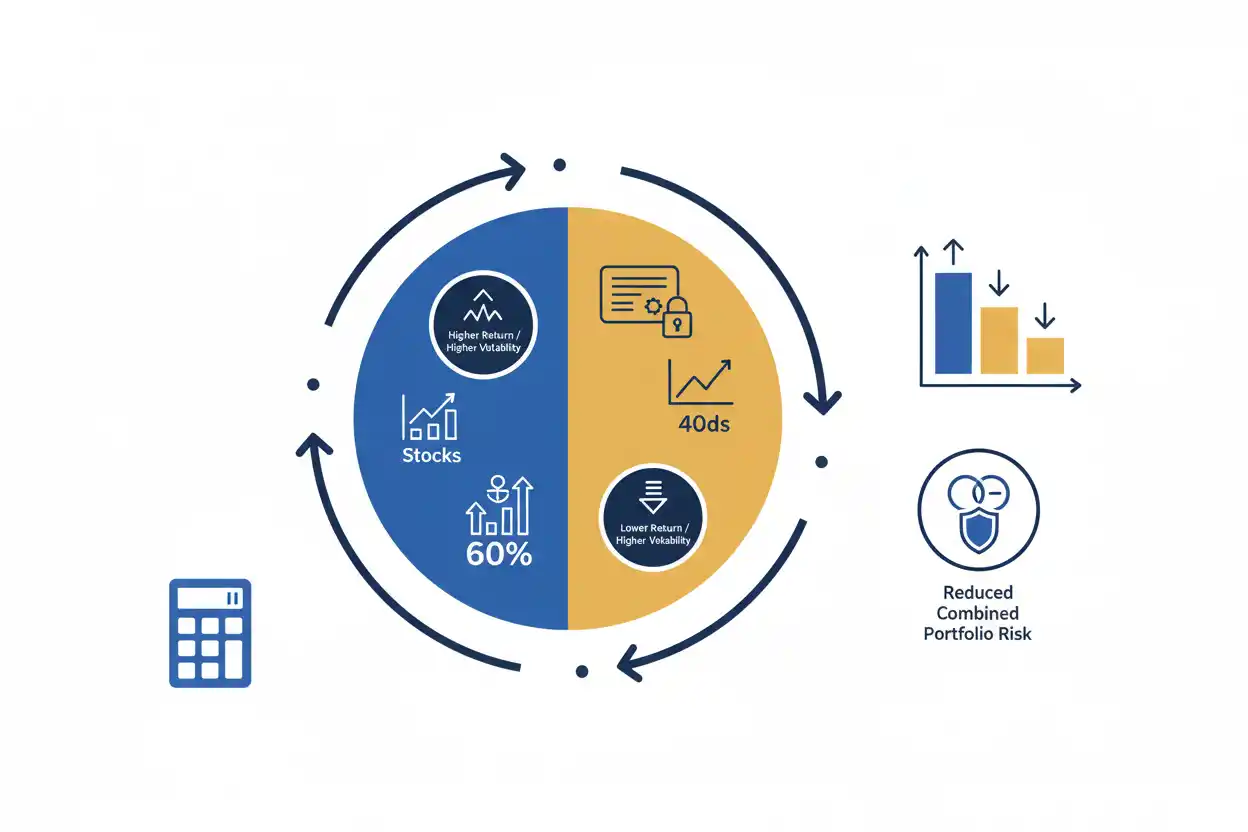

Stock-bond allocation is the percentage of an investment portfolio assigned to stocks versus bonds.
A 60/40 portfolio places 60% of capital in stocks and 40% in bonds.
If stocks return 9% and bonds return 4% during a period, a portfolio that remains exactly 60/40 for that return calculation earns:
60% × 9% + 40% × 4% = 7%
Allocation also affects risk. Because stocks and bonds can have different volatility and may not move perfectly together, portfolio risk cannot be determined from weights alone.
What Is Stock-Bond Allocation?
Stock-bond allocation answers:
How much of the portfolio is assigned to each broad asset class?
For a two-asset portfolio:
Stock Weight + Bond Weight = 100%
Examples include:
- 80/20;
- 70/30;
- 60/40;
- 50/50;
- 40/60.
The first number commonly refers to stocks and the second to bonds.
Portfolio Weight Formula
Asset Weight = Asset Value ÷ Total Portfolio Value × 100
Suppose:
- stocks = $120,000;
- bonds = $80,000.
Total:
$120,000 + $80,000 = $200,000
Stock weight:
$120,000 ÷ $200,000 = 60%
Bond weight:
$80,000 ÷ $200,000 = 40%
The portfolio is 60/40.
Calculate Target Dollar Values
If total portfolio value and target percentages are known:
Target Asset Value = Portfolio Value × Target Weight
For a $500,000 portfolio targeting 60/40:
Stocks:
$500,000 × 60% = $300,000
Bonds:
$500,000 × 40% = $200,000
Weighted Portfolio Return
A simplified portfolio-return formula is:
Portfolio Return = Stock Weight × Stock Return + Bond Weight × Bond Return
Suppose:
- stocks = 60%;
- bonds = 40%;
- stock return = 9%;
- bond return = 4%.
Then:
Portfolio Return = 0.60 × 9% + 0.40 × 4%
Portfolio Return = 5.4% + 1.6%
Portfolio Return = 7%
The portfolio return is 7% before considering fees, taxes, cash flows, or rebalancing effects.
Why You Cannot Simply Average Returns
A simple average of 9% and 4% is:
(9% + 4%) ÷ 2 = 6.5%
That would only represent the weighted portfolio return if both investments had equal 50% weights.
For a 60/40 portfolio, the correct result is 7%.
Portfolio weights matter.
Stock-Bond Allocation and Volatility
Stocks and bonds usually have different levels of return variability.
Suppose:
- stock standard deviation = 16%;
- bond standard deviation = 6%;
- stock weight = 60%;
- bond weight = 40%;
- correlation = 0.20.
The two-asset portfolio standard-deviation formula is:
σₚ = √[wₛ²σₛ² + wᵦ²σᵦ² + 2wₛwᵦσₛσᵦρ]
Insert the assumptions:
σₚ = √[(0.60² × 0.16²) + (0.40² × 0.06²) + (2 × 0.60 × 0.40 × 0.16 × 0.06 × 0.20)]
The result is approximately:
Portfolio Standard Deviation ≈ 10.35%
That is lower than the stock-only 16% volatility.
Why Correlation Matters
If stocks and bonds moved perfectly together, diversification would provide less volatility reduction.
If they moved differently, one asset could partially offset movements in the other.
This is why the standard deviation of returns for each asset is not enough by itself.
Correlation also matters.
What Happens If Correlation Changes?
Using the same weights and individual volatilities:
- correlation +1 produces higher combined volatility;
- correlation 0 can reduce volatility;
- negative correlation can reduce it further.
But correlations are not permanent.
Relationships observed historically can change, especially during periods of financial stress.
Higher Stock Allocation
Suppose Portfolio A is:
80% Stocks / 20% Bonds
and Portfolio B is:
40% Stocks / 60% Bonds
If stocks have both higher expected return and higher volatility, Portfolio A will generally have greater exposure to stock-market gains and losses.
That does not mean it will outperform during every period.
Higher Bond Allocation
A larger bond allocation can potentially:
- reduce portfolio volatility;
- provide contractual income;
- change interest-rate sensitivity;
- lower expected growth relative to a higher-stock portfolio under some assumptions.
Bonds still carry risks, including:
- interest-rate risk;
- credit risk;
- inflation risk.
“More bonds” does not mean “no risk.”
Allocation Drift
Suppose a $100,000 portfolio begins:
Stocks = $60,000
Bonds = $40,000
Stocks rise 20%:
$60,000 × 1.20 = $72,000
Bonds fall 5%:
$40,000 × 0.95 = $38,000
New total:
$110,000
New stock weight:
$72,000 ÷ $110,000
≈ 65.45%
New bond weight:
≈ 34.55%
The 60/40 portfolio has drifted to approximately 65.45/34.55.
Rebalancing Back to 60/40
At a $110,000 total:
Target stocks:
$110,000 × 60% = $66,000
Target bonds:
$110,000 × 40% = $44,000
Current stocks:
$72,000
Current bonds:
$38,000
Required adjustment:
Sell $6,000 Stocks
Buy $6,000 Bonds
The portfolio returns to the target 60/40 allocation.
Allocation vs Rebalancing
Allocation determines the target.
Rebalancing restores the target after market movements.
These are distinct decisions:
Asset Allocation = Where the portfolio should be
Rebalancing = How the portfolio is returned there
A target does not remain intact automatically.
Stock-Bond Allocation and Time Value of Money
Time value of money calculations may project a portfolio using one assumed growth rate.
The selected stock-bond allocation influences whether that return assumption is realistic.
A portfolio modeled at 8% with a conservative asset allocation should not simply inherit an aggressive equity-return assumption without analysis.
Stock-Bond Allocation and Sortino Ratio
The Sortino ratio can help compare portfolios using downside deviation.
Suppose increasing bond allocation reduces large negative return periods while lowering average return slightly.
Sortino can help evaluate whether the resulting reduction in downside risk compensated for the lower return.
It does not determine the appropriate allocation by itself.
Stock-Bond Allocation and Time-Weighted Return
Time-weighted return can measure portfolio performance while neutralizing the timing of external contributions and withdrawals.
If a 60/40 portfolio is rebalanced during the year, its TWR reflects the performance of the portfolio strategy across subperiods.
This is different from simply calculating one weighted return from beginning-of-year weights.
Stock-Bond Allocation and Social Security
For retirement planning, Social Security benefits can provide income outside the investment portfolio.
That income may influence how much market risk a household needs or is willing to take.
However, Social Security itself is not a tradable bond allocation that can mechanically be rebalanced inside a portfolio.
Stock-Bond Allocation by Time Horizon
Money needed soon generally has less capacity to recover from severe market declines than money invested for decades.
A household saving for a near-term purchase may therefore select a different allocation from someone investing for retirement 30 years away.
Time horizon affects the amount of volatility the investor can reasonably accept.
Risk Capacity vs Risk Tolerance
Risk tolerance describes willingness to experience losses.
Risk capacity describes financial ability to withstand them.
Someone may feel comfortable with market volatility but still have low risk capacity because the money is needed in two years.
A suitable stock-bond allocation should consider both.
100% Stocks
A 100% stock allocation maximizes equity exposure.
It can also create substantial drawdowns.
Even a long-horizon investor should understand that high expected return does not imply a smooth growth path.
100% Bonds
A 100% bond allocation avoids direct stock-market exposure but still faces risks.
Bond values can fall when:
- interest rates rise;
- credit quality deteriorates;
- liquidity weakens.
Inflation can also reduce the purchasing power of fixed payments.
Portfolio Income
Bonds can contribute interest income while stocks may contribute dividends.
Total portfolio return should include both:
- income;
- price changes.
Allocation analysis based only on price appreciation can understate the economic contribution of income-producing assets.
Taxes and Rebalancing
In taxable accounts, selling appreciated assets to rebalance may create tax consequences.
Investors may sometimes use:
- new contributions;
- dividends;
- withdrawals;
to move weights toward target levels before creating additional taxable sales.
The optimal implementation depends on individual circumstances.
Fees and Allocation
If two asset classes have different investment costs, the portfolio’s net return is affected by both allocation and fees.
A low-cost 60/40 portfolio and an expensive 60/40 portfolio do not necessarily produce the same net outcome.
Allocation is one part of portfolio design.
Allocation Does Not Guarantee a Return
A historical 60/40 return is not a guaranteed future return for all 60/40 portfolios.
Results vary because of:
- specific securities;
- bond duration;
- geography;
- valuation;
- fees;
- rebalancing;
- market period.
The allocation label describes weights, not a guaranteed performance profile.
Common Stock-Bond Allocation Mistakes
One mistake is assuming a 60/40 portfolio stays at 60/40 without rebalancing.
Another is averaging stock and bond returns without applying weights.
People may also assume bonds have no risk or that historical stock-bond correlations will remain constant.
A further mistake is selecting an allocation solely from age without considering spending horizon, income, liquidity, and risk capacity.
Frequently Asked Questions
What is stock-bond allocation?
It is the percentage of a portfolio invested in stocks versus bonds.
What does 60/40 mean?
It generally means 60% stocks and 40% bonds.
How do I calculate portfolio weight?
Asset Weight = Asset Value ÷ Total Portfolio Value × 100
How do I calculate weighted return?
Portfolio Return = Σ(Weight × Asset Return)
Does a 60/40 portfolio always earn a specific return?
No.
Why does correlation matter?
Assets that do not move perfectly together can reduce overall portfolio volatility.
Why does allocation drift?
Different assets earn different returns, causing their portfolio percentages to change.
How do I rebalance?
Calculate target dollar values from the current total and trade or direct cash flows toward those targets.
Are bonds risk-free?
No.
Does more stock always mean more return?
No. It generally means greater equity exposure, but realized returns can be positive or negative.
Can retirement income affect allocation decisions?
Yes. Reliable nonportfolio income can influence household risk capacity and withdrawal needs.
Why is stock-bond allocation important?
It is one of the main drivers of portfolio return and risk within the broader Savings & Investing framework.