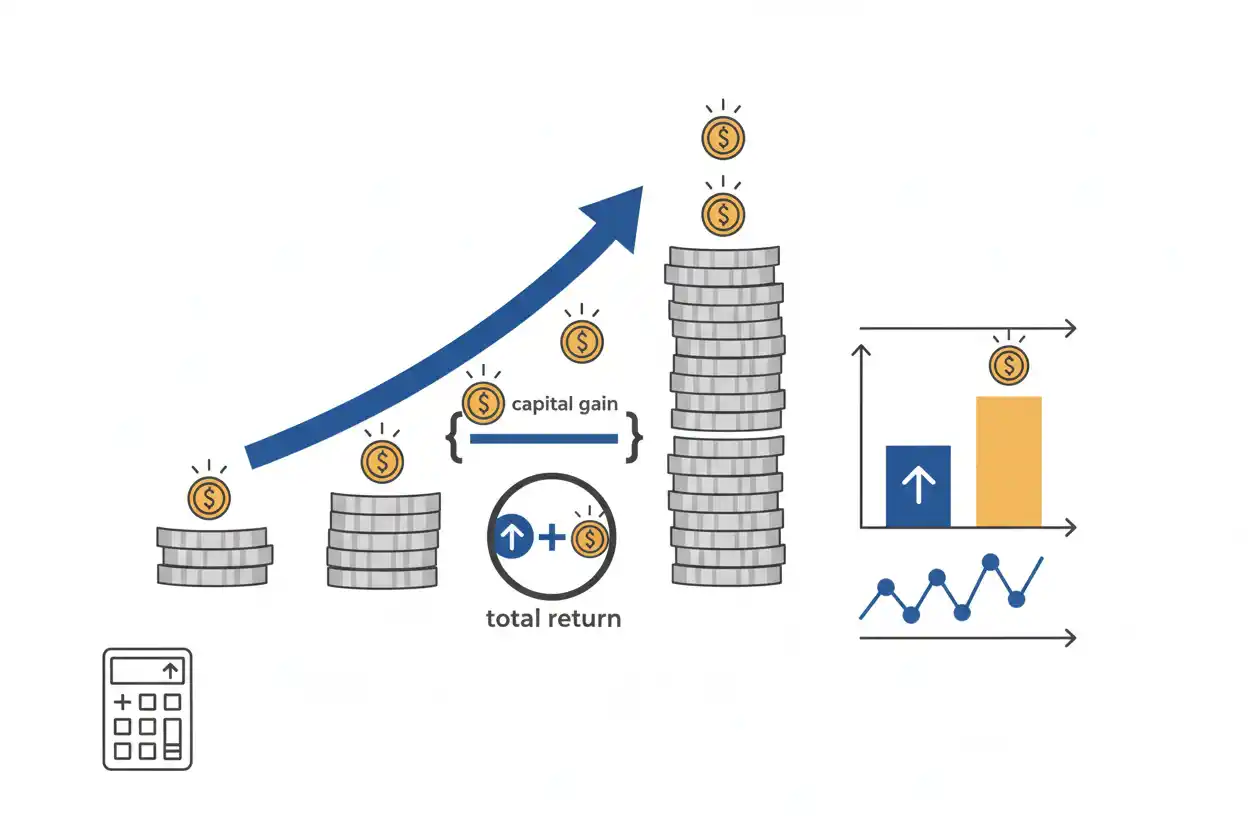

Total return measures an investment’s complete gain or loss over a period by combining price changes with income received.
If a stock is purchased at $80, ends the period at $90, and pays $3 in dividends, the total return is 16.25%.
The $10 price gain alone represents a 12.5% price return. Including the $3 dividend raises the complete investment result.
Total return therefore provides a broader performance measure than looking only at price appreciation.
What Is Total Return?
Total return can include:
- capital gains;
- capital losses;
- dividends;
- interest;
- distributions;
- other investment income.
A simple holding-period formula is:
Total Return = (Ending Value − Beginning Value + Income) ÷ Beginning Value × 100
The formula assumes no complicating external contributions or withdrawals during the measurement period.
Total Return Example
Suppose:
- beginning stock price = $80;
- ending stock price = $90;
- dividends received = $3 per share.
Capital gain:
$90 − $80 = $10
Total economic gain:
$10 + $3 = $13
Now:
Total Return = $13 ÷ $80
= 0.1625
Total Return = 16.25%
Price Return vs Total Return
Price return:
($90 − $80) ÷ $80
= 12.5%
Dividend yield based on the original $80 purchase price:
$3 ÷ $80
= 3.75%
Combined:
12.5% + 3.75% = 16.25%
Total return includes both sources of gain.
Total Return With a Capital Loss
Suppose:
- beginning value = $100;
- ending value = $92;
- dividend income = $4.
Price loss:
$92 − $100 = −$8
Add income:
−$8 + $4 = −$4
Total return:
−$4 ÷ $100
= −4%
The income offsets part of the price decline but does not eliminate the overall loss.
Bond Total Return Example
Suppose a bond is purchased for:
$1,000
During the year it pays:
$50 of coupon interest
At year-end its market value is:
$980
Capital change:
$980 − $1,000 = −$20
Add coupon:
−$20 + $50 = $30
Total return:
$30 ÷ $1,000
= 3%
The bond generated a positive total return despite ending below its original purchase price.
Why Income Matters
Two investments can have the same price change but different total returns.
Suppose:
Investment A
Price return:
5%
Income:
0%
Total return:
5%
Investment B
Price return:
5%
Income yield:
4%
Total return:
9%
Ignoring income would incorrectly make the two investments appear equally successful.
Reinvested Income
If dividends or interest are reinvested, the reinvested amount can generate future returns.
That means long-term total return can exceed a simple sum of annual price changes and income yields.
Compounding should be handled geometrically across periods.
Multi-Period Total Return
Suppose annual total returns are:
- Year 1 = +10%;
- Year 2 = −5%;
- Year 3 = +8%.
Cumulative return:
(1.10 × 0.95 × 1.08) − 1
= 1.1286 − 1
= 12.86%
The three-year cumulative total return is 12.86%.
Why You Should Not Add Annual Returns
Simply adding:
10% − 5% + 8% = 13%
produces a slightly different answer.
The correct cumulative result is 12.86% because each year’s return applies to the value created by previous years.
Returns compound multiplicatively.
Annualized Total Return
For a three-year cumulative return of 12.86%:
Annualized Return = (1 + 0.1286)^(1/3) − 1
Annualized Return ≈ 4.12%
This means a constant compounded annual return of approximately 4.12% would produce the same three-year cumulative result.
It does not mean the investment actually earned 4.12% every year.
Total Return vs Time-Weighted Return
Time-weighted return becomes particularly useful when external contributions or withdrawals occur.
Suppose a portfolio grows from $100,000 to $200,000 because the investor contributed $80,000 during the year.
Account growth alone cannot be called investment total return.
The cash flows must be separated from performance.
Total Return and Time Value of Money
Time value of money explains how investment returns compound through time.
If total returns are reinvested:
Future Value = Present Value × Product of Return Factors
For several years:
FV = PV × (1 + R₁)(1 + R₂)…
Total return supplies the performance factors; TVM explains their effect on wealth through time.
Total Return and Stock-Bond Allocation
A stock-bond allocation should generally be evaluated using total returns rather than price movements alone.
Stocks can produce dividends.
Bonds can produce coupon income.
Ignoring those cash flows can materially distort comparison between asset classes.
Total Return and Treynor Ratio
The Treynor ratio compares excess portfolio return with beta.
When total return is used in the numerator, it should be measured consistently with the benchmark and risk-free rate.
A risk-adjusted metric is only as reliable as the return data used.
Total Return and Turnover Ratio
A portfolio’s turnover ratio measures how actively holdings are bought and sold.
Higher turnover does not automatically create higher total return.
Trading can also introduce:
- transaction costs;
- spreads;
- taxes in taxable accounts.
Net total return after costs is ultimately more relevant to the investor than trading activity itself.
Gross Total Return vs Net Total Return
Suppose:
Gross Total Return = 9%
and investment expenses equal:
1%
A simplified net result might be approximately:
8%
The exact relationship depends on how and when costs are charged.
Performance comparisons should specify whether figures are:
- gross of fees;
- net of fees.
Pre-Tax vs After-Tax Total Return
Taxes can reduce the amount of investment gain an investor keeps.
A 10% pre-tax total return does not necessarily equal a 10% increase in spendable after-tax wealth.
Tax impact depends on:
- account type;
- income type;
- holding period;
- investor circumstances.
Total-return reports should therefore state the relevant convention.
Nominal vs Real Total Return
Suppose nominal total return is:
8%
and inflation is:
3%
Exact real return:
1.08 ÷ 1.03 − 1
≈ 4.85%
The investment gained 8% in nominal terms but approximately 4.85% in purchasing-power terms.
Total Return on Cash
A savings account’s total return may consist entirely of interest if principal value itself does not fluctuate.
Suppose:
- beginning balance = $10,000;
- interest = $500;
- ending principal before credited interest is unchanged.
Total return:
$500 ÷ $10,000 = 5%
Different asset types generate total return through different combinations of income and capital change.
Total Return on Real Estate
A real estate investment can generate:
- rental cash flow;
- price appreciation;
- principal reduction;
- costs.
A complete property-level return can be more complex than the simple security formula because financing and cash flows may occur throughout the period.
The underlying principle remains the same: performance should include all economically relevant gains and losses.
Total Return and Dividends
Suppose a stock’s price is unchanged:
$100 → $100
but it pays:
$5 dividend
Price return:
0%
Total return:
$5 ÷ $100 = 5%
A flat stock price does not imply zero investment return.
Total Return With Reinvested Dividends
Suppose dividends are reinvested into additional shares.
Those shares can later:
- appreciate;
- decline;
- pay additional dividends.
A total-return index typically reflects this reinvestment effect, which can create substantial long-term differences compared with a price-only index.
Holding Period Matters
A 10% total return over:
one month
and a 10% total return over:
five years
are not economically equivalent performance rates.
Annualization can place multi-year returns on a common compounded annual basis.
For very short periods, annualizing can also create misleadingly large numbers if the short-term result is not repeatable.
External Cash Flows
The simple total return formula becomes inadequate when significant contributions or withdrawals occur during the measurement period.
Suppose:
- start = $100,000;
- contribution after six months = $50,000;
- end = $165,000.
The investment return cannot be determined precisely without knowing portfolio value when the contribution occurred.
This is where time-weighted or money-weighted methods become useful.
Total Return vs Income Yield
Income yield measures only income relative to price or value.
Total return also includes capital appreciation or depreciation.
For example:
Dividend Yield = 4%
does not mean:
Total Return = 4%
if the stock also rises or falls.
Total Return vs CAGR
Total return measures cumulative performance across the full period.
CAGR converts beginning-to-ending growth into an equivalent annual compound rate.
Suppose total cumulative return over five years is 50%.
Then:
CAGR = 1.50^(1/5) − 1
≈ 8.45%
Both numbers can be correct while describing different aspects of performance.
Total Return Can Exceed 100%
Suppose $100 grows to $230 with no external contributions.
Gain:
$130
Total return:
$130 ÷ $100
= 130%
A return greater than 100% means the gain exceeds the original investment.
Total Return Cannot Fall Below −100% for an Unleveraged Long Position
If an unleveraged investment falls from $100 to $0:
Total Return = −100%
The investment has lost its entire value.
Leveraged or derivative positions can create losses beyond the original capital committed, so this boundary does not universally apply to every financial position.
Common Total Return Mistakes
One mistake is ignoring dividends or interest.
Another is treating deposits as investment gains.
People can also add multi-period percentage returns instead of compounding them.
A further mistake is comparing gross total return from one investment with net total return from another.
Frequently Asked Questions
What is total return?
Total return is the complete investment gain or loss from both capital-value changes and income.
What is the formula?
Total Return = (Ending Value − Beginning Value + Income) ÷ Beginning Value × 100
Does total return include dividends?
Yes, when measuring the complete return of a dividend-paying investment.
Does it include interest?
Yes, for interest-producing investments.
What is the difference between price return and total return?
Price return includes only price change; total return also includes investment income.
Can total return be negative when income is positive?
Yes, if capital losses exceed the income received.
Should annual returns be added together?
No. Multi-period returns should generally be geometrically compounded.
How do I annualize total return?
Annualized Return = (1 + Cumulative Return)^(1 ÷ Years) − 1
Is total return the same as time-weighted return?
Not always. TWR specifically neutralizes the effect of external cash-flow timing.
Does total return include investor contributions?
No. Contributions are external cash flows, not investment performance.
Should I compare gross or net total returns?
Use consistent figures. Net-of-cost returns are generally more representative of what the investor retained.
Why is total return important?
It provides a fuller measure of investment performance than price change alone within the broader Savings & Investing framework.