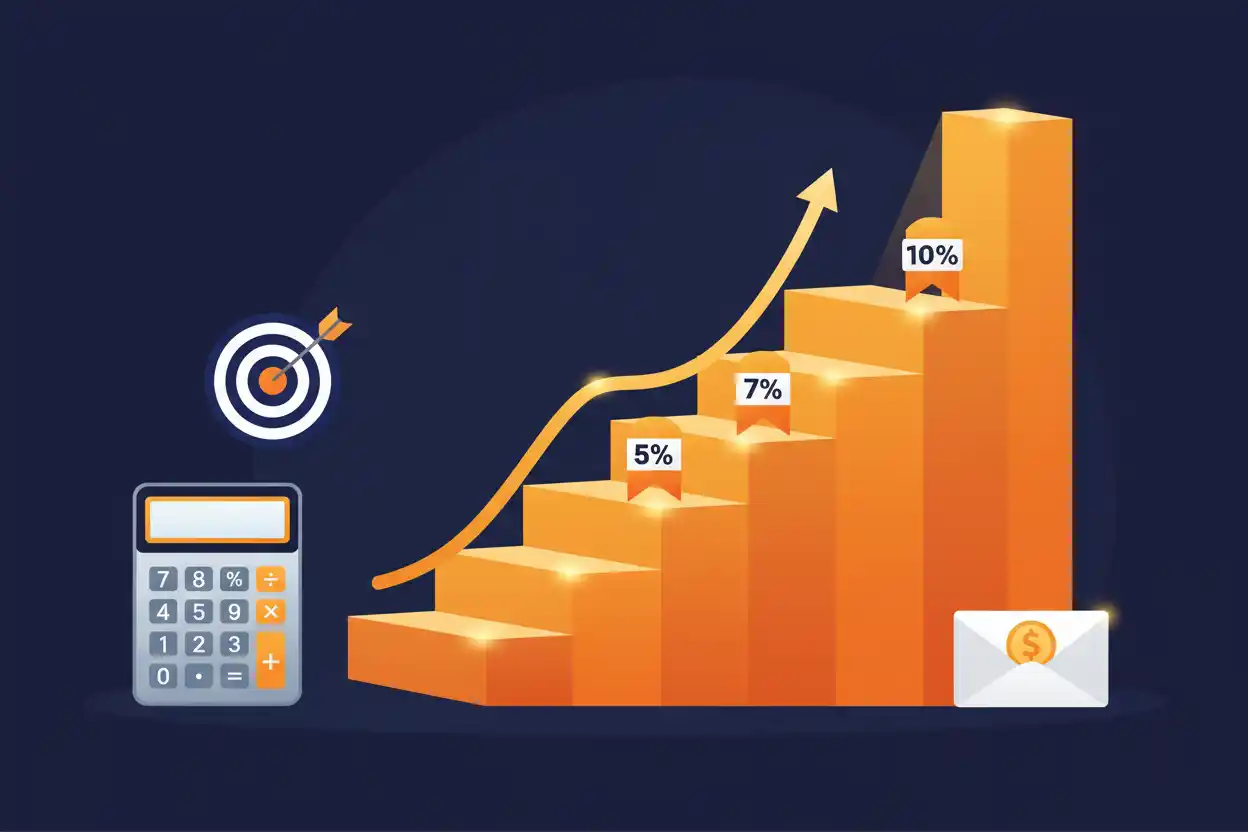
Commissions become more complicated when the rate changes as sales increase.
A salesperson might earn 5% on the first $50,000 of sales, 7% on the next $50,000, and 10% on sales above $100,000.
At $120,000 of eligible sales, commission is not:
$120,000 × 10% = $12,000
under a progressive tier system.
Instead, each slice of sales receives its own rate, producing total commission of $8,000.
Understanding whether a plan is flat, progressive, threshold-based, retroactive, accelerated, or capped is essential before calculating compensation.
Flat Commission Rate
The simplest commission formula is:
Commission = Eligible Sales × Commission Rate
Suppose:
Sales = $120,000
Flat Rate = 6%
Then:
Commission = $120,000 × 0.06
= $7,200
The entire eligible sales amount receives the same rate.
Progressive Commission Tiers
Now suppose the compensation plan pays 5% on the first $50,000, 7% on the next $50,000, and 10% on sales above $100,000.
At $120,000 of sales, calculate each tier separately.
First $50,000:
$50,000 × 5% = $2,500
Next $50,000:
$50,000 × 7% = $3,500
Remaining $20,000:
$20,000 × 10% = $2,000
Total:
$2,500 + $3,500 + $2,000
= $8,000
Effective Commission Rate
Although the highest marginal commission rate is 10%, the employee did not earn 10% on all $120,000.
The overall rate is:
Effective Commission Rate = Total Commission ÷ Total Sales × 100
$8,000 ÷ $120,000 × 100
≈ 6.67%
This distinction resembles the difference between marginal and average rates in other financial calculations.
Marginal Commission Rate
At $120,000 in the progressive example, the next eligible dollar falls into the 10% tier.
Therefore:
Marginal Commission Rate = 10%
but:
Effective Commission Rate ≈ 6.67%
Marginal rate tells you what applies to the next unit of sales.
Effective rate summarizes all commissions relative to all eligible sales.
Why Tiers Should Be Calculated Separately
Suppose an employee reaches the 10% tier.
Applying 10% to all $120,000 would produce:
$12,000
Correct progressive commission:
$8,000
Overstatement:
$12,000 − $8,000
= $4,000
This is one of the most common tiered-commission mistakes.
Threshold Commission
Not all tier systems are progressive.
Suppose a plan pays:
0% on sales up to $20,000
and:
5% on sales above $20,000
If sales are $60,000 and only the excess is commissionable:
Commissionable Sales = $60,000 − $20,000
= $40,000
Commission:
$40,000 × 5%
= $2,000
The first $20,000 generates no commission under this example.
Retroactive Threshold
A different plan might state that once $20,000 is reached, the 5% rate applies retroactively to all $60,000 of sales.
Then:
Commission = $60,000 × 5%
= $3,000
The same threshold and rate produce a $1,000 difference because the plan’s structure differs.
Plan language matters more than the headline rate.
Commission Accelerator
An accelerator raises the rate after performance reaches a target.
Suppose target is:
$100,000
with 5% commission up to target and 8% above it.
At $140,000:
First $100,000:
$100,000 × 5% = $5,000
Remaining $40,000:
$40,000 × 8% = $3,200
Total:
$8,200
Effective rate:
$8,200 ÷ $140,000
≈ 5.86%
Retroactive Accelerator
Now suppose hitting $100,000 causes 8% to apply to all $140,000.
Then:
$140,000 × 8%
= $11,200
That is $3,000 more than the incremental accelerator example.
Two plans can both advertise “8% above target” while producing different results.
Commission Decelerator
A decelerator reduces the rate under specified conditions.
Suppose a plan normally pays 6%, but sales below a quality threshold receive only 3%.
On $50,000 of affected sales:
Normal:
$50,000 × 6% = $3,000
Reduced:
$50,000 × 3% = $1,500
Difference:
$1,500
The commission rate may therefore depend on more than sales volume.
Commission Cap
Suppose a salesperson earns:
8% of Eligible Sales
but quarterly commission is capped at:
$12,000
At $175,000 of sales:
Uncapped commission:
$175,000 × 8%
= $14,000
Capped payment:
$12,000
Effective rate:
$12,000 ÷ $175,000
≈ 6.86%
Once the cap is reached, additional sales no longer increase commission under the simplified plan.
Uncapped Commission
An uncapped plan has no stated maximum commission amount.
If the rate is 7% and eligible sales are $300,000:
Commission = $300,000 × 7%
= $21,000
Whether a plan is capped can materially affect earnings at high performance levels.
Commission Pay vs Commission Structure
Commission pay focuses on how much compensation an employee earns from a defined commission formula.
This page focuses more narrowly on how the rate structure itself changes across tiers and thresholds.
The distinction becomes important when comparing two job offers with the same nominal commission rate but very different plan mechanics.
Commissions and Double-Time Pay
A commission plan does not automatically answer how double-time pay should be calculated for an employee.
Premium-pay rules can depend on the employee’s regular rate, hours worked, employment classification, agreement, and applicable law.
A commission statement and a timecard therefore measure different parts of compensation.
Commissions and Effective Tax Rate
A salesperson with highly variable income may see the broader effective tax rate change as annual taxable income changes.
That does not mean a higher commission tier itself creates a single new tax rate on every prior dollar of compensation.
Commission rate and income-tax rate are unrelated percentages.
Commissions and Capital Gains
Sales commissions are compensation for work, whereas capital gains tax applies to gain associated with disposing of capital assets.
A 10% commission rate should never be treated as though it were a capital-gains tax rate.
The calculations happen in different contexts.
Commissions in a Budget
Variable commission income makes budgeting more sensitive to performance fluctuations.
Suppose commission pay ranges from $2,000 to $8,000 monthly.
Building fixed expenses around the $8,000 month can create pressure when income returns to $2,000.
A rolling average or conservative baseline can produce a more resilient household budget.
Blended Commission Rate
Suppose an employee earns commissions from several product categories:
Product A:
$50,000 Sales at 4% = $2,000
Product B:
$30,000 Sales at 8% = $2,400
Product C:
$20,000 Sales at 10% = $2,000
Total sales:
$100,000
Total commission:
$6,400
Blended effective rate:
$6,400 ÷ $100,000
= 6.4%
This makes plans with multiple product rates easier to compare.
Team Commission Split
Suppose a $10,000 commission pool is divided:
60% to Employee A
40% to Employee B
Employee A:
$10,000 × 60% = $6,000
Employee B:
$10,000 × 40% = $4,000
Team plans should define whether percentages are based on sales, contribution, role, or another measure.
Quota Attainment
Suppose annual sales quota is:
$500,000
Actual sales:
$625,000
Quota attainment:
$625,000 ÷ $500,000 × 100
= 125%
A commission plan may use the 125% attainment level to determine an accelerator.
Quota attainment itself is not commission dollars.
Commission Per Dollar of Sales
Effective commission can also be expressed per $1 of sales.
If total commission is $8,000 on $120,000:
$8,000 ÷ $120,000
≈ $0.0667
The employee earns approximately:
6.67 cents per $1 of eligible sales
on average under the tiered example.
Cliffs
A commission cliff is a threshold below which no commission or a reduced amount is paid.
Suppose a plan pays nothing unless 80% of quota is achieved.
An employee at 79% and one at 80% can therefore experience a sharp difference in pay.
Cliffs create discontinuities that a simple linear commission formula cannot capture.
Chargebacks and Adjustments
Suppose a salesperson initially earns:
$7,500 Commission
but $12,000 of eligible sales are later reversed and had generated a 5% commission.
Chargeback:
$12,000 × 5%
= $600
Adjusted commission:
$7,500 − $600
= $6,900
Real commission statements often contain these post-sale adjustments.
Common Commission-Tier Mistakes
The biggest error is applying the highest tier rate to all sales when the plan is progressive.
Another is assuming every threshold works incrementally rather than retroactively.
People also overlook caps, cliffs, product-specific rates, and chargebacks.
Frequently Asked Questions
What is a commission tier?
It is a compensation structure in which commission rates change after specified sales or performance thresholds.
How do progressive tiers work?
Each slice of eligible sales receives the rate assigned to its tier.
What is the difference between marginal and effective commission rate?
Marginal rate applies to the next eligible dollar; effective rate is total commission divided by total eligible sales.
What is an accelerator?
It raises the commission rate after specified performance is achieved.
Can an accelerator apply retroactively?
Yes, if the compensation plan explicitly says so.
What is a commission threshold?
It is a sales or performance level that must be reached before a particular commission rate applies.
What is a commission cap?
It limits maximum commission earnings over the relevant period.
What is quota attainment?
Quota Attainment = Actual Sales ÷ Quota × 100
How do I calculate a blended commission rate?
Blended Rate = Total Commission ÷ Total Eligible Sales
Can commissions be based on profit instead of sales?
Yes.
Why can two 5% commission plans pay different amounts?
They may use different thresholds, bases, tiers, caps, or retroactive rules.
Why calculate tiers individually?
It prevents the highest rate from being incorrectly applied to sales that belong in lower tiers.