
Long-term capital gains generally arise when a capital asset is sold for more than its adjusted basis after being held for more than one year.
For U.S. federal tax classification, a capital gain or loss is generally long-term when the asset was held for more than one year before disposition; assets held one year or less are generally classified as short-term, subject to specific exceptions.
Suppose an investment has an adjusted basis of $25,500 and is later sold for $40,000 with $800 of selling costs.
Net proceeds are $39,200, producing a long-term capital gain of $13,700 if the holding-period requirement is satisfied.
Long-Term Capital Gain Formula
The basic calculation is:
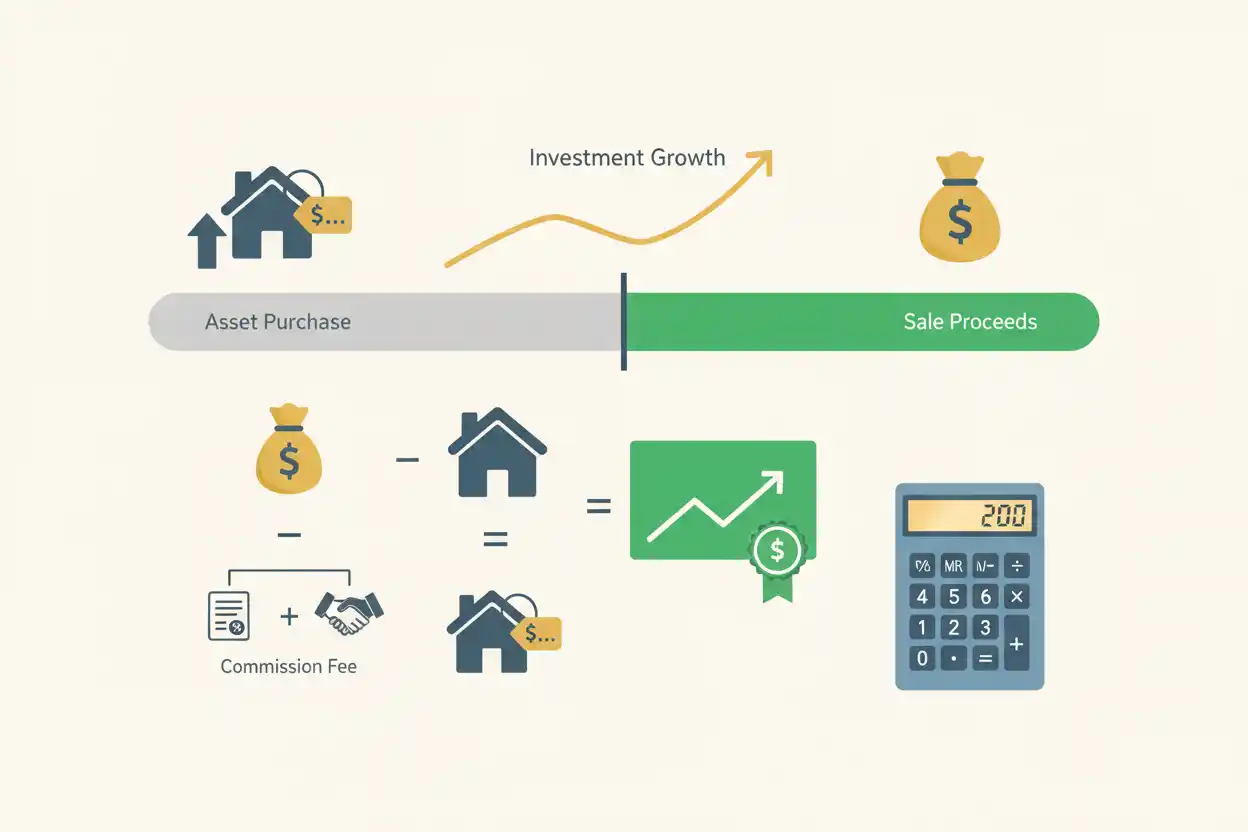
Capital Gain = Amount Realized − Adjusted Basis
If selling costs reduce the amount realized:
Net Sale Proceeds = Sale Price − Selling Costs
Then:
Long-Term Capital Gain = Net Sale Proceeds − Adjusted Basis
The holding period determines whether the resulting gain belongs in the long-term or short-term category.
Long-Term Capital Gains Example
Suppose an investor acquires an asset for:
$25,000
Additional eligible basis costs increase adjusted basis by:
$500
Therefore:
Adjusted Basis = $25,500
The investor holds the asset for three years and later sells it for:
$40,000
Selling costs are:
$800
Net proceeds:
$40,000 − $800
= $39,200
Long-term capital gain:
$39,200 − $25,500
= $13,700
The investment produces a $13,700 long-term capital gain.
Holding Period Matters
Suppose two investors realize identical $13,700 gains.
Investor A disposes of the asset after eight months.
Investor B disposes of it after three years.
The economic dollar gain is identical, but the general federal holding-period classification differs because Investor B held the asset for more than one year.
That classification can affect the tax treatment.
Long-Term vs Short-Term Gains
Long-term and short-term capital gains should not be combined blindly before classification.
A simplified conceptual flow is:
Classify Each Transaction → Net Gains and Losses Under Applicable Rules → Determine Net Capital Gain → Apply Applicable Tax Treatment
The IRS notes that net capital gains can qualify for tax rates different from ordinary-income rates, while net short-term capital gains are generally taxed as ordinary income.
Estimating Tax on a Long-Term Gain
Suppose, strictly for illustration, a 15% rate applies to the entire $13,700 gain.
Estimated Tax = $13,700 × 15%
= $2,055
After-tax gain:
$13,700 − $2,055
= $11,645
The calculation demonstrates the arithmetic only. The actual federal rate can depend on taxable income, filing status, the type of capital gain, and other tax provisions.
Capital Gain Is Not Sale Proceeds
Suppose an asset sells for:
$100,000
but adjusted basis is:
$80,000
Ignoring selling costs:
Gain = $100,000 − $80,000
= $20,000
The $100,000 received is not the capital gain.
Only the $20,000 increase over basis is the gain in the simplified example.
Long-Term Gain Percentage
Using the earlier adjusted basis of $25,500:
Gain = $13,700
Gain relative to basis:
$13,700 ÷ $25,500 × 100
≈ 53.73%
This 53.73% is an investment-return measure relative to basis.
It is not the capital-gains tax rate.
Adjusted Basis Changes the Gain
Suppose an investor believes basis is $20,000 but proper records show adjusted basis is $24,000.
Net proceeds are:
$35,000
Using incorrect basis:
Gain = $15,000
Using correct basis:
Gain = $11,000
Difference:
$4,000
A basis error can therefore materially change the reported gain.
Long-Term Capital Losses
Suppose a second long-term investment has:
Adjusted Basis = $18,000
and is sold for net proceeds of:
$14,000
Long-term loss:
$14,000 − $18,000
= −$4,000
Capital gains and losses are netted under tax rules rather than every profitable transaction being taxed independently without regard to losses.
Simple Net Long-Term Example
Suppose:
Long-Term Gain A = $13,700
Long-Term Gain B = $5,000
Long-Term Loss C = $4,000
Simplified net long-term gain before considering short-term items and other rules:
$13,700 + $5,000 − $4,000
= $14,700
The actual federal netting process should follow the applicable tax forms and rules.
Long-Term Capital Gains and Itemized Deductions
Itemized deductions can affect the taxpayer’s broader taxable-income calculation.
Because long-term capital-gain rates can depend partly on taxable income, deductions can affect how the tax calculation ultimately applies.
That does not turn the capital gain itself into an itemized deduction.
Long-Term Gains and Marginal Tax Rate
The marginal tax rate on ordinary income should not automatically be applied to long-term capital gains.
Suppose a taxpayer’s top ordinary marginal rate is hypothetically 30%.
It does not follow that:
Long-Term Capital Gains Tax Rate = 30%
Capital-gain rules have their own structure.
Long-Term Gains and Marriage Tax
A taxpayer’s filing status can affect tax thresholds and other calculations, which is one reason the marriage tax discussion matters when comparing married filing options.
The capital gain itself does not change merely because the investor marries.
What can change is the broader tax environment in which the gain is reported.
Long-Term Gains and Income Tax Basics
Income tax basics explain how gross income, deductions, taxable income, and marginal brackets fit together.
Long-term capital gains add another layer because not every dollar of taxable income necessarily uses the same rate schedule.
A complete tax estimate must therefore classify the income correctly before applying rates.
Long-Term Gains and Income Replacement
An income replacement ratio should normally compare recurring replacement income with prior earned income.
A one-time $50,000 long-term capital gain does not necessarily represent permanent replacement income.
Using an asset sale to fund living costs can reduce the household’s investment base even if it temporarily fills an income gap.
Realized vs Unrealized Long-Term Gain
Suppose an investment purchased for $30,000 is worth $50,000 after five years.
Unrealized gain:
$20,000
The asset satisfies the long holding-period condition, but the investor has not yet sold it.
The investment’s market appreciation should therefore be distinguished from a realized capital gain resulting from a disposition.
Selling Costs
Suppose:
Sale Price = $60,000
Selling Costs = $1,200
Adjusted Basis = $40,000
Net proceeds:
$58,800
Gain:
$58,800 − $40,000
= $18,800
Ignoring the $1,200 selling cost would overstate the simplified gain.
Investment Return After Tax
Suppose adjusted basis is $25,500 and after-tax gain is $11,645.
After-tax wealth received above basis:
$11,645
After-tax gain relative to basis:
$11,645 ÷ $25,500 × 100
≈ 45.67%
This measure can be more useful for personal planning than looking only at the pretax percentage.
Inflation and Long-Term Gains
Suppose an asset rises from:
$100,000 to $150,000
over 15 years.
Nominal capital gain:
$50,000
The investor’s real purchasing-power gain can be smaller after inflation.
Tax accounting and real-return analysis therefore answer different questions.
Long Holding Period Does Not Guarantee Profit
Holding an asset for more than one year only affects classification.
Suppose:
Adjusted Basis = $50,000
Net Sale Proceeds After Three Years = $42,000
Result:
Long-Term Capital Loss = −$8,000
A long holding period does not turn a loss into a gain.
Common Long-Term Capital Gains Mistakes
A frequent mistake is calculating tax from the full sale price rather than the gain.
Another is assuming every gain held at least one calendar year is automatically long-term without checking the actual holding-period rule.
Investors can also overlook adjusted basis, selling costs, losses, or apply ordinary marginal tax rates directly to long-term gains.
Frequently Asked Questions
What are long-term capital gains?
They are generally gains from disposing of capital assets held for more than one year under U.S. federal tax rules, subject to exceptions.
What is the basic formula?
Capital Gain = Amount Realized − Adjusted Basis
Is the entire sale price taxable gain?
No. Gain is measured relative to adjusted basis.
Does selling after exactly one year automatically make the gain long-term?
The general federal rule is more than one year, not merely one year.
Are long-term gains always taxed at one rate?
No.
Are long-term capital gains taxed exactly like salary?
Not necessarily. Net capital gains can have different federal tax-rate treatment from ordinary income.
Can long-term capital losses offset gains?
Capital gains and losses interact through applicable netting rules.
Does adjusted basis include only the purchase price?
Not always.
Do selling costs matter?
They can affect the amount realized and therefore the gain calculation.
Can an unrealized gain be long-term?
An asset can have been held long term while appreciating, but a realized capital gain generally requires a disposition.
Does holding an asset longer guarantee a gain?
No.
Why calculate the gain before the tax?
The tax rate is applied only after the taxable gain and its classification have been determined within the broader Taxes & Pay calculation.