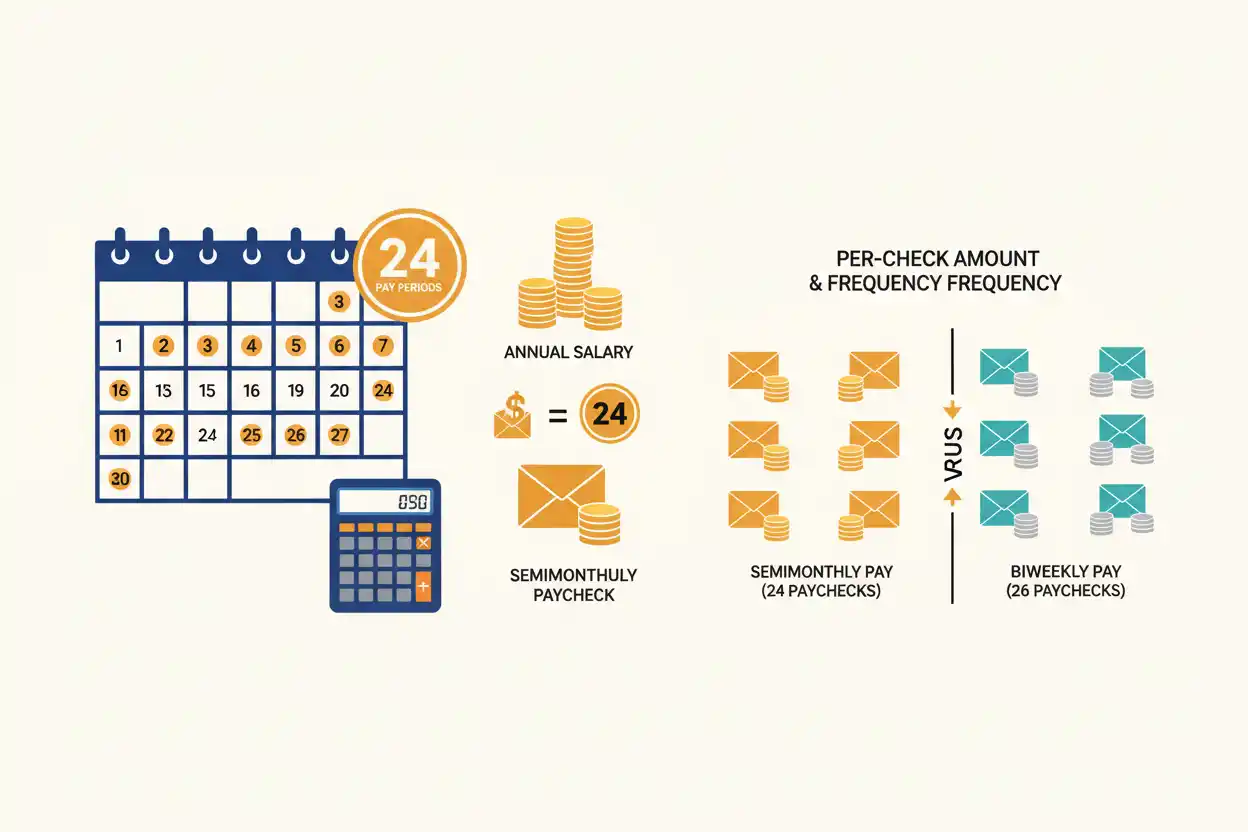

Semimonthly pay means an employee receives two regular paychecks each month.
That creates:
2 Paychecks × 12 Months = 24 Pay Periods per Year
If annual salary is $72,000:
Semimonthly Gross Pay = $72,000 ÷ 24
= $3,000
Semimonthly pay is frequently confused with biweekly pay. The difference matters because biweekly payroll typically produces 26 checks per year, while semimonthly payroll produces 24.
Semimonthly Pay Formula
When annual salary is known:
Semimonthly Pay = Annual Salary ÷ 24
Suppose annual salary is:
$84,000
Then:
$84,000 ÷ 24
= $3,500
The employee’s ordinary gross semimonthly paycheck is $3,500.
Annual Salary From Semimonthly Pay
Reverse the formula:
Annual Salary = Semimonthly Pay × 24
Suppose each regular semimonthly paycheck is:
$3,250
Annual salary:
$3,250 × 24
= $78,000
Semimonthly vs Biweekly Pay
Semimonthly:
24 Paychecks per Year
Biweekly:
Usually 26 Paychecks per Year
Suppose annual salary is $78,000.
Semimonthly:
$78,000 ÷ 24 = $3,250
Biweekly:
$78,000 ÷ 26 = $3,000
The semimonthly check is $250 larger because the same annual compensation is divided among fewer payments.
Why Semimonthly Pay Is Not Every Two Weeks
Two payments per month and one payment every two weeks sound similar, but the calendar math differs.
Twelve months multiplied by two gives:
24 Semimonthly Payments
A 52-week year divided by two gives:
26 Biweekly Periods
That two-paycheck difference changes the size and timing of regular checks.
Monthly Income From Semimonthly Pay
Because semimonthly employees receive two regular paychecks every month:
Monthly Gross Income = Semimonthly Pay × 2
For a $3,250 paycheck:
$3,250 × 2
= $6,500
Unlike biweekly pay, this conversion does not require annualizing through 26 periods.
Semimonthly Pay From Monthly Salary
If monthly gross salary is:
$6,500
then:
Semimonthly Pay = $6,500 ÷ 2
= $3,250
The two semimonthly paychecks together equal the month’s regular gross salary.
Semimonthly Pay Dates
A semimonthly employer typically selects two recurring pay dates during each month, such as the middle and end of the month or other consistent dates.
The gap between those pay dates is not always exactly 14 days.
One interval might contain 15 days and another 16 days, depending on the calendar.
This does not change the fact that there are 24 regular annual pay periods.
Semimonthly Pay and Self-Employment Tax
Self-employment tax is calculated from qualifying net self-employment earnings rather than from a 24-pay-period employee schedule.
A freelancer receiving customer payments twice each month does not become a semimonthly salaried employee simply because the cash arrives on that frequency.
Pay timing and tax classification are separate questions.
Semimonthly Pay and Sales Tax Rate
A sales tax rate applies to taxable purchases rather than payroll frequency.
Someone earning $3,250 semimonthly pays the same applicable sales tax rate on a qualifying purchase as another consumer in the same transaction circumstances.
Income frequency does not change the transaction-tax percentage.
Semimonthly Pay and Short-Term Capital Gains
Short-term capital gains come from disposing of capital assets, not from employment pay frequency.
If an employee receives $6,500 monthly gross salary and separately realizes a $5,000 short-term investment gain, the gain should not be divided by two and labeled semimonthly wages.
The income sources remain distinct.
Semimonthly Pay and Social Security Tax
Social Security tax can be withheld from applicable wages on each paycheck.
Suppose ordinary semimonthly Social Security wages are $3,250 and the applicable employee rate is 6.2%.
The tax for a paycheck while wages remain within the annual wage base is:
$3,250 × 6.2%
= $201.50
Payroll frequency determines how wages are distributed across the year; the annual Social Security wage limit still applies across all qualifying wages.
Gross vs Net Semimonthly Pay
Suppose:
Gross Semimonthly Pay = $3,250
and taxes plus employee deductions total:
$850
Net pay:
$3,250 − $850
= $2,400
Monthly net income from two identical checks:
$4,800
Gross and net semimonthly amounts should always be labeled separately.
Take-Home Percentage
Using the same paycheck:
Net Pay = $2,400
Gross Pay = $3,250
Take-home percentage:
$2,400 ÷ $3,250 × 100
≈ 73.85%
The remaining 26.15% represents the combined modeled payroll deductions rather than one tax rate.
Semimonthly Pay With a Bonus
Suppose:
Regular Gross Pay = $3,250
and a bonus of:
$1,500
is included in one paycheck.
Gross paycheck:
$4,750
The employee is still paid semimonthly.
The bonus changes one paycheck’s amount, not the annual pay frequency.
Semimonthly Pay With Commission
Suppose base semimonthly pay is:
$2,000
and commission for the period is:
$1,800
Gross pay:
$3,800
A later paycheck may contain a different commission amount.
The base semimonthly salary should remain distinguishable from variable compensation.
Semimonthly Pay With Overtime
Some semimonthly employees can also earn overtime or other premium pay.
Suppose ordinary gross pay is:
$2,500
and overtime adds:
$300
Gross paycheck:
$2,800
The semimonthly pay frequency does not itself determine which hours qualify for overtime.
Work-period rules and payroll frequency are separate.
Convert Semimonthly to Weekly Pay
Annualize first.
Suppose:
Semimonthly Pay = $3,250
Annual pay:
$3,250 × 24 = $78,000
Weekly equivalent:
$78,000 ÷ 52
= $1,500
Convert Semimonthly to Biweekly Pay
Again, annualize first:
$3,250 × 24 = $78,000
Then divide by 26:
$78,000 ÷ 26
= $3,000
One semimonthly paycheck is not equivalent to one biweekly paycheck even though both schedules produce roughly two checks in many months.
Convert Semimonthly to Hourly Equivalent
Suppose annualized salary is $78,000 and the comparison assumes 2,080 paid hours.
Hourly Equivalent = $78,000 ÷ 2,080
= $37.50
A salaried employee’s actual legal compensation arrangement may differ from this simple hourly equivalent.
Pay Raise Example
Suppose semimonthly gross pay rises:
$3,000 → $3,180
Increase:
$180
Raise percentage:
$180 ÷ $3,000 × 100
= 6%
Annual salary rises from:
$3,000 × 24 = $72,000
to:
$3,180 × 24 = $76,320
Annual increase:
$4,320
Salary Reduction Example
Suppose semimonthly pay falls:
$3,500 → $3,150
Reduction:
$350
Percentage reduction:
$350 ÷ $3,500
= 10%
Annualized salary falls from:
$84,000
to:
$75,600
The percentage remains 10% at both the paycheck and annual level.
Budgeting With Semimonthly Income
Semimonthly pay aligns naturally with monthly budgeting because two regular checks arrive every month.
Suppose net semimonthly income is:
$2,400
Monthly net:
$4,800
A household can divide expenses between the two recurring pay dates.
However, the number of days between checks can vary, so cash timing still matters.
Semimonthly Savings
Suppose an employee saves:
$300 From Every Paycheck
Annual savings:
$300 × 24
= $7,200
Monthly average:
$600
This is different from saving $300 biweekly, which would produce:
$300 × 26 = $7,800
per ordinary 26-pay-period year.
Why 24 Matters
Using the wrong number of pay periods creates immediate errors.
Suppose semimonthly pay is $3,000.
Correct annual salary:
$3,000 × 24
= $72,000
Incorrectly multiplying by 26:
$78,000
Error:
$6,000
The difference is large enough to distort job comparisons, budgets, and tax estimates.
Common Semimonthly Pay Mistakes
The most frequent mistake is treating semimonthly pay as biweekly pay.
Another is multiplying a semimonthly check by 26 instead of 24.
Employees can also assume the gaps between checks are always exactly 14 days or treat bonuses and commissions as though they permanently changed the base semimonthly salary.
Frequently Asked Questions
What does semimonthly pay mean?
It means receiving two regular paychecks each month.
How many semimonthly paychecks are there per year?
How do I calculate semimonthly pay from annual salary?
Semimonthly Pay = Annual Salary ÷ 24
What is $72,000 semimonthly?
$3,000 per Paycheck
How do I annualize semimonthly pay?
Semimonthly Pay × 24
Is semimonthly the same as biweekly?
No.
Why is a semimonthly paycheck larger than a biweekly paycheck at the same annual salary?
Because the annual salary is divided among 24 rather than 26 checks.
How do I calculate monthly income?
Semimonthly Pay × 2
Are semimonthly pay periods always the same number of days?
No.
Can bonuses make one semimonthly check larger?
Yes, without changing the underlying pay frequency.
Does semimonthly frequency determine overtime?
No.
Why identify pay frequency before annualizing income?
Because using the wrong annual paycheck count can materially overstate or understate compensation.