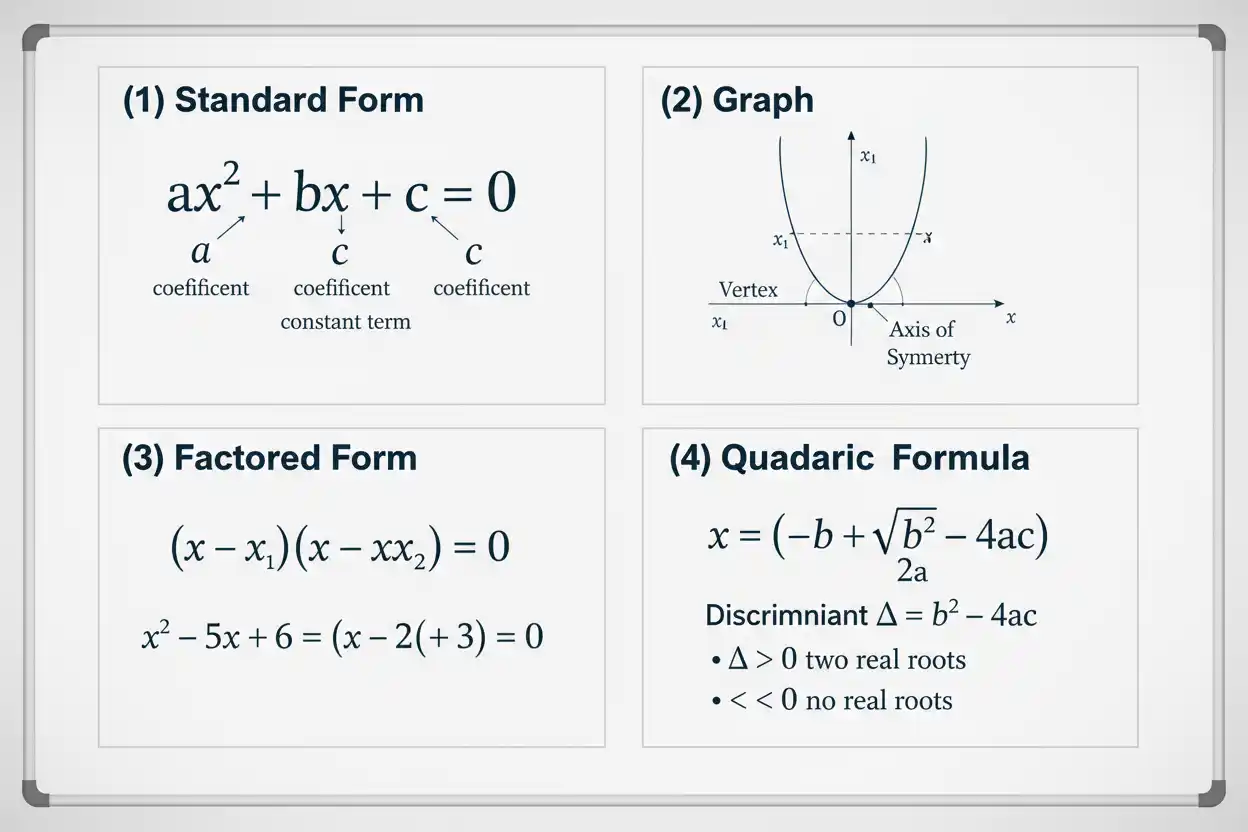

A quadratic equation is a second-degree equation that can be written in the standard form:
ax² + bx + c = 0
where a, b, and c are constants and:
a ≠ 0
For example:
x² – 5x + 6 = 0
is a quadratic equation because the highest power of x is 2.
It factors as:
(x – 2)(x – 3) = 0
so its solutions are:
x = 2
and:
x = 3
A quadratic equation can have two distinct real solutions, one repeated real solution, or two complex solutions. The appropriate solving method depends on the structure of the equation.
What Is a Quadratic Equation?
A quadratic equation is a polynomial equation of degree 2.
Its standard form is:
ax² + bx + c = 0
The three coefficients have specific roles:
- a is the coefficient of x².
- b is the coefficient of x.
- c is the constant term.
The value of a cannot be zero. If a = 0, the x² term disappears and the equation is no longer quadratic.
For example:
3x² + 4x – 7 = 0
has:
a = 3
b = 4
c = -7
By contrast:
4x – 7 = 0
is a linear equation, not a quadratic equation.
Standard Form of a Quadratic Equation
The standard form is:
ax² + bx + c = 0
Writing a quadratic equation in this form is often the first step before choosing a solution method.
Suppose:
x² + 9 = 6x
Move all terms to one side:
x² – 6x + 9 = 0
Now the equation is in standard form with:
a = 1
b = -6
c = 9
It can then be recognized as:
(x – 3)² = 0
so:
x = 3
What Are the Solutions of a Quadratic Equation?
A solution is a value of x that makes the equation true.
Solutions are also called:
- roots;
- zeros;
- x-intercepts when discussing the corresponding graph.
For:
x² – 4 = 0
factor using the difference of squares:
(x – 2)(x + 2) = 0
Therefore:
x = 2
or:
x = -2
Both values make the original equation equal zero.
Main Methods for Solving Quadratic Equations
Several methods can solve a quadratic equation. The best choice depends on its structure.
A quadratic may be solved by factoring when the polynomial has convenient factors. Completing the square works systematically and also reveals vertex-related structure. Square-root methods are efficient when the equation can be reduced to x² = k or (x – h)² = k. The quadratic formula works for every quadratic equation with a ≠ 0.
The broad goal is always the same: determine every value of x that satisfies the original equation.
Solving a Quadratic Equation by Factoring
Consider:
x² + 7x + 12 = 0
Find two numbers whose product is 12 and whose sum is 7:
3 and 4
Factor:
(x + 3)(x + 4) = 0
Apply the zero-product property:
x + 3 = 0
or:
x + 4 = 0
Therefore:
x = -3
or:
x = -4
Factoring is particularly efficient when integer or simple rational factors are visible. The detailed techniques for identifying those factors belong to factoring quadratics.
Zero-Product Property
Factoring works because:
If AB = 0, then A = 0 or B = 0
For example:
(2x – 5)(x + 1) = 0
Set each factor equal to zero:
2x – 5 = 0
or:
x + 1 = 0
This gives:
x = 5/2
or:
x = -1
The equation must equal zero before the zero-product property can be applied directly.
Example 1: Quadratic With a Common Factor
Solve:
3x² – 12x = 0
Factor out 3x:
3x(x – 4) = 0
Therefore:
3x = 0
or:
x – 4 = 0
So:
x = 0
or:
x = 4
A common factor should usually be removed before attempting a more complicated method.
Solving by the Square-Root Method
Some quadratic equations can be reduced directly to:
x² = k
For example:
x² = 49
Take both square roots:
x = ±√49
Therefore:
x = ±7
Both signs are required because:
7² = 49
and:
(-7)² = 49
The same principle works with a shifted square.
Suppose:
(x – 2)² = 25
Take square roots:
x – 2 = ±5
Therefore:
x = 7
or:
x = -3
Example 2: Isolate the Squared Term
Solve:
2x² – 18 = 0
Add 18:
2x² = 18
Divide by 2:
x² = 9
Take square roots:
x = ±3
Therefore:
x = -3, 3
Solving by Completing the Square
Completing the square transforms a quadratic expression into a perfect square.
Consider:
x² + 6x + 5 = 0
Move the constant:
x² + 6x = -5
Take half of the coefficient of x:
6 / 2 = 3
Square it:
3² = 9
Add 9 to both sides:
x² + 6x + 9 = 4
The left side becomes:
(x + 3)² = 4
Take square roots:
x + 3 = ±2
Therefore:
x = -1
or:
x = -5
Completing the square is also the algebraic idea from which the quadratic formula can be derived.
The Quadratic Formula
For:
ax² + bx + c = 0
the solutions can be calculated with:
x = (-b ± √(b² – 4ac)) / 2a
This method works whether or not the quadratic factors conveniently.
For example:
x² – 3x – 1 = 0
has:
a = 1
b = -3
c = -1
Substitute:
x = (-(-3) ± √((-3)² – 4(1)(-1))) / 2(1)
Simplify:
x = (3 ± √13) / 2
These are the exact solutions.
The detailed substitution rules and formula-specific examples are covered in quadratic formula.
The Discriminant
The expression inside the square root in the quadratic formula is:
D = b² – 4ac
This is called the discriminant.
Its sign reveals the nature of the solutions.
If:
D > 0
the equation has two distinct real roots.
If:
D = 0
the equation has one repeated real root.
If:
D < 0
the equation has two non-real complex roots.
For a detailed treatment of this classification, see the discriminant.
Example 3: Two Real Roots
Consider:
x² – 5x + 6 = 0
Here:
a = 1
b = -5
c = 6
Calculate the discriminant:
D = (-5)² – 4(1)(6)
D = 25 – 24
D = 1
Since:
D > 0
the equation has two distinct real solutions.
Factoring confirms them:
(x – 2)(x – 3) = 0
so:
x = 2, 3
Example 4: One Repeated Root
Consider:
x² – 8x + 16 = 0
The discriminant is:
D = (-8)² – 4(1)(16)
D = 64 – 64
D = 0
Therefore there is one repeated real root.
Factor:
(x – 4)² = 0
so:
x = 4
The root has multiplicity 2.
Example 5: Complex Roots
Consider:
x² + 4x + 8 = 0
Calculate:
D = 4² – 4(1)(8)
D = 16 – 32
D = -16
Because the discriminant is negative, the roots are not real.
Using the quadratic formula:
x = (-4 ± √(-16)) / 2
Since:
√(-16) = 4i
the roots are:
x = (-4 ± 4i) / 2
x = -2 ± 2i
The interpretation of such solutions is developed further under complex roots.
Quadratic Equation and Its Graph
The corresponding quadratic function:
y = ax² + bx + c
graphs as a parabola.
Solving:
ax² + bx + c = 0
means finding where that parabola has:
y = 0
Therefore real solutions correspond to x-intercepts.
If a parabola crosses the x-axis twice, the equation has two distinct real roots.
If it touches the x-axis once, it has a repeated root.
If it never reaches the x-axis, it has no real roots, although it still has complex roots.
Example: Roots From a Graph
Suppose a parabola crosses the x-axis at:
x = -2
and:
x = 5
Then the associated quadratic has factors proportional to:
(x + 2)(x – 5)
and its roots are:
x = -2, 5
The graph reveals the real solutions visually.
Sum and Product of Quadratic Roots
If a quadratic equation:
ax² + bx + c = 0
has roots r₁ and r₂, then:
r₁ + r₂ = -b/a
and:
r₁r₂ = c/a
For example:
2x² – 7x + 3 = 0
has:
a = 2
b = -7
c = 3
Therefore:
r₁ + r₂ = 7/2
and:
r₁r₂ = 3/2
Factor:
(2x – 1)(x – 3) = 0
so the roots are:
1/2 and 3
Check:
1/2 + 3 = 7/2
and:
(1/2)(3) = 3/2
Building a Quadratic Equation From Its Roots
If the roots are r₁ and r₂, a quadratic can be written as:
(x – r₁)(x – r₂) = 0
For roots 2 and -5:
(x – 2)(x + 5) = 0
Expand:
x² + 3x – 10 = 0
Any nonzero constant multiple of this equation has the same roots.
For example:
2x² + 6x – 20 = 0
also has roots 2 and -5.
A Quadratic Equation Does Not Need All Three Terms
A quadratic equation must contain a nonzero x² term, but the x term or constant term may be absent.
For example:
x² – 16 = 0
is quadratic even though b = 0.
Likewise:
5x² – 10x = 0
is quadratic even though c = 0.
Missing terms can often make factoring easier.
Quadratic Equations With Fractions
Consider:
x²/2 – 3x/2 – 2 = 0
Multiply the entire equation by 2:
x² – 3x – 4 = 0
Factor:
(x – 4)(x + 1) = 0
Therefore:
x = 4
or:
x = -1
Clearing numerical denominators can make the quadratic structure easier to see.
Quadratic Equations With Radicals
A radical equation may produce a quadratic after the radical is isolated and both sides are squared.
For example, an intermediate step might become:
x² – 5x + 4 = 0
At that point, quadratic methods determine the candidate values.
However, radical equations can produce extraneous solutions after squaring, so solutions must ultimately be checked against the original radical equation.
The quadratic equation itself does not introduce that special restriction; it comes from the preceding radical manipulation.
Quadratic Equations Inside Piecewise Functions
A branch of a piecewise function may contain a quadratic rule.
For example:
f(x) = x² – 4, if x ≥ 0
If a problem asks when this branch equals zero:
x² – 4 = 0
the algebraic solutions are:
x = ±2
But the branch condition requires:
x ≥ 0
so only:
x = 2
belongs to that piece.
This shows why domain conditions must be respected even after a quadratic equation has been solved correctly.
Quadratic Equations and Polynomial Division
A higher-degree polynomial may reduce to a quadratic after one known factor is removed with polynomial long division.
For example, dividing a cubic by a known linear factor may produce:
x² – 5x + 6
The remaining equation:
x² – 5x + 6 = 0
can then be solved with quadratic methods.
Polynomial long division reduces the degree; it does not replace the quadratic-solving step.
Choosing a Quadratic Equation Method
Factoring is usually efficient when factors are obvious. The square-root method is efficient when the squared expression can be isolated immediately. Completing the square is systematic and useful when perfect-square structure matters. The quadratic formula is universal and particularly helpful when factoring is inconvenient.
A good first step is to simplify the equation and write:
ax² + bx + c = 0
Then inspect the coefficients and structure before choosing a method.
Checking Quadratic Equation Solutions
Always substitute a proposed root into the original equation.
Suppose:
2x² – 5x – 3 = 0
Factoring gives:
(2x + 1)(x – 3) = 0
so:
x = -1/2
or:
x = 3
Check x = 3:
2(3²) – 5(3) – 3
= 18 – 15 – 3
= 0
Check x = -1/2:
2(1/4) – 5(-1/2) – 3
= 1/2 + 5/2 – 3
= 3 – 3
= 0
Both roots are valid.
Common Quadratic Equation Mistakes
Forgetting to Set the Equation Equal to Zero
To factor and use the zero-product property, first rewrite the equation as:
ax² + bx + c = 0
Forgetting the ± Sign
From:
x² = 25
the solutions are:
x = ±5
not only x = 5.
Misidentifying a, b, and c
For:
2x² – 7x – 4 = 0
the coefficients are:
a = 2
b = -7
c = -4
The signs belong to the coefficients.
Dividing by a Variable Factor Too Early
From:
x(x – 4) = 0
dividing both sides by x would remove the valid solution x = 0.
Use the zero-product property instead.
Assuming Every Quadratic Has Two Distinct Real Roots
The discriminant may be positive, zero, or negative, producing different root types.
Confusing the Quadratic Equation With the Quadratic Formula
A quadratic equation is the equation being solved. The quadratic formula is one method for solving it.
Worked Quadratic Equation Example
Solve:
2x² – 7x + 3 = 0
Try factoring.
The product:
a × c = 2 × 3 = 6
We need terms whose product is 6 and whose sum is -7:
-6 and -1
Split the middle term:
2x² – 6x – x + 3 = 0
Group:
2x(x – 3) – 1(x – 3) = 0
Factor:
(2x – 1)(x – 3) = 0
Therefore:
2x – 1 = 0
or:
x – 3 = 0
So:
x = 1/2
or:
x = 3
Check with the root relationships:
r₁ + r₂ = 1/2 + 3 = 7/2
and:
-b/a = -(-7)/2 = 7/2
Also:
r₁r₂ = (1/2)(3) = 3/2
and:
c/a = 3/2
Both checks agree.
Frequently Asked Questions
What is a quadratic equation?
A quadratic equation is a second-degree polynomial equation that can be written:
ax² + bx + c = 0
where a ≠ 0.
What is the standard form of a quadratic equation?
The standard form is:
ax² + bx + c = 0
How many solutions can a quadratic equation have?
Over the real numbers, it can have two distinct real solutions, one repeated real solution, or no real solutions. Over the complex numbers, a quadratic has two roots when multiplicity is counted.
What methods solve quadratic equations?
Common methods include factoring, taking square roots, completing the square, and using the quadratic formula.
What is the quadratic formula?
For ax² + bx + c = 0:
x = (-b ± √(b² – 4ac)) / 2a
What does the discriminant tell you?
For:
D = b² – 4ac
a positive D gives two distinct real roots, D = 0 gives one repeated real root, and a negative D gives two complex roots.
Why must a not equal zero?
If a = 0, the x² term disappears. The equation then becomes linear or otherwise lower degree rather than quadratic.
Can a quadratic equation have one solution?
Yes. If the discriminant equals zero, the two algebraic roots coincide and produce one repeated real root.
Can a quadratic equation have no real solutions?
Yes. A negative discriminant means the equation has no real roots, although it has two complex roots.
How do you check a quadratic equation answer?
Substitute each proposed value into the original equation. A valid solution makes both sides equal.
Are roots, zeros, and solutions the same?
In the context of P(x) = 0, these terms generally refer to the values of x that make the polynomial zero. Real roots also correspond to x-intercepts of the graph.
What is the fastest way to solve a quadratic equation?
There is no single fastest method for every equation. Factoring is often quickest when factors are obvious, while the quadratic formula works for every quadratic with a ≠ 0.