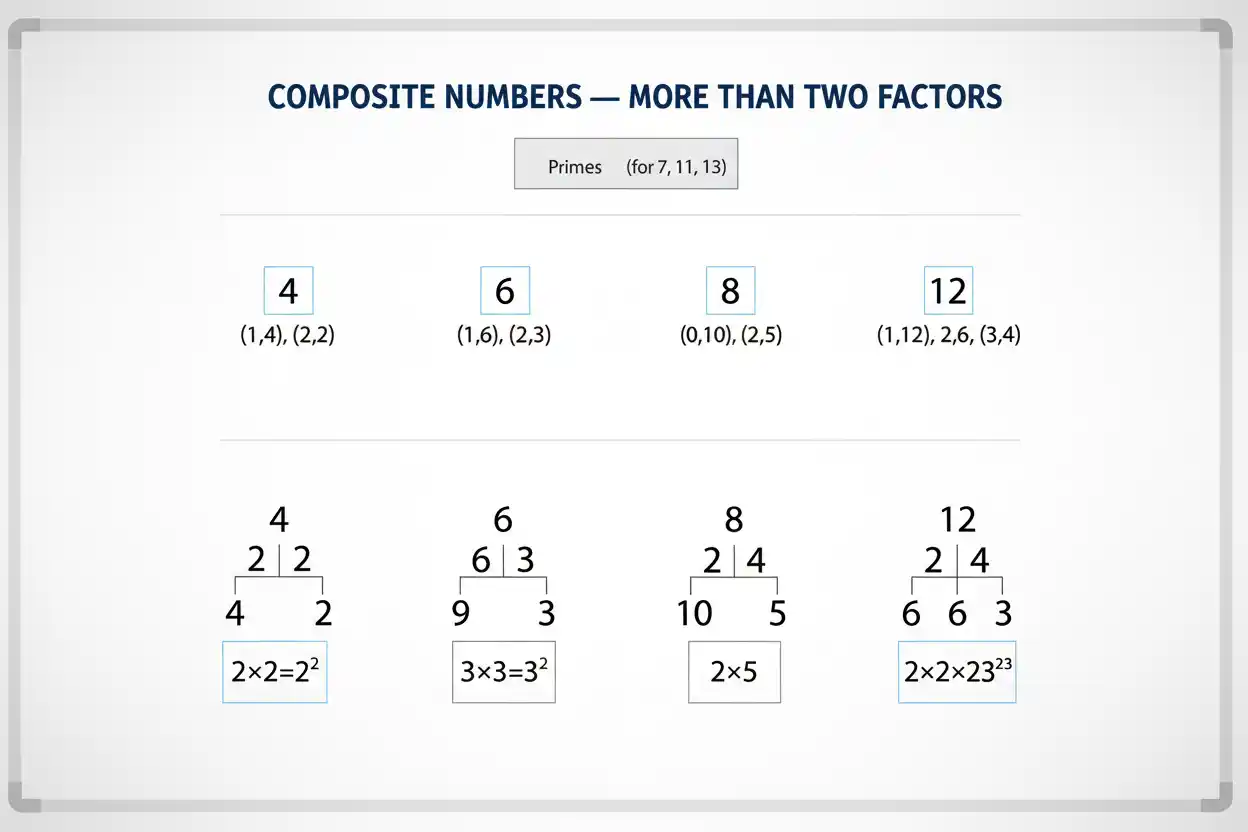

Composite numbers are positive integers greater than 1 that have more than two positive factors. In other words, a composite number can be divided exactly by 1, itself, and at least one additional positive integer.
For example, 12 is composite because its positive factors are:
1, 2, 3, 4, 6, 12
By contrast, 13 has only two positive factors:
1, 13
so 13 is prime rather than composite.
Composite numbers are fundamental to arithmetic and number theory because they reveal how integers can be built from smaller factors.
What Is a Composite Number?
A positive integer n is composite if:
n > 1
and there are positive integers a and b such that:
n = a × b
with:
1 < a < n
and:
1 < b < n
This means the number can be expressed as a product of two smaller positive integers.
For example:
21 = 3 × 7
Because both 3 and 7 are greater than 1 and smaller than 21, 21 is composite.
Likewise:
35 = 5 × 7
so 35 is composite.
First Composite Numbers
The first several composite numbers are:
4, 6, 8, 9, 10, 12, 14, 15, 16, 18, 20, 21, 22, 24, 25, 26, 27, 28, 30, …
The smallest composite number is:
4
Its factors are:
1, 2, 4
Because it has three positive factors, it satisfies the definition.
Why 4 Is the Smallest Composite Number
Consider the positive integers below 4.
For 1:
Factors of 1 = 1
For 2:
Factors of 2 = 1, 2
For 3:
Factors of 3 = 1, 3
The number 1 is neither prime nor composite, while 2 and 3 are prime.
For 4:
Factors of 4 = 1, 2, 4
It is therefore the first number with more than two positive factors.
Composite Number Rule
A useful practical rule is:
A positive integer greater than 1 is composite if it has a divisor other than 1 and itself.
Equivalently, if you can find an integer d satisfying:
1 < d < n
and:
n mod d = 0
then n is composite.
For example, consider 77.
Try 7:
77 ÷ 7 = 11
Since 7 divides 77 exactly:
77 = 7 × 11
Therefore, 77 is composite.
Once a single nontrivial divisor has been found, there is no need to find every factor merely to establish that the number is composite.
Composite Numbers vs. Prime Numbers
The distinction is based on the number of positive factors.
A prime number has exactly two:
1 and itself
A composite number has more than two.
For example:
Factors of 17 = 1, 17
So 17 is prime.
But:
Factors of 18 = 1, 2, 3, 6, 9, 18
So 18 is composite.
The dedicated prime numbers topic addresses primality and prime-number ranges more directly, while this page focuses on identifying and understanding composite integers.
Is 1 Composite?
No.
The number 1 has only one positive factor:
1
A prime number requires exactly two positive factors, while a composite number requires more than two.
Therefore:
1 is neither prime nor composite.
This special classification is important because treating 1 as prime or composite would disrupt many standard number-theory definitions.
Is 0 Composite?
No.
Under the standard definition used for positive integers:
0 is neither prime nor composite.
Composite-number classification applies to positive integers greater than 1.
Are Negative Numbers Composite?
In elementary arithmetic, prime and composite classifications are normally applied only to positive integers greater than 1.
So numbers such as:
-4, -10, -25
are generally not called composite numbers in that setting.
Their absolute values may be composite, but the ordinary prime/composite classification concerns positive integers.
How to Tell if a Number Is Composite
One method is to list its factors.
Consider 28:
1 × 28 = 28
2 × 14 = 28
4 × 7 = 28
So its positive factors are:
1, 2, 4, 7, 14, 28
Because there are more than two positive factors:
28 is composite.
For small numbers, factor pairs make the classification straightforward.
Factor Pairs of Composite Numbers
Every composite number has at least one factor pair other than:
1 × n
For 24:
1 × 24
2 × 12
3 × 8
4 × 6
The nontrivial factor pairs show immediately that 24 is composite.
For a prime number such as 23, the only positive pair is:
1 × 23
That absence of additional factor pairs is what distinguishes primes.
Using Divisibility Rules
Divisibility rules can identify many composite numbers quickly.
If an integer greater than 2 is even, it is divisible by 2 and therefore composite.
For example:
86 ÷ 2 = 43
so:
86 = 2 × 43
Therefore, 86 is composite.
If a number greater than 3 has digits whose sum is divisible by 3, then the original number is divisible by 3.
For 123:
1 + 2 + 3 = 6
Since 6 is divisible by 3:
123 ÷ 3 = 41
Therefore:
123 = 3 × 41
and 123 is composite.
A divisibility test can establish compositeness without requiring a complete factor list.
Every Even Number Greater Than 2 Is Composite
An even integer can be written as:
n = 2k
for some integer k.
If:
n > 2
then:
k > 1
Therefore n has factors 1, 2, k, and n, although some values may coincide in small cases.
Examples include:
4 = 2 × 2
10 = 2 × 5
38 = 2 × 19
100 = 2 × 50
So every even positive integer greater than 2 is composite.
The only even prime is:
2
Odd Numbers Can Also Be Composite
Being odd does not make a number prime.
Examples include:
9 = 3 × 3
15 = 3 × 5
21 = 3 × 7
25 = 5 × 5
27 = 3 × 9
49 = 7 × 7
All are odd, but each has a divisor other than 1 and itself.
Therefore, an odd number must still be tested before it can be classified as prime.
Prime Factorization of Composite Numbers
Every composite positive integer can be expressed as a product of prime numbers.
For example:
60 = 2 × 30
Continue factoring:
30 = 2 × 15
and:
15 = 3 × 5
Therefore:
60 = 2² × 3 × 5
This is its prime factorization.
The prime-factorization page owns the detailed methods for decomposing numbers into primes. For composite numbers, the important point is that such a decomposition always contains at least two prime factors when multiplicity is counted.
For example:
49 = 7²
Although only one distinct prime appears, there are two copies of 7, so 49 is still composite.
The Fundamental Structure of Composite Numbers
Every integer greater than 1 is either prime or can be decomposed into primes.
For a composite number:
n = p₁^a₁ × p₂^a₂ × … × pₖ^aₖ
where each p is prime and each exponent is a positive integer.
For example:
72 = 2³ × 3²
This structure explains why 72 has many divisors.
Any positive divisor can be created by choosing an allowed power of 2 and an allowed power of 3:
For 2:
2⁰, 2¹, 2², 2³
For 3:
3⁰, 3¹, 3²
Combining those choices produces the factors of 72.
Number of Positive Factors
Prime factorization can also determine how many positive factors a number has.
If:
n = p^a × q^b
then the number of positive divisors is:
(a + 1)(b + 1)
More generally:
Number of positive factors = (a₁ + 1)(a₂ + 1)…(aₖ + 1)
For example:
72 = 2³ × 3²
Therefore:
Number of positive factors = (3 + 1)(2 + 1)
= 4 × 3
= 12
So 72 has 12 positive factors.
A number is composite whenever this divisor count is greater than 2.
Example: Number of Factors of 36
Prime-factorize 36:
36 = 2² × 3²
The number of positive factors is:
(2 + 1)(2 + 1)
= 3 × 3
= 9
The factors are:
1, 2, 3, 4, 6, 9, 12, 18, 36
There are indeed nine.
Since nine is greater than two:
36 is composite.
Perfect Squares and Composite Numbers
Many perfect squares are composite.
For example:
4 = 2²
9 = 3²
25 = 5²
49 = 7²
Each has a nontrivial factor created by its square root.
In fact, every perfect square greater than 1 is composite because:
n² = n × n
with n > 1.
For example:
121 = 11² = 11 × 11
Therefore, 121 is composite.
Perfect Cubes Greater Than 1 Are Composite
A similar idea applies to integer cubes.
For example:
8 = 2³ = 2 × 4
27 = 3³ = 3 × 9
125 = 5³ = 5 × 25
Each can be written as a product of smaller positive integers.
The operation of finding cube roots is a separate calculation, but recognizing an exact integer cube can make compositeness immediately obvious.
Common Factors Between Composite Numbers
Two composite numbers may share several divisors.
Consider 18 and 24.
Factors of 18:
1, 2, 3, 6, 9, 18
Factors of 24:
1, 2, 3, 4, 6, 8, 12, 24
Their common factors are:
1, 2, 3, 6
However, composite numbers do not necessarily share a factor greater than 1.
Consider:
8 = 2³
and:
9 = 3²
Both are composite, but their only positive common factor is:
1
So composite classification describes each number individually, not whether two numbers share divisors.
Greatest Common Factors and Composite Numbers
Because composite numbers contain nontrivial factors, they often appear in greatest common factor problems.
For example:
48 = 2⁴ × 3
and:
60 = 2² × 3 × 5
Their greatest common factor is:
2² × 3 = 12
This relationship is useful when comparing composite integers, but the GCF question is distinct from simply deciding whether each number is composite.
How Far Do You Need to Test Divisors?
To determine whether a number is composite, you do not need to test every integer smaller than it.
Suppose:
n = a × b
If both a and b were greater than √n, then:
a × b > n
which would be impossible.
Therefore, if n is composite, at least one factor must satisfy:
factor ≤ √n
This means a number can be tested for compositeness by checking possible prime divisors only up to its square root.
Example: Is 91 Composite?
First:
√91 ≈ 9.54
So any necessary small factor must be no greater than about 9.54.
The relevant prime candidates are:
2, 3, 5, 7
91 is not divisible by 2, 3, or 5.
Try 7:
91 ÷ 7 = 13
Therefore:
91 = 7 × 13
So:
91 is composite.
No larger divisor tests are necessary.
Example: Is 97 Composite?
Calculate:
√97 ≈ 9.85
Check prime divisors no greater than 9.85:
2, 3, 5, 7
97 is not divisible by any of them.
Therefore, no nontrivial factor pair exists, and 97 is prime rather than composite.
The detailed study of prime testing remains within the separate prime-number topic; this square-root observation is useful here because it provides an efficient way to rule in or rule out compositeness.
Composite Numbers in a Range
Consider the integers from 10 through 20:
10, 11, 12, 13, 14, 15, 16, 17, 18, 19, 20
Classify them:
10 = composite
11 = prime
12 = composite
13 = prime
14 = composite
15 = composite
16 = composite
17 = prime
18 = composite
19 = prime
20 = composite
So the composite numbers from 10 through 20 are:
10, 12, 14, 15, 16, 18, 20
Consecutive Composite Numbers
Composite numbers can occur consecutively.
For example:
24 = 2 × 12
25 = 5 × 5
26 = 2 × 13
27 = 3 × 9
28 = 4 × 7
All five integers from 24 through 28 are composite.
Therefore, it is not true that every composite number must be immediately followed or preceded by a prime.
Product of Two Integers Greater Than 1
A simple way to construct a composite number is to multiply any two positive integers greater than 1.
If:
a > 1
and:
b > 1
then:
n = a × b
is composite.
For example:
7 × 11 = 77
12 × 13 = 156
25 × 4 = 100
Each product has at least the factors:
1, a, b, n
subject to possible overlaps when a = b.
This provides one of the clearest characterizations of composite numbers.
Are Products Involving a Prime Always Composite?
If a prime is multiplied by any integer greater than 1, the result is composite.
For example:
13 × 5 = 65
65 is divisible by both 5 and 13, so it has more than two positive factors.
Similarly:
2 × 17 = 34
and 34 is composite.
The primality of one factor does not make the product prime.
Composite Numbers and Decimal Arithmetic
Composite-number classification applies to integers rather than ordinary non-integer decimals.
For example:
12
can be classified as composite.
But:
12.5
is not classified as prime or composite under the standard definition because it is not an integer.
Operations involving decimal values belong to decimal arithmetic, which answers a different mathematical question.
Composite Numbers and Algebraic Methods
A composite-number problem concerns integer divisors. It should not be confused with algebraic transformations.
For example, completing the square rewrites quadratic expressions into perfect-square form. It does not classify integers according to how many positive divisors they have.
Similarly, counting arrangements through combinatorics deals with the number of possible selections or arrangements, not whether an integer has nontrivial factors.
Keeping these mathematical structures separate helps identify the correct method before performing calculations.
Common Composite-Number Mistakes
One of the most common errors is calling 1 composite.
It is not.
1 has exactly one positive factor.
Another mistake is assuming every odd number is prime. Numbers such as 9, 15, 21, 25, and 27 are all odd composite numbers.
A third error is assuming that a number must have many obvious factors to be composite. Only one nontrivial factor pair is needed.
For example:
143 = 11 × 13
Even if the factors are not immediately obvious, this product proves that 143 is composite.
It is also incorrect to classify non-integer decimals using the prime/composite distinction.
How to Verify That a Number Is Composite
The most direct proof is to provide a nontrivial factorization.
For example, to prove that 187 is composite:
187 = 11 × 17
Since:
1 < 11 < 187
and:
1 < 17 < 187
the number has divisors other than 1 and itself.
Therefore:
187 is composite.
One valid factorization is sufficient.
Frequently Asked Questions
What is a composite number?
A composite number is a positive integer greater than 1 with more than two positive factors.
What is the smallest composite number?
The smallest composite number is:
4
Its factors are:
1, 2, 4
Is 1 a composite number?
No. The number 1 has only one positive factor, so it is neither prime nor composite.
Is 2 composite?
No. The only positive factors of 2 are:
1 and 2
Therefore, 2 is prime.
Is every even number composite?
Every even positive integer greater than 2 is composite. The number 2 itself is prime.
Can an odd number be composite?
Yes. Examples include:
9, 15, 21, 25, 27, 33, 35, 49
Is 49 composite?
Yes.
49 = 7 × 7
Its positive factors are:
1, 7, 49
Since it has more than two factors, it is composite.
Is 51 composite?
Yes.
The digit sum is:
5 + 1 = 6
Since 6 is divisible by 3, 51 is divisible by 3:
51 = 3 × 17
Therefore, 51 is composite.
Is 121 composite?
Yes.
121 = 11 × 11
Therefore, it has a divisor other than 1 and itself.
Do all composite numbers have prime factors?
Yes. Every composite positive integer can be expressed as a product of prime numbers.
How can I quickly prove that a number is composite?
Find any divisor other than 1 and the number itself. Equivalently, show a factorization:
n = a × b
where both a and b are integers greater than 1.
Final Example
Determine whether 221 is composite.
Calculate approximately:
√221 ≈ 14.87
Possible prime divisors up to that value are:
2, 3, 5, 7, 11, 13
221 is not divisible by 2, 3, 5, 7, or 11.
Test 13:
221 ÷ 13 = 17
Therefore:
221 = 13 × 17
Because 221 has factors other than 1 and itself:
221 is composite.
The defining idea is simple: a positive integer greater than 1 is composite as soon as one nontrivial factor pair can be established.