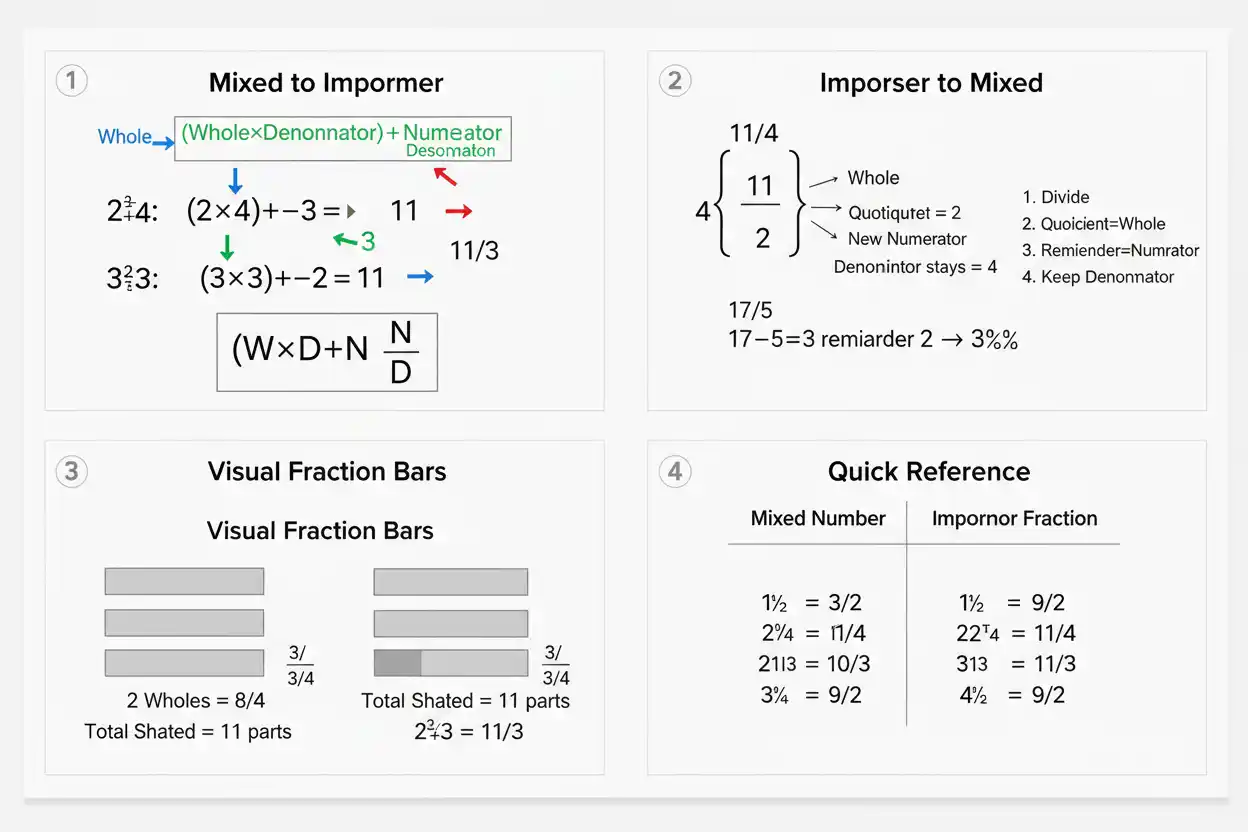

Mixed numbers combine a whole number with a proper fraction. For example:
2 3/4
means:
2 + 3/4
and represents the same value as the improper fraction:
11/4
The main conversion formula is:
w n/d = (wd + n)/d
where:
w = whole-number part
n = fractional numerator
d = denominator
For example:
3 2/5 = (3 × 5 + 2)/5
= 17/5
To convert an improper fraction back to a mixed number, divide the numerator by the denominator. The quotient becomes the whole-number part and the remainder becomes the new numerator.
Mixed numbers are common in measurements, recipes, distances, construction, and other situations where a quantity contains one or more whole units plus part of another unit.
What Is a Mixed Number?
A mixed number has the form:
w n/d
where w is a whole number and n/d is normally a proper fraction satisfying:
0 ≤ n < d
with:
d > 0
For example:
4 1/3
means:
4 + 1/3
The number contains:
4 whole units
plus:
1/3 of another unit
Its decimal value is approximately:
4.333…
Mixed numbers are simply one representation of rational quantities.
Mixed Number vs. Fraction
Consider:
2 1/2
This is a mixed number.
The equivalent improper fraction is:
5/2
Both have the same value:
2 1/2 = 5/2 = 2.5
The notation changes, but the underlying number does not.
An improper fraction is usually easier for calculations, while a mixed number is often easier to interpret as a measurement or physical amount.
Parts of a Mixed Number
In:
5 3/8
the whole-number part is:
5
The numerator is:
3
The denominator is:
8
The fractional part:
3/8
is proper because:
3 < 8
The complete mixed number represents:
5 + 3/8
Mixed Number to Improper Fraction Formula
For a nonnegative mixed number:
w n/d
the equivalent improper fraction is:
(wd + n)/d
For example:
4 3/7
becomes:
(4 × 7 + 3)/7
Calculate:
4 × 7 = 28
Then:
28 + 3 = 31
Therefore:
4 3/7 = 31/7
The denominator remains unchanged.
Why the Formula Works
Take:
4 3/7
Four whole units can be written in sevenths:
4 = 28/7
Add:
28/7 + 3/7
= 31/7
Therefore:
4 3/7 = 31/7
Multiplying the whole-number part by the denominator counts how many fractional units are contained in the whole units.
Then the existing numerator is added.
Example: Convert 3 5/8
Use:
(whole × denominator + numerator)/denominator
Substitute:
(3 × 8 + 5)/8
Calculate:
24 + 5 = 29
Therefore:
3 5/8 = 29/8
Example: Convert 7 2/3
Calculate:
7 × 3 = 21
Add the numerator:
21 + 2 = 23
Keep the denominator:
3
Therefore:
7 2/3 = 23/3
Example: Convert 12 5/6
Use:
(12 × 6 + 5)/6
= (72 + 5)/6
= 77/6
Therefore:
12 5/6 = 77/6
Improper Fraction to Mixed Number Formula
Suppose:
a/b
is a positive improper fraction.
Use integer division:
a = bq + r
where:
q = quotient
r = remainder
and:
0 ≤ r < b
Then:
a/b = q r/b
when r ≠ 0.
If:
r = 0
the fraction simplifies to the whole number q.
This quotient-and-remainder structure is the same one used in long division.
Example: Convert 17/5
Divide:
17 ÷ 5 = 3 remainder 2
Therefore:
17 = 5 × 3 + 2
Write:
17/5 = 3 + 2/5
So:
17/5 = 3 2/5
Example: Convert 29/6
Divide:
29 ÷ 6 = 4 remainder 5
Therefore:
29/6 = 4 5/6
Check:
4 × 6 + 5 = 29
The original numerator is recovered.
Example With No Fractional Remainder
Convert:
35/7
Divide:
35 ÷ 7 = 5
The remainder is:
0
Therefore:
35/7 = 5
There is no need to write:
5 0/7
The simplified result is simply the integer 5.
Mixed Numbers and Division
The connection between mixed numbers and division is direct.
For:
23/4
integer division gives:
23 = 4 × 5 + 3
Therefore:
23/4 = 5 3/4
The quotient tells you how many complete wholes fit, while the remainder tells you how much of another whole remains.
Visual Meaning of 2 3/4
Imagine objects divided into fourths.
Two complete objects contain:
8 fourths
because:
2 × 4 = 8
Add:
3 fourths
and the total becomes:
11 fourths
Therefore:
2 3/4 = 11/4
This illustrates why converting a mixed number to an improper fraction multiplies the whole-number part by the denominator first.
Simplifying a Mixed Number’s Fractional Part
A mixed number should normally have its fractional part in lowest terms.
Consider:
3 6/8
Simplify:
6/8 = 3/4
Therefore:
3 6/8 = 3 3/4
The whole-number part remains unchanged.
The detailed reduction process is covered by fraction simplification.
Mixed Number With an Improper Fractional Part
Suppose an expression is written:
2 7/4
This is not standard mixed-number form because:
7/4 > 1
Convert:
7/4 = 1 3/4
Then:
2 + 1 3/4
= 3 3/4
Therefore the normalized mixed number is:
3 3/4
A standard mixed number keeps the fractional part proper.
Adding Mixed Numbers With Like Denominators
Consider:
2 1/5 + 3 2/5
Add whole-number parts:
2 + 3 = 5
Add fractions:
1/5 + 2/5 = 3/5
Therefore:
2 1/5 + 3 2/5 = 5 3/5
When the fractional sum remains below 1, no regrouping is necessary.
Addition That Requires Regrouping
Calculate:
2 3/4 + 1 2/4
Add whole parts:
2 + 1 = 3
Add fractions:
3/4 + 2/4 = 5/4
Since:
5/4 = 1 1/4
combine the extra whole:
3 + 1 1/4
= 4 1/4
Therefore:
2 3/4 + 1 2/4 = 4 1/4
Adding Mixed Numbers With Different Denominators
Consider:
1 1/3 + 2 1/4
One method is to add the whole numbers and fractions separately.
Whole numbers:
1 + 2 = 3
Fractions:
1/3 + 1/4
Use denominator 12:
1/3 = 4/12
1/4 = 3/12
Then:
4/12 + 3/12 = 7/12
Therefore:
1 1/3 + 2 1/4 = 3 7/12
The general addition and subtraction rules are developed under fraction operations.
Adding by Converting to Improper Fractions
The same problem:
1 1/3 + 2 1/4
can be converted first:
1 1/3 = 4/3
2 1/4 = 9/4
Then:
4/3 + 9/4
Use denominator 12:
16/12 + 27/12
= 43/12
Convert:
43 ÷ 12 = 3 remainder 7
Therefore:
43/12 = 3 7/12
Both methods agree.
Subtracting Mixed Numbers Without Borrowing
Calculate:
5 4/7 – 2 1/7
Subtract whole numbers:
5 – 2 = 3
Subtract fractional parts:
4/7 – 1/7 = 3/7
Therefore:
5 4/7 – 2 1/7 = 3 3/7
Subtracting Mixed Numbers With Borrowing
Consider:
5 1/4 – 2 3/4
You cannot subtract:
1/4 – 3/4
without producing a negative fractional component if you want a conventional nonnegative mixed-number remainder.
Borrow one whole from 5:
5 1/4 = 4 + 1 + 1/4
Since:
1 = 4/4
we get:
5 1/4 = 4 5/4
Now subtract:
4 5/4 – 2 3/4
Whole parts:
4 – 2 = 2
Fractions:
5/4 – 3/4 = 2/4
Simplify:
2/4 = 1/2
Therefore:
5 1/4 – 2 3/4 = 2 1/2
Subtraction by Improper Fractions
The same calculation can be handled without borrowing manually.
Convert:
5 1/4 = 21/4
2 3/4 = 11/4
Subtract:
21/4 – 11/4 = 10/4
Simplify:
10/4 = 5/2
Convert:
5/2 = 2 1/2
Therefore:
5 1/4 – 2 3/4 = 2 1/2
For many calculations, conversion to improper fractions is the more systematic method.
Multiplying Mixed Numbers
Convert each mixed number to an improper fraction first.
Calculate:
2 1/3 × 1 1/2
Convert:
2 1/3 = 7/3
1 1/2 = 3/2
Multiply:
7/3 × 3/2
Cancel 3:
= 7/2
Convert:
7/2 = 3 1/2
Therefore:
2 1/3 × 1 1/2 = 3 1/2
Do not multiply whole-number parts separately from fractional parts.
Another Multiplication Example
Calculate:
3 3/4 × 2 2/5
Convert:
3 3/4 = 15/4
2 2/5 = 12/5
Multiply:
15/4 × 12/5
Cross-cancel:
15/5 = 3
12/4 = 3
Then:
3 × 3 = 9
Therefore:
3 3/4 × 2 2/5 = 9
Dividing Mixed Numbers
Convert the mixed numbers to improper fractions, then multiply by the reciprocal of the divisor.
Calculate:
2 1/2 ÷ 1 1/4
Convert:
2 1/2 = 5/2
1 1/4 = 5/4
Then:
5/2 ÷ 5/4
Multiply by the reciprocal:
5/2 × 4/5
Cancel:
= 4/2
= 2
Therefore:
2 1/2 ÷ 1 1/4 = 2
Another Division Example
Calculate:
4 2/3 ÷ 1 1/6
Convert:
4 2/3 = 14/3
1 1/6 = 7/6
Then:
14/3 ÷ 7/6
= 14/3 × 6/7
Cancel:
14/7 = 2
6/3 = 2
So:
2 × 2 = 4
Therefore:
4 2/3 ÷ 1 1/6 = 4
Mixed Numbers and Decimals
A mixed number can be converted to decimal form by converting its fractional part.
For example:
3 1/4
Since:
1/4 = 0.25
we get:
3 1/4 = 3.25
Likewise:
5 3/8
has:
3/8 = 0.375
so:
5 3/8 = 5.375
Decimal to Mixed Number
Suppose:
2.75
Separate the integer part:
2
and decimal fraction:
0.75
Convert:
0.75 = 75/100
Simplify:
75/100 = 3/4
Therefore:
2.75 = 2 3/4
The detailed decimal-to-fraction procedure is covered by decimal to fraction.
Repeating Decimal to Mixed Number
Consider:
3.333…
The repeating fractional portion is:
0.333… = 1/3
Therefore:
3.333… = 3 1/3
This is an exact equality when the threes repeat indefinitely.
A finite decimal such as:
3.33
would instead represent:
3 33/100
Mixed Numbers and Percentages
A mixed number greater than 1 converts to a percentage greater than 100%.
For example:
1 1/2 = 3/2
Then:
3/2 × 100% = 150%
Therefore:
1 1/2 = 150%
The detailed conversion method is covered by fractions to percent.
Mixed Numbers in Measurements
Mixed numbers frequently describe physical measurements.
Examples include:
2 1/2 meters
5 3/4 inches
1 1/3 cups
7 1/2 hours
The notation separates complete units from the remaining fractional unit, which can make quantities easier to visualize.
Mixed Numbers in Mass-to-Volume Results
A calculation involving milligrams to milliliters may occasionally produce a volume that can be represented as a mixed number.
For example:
1.75 mL
is equivalent to:
1 3/4 mL
Metric measurements are commonly written in decimal form, but the mixed-number representation is mathematically equivalent.
The density conversion determines the numerical volume; mixed-number notation only changes how that result is expressed.
Mixed Numbers and Rational Numbers
Every finite mixed number with an integer whole part and fractional part made from integers is a rational number.
For example:
4 3/7
converts to:
31/7
Since this is a ratio of integers:
4 3/7 is rational
Mixed-number notation does not create a new category of number.
Mixed Numbers and Integer Operations
The whole-number components follow ordinary integer operations.
For example:
8 1/4 – 3 1/4
contains whole-number subtraction:
8 – 3 = 5
and fraction subtraction:
1/4 – 1/4 = 0
Therefore:
8 1/4 – 3 1/4 = 5
The same sign and order rules that apply to integers continue to matter inside larger mixed-number expressions.
Negative Mixed Numbers
A negative mixed number such as:
-2 1/3
is conventionally interpreted as:
-(2 + 1/3)
Therefore:
-2 1/3 = -7/3
It should not be interpreted as:
-2 + 1/3
because that would equal:
-5/3
The negative sign applies to the entire mixed number.
Convert a Negative Mixed Number
Convert:
-4 3/5
First convert the positive magnitude:
4 3/5 = (4 × 5 + 3)/5
= 23/5
Apply the negative sign:
-4 3/5 = -23/5
Negative Improper Fraction to Mixed Number
Consider:
-17/4
Divide the magnitude:
17 ÷ 4 = 4 remainder 1
Therefore:
17/4 = 4 1/4
Apply the sign to the entire result:
-17/4 = -4 1/4
This convention keeps the mixed number’s fractional component positive.
Comparing Mixed Numbers
If whole-number parts differ, the larger whole-number part usually determines the larger positive mixed number.
For example:
4 1/8 > 3 7/8
because:
4 > 3
If the whole-number parts are equal, compare the fractional parts.
For:
5 3/7
and:
5 4/9
compare:
3/7
and:
4/9
Cross-multiply:
3 × 9 = 27
4 × 7 = 28
Therefore:
4/9 > 3/7
so:
5 4/9 > 5 3/7
Ordering Mixed Numbers
Consider:
2 1/3, 1 7/8, 2 1/4
The number with whole part 1 is smallest:
1 7/8
Now compare:
2 1/3
and:
2 1/4
Since:
1/3 > 1/4
the order is:
1 7/8 < 2 1/4 < 2 1/3
Mixed Numbers on a Number Line
The value:
3 1/2
lies halfway between:
3 and 4
The value:
3 3/4
lies three-fourths of the way from 3 to 4.
A mixed number therefore identifies both:
- the whole-number interval containing the value;
- the fractional position inside that interval.
Estimating With Mixed Numbers
Suppose:
4 7/8
Since:
7/8
is close to 1, the mixed number is close to:
5
Similarly:
6 1/10
is close to:
6
Estimation can provide a useful reasonableness check after arithmetic.
For example:
4 7/8 + 3 1/8
should be close to:
5 + 3 = 8
The exact answer is:
8
Common Mistake: Adding Whole Number and Numerator Directly
For:
3 2/5
it is incorrect to write:
(3 + 2)/5 = 5/5
The whole number represents:
3 × 5 = 15 fifths
Therefore:
3 2/5 = (15 + 2)/5
= 17/5
Common Mistake: Changing the Denominator
When converting:
4 3/7
the denominator remains:
7
The result is:
31/7
not:
31/10
or another denominator.
The fractional unit remains sevenths.
Common Mistake: Multiplying Mixed Numbers Directly
For:
2 1/2 × 3 1/4
you should not calculate:
2 × 3
and:
1/2 × 1/4
then simply combine those results.
Convert first:
2 1/2 = 5/2
3 1/4 = 13/4
Then multiply:
5/2 × 13/4
= 65/8
= 8 1/8
Therefore:
2 1/2 × 3 1/4 = 8 1/8
Common Mistake: Forgetting to Regroup
Consider:
3 5/6 + 2 4/6
Add:
5 + 9/6
But:
9/6 = 1 3/6
So:
5 + 1 3/6
= 6 3/6
Simplify:
6 1/2
Therefore:
3 5/6 + 2 4/6 = 6 1/2
A final mixed number should normally have a proper fractional part.
Common Mistake: Leaving the Fraction Unsimplified
For:
7 6/8
simplify:
6/8 = 3/4
Therefore:
7 6/8 = 7 3/4
Both forms have the same value, but the second is in conventional simplest form.
How to Check a Mixed-to-Improper Conversion
Suppose:
5 3/8 = 43/8
Check by dividing:
43 ÷ 8 = 5 remainder 3
That reconstructs:
5 3/8
Therefore the conversion is correct.
How to Check an Improper-to-Mixed Conversion
Suppose:
31/6 = 5 1/6
Convert back:
5 × 6 + 1
= 30 + 1
= 31
Therefore:
5 1/6 = 31/6
The original fraction is recovered.
Frequently Asked Questions
What is a mixed number?
A mixed number combines a whole number and a proper fraction.
For example:
3 1/4
How do you convert a mixed number to an improper fraction?
Use:
(whole × denominator + numerator)/denominator
What is 2 3/4 as an improper fraction?
(2 × 4 + 3)/4 = 11/4
Therefore:
2 3/4 = 11/4
What is 4 1/3 as an improper fraction?
(4 × 3 + 1)/3
= 13/3
How do you convert an improper fraction to a mixed number?
Divide the numerator by the denominator. The quotient becomes the whole number, and the remainder becomes the new numerator.
What is 17/5 as a mixed number?
3 2/5
What is 29/4 as a mixed number?
29 ÷ 4 = 7 remainder 1
Therefore:
29/4 = 7 1/4
Do mixed numbers need to be simplified?
The fractional part should normally be in lowest terms and remain less than 1.
How do you multiply mixed numbers?
Convert them to improper fractions, multiply, simplify, and convert back if a mixed-number answer is useful.
How do you divide mixed numbers?
Convert to improper fractions and multiply the first fraction by the reciprocal of the second.
Can mixed numbers be negative?
Yes. A notation such as -2 1/3 conventionally means the negative of the entire mixed quantity.
Are mixed numbers rational?
Yes. Every mixed number made from integer parts and a valid integer fraction can be expressed as a ratio of integers.
Final Example
Evaluate:
3 2/5 + 1 3/4 × 2
Follow the order of operations.
First convert the multiplication term.
1 3/4 = 7/4
Then:
7/4 × 2
Write:
2 = 2/1
So:
7/4 × 2/1 = 14/4
Simplify:
14/4 = 7/2
= 3 1/2
Now add:
3 2/5 + 3 1/2
Convert the fractional parts to tenths:
2/5 = 4/10
1/2 = 5/10
Add:
4/10 + 5/10 = 9/10
Whole parts:
3 + 3 = 6
Therefore:
3 2/5 + 1 3/4 × 2 = 6 9/10
The central mixed-number conversion rules are:
w n/d = (wd + n)/d
and, when:
a = bq + r
then:
a/b = q r/b
for a nonzero remainder. These two relationships make it easy to move between mixed numbers and improper fractions whenever a calculation or practical measurement calls for a different representation.