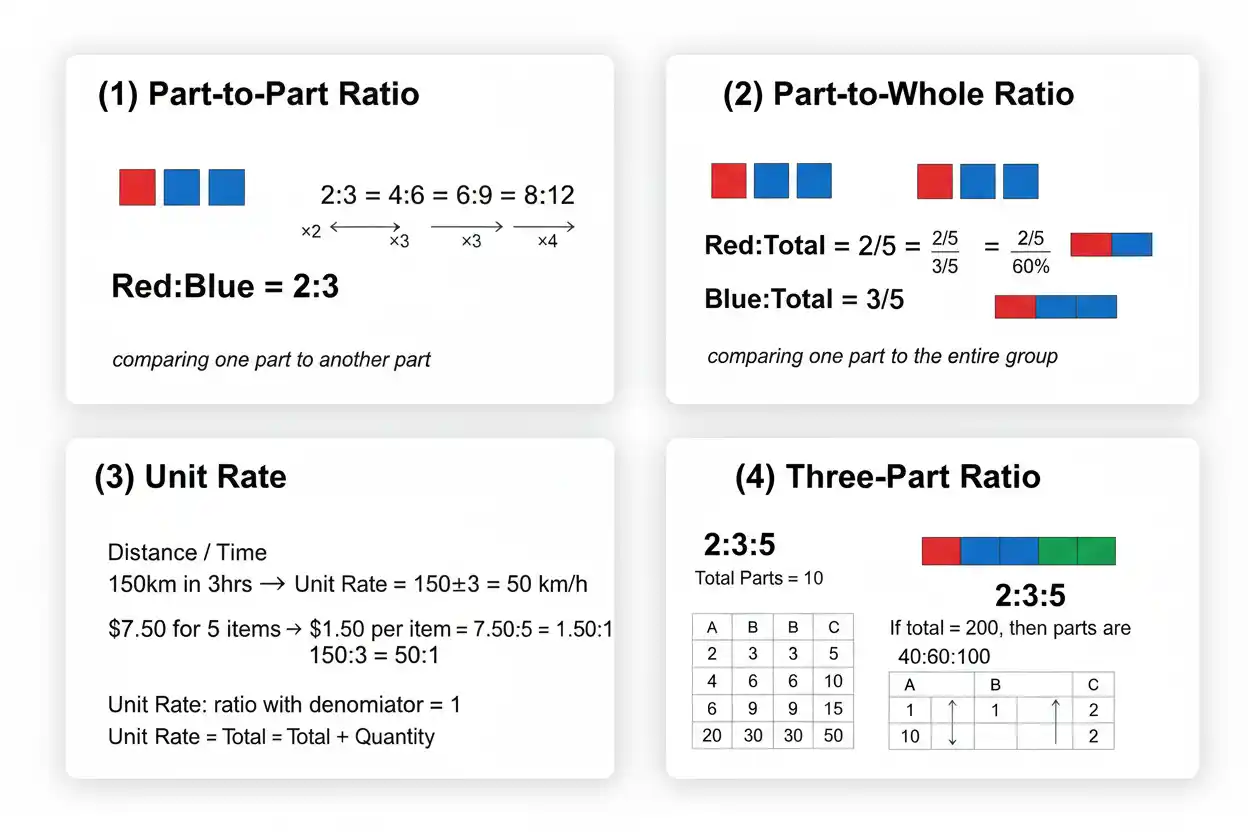
Ratios compare quantities through division and show their relative sizes.
A two-term ratio can be written:
a:b
a to b
or:
a/b
provided the second quantity is nonzero when the ratio is interpreted as division.
For example, if a group contains:
8 red objects
and:
12 blue objects
the red-to-blue ratio is:
8:12
Simplify both terms by:
4
to get:
2:3
This means that for every 2 units of the first quantity, there are 3 corresponding units of the second quantity.
Ratios can compare parts, wholes, rates, measurements, scaled quantities, mixtures, probabilities, sequence terms, and many other numerical relationships.
What Are Ratios?
A ratio compares quantities multiplicatively rather than merely subtracting them.
Suppose:
A = 6
B = 9
The ratio:
A:B = 6:9
simplifies:
2:3
This says:
A/B = 2/3
It does not say the difference is 3, even though:
9 – 6 = 3
Difference and ratio measure different kinds of relationships.
Basic Ratio Formula
For two quantities:
A and B
the ratio of A to B is:
A:B = A/B
For example:
15:20
corresponds to:
15/20
Simplify:
15/20 = 3/4
Therefore:
15:20 = 3:4
The singular ratio page focuses on this basic one-comparison formula. Here the broader emphasis is on different ratio structures, equivalent ratios, multi-part comparisons, scaling, rates, and applications.
Order Matters
The ratio:
2:5
is not the same as:
5:2
Numerically:
2/5 = 0.4
while:
5/2 = 2.5
For a group with:
2 cats
and:
5 dogs
cats to dogs:
2:5
dogs to cats:
5:2
Always follow the order stated in the problem.
Simplifying Ratios
Whole-number ratios are simplified by dividing every term by their greatest common factor.
Simplify:
30:45
Find:
GCF(30,45) = 15
Divide:
30/15 = 2
45/15 = 3
Therefore:
30:45 = 2:3
Equivalent Ratios
Equivalent ratios represent the same numerical comparison.
Starting from:
3:7
multiply both terms by 2:
6:14
Multiply both by 5:
15:35
Thus:
3:7 = 6:14 = 15:35
In general:
a:b = ka:kb
for nonzero scale factor k.
These equal ratio relationships naturally form proportions.
Ratio Tables
Equivalent ratios can be organized in a table.
Starting with:
2:5
| First Quantity | Second Quantity |
|---|---|
| 2 | 5 |
| 4 | 10 |
| 6 | 15 |
| 10 | 25 |
| 20 | 50 |
Each row has:
First/Second = 2/5
Therefore every row represents the same ratio.
Find a Missing Ratio Value
Suppose:
4:7 = 20:x
The first term has been multiplied by:
5
Therefore multiply the second term by 5:
7 × 5 = 35
So:
x = 35
Alternatively, write the proportion:
4/7 = 20/x
Cross multiply:
4x = 140
x = 35
Part-to-Part Ratios
A part-to-part ratio compares two categories within the same overall group.
Suppose there are:
10 red balls
and:
15 blue balls
Red to blue:
10:15
Simplify:
2:3
This ratio compares the two parts directly.
Part-to-Whole Ratios
Using the same group:
Red = 10
Blue = 15
Total:
25
Red to total:
10:25
Simplify:
2:5
Blue to total:
15:25
Simplify:
3:5
Part-to-part:
2:3
Part-to-whole:
2:5
These answer different questions.
Convert Part-to-Part Ratio to Fractions of a Whole
Suppose two categories have ratio:
4:7
Total ratio parts:
4 + 7 = 11
Therefore the first category represents:
4/11
of the total.
The second represents:
7/11
of the total.
As percentages:
4/11 × 100% ≈ 36.36%
7/11 × 100% ≈ 63.64%
The percentages sum to:
100%
Three-Part Ratios
Ratios can compare three or more quantities.
For example:
2:3:5
means the quantities are proportional to:
2 parts
3 parts
5 parts
Total ratio units:
2 + 3 + 5 = 10
Therefore the three quantities represent:
20%
30%
50%
of the combined total.
Divide a Total in a Three-Part Ratio
Divide:
600
in the ratio:
2:3:5
Total ratio parts:
10
One part:
600/10 = 60
First share:
2 × 60 = 120
Second:
3 × 60 = 180
Third:
5 × 60 = 300
Therefore:
120:180:300
Check:
120 + 180 + 300 = 600
and dividing each by 60 recovers:
2:3:5
Ratios With Four or More Terms
The same method extends to:
a:b:c:d
For example:
1:2:3:4
has total parts:
10
If the total quantity is:
500
one part equals:
50
Therefore quantities are:
50, 100, 150, 200
These preserve the original four-term ratio.
Ratios and Rational Numbers
A two-term integer ratio:
a:b
with nonzero b has numerical value:
a/b
which is a rational number.
For example:
7:8
has value:
7/8
= 0.875
The contextual ratio compares two quantities, while the rational number is the numerical quotient of that comparison.
Ratios Within the Real Numbers
Ratio values that can be expressed as:
a/b
for integers a and nonzero b are rational and therefore belong to the real numbers.
But ratios can also compare real-valued measurements.
For example:
√2 : 1
has quotient:
√2
which is irrational but still real.
Thus the concept of a ratio is broader than ratios formed only from integer terms.
Ratios With Decimal Values
Simplify:
1.5:2.25
Multiply each term by 100:
150:225
Divide by:
75
giving:
2:3
You could also multiply first by only 4:
1.5 × 4 = 6
2.25 × 4 = 9
Then:
6:9 = 2:3
Any common nonzero scaling preserves the ratio.
Ratios With Fractions
Simplify:
2/3 : 5/6
Multiply both terms by the least common denominator:
6
Then:
2/3 × 6 = 4
5/6 × 6 = 5
Therefore:
2/3 : 5/6 = 4:5
This converts a fractional ratio into an equivalent whole-number ratio.
Ratios With Mixed Numbers
Simplify:
1 1/2 : 2 1/4
Convert:
1 1/2 = 3/2
2 1/4 = 9/4
Multiply both by 4:
6:9
Simplify:
2:3
The ratio has not changed; only its representation has.
Ratios With Units
Ratios should use compatible units when the quantities measure the same dimension.
Suppose:
2 meters : 50 centimeters
Convert:
2 meters = 200 centimeters
Then:
200:50
Simplify:
4:1
Without converting units first, writing:
2:50
would compare inconsistent measurement scales.
Ratios With Different Units
When quantities have different units, the comparison is usually called a rate.
For example:
180 km : 3 hours
gives:
60 km : 1 hour
or:
60 km/h
The mathematical structure is still division:
180/3 = 60
but the units remain meaningful.
Unit Ratios
A ratio with second term 1 can be useful for comparisons.
For:
24:6
divide both terms by 6:
4:1
For quantities with units:
$15 : 3 kg
becomes:
$5 : 1 kg
The unit form makes comparisons between alternatives easier.
Compare Two Unit Prices
Product A:
$12 for 4 units
Unit price:
12/4 = $3 per unit
Product B:
$20 for 5 units
Unit price:
20/5 = $4 per unit
Therefore Product A has the lower price-to-unit ratio.
The ratio calculation provides a common reference of one unit.
Comparing Ratios by Cross Multiplication
Compare:
5:8
and:
7:10
Write:
5/8
and:
7/10
Cross multiply:
5 × 10 = 50
8 × 7 = 56
Since:
50 < 56
we have:
5/8 < 7/10
Therefore:
5:8 < 7:10
Comparing Ratios Using Decimals
The same ratios give:
5/8 = 0.625
7/10 = 0.7
Therefore:
0.625 < 0.7
This confirms:
5:8 < 7:10
Cross multiplication avoids decimal conversion when exact integer arithmetic is easier.
Combining Ratios With a Shared Quantity
Suppose:
A:B = 2:3
and:
B:C = 4:5
To combine them, make the B terms equal.
First ratio:
A:B = 2:3
Second:
B:C = 4:5
LCM of:
3 and 4
is:
12
Scale first ratio by 4:
A:B = 8:12
Scale second by 3:
B:C = 12:15
Therefore:
A:B:C = 8:12:15
Another Combined Ratio Example
Suppose:
X:Y = 3:5
and:
Y:Z = 2:7
Make Y equal.
LCM of:
5 and 2
is:
10
Scale:
X:Y = 6:10
and:
Y:Z = 10:35
Therefore:
X:Y:Z = 6:10:35
The shared middle quantity must represent the same amount in both ratios before combining them.
Ratio and Proportional Scaling
If:
A:B = 3:4
and the first quantity becomes:
18
the scale factor is:
18/3 = 6
Therefore the second quantity becomes:
4 × 6 = 24
So:
18:24 = 3:4
This is the basic mechanism behind proportional enlargement and reduction.
Ratio in Recipes
Suppose a mixture uses ingredients in ratio:
2:3:1
and you need:
24 total cups
Total ratio parts:
2 + 3 + 1 = 6
One part:
24/6 = 4 cups
Quantities:
2 × 4 = 8
3 × 4 = 12
1 × 4 = 4
Therefore the mixture uses:
8 cups, 12 cups, and 4 cups
Ratio in Maps
Suppose map scale is:
1:50,000
This means:
1 unit on the map
corresponds to:
50,000 of the same units in reality.
If the map distance is:
3 cm
actual distance:
3 × 50,000
= 150,000 cm
Convert:
150,000 cm = 1.5 km
Therefore:
3 cm on the map represents 1.5 km
Ratio in Similar Figures
Suppose corresponding side lengths have ratio:
2:5
If the smaller figure has a side of:
8 cm
the corresponding larger side is:
8 × 5/2
= 20 cm
Therefore:
8:20 = 2:5
Length ratios scale directly.
Area and volume ratios require powers of the linear scale factor and should not be treated as identical to side-length ratios.
Ratio and Percentages
A ratio can be converted to a percentage depending on the reference.
For:
A:B = 3:4
the first quantity as a percentage of the second is:
3/4 × 100%
= 75%
But if 3:4 represents two parts of one total, then the first category is:
3/(3+4)
= 3/7
of the whole.
Percentage:
3/7 × 100%
≈ 42.86%
These are different questions.
Ratio as a Growth Multiplier
Suppose a value changes from:
80 to 100
The new-to-original ratio is:
100:80
Simplify:
5:4
Numerically:
5/4 = 1.25
Therefore the new value equals:
1.25
times the original, corresponding to:
25%
growth.
Ratios often provide the multiplier underlying percentage-change calculations.
Ratios in Geometric Sequences
A geometric sequence has a constant ratio between consecutive nonzero terms.
For:
5,15,45,135,…
calculate:
15/5 = 3
45/15 = 3
135/45 = 3
Therefore:
common ratio = 3
The next term is:
135 × 3 = 405
Ratios and Arithmetic Sequences
An arithmetic sequence is based on a constant difference rather than a constant ratio.
For:
5,10,15,20,…
differences are:
5,5,5
but ratios are:
2
1.5
4/3
Therefore the sequence is arithmetic, not geometric.
This distinction prevents confusing additive and multiplicative patterns.
Ratios and Remainders
A ratio is based on division, but it should not be confused with a remainder.
For integer division:
a = bq + r
where:
0 ≤ r < b
the quotient q describes how many complete copies of b fit into a, while r is the leftover amount.
For example:
17 ÷ 5 = 3 remainder 2
The ratio:
17/5 = 3.4
is the exact quotient as a rational value.
The remainder:
2
is instead the leftover after three complete groups of five.
These are related through division but represent different mathematical quantities.
Ratio of Remainder to Divisor
In some applications, the remainder itself may be compared with the divisor.
For:
17 ÷ 5
remainder:
2
divisor:
5
Ratio:
2:5
or:
2/5
This equals:
0.4
which is the fractional part beyond the whole-number quotient:
3 + 2/5 = 3.4
This connection shows how ratio, fraction, quotient, and remainder can describe the same division from different perspectives.
Ratios and Real Numbers
Ratios need not always use integers.
For example:
π:2
has numerical quotient:
π/2
which is a real number but not rational.
Likewise:
√2:√8
simplifies:
√2/(2√2)
= 1/2
so a ratio formed from irrational quantities can sometimes simplify to a rational result.
Ratios and Proportions
Two ratios are proportional when they are equal:
a:b = c:d
meaning:
a/b = c/d
For nonzero denominators:
ad = bc
For example:
4:6
and:
10:15
are equivalent because:
4 × 15 = 60
6 × 10 = 60
This is the foundation of proportional reasoning.
Ratio Tables and Constant Multipliers
Suppose:
x:y = 3:8
Then:
| x | y |
|---|---|
| 3 | 8 |
| 6 | 16 |
| 9 | 24 |
| 15 | 40 |
| 30 | 80 |
Each pair has:
x/y = 3/8
The table can be generated by multiplying both ratio terms by the same scale factor.
Finding an Unknown From a Total and Ratio
Suppose two quantities have ratio:
5:7
and their total is:
144
Total ratio parts:
5 + 7 = 12
One part:
144/12 = 12
First quantity:
5 × 12 = 60
Second:
7 × 12 = 84
Therefore:
The quantities are 60 and 84
Finding a Total From One Ratio Part
Suppose:
A:B = 3:5
and:
A = 27
Since:
3 ratio units = 27
one ratio unit is:
27/3 = 9
Therefore:
B = 5 × 9
= 45
Total:
27 + 45
= 72
So:
B = 45 and total = 72
Finding a Ratio From Actual Quantities
Suppose three quantities are:
24, 36, 60
Their ratio is:
24:36:60
Find the common GCF:
12
Divide every term:
2:3:5
Therefore:
24:36:60 = 2:3:5
Ratios With Zero
A ratio may have zero as the first term:
0:5
which corresponds to:
0/5 = 0
But a ratio:
5:0
cannot be interpreted as an ordinary quotient because:
5/0
is undefined.
Context sometimes uses colon notation informally with zero counts, but division-based calculations require a nonzero second term.
Negative Ratios
Algebraically, ratios may involve negative quantities.
For example:
-2:5
has quotient:
-2/5
And:
-2:-5
has quotient:
2/5
In physical applications, whether negative ratio terms are meaningful depends on what the quantities represent.
Common Mistake: Reversing the Requested Order
If there are:
7 adults
and:
4 children
adults to children:
7:4
children to adults:
4:7
Read the wording in the same sequence in which the ratio should be written.
Common Mistake: Confusing Part-to-Part and Part-to-Whole
With:
3 red
and:
2 blue
red to blue:
3:2
red to total:
3:5
These are different comparisons.
Always determine what the second quantity in the ratio is supposed to represent.
Common Mistake: Using Different Scale Factors
From:
2:3
multiplying only the first term by 4 and the second by 5 gives:
8:15
This is not equivalent.
To preserve a ratio, use the same scale factor:
2×4 : 3×4
= 8:12
Therefore:
2:3 = 8:12
Common Mistake: Simplifying Before Converting Units
For:
2 m : 50 cm
do not simplify numerical values:
2:50
first.
Convert to matching units:
200 cm : 50 cm
Then:
4:1
The numerical terms only become directly comparable after unit conversion.
Common Mistake: Assuming Ratios Must Add to 100
Ratio terms do not normally sum to 100.
For:
3:7
the terms sum to:
10
To convert them into percentages of a whole:
3/10 = 30%
7/10 = 70%
The ratio itself remains:
3:7
Common Mistake: Adding Ratios Directly
If:
A:B = 2:3
and:
B:C = 4:5
you cannot immediately write:
A:B:C = 2:3:5
because the two versions of B do not match.
First equalize the shared quantity.
The correct combined ratio is:
8:12:15
How to Check Equivalent Ratios
Suppose:
14:21
is claimed equivalent to:
10:15
Simplify:
14:21 = 2:3
10:15 = 2:3
Therefore the ratios are equivalent.
Cross multiplication also gives:
14 × 15 = 210
21 × 10 = 210
The claim is correct.
Frequently Asked Questions
What are ratios?
Ratios are multiplicative comparisons between two or more quantities.
How is a ratio written?
Common forms include:
a:b
a to b
a/b
Does order matter in ratios?
Yes. a:b generally differs from b:a.
How do you simplify ratios?
Divide every term by the same greatest common factor.
Simplify 18:30.
GCF = 6
so:
18:30 = 3:5
What are equivalent ratios?
Ratios obtained by multiplying or dividing all corresponding terms by the same nonzero factor.
What is a part-to-part ratio?
A comparison between two categories within one total.
What is a part-to-whole ratio?
A comparison between one category and the total.
Can ratios have more than two terms?
Yes.
For example:
2:3:5
Can ratios contain decimals?
Yes. They can often be scaled into whole-number form.
Can ratios contain fractions?
Yes. Multiplying all terms by a common denominator often simplifies them.
What is the difference between ratios and proportions?
A ratio is a comparison. A proportion states that two ratios are equal.
What is a unit ratio?
A ratio expressed relative to one unit of the second quantity.
How do you divide a total using a ratio?
Add the ratio terms, divide the total by that sum, then multiply one-part value by each ratio term.
Final Example
Three departments receive a budget in the ratio:
4:5:7
The total budget is:
320,000
First calculate total ratio parts:
4 + 5 + 7 = 16
One part:
320,000/16
= 20,000
First department:
4 × 20,000
= 80,000
Second:
5 × 20,000
= 100,000
Third:
7 × 20,000
= 140,000
Therefore the allocation is:
80,000 : 100,000 : 140,000
Check the total:
80,000 + 100,000 + 140,000
= 320,000
Check the ratio by dividing each amount by:
20,000
giving:
4:5:7
The central ratio principles are:
Ratio = one quantity ÷ another
Equivalent ratios use the same scale factor
Multi-part ratios divide a total according to the sum of their ratio units
Once the order, units, and reference quantities are identified correctly, ratios provide a compact way to compare, scale, distribute, and relate numerical quantities.