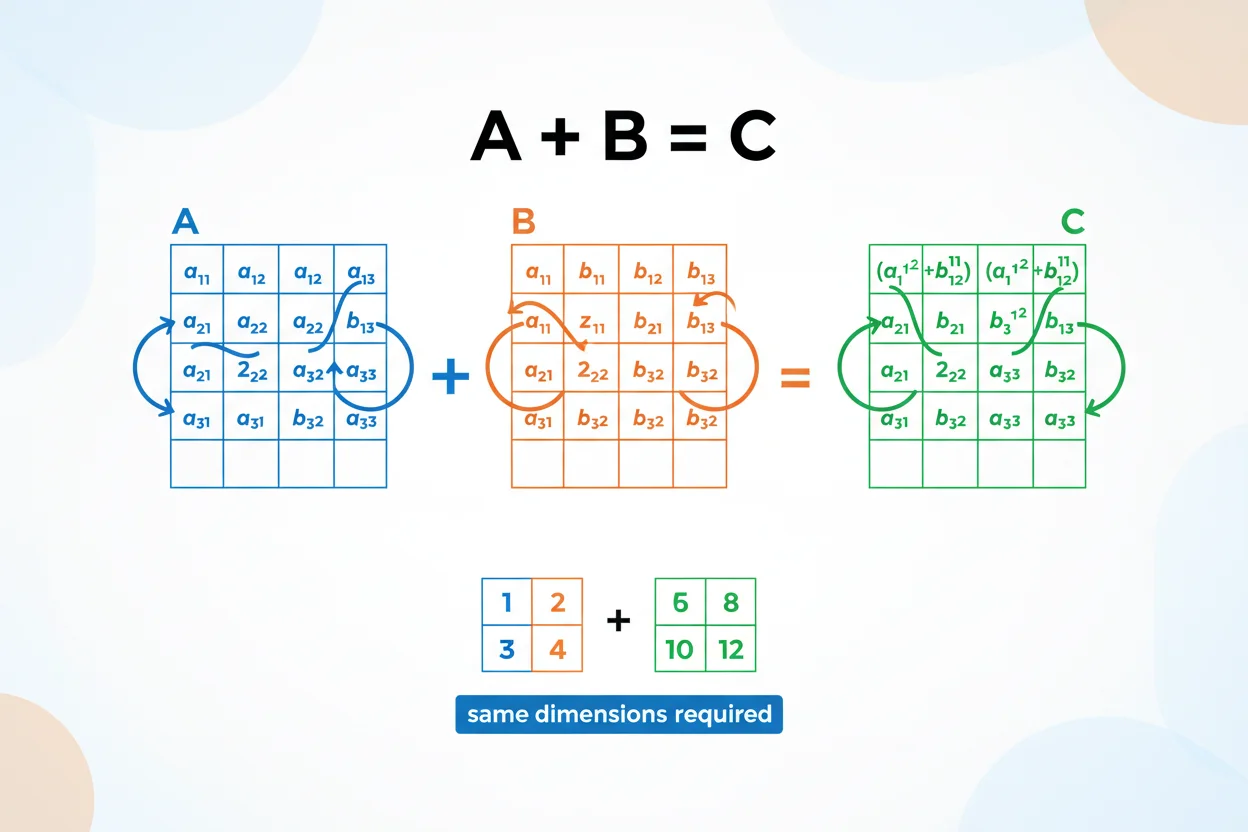

Matrix addition combines two matrices of the same dimensions by adding corresponding entries. If A and B are both m × n matrices, their sum C = A + B is also an m × n matrix, with each entry defined by cᵢⱼ = aᵢⱼ + bᵢⱼ. A 2 × 3 matrix can therefore be added to another 2 × 3 matrix, but not to a 3 × 2 or 2 × 2 matrix. The operation is element-by-element and does not involve multiplying rows by columns. Matrix addition is commutative and associative, has a zero matrix as its additive identity, and gives every matrix an additive inverse. Matrix subtraction follows the same dimension rule and can be interpreted as addition of the negative matrix. These properties make matrix addition behave much like vector addition and ordinary numerical addition while preserving matrix structure. It is a fundamental matrix operation used in linear transformations, systems, numerical models, and expressions involving several matrices.
What Is Matrix Addition?
Suppose:
A = [aᵢⱼ]
and:
B = [bᵢⱼ]
have exactly the same dimensions.
Their sum is:
A + B = [aᵢⱼ + bᵢⱼ]
This means every entry in A is paired with the entry occupying the same row and column in B.
For example:
A = [ 1 2 ]
[ 3 4 ]
and:
B = [ 5 6 ]
[ 7 8 ]
Then:
A + B = [ 1+5 2+6 ]
[ 3+7 4+8 ]
Therefore:
A + B = [ 6 8 ]
[ 10 12 ]
No row-column multiplication is involved.
Matrix Addition Formula
For two m × n matrices:
A = [aᵢⱼ]
and:
B = [bᵢⱼ]
the matrix addition formula is:
A + B = [aᵢⱼ + bᵢⱼ]
or equivalently:
(A + B)ᵢⱼ = aᵢⱼ + bᵢⱼ
for:
i = 1, 2, …, m
and:
j = 1, 2, …, n
The resulting matrix has the same number of rows and columns as the original matrices.
Dimension Rule
Matrix addition is defined only when both matrices have the same dimensions.
If:
A is m × n
then B must also be:
m × n
For example:
2 × 3 + 2 × 3 → valid
but:
2 × 3 + 3 × 2 → not defined
and:
2 × 3 + 2 × 2 → not defined
Having the same number of entries is not enough. The row and column arrangement must match exactly.
Example With 2 × 3 Matrices
Let:
A = [ 2 1 −3 ]
[ 4 0 5 ]
and:
B = [ 6 −2 7 ]
[ 1 3 −4 ]
Add corresponding entries:
A + B = [ 2+6 1+(−2) −3+7 ]
[ 4+1 0+3 5+(−4) ]
Therefore:
A + B = [ 8 −1 4 ]
[ 5 3 1 ]
The result remains:
2 × 3
Example With Negative Entries
Let:
A = [ −4 7 ]
[ 2 −1 ]
and:
B = [ 5 −3 ]
[ −6 8 ]
Then:
A + B = [ −4+5 7−3 ]
[ 2−6 −1+8 ]
So:
A + B = [ 1 4 ]
[ −4 7 ]
Signs should be handled exactly as in ordinary arithmetic.
Matrix Addition With Decimals
Consider:
A = [ 1.2 3.5 ]
[ 0.4 −2.1 ]
and:
B = [ 2.8 −1.5 ]
[ 1.6 4.1 ]
Then:
A + B = [ 4.0 2.0 ]
[ 2.0 2.0 ]
The operation does not depend on entries being integers.
Any compatible numerical entries can be added according to the underlying number system.
Matrix Addition With Fractions
Let:
A = [ 1/2 1/3 ]
[ 3/4 2/5 ]
and:
B = [ 1/2 2/3 ]
[ 1/4 3/5 ]
Then:
A + B = [ 1 1 ]
[ 1 1 ]
Corresponding fractions are added normally.
The matrix structure only determines which values are paired.
How to Add Matrices
The process is straightforward.
First verify that both matrices have the same number of rows and columns.
Then pair entries in identical positions.
Add each pair using ordinary arithmetic.
Finally place every result in the corresponding position of the new matrix.
For example:
A = [ a b ]
[ c d ]
and:
B = [ e f ]
[ g h ]
give:
A + B = [ a+e b+f ]
[ c+g d+h ]
Matrix Addition Is Commutative
Matrix addition satisfies:
A + B = B + A
when A and B have the same dimensions.
For example:
A = [ 1 2 ]
[ 3 4 ]
and:
B = [ 5 6 ]
[ 7 8 ]
give:
A + B = [ 6 8 ]
[ 10 12 ]
and:
B + A = [ 6 8 ]
[ 10 12 ]
This follows because ordinary scalar addition is commutative in every corresponding entry.
Matrix Addition Is Associative
For same-sized matrices:
(A + B) + C = A + (B + C)
The grouping does not affect the result.
At every position:
(aᵢⱼ + bᵢⱼ) + cᵢⱼ
equals:
aᵢⱼ + (bᵢⱼ + cᵢⱼ)
because ordinary numerical addition is associative.
This allows several matrices to be added without ambiguity about grouping.
Example of Associativity
Let:
A = [1 2]
B = [3 4]
C = [5 6]
Treat these as 1 × 2 matrices.
Then:
(A + B) + C
= [4 6] + [5 6]
= [9 12]
Meanwhile:
A + (B + C)
= [1 2] + [8 10]
= [9 12]
The same property holds for matrices of any compatible common size.
Zero Matrix
The additive identity is the zero matrix.
For an m × n matrix A, let:
0ₘₓₙ
be the m × n matrix whose every entry is zero.
Then:
A + 0 = A
For example:
[ 2 −1 ] + [ 0 0 ] = [ 2 −1 ]
[ 5 3 ] [ 0 0 ] [ 5 3 ]
The zero matrix must have the same dimensions as A for the addition to be defined.
Additive Inverse
Every matrix A has an additive inverse:
−A
formed by negating every entry.
If:
A = [ 2 −3 ]
[ 4 1 ]
then:
−A = [ −2 3 ]
[ −4 −1 ]
Adding them gives:
A + (−A) = 0
The zero result follows entry by entry.
Matrix Subtraction
Matrix subtraction is defined as:
A − B = A + (−B)
As with addition, A and B must have the same dimensions.
For example:
A = [ 7 4 ]
[ 2 9 ]
and:
B = [ 3 6 ]
[ 1 5 ]
Then:
A − B = [ 7−3 4−6 ]
[ 2−1 9−5 ]
Therefore:
A − B = [ 4 −2 ]
[ 1 4 ]
Unlike addition, subtraction is not commutative.
Generally:
A − B ≠ B − A
Scalar Multiplication and Addition
If c is a scalar, then:
c(A + B) = cA + cB
For example, let:
A = [1 2]
and:
B = [3 4]
Then:
A + B = [4 6]
Multiply by 2:
2(A + B) = [8 12]
Separately:
2A = [2 4]
2B = [6 8]
and:
2A + 2B = [8 12]
The distributive property holds because it holds for every individual entry.
Addition of Scalar Multiples
Matrices also satisfy:
(a + b)A = aA + bA
For example:
5A = (2 + 3)A
= 2A + 3A
This property helps matrices behave as elements of a vector space.
Indeed, the set of all m × n matrices over a given field forms a vector space under matrix addition and scalar multiplication.
Matrix Addition and Linear Transformations
Suppose two linear transformations have the same domain and codomain:
T(x) = Ax
and:
S(x) = Bx
Their sum is defined by:
(T + S)(x) = T(x) + S(x)
Then:
(T + S)(x) = Ax + Bx
which equals:
(A + B)x
Therefore matrix addition represents addition of linear transformations when their matrix dimensions agree.
Example With Transformations
Let:
A = [ 1 0 ]
[ 0 2 ]
and:
B = [ 3 1 ]
[ 2 0 ]
Then:
A + B = [ 4 1 ]
[ 2 2 ]
For:
x = (1, 2)
we have:
(A + B)x
= [ 4 1 ] [1]
[ 2 2 ] [2]
= (6, 6)
Separately:
Ax = (1, 4)
and:
Bx = (5, 2)
Adding:
(1, 4) + (5, 2) = (6, 6)
The two procedures agree.
Matrix Addition Versus Matrix Multiplication
Matrix addition and matrix multiplication have very different rules.
For addition:
same dimensions are required
and entries are combined position by position.
For multiplication:
inner dimensions must match
and each output entry comes from a row-column dot product.
For example, two 2 × 3 matrices can always be added.
But two 2 × 3 matrices cannot ordinarily be multiplied together because the inner dimensions:
3 and 2
do not match.
Addition Is Commutative; Multiplication Usually Is Not
Matrix addition satisfies:
A + B = B + A
Matrix multiplication generally does not:
AB ≠ BA
This is a crucial difference.
Rules that are valid for scalar arithmetic should not automatically be transferred to matrix multiplication.
Matrix addition is much closer to ordinary component-wise vector addition.
Matrix Addition and Matrix Operations
The Matrix operations include addition, subtraction, scalar multiplication, matrix multiplication, transposition, inversion, and related procedures.
Matrix addition is one of the simplest because no interaction occurs between different positions.
Each entry is processed independently.
Other operations can depend on rows, columns, determinants, or broader matrix structure.
Adding Matrices of Different Shapes
Consider:
A = [ 1 2 3 ]
[ 4 5 6 ]
which is:
2 × 3
and:
B = [ 1 2 ]
[ 3 4 ]
[ 5 6 ]
which is:
3 × 2
Although both contain six entries:
A + B
is not defined.
The positions do not correspond because the matrix dimensions differ.
Equal total entry counts are therefore insufficient.
Addition of Square Matrices
Square matrices are added exactly like rectangular matrices.
For example:
A = [ 1 2 3 ]
[ 4 5 6 ]
[ 7 8 9 ]
and:
B = [ 9 8 7 ]
[ 6 5 4 ]
[ 3 2 1 ]
give:
A + B = [ 10 10 10 ]
[ 10 10 10 ]
[ 10 10 10 ]
The fact that they are square does not change the addition rule.
Addition of Row Matrices
Two 1 × n matrices can be added component by component.
For example:
[2 5 −1] + [3 −2 4]
equals:
[5 3 3]
This is essentially ordinary vector addition written in row-matrix form.
Addition of Column Matrices
Similarly:
[ 2 ] [ 5 ]
[ 3 ] + [−1]
[ 4 ] [ 6 ]
equals:
[ 7 ]
[ 2 ]
[10 ]
Again, the operation is identical to component-wise vector addition.
Matrix Addition and the Determinant
The matrix determinant is defined only for square matrices and is not generally additive.
In general:
det(A + B) ≠ det(A) + det(B)
For example, let:
A = I
and:
B = I
for the 2 × 2 identity matrix.
Then:
det(A) = 1
det(B) = 1
so:
det(A) + det(B) = 2
But:
A + B = 2I
whose determinant is:
det(2I) = 4
Therefore:
4 ≠ 2
Matrix addition itself is straightforward, but determinant behavior cannot be inferred by adding determinant values.
Matrix Addition and Matrix Inverses
The matrix inverse also does not distribute over addition in the obvious way.
In general:
(A + B)⁻¹ ≠ A⁻¹ + B⁻¹
even when all of the relevant inverse matrices exist.
Invertibility of A and B separately also does not guarantee that:
A + B
is invertible.
For example:
B = −A
with A invertible gives:
A + B = 0
and the zero matrix is not invertible.
Example: Invertible Matrices With Noninvertible Sum
Let:
A = I
and:
B = −I
Both A and B are invertible.
But:
A + B = 0
The determinant of the zero matrix is:
0
Therefore A + B is singular.
This demonstrates why invertibility must be checked on the resulting matrix rather than inferred from its addends.
Matrix Addition and Rank
The rank of a sum does not generally equal the sum of the ranks.
However, an important inequality is:
rank(A + B) ≤ rank(A) + rank(B)
for same-sized matrices.
The exact rank can increase, decrease, or remain unchanged depending on how the matrices interact.
For example:
B = −A
gives:
A + B = 0
whose rank is zero even if A and B individually have high rank.
The dedicated matrix rank treatment handles rank calculations and interpretation.
Addition and Transpose
Matrix addition works cleanly with transposition:
(A + B)ᵀ = Aᵀ + Bᵀ
This follows because transposition only swaps row and column positions.
Adding before or after that positional swap produces the same entries.
Similarly:
(A − B)ᵀ = Aᵀ − Bᵀ
These rules are useful in algebraic matrix manipulations.
Solving for an Unknown Matrix
Matrix equations involving addition can often be solved exactly as scalar equations are, provided dimensions match.
Suppose:
A + X = B
Then:
X = B − A
For example:
A = [ 1 2 ]
[ 3 4 ]
and:
B = [ 7 5 ]
[ 2 9 ]
Then:
X = B − A
= [ 6 3 ]
[−1 5 ]
Check:
A + X
= [ 1+6 2+3 ]
[ 3−1 4+5 ]
= [ 7 5 ]
[ 2 9 ]
which equals B.
Equation With Scalar Multiples
Suppose:
2A + B = C
and A and C are known.
Then:
B = C − 2A
All matrices must have the same dimensions.
For example:
A = [1 2]
and:
C = [7 10]
Then:
2A = [2 4]
so:
B = [7 10] − [2 4]
= [5 6]
The algebra follows ordinary vector-space rules.
Matrix Addition and Linear Approximation
A linear approximation can involve adding first-order contributions from several variables or components.
In multivariable settings, derivative information may be organized into vectors and matrices.
Those objects follow ordinary matrix addition rules when they have compatible shapes.
However, matrix addition itself is an exact algebraic operation, whereas linear approximation is generally an estimate of nonlinear behavior near a point.
Matrix Addition and Line Integrals
A line integral can involve vector fields, and vector fields may themselves be combined by addition.
Integration is linear:
∫꜀ (F + G) · dr
= ∫꜀ F · dr + ∫꜀ G · dr
When vector or matrix representations are used in such models, the underlying component-wise addition follows the same linear structure.
The path integration remains a separate operation.
Matrix Addition and Basis Representations
A matrix records coordinates relative to chosen bases.
When two matrices represent linear maps between the same coordinate spaces, their addition corresponds to adding the maps.
The concept of basis and dimension matters because the matrices must represent compatible domains and codomains before entrywise addition has the intended transformation meaning.
Matrices of the same numerical dimensions can always be added algebraically, but interpretation should still respect what their entries represent.
Matrix Addition and Eigenvalues
Eigenvalues of sums are generally not obtained by simply adding arbitrary eigenvalues of the two matrices.
If v is a common eigenvector satisfying:
Av = λv
and:
Bv = μv
then:
(A + B)v = Av + Bv
= λv + μv
= (λ + μ)v
So λ + μ is an eigenvalue of A + B for that common eigenvector.
Without a shared eigenvector or additional matrix structure, this shortcut is not generally valid.
Addition of More Than Two Matrices
Any number of matrices can be added if all have the same dimensions.
For:
A + B + C + D
each result entry is:
aᵢⱼ + bᵢⱼ + cᵢⱼ + dᵢⱼ
Associativity means parentheses can be placed however convenient:
((A + B) + C) + D
or:
A + (B + (C + D))
The final result is identical.
Matrix Addition Within Calculus and Linear Algebra
Matrix addition is a basic algebraic operation within the broader Calculus & Linear Algebra framework.
Its simplicity is important: because matrices can represent systems, transformations, derivative arrays, data relationships, and geometric operations, being able to combine compatible matrices reliably is foundational.
The core procedure nevertheless remains narrow:
verify dimensions → add corresponding entries → preserve the matrix shape
More advanced properties of the resulting matrix must be analyzed separately.
Example: Add Three Matrices
Let:
A = [ 1 2 ]
[ 3 4 ]
B = [ 2 0 ]
[−1 5 ]
C = [ 4 −3 ]
[ 2 1 ]
Then:
A + B + C
has first row:
1 + 2 + 4 = 7
2 + 0 − 3 = −1
and second row:
3 − 1 + 2 = 4
4 + 5 + 1 = 10
Therefore:
A + B + C = [ 7 −1 ]
[ 4 10 ]
Example: Find a Missing Matrix
Suppose:
A + B = C
where:
A = [ 3 −1 ]
[ 2 5 ]
and:
C = [ 8 4 ]
[ 7 1 ]
Then:
B = C − A
Calculate:
B = [ 8−3 4−(−1) ]
[ 7−2 1−5 ]
Therefore:
B = [ 5 5 ]
[ 5 −4 ]
Check:
A + B = [ 8 4 ]
[ 7 1 ]
The recovered matrix is correct.
Common Matrix Addition Mistakes
The most common error is attempting to add matrices with different dimensions.
Another mistake is pairing entries based on visual proximity rather than identical row-column positions.
Matrix addition should not be confused with matrix multiplication. There are no row-by-column dot products in addition.
Negative values require ordinary sign care, especially during matrix subtraction.
Students may also assume:
det(A + B) = det(A) + det(B)
or:
(A + B)⁻¹ = A⁻¹ + B⁻¹
Neither identity is generally valid.
Finally, the dimensions of the result should always match the dimensions of the matrices being added. If a calculation unexpectedly changes the number of rows or columns, the procedure has been applied incorrectly.
Frequently Asked Questions
What is matrix addition?
Matrix addition combines two same-sized matrices by adding entries in corresponding positions.
What is the matrix addition formula?
For same-sized matrices:
(A + B)ᵢⱼ = aᵢⱼ + bᵢⱼ
Do matrices need the same size to be added?
Yes. They must have exactly the same number of rows and columns.
Can a 2 × 3 matrix be added to a 3 × 2 matrix?
No. Even though they contain the same total number of entries, their dimensions are different.
Is matrix addition commutative?
Yes:
A + B = B + A
for matrices of the same dimensions.
Is matrix addition associative?
Yes:
(A + B) + C = A + (B + C)
What is the additive identity for matrices?
The same-sized zero matrix:
A + 0 = A
What is the additive inverse of a matrix?
The additive inverse of A is −A:
A + (−A) = 0
How is matrix subtraction performed?
Subtract corresponding entries, or equivalently:
A − B = A + (−B)
Is matrix addition the same as matrix multiplication?
No. Addition is element by element and requires identical dimensions. Multiplication uses row-column products and has a different compatibility rule.
Can determinants be added when matrices are added?
Not generally:
det(A + B) ≠ det(A) + det(B)
Is the inverse of a matrix sum the sum of the inverses?
Not generally:
(A + B)⁻¹ ≠ A⁻¹ + B⁻¹
How is matrix addition related to linear transformations?
If T(x) = Ax and S(x) = Bx, then the summed transformation T + S is represented by A + B.
How can I check a matrix addition answer?
Confirm that the original matrices have identical dimensions, then recheck every output entry against the two values in the same row and column of the input matrices.