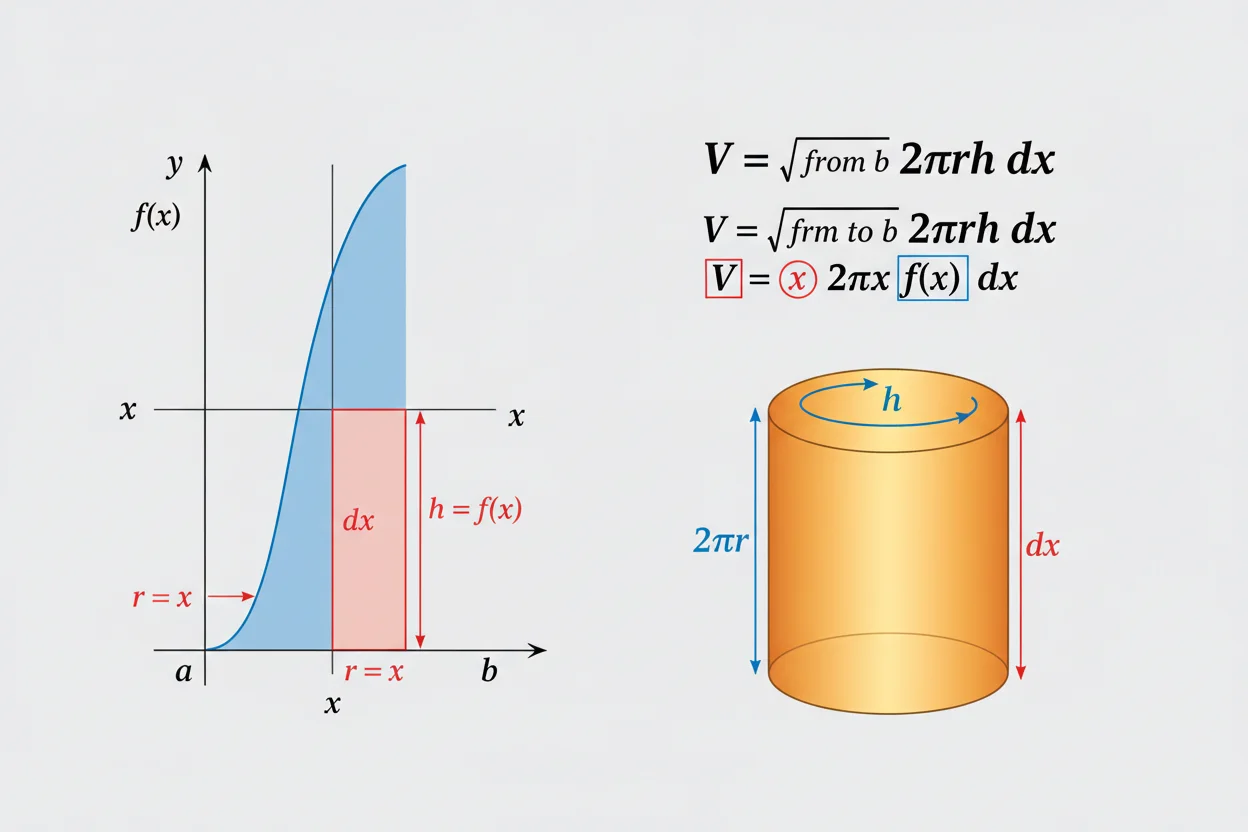

Volume by shells is a method for finding the volume of a solid of revolution by integrating thin cylindrical shells. Instead of slicing perpendicular to the rotation axis, as in the disk and washer methods, the shell method uses slices parallel to the axis. When a vertical strip at x rotates around the y-axis, it forms a cylindrical shell with radius x, height determined by the vertical length of the region, and thickness dx. The approximate shell volume is circumference × height × thickness, giving dV = 2πrh dx. The full volume is therefore V = 2π∫rh dx. For rotation around a horizontal axis, horizontal shells and integration with respect to y are typically used. The shell method is especially useful when it avoids solving a function for the opposite variable or eliminates the need to split a disk or washer integral into multiple pieces.
What Is the Shell Method?
Take a thin rectangular strip.
Rotate it around an axis parallel to the strip.
Instead of creating a disk, the strip sweeps out a thin cylindrical shell.
A cylinder’s circumference is:
2πr
If the shell height is:
h
and its very small thickness is:
Δx
then its volume is approximately:
ΔV ≈ 2πr h Δx
As the shells become arbitrarily thin:
V = 2π∫r h dx
This is the cylindrical shell method.
Volume By Shells Formula
For vertical shells:
V = 2π∫ₐᵇ radius(x) × height(x) dx
For horizontal shells:
V = 2π∫𝚌ᵈ radius(y) × height(y) dy
In compact form:
V = 2π∫rh d(variable)
The three quantities to identify are:
radius
height
thickness
Once those are correct, the volume integral follows directly.
Why the Formula Is 2πrh
A thin shell resembles a hollow cylinder.
Its lateral circumference is:
2πr
Multiply by shell height h:
2πrh
This gives the approximate lateral area of the shell.
Multiplying by tiny radial thickness:
dr
or the equivalent coordinate thickness gives:
dV ≈ 2πrh dr
The limiting sum of these thin cylindrical layers becomes:
V = 2π∫rh dr
In coordinate-axis problems, the radial variable may be x or y.
Shells Around the y-Axis
Suppose a region extends vertically from:
y = g(x)
to:
y = f(x)
and rotates around the y-axis.
A vertical strip creates a cylindrical shell.
Its radius is:
r = |x|
and its height is:
h = f(x) − g(x)
when f is the upper curve.
Therefore:
V = 2π∫ₐᵇ |x|[f(x) − g(x)]dx
If:
x ≥ 0
throughout the region:
V = 2π∫ₐᵇ x[f(x) − g(x)]dx
Basic Shell Example
Rotate the region under:
y = x²
for:
0 ≤ x ≤ 1
around the y-axis.
Each vertical strip has:
radius = x
and:
height = x²
Therefore:
V = 2π∫₀¹x(x²)dx
= 2π∫₀¹x³dx
Integrate:
V = 2π[x⁴/4]₀¹
= 2π(1/4)
Therefore:
V = π/2
The shell method keeps the original function y = x² without solving for x in terms of y.
Verify the Same Volume With Disks
The same region can be described using:
x = √y
for:
0 ≤ y ≤ 1
Rotating a horizontal slice around the y-axis gives a disk with:
R(y) = √y
The Volume By Disks formula gives:
V = π∫₀¹(√y)²dy
= π∫₀¹y dy
= π/2
Both methods give the same volume.
The more convenient setup depends on how the region is described.
Shell Height
For vertical shells, height is usually:
top function − bottom function
Thus if:
y = f(x)
lies above:
y = g(x)
then:
h(x) = f(x) − g(x)
For horizontal shells:
height
means horizontal length, so it is commonly:
right function − left function
when the curves are expressed as x-functions of y.
The word height refers to the length of the generating strip, not necessarily to a vertical distance.
Shell Radius
Radius is the perpendicular distance from the strip to the axis of rotation.
Around the y-axis:
r = |x|
Around:
x = k
use:
r = |x − k|
Around the x-axis:
r = |y|
Around:
y = k
use:
r = |y − k|
Thinking in terms of distance prevents many shell-method setup errors.
Rotation Around a Shifted Vertical Axis
Suppose the region under:
y = x
for:
0 ≤ x ≤ 1
is rotated around:
x = 2
Using vertical shells, the radius is:
r = 2 − x
because the entire region lies to the left of x = 2.
The shell height is:
h = x
Therefore:
V = 2π∫₀¹(2 − x)x dx
Expand:
V = 2π∫₀¹(2x − x²)dx
Integrate:
V = 2π[x² − x³/3]₀¹
= 2π(1 − 1/3)
= 2π(2/3)
Therefore:
V = 4π/3
Why the Radius Is 2 − x
The axis is:
x = 2
A vertical strip is located at coordinate x.
The horizontal distance between them is:
|x − 2|
Because:
0 ≤ x ≤ 1
we know:
x − 2 < 0
so:
|x − 2| = 2 − x
The radius changes from 2 to 1 across the interval.
Using r = x would incorrectly measure distance from the y-axis rather than from the actual rotation axis.
Shells Around the x-Axis
For rotation around the x-axis, use horizontal shells when convenient.
Suppose the region is expressed as:
x_left = g(y)
x_right = f(y)
Then the shell radius is:
r = |y|
and the horizontal shell height is:
h = f(y) − g(y)
Therefore:
V = 2π∫ |y|[f(y) − g(y)]dy
If y is nonnegative:
V = 2π∫ y[f(y) − g(y)]dy
Horizontal Shell Example
Consider the region bounded by:
x = 4 − y²
x = 0
for:
0 ≤ y ≤ 2
Rotate it around the x-axis.
A horizontal strip creates a shell.
Radius:
r = y
Height:
h = 4 − y²
Therefore:
V = 2π∫₀² y(4 − y²)dy
Expand:
V = 2π∫₀²(4y − y³)dy
Integrate:
V = 2π[2y² − y⁴/4]₀²
At y = 2:
2(4) − 16/4 = 8 − 4 = 4
Therefore:
V = 8π
Shells Are Parallel to the Axis
This is the defining slicing rule.
Around a vertical axis:
vertical slices → shells
Around a horizontal axis:
horizontal slices → shells
By contrast:
slices perpendicular to axis → disks or washers
This one distinction often identifies the intended method immediately.
Shell Method Versus Disk Method
Volume By Disks uses:
V = π∫R²d(variable)
Shells use:
V = 2π∫rh d(variable)
Disk slices are perpendicular to the axis.
Shell slices are parallel to the axis.
For the same solid, both can be valid.
The better method is usually the one producing simpler bounds and functions.
Shell Method Versus Washers
Volume By Washers uses perpendicular slices that create rings:
V = π∫(R² − r²)d(variable)
The shell method uses parallel slices:
V = 2π∫rh d(variable)
A washer requires identifying outer and inner radii.
A shell requires identifying one radius and one strip height.
Depending on the geometry, one description can be significantly simpler than the other.
When Shells Avoid Solving for x
Suppose:
y = x³
is rotated around the y-axis.
The disk method would often require:
x = ∛y
The shell method can keep:
y = x³
and use:
radius = x
height = x³
This ability to preserve the original function is one of the most common reasons for choosing shells.
When Shells Avoid Piecewise Integrals
Some solids produce disk or washer cross sections whose boundaries change partway through the interval.
A shell description can sometimes represent the entire region with one consistent:
height = top − bottom
formula.
Conversely, some shell problems require splitting while washers do not.
There is no universal rule that shells are simpler. The geometry must be inspected first.
Shell Height From Area-Between-Curves Geometry
For vertical shells, the height:
f(x) − g(x)
is the same vertical difference used in an Area Between Curves calculation.
The shell method multiplies that strip length by:
2πr
before integrating.
So an area strip:
[f(x) − g(x)]dx
becomes a shell-volume contribution:
2πr[f(x) − g(x)]dx
This provides a useful geometric interpretation of the formula.
Example Between Two Curves
Suppose the region is bounded by:
y = x
and:
y = x²
for:
0 ≤ x ≤ 1
and rotates around the y-axis.
Since:
x ≥ x²
on this interval, the shell height is:
h = x − x²
The radius is:
r = x
Therefore:
V = 2π∫₀¹x(x − x²)dx
= 2π∫₀¹(x² − x³)dx
Evaluate:
V = 2π[x³/3 − x⁴/4]₀¹
= 2π(1/3 − 1/4)
= 2π(1/12)
Therefore:
V = π/6
Finding Shell Bounds
Vertical shells use x-bounds.
Horizontal shells use y-bounds.
If the boundaries are determined by curve intersections, solve those equations first.
For example, if:
f(x) = g(x)
at:
x = a
and:
x = b
then those values can define the shell interval.
Bounds describe where the generating strips begin and end before rotation.
Shells Around x = k
For vertical shells around:
x = k
the general formula is:
V = 2π∫ₐᵇ |x − k|h(x)dx
provided the shell construction does not double-count overlapping cylindrical radii.
When the entire region lies on one side of the axis, the absolute value usually simplifies immediately.
For example:
x < k → r = k − x
x > k → r = x − k
Shells Around y = k
For horizontal shells around:
y = k
use:
V = 2π∫𝚌ᵈ |y − k|h(y)dy
where h(y) is the horizontal strip length.
Again, the region’s position relative to the axis determines whether the radius simplifies to:
k − y
or:
y − k
Avoiding Overlapping Shells
The shell method assumes each strip generates a distinct cylindrical shell.
If the axis passes through a region in a way that causes different strips to rotate onto the same shell radius, a naive shell integral can double-count volume.
In such cases, the region may need to be split carefully or a disk/washer approach may be safer.
Always inspect how the strips sweep through space rather than applying:
2πrh
mechanically.
Shell Method and Definite Integrals
Once radius and height are established, the shell method becomes a Definite Integral:
V = 2π∫ₐᵇr(x)h(x)dx
An antiderivative is then evaluated at the bounds.
The calculus is often routine compared with the geometry required to construct:
r(x)
and:
h(x)
correctly.
Shell Method and Integrals
Within the broader theory of Integrals, the shell method is an accumulation formula:
volume = ∫ thin shell volume
Each infinitesimal contribution has three geometric factors:
circumference
height
thickness
The integral simply adds these contributions throughout the solid.
Shell Method and the Fundamental Theorem
If:
F′(x) = r(x)h(x)
then:
V = 2π[F(b) − F(a)]
by the Fundamental Theorem Of Calculus.
The theorem evaluates the accumulated shell integral once the geometry has produced the correct integrand.
Shell Integrals Requiring Substitution
A shell integral may require Integration By Substitution or another integration technique.
For example:
V = 2π∫x(1 + x²)⁴dx
is well suited to:
u = 1 + x²
because:
du = 2x dx
The shell formula determines the geometric integrand.
The resulting algebra determines the integration technique.
Shell Method Versus Surface Area
The shell formula:
V = 2π∫rh dx
can look superficially similar to the Surface Area Of Revolution formula:
S = 2π∫r ds
The meanings are different.
For shells:
h × thickness
creates an area element of the original region, which sweeps through volume.
For surface area:
ds
is the slant length of the rotating boundary.
One computes cubic units; the other computes square units.
Shell Method Versus Triple Integral
A Triple Integral can calculate volume directly:
V = ∭ᴱdV
The shell method exploits rotational symmetry to compress the three-dimensional accumulation into one variable:
V = 2π∫rh dx
For solids of revolution, this is often substantially simpler.
A triple integral becomes more useful when the quantity being accumulated varies independently in several spatial directions.
Shell Radius and Vector Magnitude
A shell radius is a scalar perpendicular distance from a strip to the rotation axis.
Standard axis-aligned problems obtain it from coordinate differences such as:
|x − k|
or:
|y − k|
The general mathematical notion of geometric length is related to Vector Magnitude, but ordinary shell problems do not require computing the full length of a position vector.
The relevant distance is specifically the perpendicular distance to the rotation axis.
Shell Geometry and Vector Projection
For a general non-coordinate axis, perpendicular distance can be understood by decomposing a displacement into parallel and perpendicular components using Vector Projection.
In standard shell problems, however, axes such as:
x = k
and:
y = k
make this decomposition unnecessary.
Coordinate differences provide the radius directly.
The underlying geometric principle remains the same: shell radius measures perpendicular separation from the axis.
Shells and Vector Operations
The shell calculation itself uses scalar quantities rather than Vector Operations.
Radius, height, thickness, and volume are scalars.
Vectors may describe the same geometry in more general coordinate settings, but once the shell radius and height have been reduced to numerical functions, the integral is an ordinary scalar calculation.
Shell Method and Volume by Disks
The mapped Volume By Disks approach is often the main alternative when the region reaches the rotation axis.
Suppose vertical shells around the y-axis require:
r = x
h = f(x)
The disk approach would instead use horizontal slices, requiring the region to be expressed in terms of y.
Comparing those two possible setups before integrating can save substantial algebra.
Shell Method and Volume by Washers
When perpendicular cross sections contain a hole, Volume By Washers may be the most natural method.
Its formula:
π(R² − r²)
can be simpler than:
2π(radius)(height)
if the outer and inner radii are already easy to identify.
Conversely, shells can avoid managing two radius functions.
The best method minimizes geometric and algebraic complexity while representing the solid exactly.
Shell Method and Area Under a Curve
For a region under:
y = f(x)
the ordinary Area Under A Curve strip is:
f(x)dx
If that vertical strip rotates around the y-axis, it sweeps out a shell.
Multiplying by the circumference:
2πx
gives:
dV = 2πx f(x)dx
This is an intuitive derivation of the common formula:
V = 2π∫ₐᵇx f(x)dx
for a nonnegative region rotated around the y-axis.
Units of Shell Volume
Suppose radius and height are measured in meters.
Then:
radius × height
has units:
m²
Multiplying by strip thickness:
dx
adds another meter:
m³
The factor:
2π
is dimensionless.
Therefore the final shell integral correctly produces cubic units.
Checking a Shell Setup
For each shell, identify:
radius = distance to axis
height = length of generating strip
thickness = dx or dy
Then check that the strip is parallel to the rotation axis.
Confirm that the bounds match the thickness variable.
Finally, inspect whether rotating different strips creates distinct shells rather than overlapping the same radius.
These checks usually catch setup errors before any integration begins.
Common Volume By Shells Mistakes
A common error is using slices perpendicular to the axis while applying the shell formula. Shell-generating strips must be parallel to the axis.
Another frequent mistake is using the coordinate itself as the radius when the rotation axis is shifted. Around x = k, use:
|x − k|
not automatically x.
For vertical shells:
height = top − bottom
For horizontal shells:
height = right − left
The shell thickness must match the integration variable.
The factor:
2πr
should not be omitted.
Students may also confuse the shell formula with surface area because both contain 2πr.
Finally, be careful when the axis passes through the region. Naively rotating strips from both sides can generate overlapping shells and double-count volume.
Frequently Asked Questions
What is volume by shells?
Volume by shells finds a solid-of-revolution volume by integrating thin cylindrical shells generated by strips parallel to the rotation axis.
What is the shell method formula?
V = 2π∫radius × height × thickness
or, with vertical shells:
V = 2π∫ₐᵇr(x)h(x)dx
Why does the shell formula contain 2πr?
Because:
2πr
is the circumference of each cylindrical shell.
What does shell height mean?
It is the length of the original strip. For vertical shells it is commonly top minus bottom; for horizontal shells it is commonly right minus left.
Are shell slices parallel or perpendicular to the rotation axis?
Parallel.
What is the shell radius around the y-axis?
For a vertical strip at x:
r = |x|
What is the radius around x = k?
r = |x − k|
How do shells work around the x-axis?
Use horizontal strips, usually integrate with respect to y, and use the vertical distance from the strip to the x-axis as the radius.
What is the difference between shells and disks?
Shells use slices parallel to the axis and cylindrical shells. Disks use perpendicular slices and filled circular cross sections.
What is the difference between shells and washers?
Washers use perpendicular ring-shaped cross sections with outer and inner radii. Shells use one cylindrical radius and a strip height.
When are shells easier than disks or washers?
Often when shells let you keep the function in its original variable or avoid splitting the region into several cross-sectional formulas.
Can the shell method and disk method give the same volume?
Yes. They describe the same solid using different slicing directions.
Does the shell formula calculate surface area?
No. It calculates volume and therefore produces cubic units.
How can I check a shell-method setup?
Confirm that the strip is parallel to the axis, calculate radius as perpendicular distance to the axis, calculate the strip height, match dx or dy to the strip thickness, and verify that the shells do not double-count the solid.