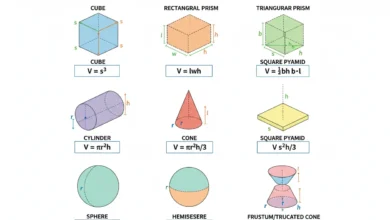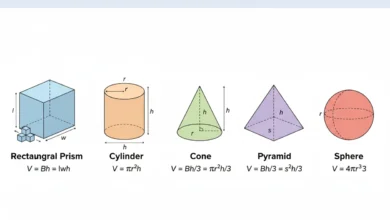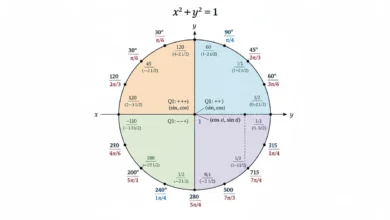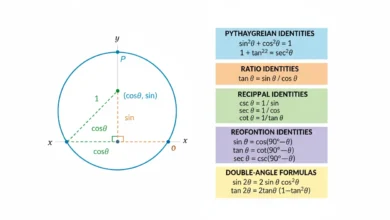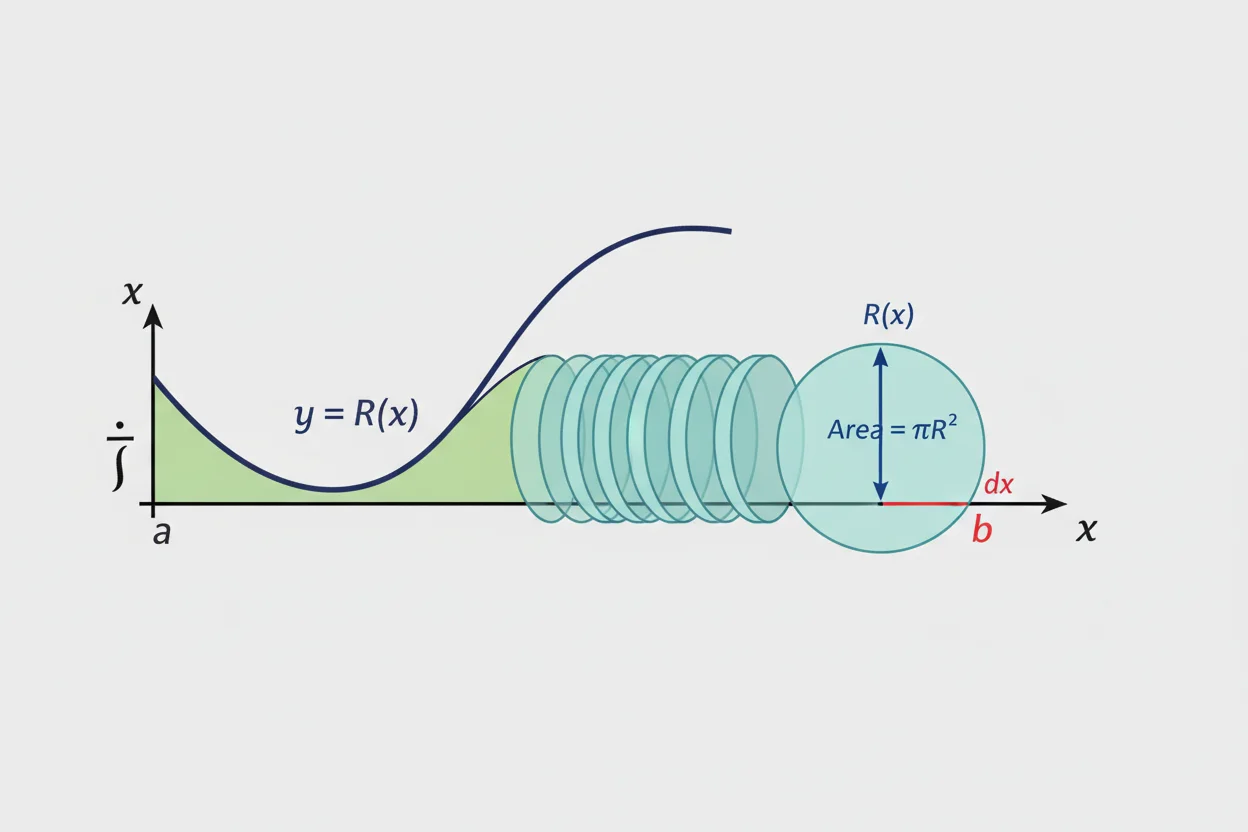

Volume by disks is a calculus method for finding the volume of a solid of revolution by adding thin circular cross sections. When a plane region touches the axis of rotation and each perpendicular slice rotates into a solid circle with no central hole, the disk method applies. A disk with radius R has area πR², so a thin disk with thickness dx contributes approximately π[R(x)]²dx of volume. Adding all the disks produces the formula V = π∫[R(x)]²dx. The radius is always the perpendicular distance from the generating boundary to the axis of rotation. If the slices instead contain a central hole, the appropriate cross-section is a washer rather than a disk. Correctly identifying the axis, slice orientation, radius, bounds, and integration variable is therefore the essential part of a volume by disks problem.
What Is the Disk Method?
Suppose a region lies between:
y = f(x)
and the x-axis for:
a ≤ x ≤ b
Rotate the region around the x-axis.
A vertical slice of the region has height:
f(x)
When rotated around the x-axis, that slice forms a circular disk whose radius is:
R(x) = |f(x)|
The disk area is:
A(x) = π[R(x)]²
A very thin disk has volume approximately:
dV = A(x)dx
Therefore:
dV = π[R(x)]²dx
Integrating across the interval gives the exact volume.
Volume By Disks Formula
The general disk formula is:
V = π∫ₐᵇ [R(x)]² dx
when slices have thickness dx.
If integration is with respect to y:
V = π∫𝚌ᵈ [R(y)]² dy
The radius R is the perpendicular distance from the rotating boundary to the axis.
The formula can also be viewed as a special application of a Definite Integral in which the integrand represents cross-sectional area.
Why the Formula Uses πR²
The area of each disk is the familiar circle-area formula:
A = πR²
If the disk has very small thickness:
Δx
its approximate volume is:
ΔV ≈ πR²Δx
Add many disks:
Σπ[R(xᵢ)]²Δx
As:
Δx → 0
the limiting sum becomes:
V = π∫ₐᵇ[R(x)]²dx
The integral therefore adds infinitely many infinitesimally thin circular cross sections.
Disk Method Around the x-Axis
If:
y = f(x)
and the region between the curve and x-axis is rotated around the x-axis, then:
R(x) = |f(x)|
so:
V = π∫ₐᵇ[f(x)]²dx
because squaring removes the sign.
When f(x) is nonnegative throughout the interval, the radius is simply:
R(x) = f(x)
This is the most common volume by disks setup.
Basic Example: y = x² Around the x-Axis
Find the volume obtained by rotating the region under:
y = x²
from:
x = 0
to:
x = 1
around the x-axis.
The radius is:
R(x) = x²
Therefore:
V = π∫₀¹(x²)²dx
Simplify:
V = π∫₀¹x⁴dx
Integrate:
V = π[x⁵/5]₀¹
So:
V = π/5
The solid has volume:
π/5 cubic unit
Example: y = √x Around the x-Axis
Rotate the region under:
y = √x
for:
0 ≤ x ≤ 4
around the x-axis.
The disk radius is:
R(x) = √x
Therefore:
V = π∫₀⁴(√x)²dx
Since:
(√x)² = x
we obtain:
V = π∫₀⁴x dx
= π[x²/2]₀⁴
= π(16/2)
Therefore:
V = 8π
This example shows why simplifying the squared radius before integrating can make the calculation much easier.
Disk Method Around the y-Axis
When slices are perpendicular to the y-axis, integration is usually performed with respect to y.
Suppose the region is described by:
x = g(y)
and is rotated around the y-axis.
The disk radius is:
R(y) = |g(y)|
Therefore:
V = π∫𝚌ᵈ[g(y)]²dy
where c and d are y-values.
The integration variable should match the thickness of the slices.
Example Around the y-Axis
Rotate the region bounded by:
x = y²
x = 0
and:
0 ≤ y ≤ 2
around the y-axis.
A horizontal slice rotates into a disk.
Its radius is:
R(y) = y²
Therefore:
V = π∫₀²(y²)²dy
= π∫₀²y⁴dy
Integrate:
V = π[y⁵/5]₀²
= π(32/5)
Therefore:
V = 32π/5
Slices Must Be Perpendicular to the Axis
The disk method uses slices perpendicular to the axis of rotation.
For rotation around the x-axis:
vertical slices → dx
are usually natural.
For rotation around the y-axis:
horizontal slices → dy
are usually natural.
The phrase “usually” matters because a curve can sometimes be rewritten in another variable, but the defining geometric feature remains the same:
disk slices are perpendicular to the axis
This distinguishes the method from Volume By Shells, where the slices are parallel to the axis.
Disk Versus Washer
A disk is a filled circle.
A washer is a circular cross section with a hole.
The disk formula is:
A = πR²
The Volume By Washers cross-sectional area is:
A = π(R² − r²)
where:
R = outer radius
r = inner radius
When:
r = 0
the washer formula reduces to:
A = πR²
So the disk method is mathematically a special case of the washer method with zero inner radius.
When to Use Disks Instead of Washers
Use disks when the rotated region reaches the axis of rotation, leaving no central gap.
Suppose the region extends from:
y = 0
to:
y = f(x)
and rotates around:
y = 0
Each slice reaches the axis, so the cross section is filled.
If instead the region lies between:
y = g(x)
and:
y = f(x)
with both curves away from the rotation axis, rotating the slice can create a hole.
That is a washer problem.
Disk Method Around a Shifted Horizontal Axis
Suppose:
y = f(x)
is rotated around:
y = k
The radius is the perpendicular vertical distance:
R(x) = |f(x) − k|
If the region fills all the way from the rotation axis to the boundary, then:
V = π∫ₐᵇ[f(x) − k]²dx
The absolute value is unnecessary after squaring, but using distance first helps ensure the geometry is correct.
Shifted-Axis Example
Suppose the region between:
y = x + 2
and:
y = 1
for:
0 ≤ x ≤ 2
is rotated around:
y = 1
The region touches the rotation axis.
The radius is:
R(x) = (x + 2) − 1
= x + 1
Therefore:
V = π∫₀²(x + 1)²dx
Expand:
(x + 1)² = x² + 2x + 1
So:
V = π[x³/3 + x² + x]₀²
= π(8/3 + 4 + 2)
= π(26/3)
Therefore:
V = 26π/3
Rotation Around a Shifted Vertical Axis
If a region described by:
x = g(y)
rotates around:
x = k
then:
R(y) = |g(y) − k|
provided the region extends from the axis to the curve.
The volume is:
V = π∫[g(y) − k]²dy
Again, use y-bounds because the disks have horizontal thickness dy.
Radius Is a Distance
A reliable way to avoid formula mistakes is to think:
radius = perpendicular distance to axis
For an x-axis rotation:
R = |y|
For a y-axis rotation:
R = |x|
For:
y = k
use:
R = |y − k|
For:
x = k
use:
R = |x − k|
This distance interpretation is more dependable than memorizing a separate formula for every possible rotation axis.
Negative Function Values
Suppose:
f(x) < 0
and the region between f(x) and the x-axis rotates around the x-axis.
The geometric radius is:
|f(x)|
not a negative number.
However:
[|f(x)|]² = [f(x)]²
so the disk formula often appears without an explicit absolute value.
For example, if:
f(x) = −x
then:
R² = (−x)² = x²
The resulting volume remains positive.
Disk Method and Area Under a Curve
The Area Under A Curve formula accumulates linear heights:
A = ∫f(x)dx
The disk method instead accumulates circular cross-sectional areas:
V = π∫[R(x)]²dx
This distinction explains why simply integrating the original curve does not produce the volume of revolution.
The curve determines the radius, but the cross section contributes:
πR²
rather than merely R.
Disk Method and Integrals
The disk method is an application of Integrals rather than a separate kind of accumulation.
The geometry determines:
A(x) = π[R(x)]²
Then ordinary integration adds those areas through the thickness of the solid:
V = ∫A(x)dx
The method therefore follows the general cross-sectional principle:
volume = integral of cross-sectional area
Fundamental Theorem and Disk Volumes
Once the disk integral has been set up correctly, the Fundamental Theorem Of Calculus allows an antiderivative to be evaluated at the bounds.
If:
V = π∫ₐᵇR(x)²dx
and F′(x) = R(x)², then:
V = π[F(b) − F(a)]
The difficult part of many disk problems is therefore identifying R and the correct interval rather than performing the final endpoint subtraction.
Disk Method With Substitution
Some radius formulas produce integrals requiring Integration By Substitution.
For example:
V = π∫2x(x² + 1)³dx
might arise after simplifying a cross-sectional area in a more complicated model.
Let:
u = x² + 1
Then:
du = 2x dx
The geometric setup and the integration technique are separate decisions.
First construct the correct disk area; then choose an integration method based on the resulting integrand.
Piecewise Disk Integrals
A single formula may not describe the radius throughout an entire solid.
Suppose one curve determines the outer boundary for:
a ≤ x ≤ c
and another determines it for:
c ≤ x ≤ b
Then split the volume:
V = π∫ₐᶜR₁(x)²dx + π∫𝚌ᵇR₂(x)²dx
Piecewise integration is preferable to forcing an incorrect radius expression over the full interval.
Intersection points often determine where the formula changes.
Finding Bounds From Curve Intersections
Suppose a region is bounded by two curves whose intersections determine the start and end of the rotating region.
Solve:
f(x) = g(x)
to find the appropriate x-values.
Those values become potential integration bounds.
This is similar to the setup used for Area Between Curves, although the disk method converts the relevant distance to the axis into a squared circular radius.
Disk Method Versus Shell Method
The disk method uses slices perpendicular to the rotation axis.
The shell method uses slices parallel to it.
For rotation around the y-axis, a disk approach may require rewriting:
y = f(x)
as:
x = g(y)
A shell approach can often keep the original x-variable.
That makes Volume By Shells more efficient for some solids.
The two methods can produce the same volume through different integrals.
Example Where Shells May Be Easier
Consider the region under:
y = x²
for:
0 ≤ x ≤ 1
rotated around the y-axis.
Using disks requires writing:
x = √y
and integrating with respect to y.
Using shells keeps:
y = x²
and forms:
radius = x
height = x²
Neither method is mathematically more correct; efficiency depends on which representation is simpler.
Disk Method Versus Surface Area
Surface Area Of Revolution measures the rotating boundary rather than the volume of the interior.
Its characteristic formula is:
S = 2π∫R ds
The disk volume formula is:
V = π∫R²dx
The surface formula contains an arc-length factor.
The volume formula contains the area of each filled circular cross section.
Confusing the two can produce answers with the wrong dimensions.
Disk Method Versus Triple Integral
A Triple Integral can also calculate a solid’s volume:
V = ∭ᴱdV
The disk method exploits rotational symmetry to reduce the same type of three-dimensional volume problem to one integral:
V = π∫R²dx
When a solid is naturally generated by rotation and has simple circular cross sections, the disk method is usually more efficient.
Triple integration becomes valuable for more general solids or quantities varying through all three spatial coordinates.
Disk Geometry and Vector Magnitude
In standard coordinate-axis problems, the disk radius is usually an ordinary coordinate distance.
In more general geometric settings, distance can be interpreted through Vector Magnitude.
For example, the length of a displacement vector measures a point-to-point distance.
The disk method itself does not require a vector norm for ordinary x- or y-axis rotation, but both ideas rely on radius being a nonnegative geometric distance.
Disk Geometry and Vector Projection
For a general line or direction, the perpendicular distance to an axis can be understood through Vector Projection and a perpendicular component.
Standard disk problems avoid this additional machinery because the rotation axis is usually:
x-axis
y-axis
y = k
or:
x = k
In those cases, coordinate differences give the radius directly.
Disk Method and Vector Operations
The ordinary disk formula is a scalar integration calculation rather than a Vector Operations problem.
This matters because:
radius
area
and:
volume
are scalar quantities.
Vectors can describe positions or directions in more general geometry, but the final disk cross-sectional area remains:
πR²
where R is a scalar distance.
Units of a Disk Volume
Suppose x and R are measured in centimeters.
Then:
R²
has units:
cm²
The differential:
dx
has units:
cm
Therefore:
πR²dx
has units:
cm³
The final answer is a volume.
If a disk-method calculation produces only square units, the thickness factor or integration variable has likely been omitted.
Checking a Disk-Method Answer
First identify the axis of rotation.
Then verify that each perpendicular slice becomes a filled disk rather than a washer.
Check:
radius = distance to axis
Confirm that the radius is squared.
Make sure the bounds correspond to the integration variable.
Finally, check that the answer has cubic units and is nonnegative.
If the generated solid has a familiar geometric form, compare the integral with the known volume formula.
Common Volume By Disks Mistakes
A frequent mistake is using the original function as the integrand without squaring the radius.
The correct cross-sectional area is:
πR²
not:
πR
Another error is using disks when the rotated cross section has a central hole. That requires washers.
Slices must be perpendicular to the axis.
The radius should be measured from the rotation axis, especially when the axis is shifted away from x = 0 or y = 0.
If integrating with respect to y, use y-bounds and express the radius as a function of y.
Do not automatically include absolute values inside a squared radius if they unnecessarily complicate the expression, but always determine the geometric radius as a nonnegative distance first.
Finally, verify whether one radius formula works throughout the interval or whether the solid requires a piecewise setup.
Frequently Asked Questions
What is volume by disks?
Volume by disks finds the volume of a solid of revolution by integrating the areas of thin filled circular cross sections.
What is the disk method formula?
V = π∫ₐᵇ[R(x)]²dx
or:
V = π∫𝚌ᵈ[R(y)]²dy
depending on the slicing variable.
When should I use the disk method?
Use it when slices perpendicular to the rotation axis create filled circles with no central hole.
How do I find the radius?
Use the perpendicular distance from the generating boundary to the rotation axis.
What is the radius around the x-axis?
For y = f(x):
R = |f(x)|
when the other boundary is the x-axis.
What is the difference between a disk and a washer?
A disk has no central hole. A washer has outer and inner radii.
What happens if the inner radius is zero?
The washer formula reduces to the disk formula.
Should disk slices be parallel or perpendicular to the axis?
Perpendicular.
Can I use the disk method around the y-axis?
Yes. Horizontal slices and integration with respect to y are often used.
What if the rotation axis is y = k?
Measure:
R = |f(x) − k|
when the region extends from that axis to the generating curve.
Why is the radius squared?
Each cross section is a circle with area:
πR²
Does the disk formula calculate surface area?
No. It calculates volume. Surface area of revolution uses a different formula involving arc length.
How can I check a disk-method setup?
Confirm the slice creates a filled circle, measure the perpendicular radius from the axis, square it, use the matching bounds, and check that the final units are cubic.