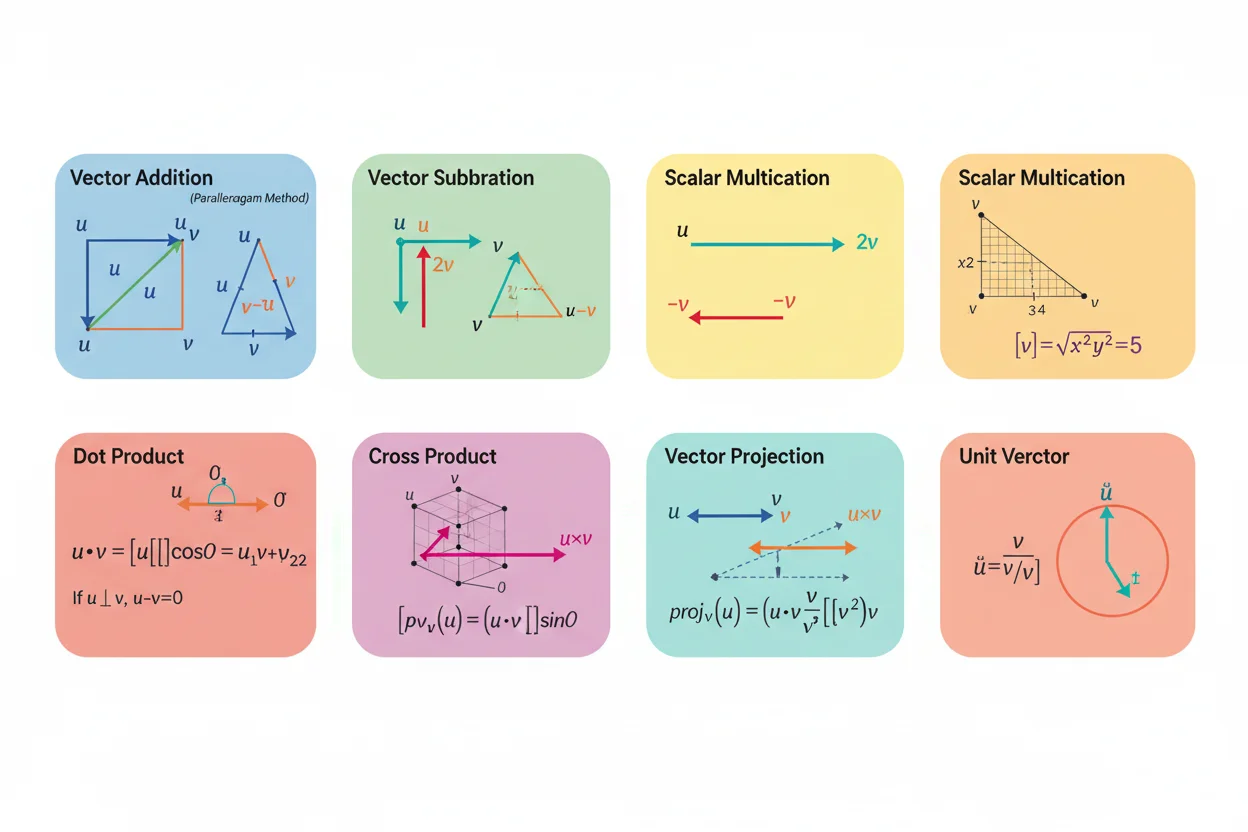

Vector operations are mathematical procedures used to combine, transform, compare, and analyze vectors. The most common vector operations include addition, subtraction, scalar multiplication, magnitude, dot product, cross product, and projection. If u = (u₁, u₂) and v = (v₁, v₂), their sum is u + v = (u₁ + v₁, u₂ + v₂), while subtraction is performed component by component. Multiplying a vector by a scalar changes its magnitude and may reverse its direction. Other operations produce scalar quantities rather than vectors; for example, the dot product u·v is a scalar that measures directional alignment. Vector operations provide the algebra behind geometry, forces, velocity, linear transformations, gradients, line integrals, projections, and multidimensional calculations. The key to using them correctly is identifying the type of output expected—vector or scalar—and applying the corresponding component formula.
What Are Vector Operations?
A vector can be represented by components such as:
v = (v₁, v₂)
in two dimensions or:
v = (v₁, v₂, v₃)
in three dimensions.
Vector operations perform calculations using these components while preserving or extracting geometric information.
Common operations include:
vector addition
vector subtraction
scalar multiplication
vector magnitude
normalization
dot product
cross product
vector projection
These operations serve different purposes.
Addition combines displacements or effects. Magnitude measures length. A dot product measures alignment, while a cross product constructs a perpendicular vector in three dimensions.
The broader framework is closely tied to Calculus & Linear Algebra, where vectors are used to represent coordinates, directions, rates, and transformations.
Vector Addition Formula
If:
u = (u₁, u₂)
and:
v = (v₁, v₂)
then:
u + v = (u₁ + v₁, u₂ + v₂)
In three dimensions:
u = (u₁, u₂, u₃)
v = (v₁, v₂, v₃)
so:
u + v = (u₁ + v₁, u₂ + v₂, u₃ + v₃)
Corresponding components are added.
Vector Addition Example
Let:
u = (3, 5)
and:
v = (−1, 4)
Then:
u + v = (3 − 1, 5 + 4)
= (2, 9)
Therefore:
u + v = (2, 9)
The result is another vector.
Geometric Meaning of Vector Addition
Vector addition can be interpreted geometrically with the head-to-tail method.
Draw u first.
Then place the tail of v at the head of u.
The resultant vector extends from the starting point of u to the ending point of v.
Another interpretation is the parallelogram rule. When u and v begin at the same point, they form adjacent sides of a parallelogram, and:
u + v
is its diagonal.
This makes vector addition useful for combining forces, velocities, and displacements.
Properties of Vector Addition
Vector addition is commutative:
u + v = v + u
It is also associative:
(u + v) + w = u + (v + w)
The zero vector acts as an additive identity:
v + 0 = v
Every vector has an additive inverse:
v + (−v) = 0
These properties closely resemble ordinary number addition.
Vector Subtraction Formula
Vector subtraction is performed component by component.
For:
u = (u₁, u₂)
and:
v = (v₁, v₂)
we have:
u − v = (u₁ − v₁, u₂ − v₂)
Equivalently:
u − v = u + (−v)
Subtracting v therefore means adding its opposite vector.
Vector Subtraction Example
Let:
u = (7, 2)
and:
v = (3, −4)
Then:
u − v = (7 − 3, 2 − (−4))
= (4, 6)
Therefore:
u − v = (4, 6)
The second component increases because subtracting −4 is equivalent to adding 4.
Vector Between Two Points
Subtraction is especially important for constructing displacement vectors.
Suppose:
P = (x₁, y₁)
and:
Q = (x₂, y₂)
The vector from P to Q is:
PQ = Q − P
so:
PQ = (x₂ − x₁, y₂ − y₁)
For:
P = (1, 3)
and:
Q = (6, 7)
we get:
PQ = (5, 4)
This vector records both the direction and displacement needed to move from P to Q.
Scalar Multiplication
A scalar is an ordinary number.
If:
c
is a scalar and:
v = (v₁, v₂, …, vₙ)
then:
cv = (cv₁, cv₂, …, cvₙ)
Every vector component is multiplied by c.
For example:
v = (2, −3)
and:
c = 4
give:
4v = (8, −12)
Geometric Effect of Scalar Multiplication
If:
c > 1
the vector becomes longer while retaining its direction.
If:
0 < c < 1
the vector becomes shorter.
If:
c < 0
the vector reverses direction and its magnitude is scaled by |c|.
If:
c = 0
the result is:
0
For example:
−2(3, 4) = (−6, −8)
The direction reverses and the length doubles.
Vector Magnitude
The Vector Magnitude measures vector length.
For:
v = (a, b)
the magnitude is:
|v| = √(a² + b²)
For:
v = (a, b, c)
use:
|v| = √(a² + b² + c²)
For example:
v = (3, 4)
has:
|v| = √(9 + 16)
= 5
Magnitude produces a scalar rather than another vector.
Magnitude After Scalar Multiplication
Magnitude obeys:
|cv| = |c||v|
Suppose:
|v| = 5
and:
c = −3
Then:
|−3v| = 3(5)
= 15
The negative scalar reverses direction, but geometric length remains positive.
Unit Vectors
A unit vector has magnitude 1.
A nonzero vector v can be normalized using:
u = v/|v|
For:
v = (3, 4)
we have:
|v| = 5
so:
u = (3/5, 4/5)
Check:
|u| = √[(3/5)² + (4/5)²]
= 1
Normalization separates direction from magnitude.
Standard Unit Vectors
In Cartesian coordinates, common unit vectors are:
i = (1, 0, 0)
j = (0, 1, 0)
k = (0, 0, 1)
A vector:
v = (a, b, c)
can therefore be written:
v = ai + bj + ck
This representation makes the coordinate directions explicit.
Dot Product
The Dot Product takes two vectors and produces a scalar.
For:
u = (u₁, u₂, …, uₙ)
and:
v = (v₁, v₂, …, vₙ)
the formula is:
u·v = u₁v₁ + u₂v₂ + … + uₙvₙ
For two-dimensional vectors:
u·v = u₁v₁ + u₂v₂
Dot Product Example
Let:
u = (2, 3)
and:
v = (4, −1)
Then:
u·v = 2(4) + 3(−1)
= 8 − 3
= 5
The result:
5
is a scalar.
Geometric Meaning of the Dot Product
The dot product also satisfies:
u·v = |u||v|cosθ
where θ is the angle between two nonzero vectors.
Therefore:
cosθ = (u·v)/(|u||v|)
The sign of the dot product gives directional information.
If:
u·v > 0
the angle is acute.
If:
u·v = 0
the vectors are perpendicular.
If:
u·v < 0
the angle is obtuse.
Orthogonal Vectors
Two nonzero vectors are orthogonal when:
u·v = 0
For example:
u = (1, 2)
v = (−2, 1)
Then:
u·v = 1(−2) + 2(1)
= 0
Therefore the vectors are perpendicular.
Orthogonality is fundamental to projections, coordinate systems, and basis construction.
Vector Projection
Vector Projection determines the component of one vector that points along another.
The projection of a onto a nonzero vector b is:
proj_b a = (a·b / |b|²)b
This produces a vector parallel to b.
The scalar component is:
comp_b a = a·b / |b|
Projection uses both the dot product and magnitude, making it a natural combination of several vector operations.
Projection Example
Let:
a = (3, 4)
and:
b = (1, 0)
Then:
a·b = 3
and:
|b|² = 1
Therefore:
proj_b a = 3(1, 0)
= (3, 0)
The remaining perpendicular component is:
a − proj_b a
= (3, 4) − (3, 0)
= (0, 4)
Thus a has been decomposed into horizontal and vertical components.
Cross Product
The Cross Product is defined for three-dimensional vectors and produces a vector perpendicular to both inputs.
For:
u = (u₁, u₂, u₃)
and:
v = (v₁, v₂, v₃)
the formula is:
u × v
= (u₂v₃ − u₃v₂, u₃v₁ − u₁v₃, u₁v₂ − u₂v₁)
Unlike the dot product, the cross product returns a vector.
Cross Product Example
Let:
u = (1, 0, 0)
and:
v = (0, 1, 0)
Then:
u × v = (0, 0, 1)
so:
i × j = k
Reversing the order gives:
j × i = −k
Therefore the cross product is not commutative.
Instead:
u × v = −(v × u)
Cross Product Magnitude
The magnitude satisfies:
|u × v| = |u||v|sinθ
This quantity equals the area of the parallelogram spanned by u and v.
The triangle with the same two side vectors has area:
1/2 |u × v|
Thus the cross product combines direction and area geometry.
Dot Product Versus Cross Product
The dot product produces:
a scalar
The cross product produces:
a vector
The dot product is linked to:
cosθ
while the cross-product magnitude is linked to:
sinθ
The dot product is zero for perpendicular vectors.
The cross product is zero for parallel or antiparallel vectors.
Identifying the desired output is usually enough to determine which operation a problem requires.
Linear Combinations
A linear combination of vectors has form:
c₁v₁ + c₂v₂ + … + cₖvₖ
where the c-values are scalars.
For example:
2(1, 3) − 4(2, −1)
gives:
(2, 6) − (8, −4)
= (−6, 10)
Linear combinations are central to Basis And Dimension because a span consists of all possible linear combinations of a chosen vector set.
Vector Operations and Linear Transformations
A Linear Transformation respects vector addition and scalar multiplication:
T(u + v) = T(u) + T(v)
and:
T(cv) = cT(v)
These two properties explain why vector addition and scalar multiplication are the foundational operations of linear algebra.
If a transformation is represented by matrix A:
T(v) = Av
then Matrix Multiplication converts vector coordinates into the transformed coordinates.
Example of a Matrix Acting on a Vector
Let:
A = [ 2 0 ]
[ 0 3 ]
and:
v = (4, 5)
Then:
Av = (8, 15)
The transformation doubles the first vector component and triples the second.
The vector-operation viewpoint describes the input and output geometrically, while matrix multiplication performs the coordinate calculation.
Vector Operations and the Gradient
The Gradient is itself a vector:
∇f = (fₓ, fᵧ, …)
Its magnitude measures the maximum local directional rate of increase.
Its direction identifies steepest ascent.
Vector normalization, magnitude, and dot products therefore become essential when interpreting gradients.
Directional Derivatives
For a differentiable scalar function and unit direction u, the Directional Derivative is:
Dᵤf = ∇f · u
This calculation combines several vector operations.
First normalize the desired direction if necessary.
Then calculate the dot product with the gradient.
The result is a scalar rate of change in that direction.
Directional Derivative Example
Suppose:
∇f = (6, 8)
and the direction is:
v = (3, 4)
First find:
|v| = 5
so the unit vector is:
u = (3/5, 4/5)
Then:
Dᵤf = (6, 8)·(3/5, 4/5)
= 18/5 + 32/5
= 10
The rate is 10 per unit distance in that direction.
Vector Operations in Line Integrals
A vector Line Integral commonly contains:
F · dr
After parameterization:
∫꜀ F·dr
becomes:
∫ F(r(t)) · r′(t) dt
The dot product extracts the component of the vector field acting along the path direction.
Vector operations therefore directly determine quantities such as mechanical work and circulation.
Vector Magnitude in Arc Length
For a parameterized curve:
r(t)
its Arc Length uses:
L = ∫|r′(t)|dt
The vector:
r′(t)
is tangent to the curve.
Its magnitude is the speed at which the curve is traversed.
Thus vector differentiation and magnitude convert parameter change into actual path distance.
Vector Operations and Triple Integrals
A Triple Integral is primarily a scalar accumulation tool, but vector concepts often help describe its geometry.
For example:
√(x² + y² + z²)
is the magnitude of the position vector and becomes the radial coordinate in spherical descriptions.
Vector fields can also supply quantities whose components or magnitudes are integrated throughout a three-dimensional region.
The integral and vector operations play different roles but frequently occur in the same multivariable model.
Vector Operations and Surface Area of Revolution
A parameterized Surface Area Of Revolution uses:
ds = |r′(t)|dt
so the vector magnitude of the tangent vector contributes directly to the surface-area element.
The complete surface formula can be written:
S = 2π∫ radius(t)|r′(t)|dt
This is another example of vector operations supplying geometric quantities used by calculus.
Vector Operations and Volume by Disks
Volume By Disks is an integration method rather than a vector operation, but both rely on interpreting coordinates and distances geometrically.
A disk radius is a scalar distance from an axis.
A vector magnitude similarly converts coordinate components into a distance.
Keeping those concepts distinct is important: vector operations manipulate vectors and scalars, while the disk method accumulates cross-sectional areas to obtain volume.
Vector Operations and Vector Projection
The mapped Vector Projection page specializes one particularly important combination of vector operations:
dot product
magnitude
scalar multiplication
Projection answers:
how much of a lies in the direction of b?
The broader vector-operations framework explains the individual tools, while projection combines them into a directional decomposition.
Scalar Output Versus Vector Output
Different operations produce different types of answers.
Vector addition:
vector + vector → vector
Vector subtraction:
vector − vector → vector
Scalar multiplication:
scalar × vector → vector
Magnitude:
vector → scalar
Dot product:
vector · vector → scalar
Cross product:
vector × vector → vector
Projection:
vector onto vector → vector
Recognizing the output type can prevent many formula-selection mistakes.
Component Form Versus Geometric Form
Many vector operations have both component and geometric formulas.
For the dot product:
u·v = Σuᵢvᵢ
and:
u·v = |u||v|cosθ
The first is useful when coordinates are given.
The second is useful when lengths and angles are known.
Likewise, vector magnitude can be computed from components or understood geometrically as length.
Moving between the two viewpoints is one of the main strengths of vector algebra.
Common Vector Operations Mistakes
A common mistake is adding or subtracting vector components in mismatched positions. Corresponding coordinates must be combined.
Scalar multiplication must affect every component.
Vector magnitude requires squaring components, adding them, and taking the square root; simply adding absolute component values gives a different norm.
The dot product returns a scalar, while the cross product returns a vector.
The cross product order matters:
u × v = −(v × u)
A direction vector should normally be normalized before using it in a directional derivative.
For projection, divide by:
|b|²
when projecting onto a nonunit vector b.
Finally, the zero vector cannot be normalized because division by its magnitude would require division by zero.
Frequently Asked Questions
What are vector operations?
Vector operations are procedures for combining or analyzing vectors, including addition, subtraction, scalar multiplication, magnitude, dot product, cross product, and projection.
How do you add two vectors?
Add corresponding components:
(a, b) + (c, d) = (a + c, b + d)
How do you subtract vectors?
Subtract corresponding components:
(a, b) − (c, d) = (a − c, b − d)
What is scalar multiplication?
For scalar k:
k(a, b) = (ka, kb)
How do you calculate vector magnitude?
For:
v = (a, b)
use:
|v| = √(a² + b²)
What is a unit vector?
A unit vector has magnitude 1. Normalize a nonzero vector with:
u = v/|v|
What does the dot product return?
It returns a scalar:
u·v = Σuᵢvᵢ
What does the cross product return?
In three dimensions it returns a vector perpendicular to both input vectors.
When are two vectors perpendicular?
For nonzero vectors:
u·v = 0
What is vector projection?
It is the component of one vector parallel to another:
proj_b a = (a·b/|b|²)b
Does vector addition obey the commutative law?
Yes:
u + v = v + u
Does the cross product obey the commutative law?
No:
u × v = −(v × u)
What is a linear combination of vectors?
It is an expression such as:
c₁v₁ + c₂v₂ + … + cₙvₙ
How can I check vector operations?
Confirm the dimensions match, perform component arithmetic carefully, identify whether the expected answer is a vector or scalar, and use geometric properties such as magnitude, orthogonality, or direction as secondary checks.