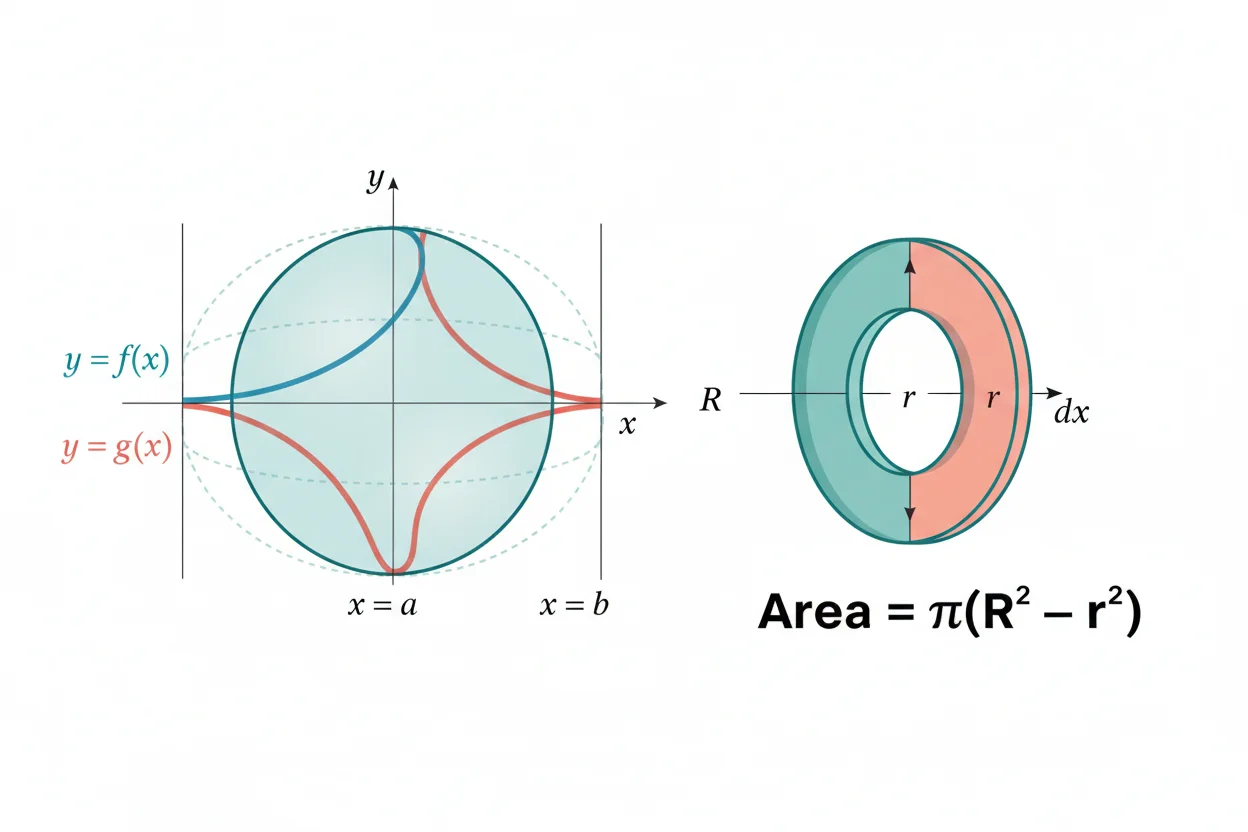

Volume by washers is a calculus method for finding the volume of a solid of revolution when perpendicular cross sections contain a central hole. Each slice rotates into a washer, or annulus, with an outer radius R and an inner radius r. The washer’s area is π(R² − r²), so integrating these cross-sectional areas gives V = π∫(R² − r²)d(variable). The outer radius is the distance from the rotation axis to the farther boundary, while the inner radius is the distance to the nearer boundary. Both radii must be measured from the actual axis of rotation rather than automatically from the x-axis or y-axis. If the inner radius is zero, the washer becomes a filled disk and the formula reduces to the disk method. The main challenge in a washer problem is therefore identifying the correct slicing direction, radii, bounds, and integration variable before carrying out the integral.
What Is the Washer Method?
Suppose a planar region is rotated around an axis.
If a slice perpendicular to that axis does not touch the axis, its rotation leaves an empty circular center.
The resulting cross section resembles a washer.
Its area equals:
outer circle area − inner circle area
Therefore:
A = πR² − πr²
Factor π:
A = π(R² − r²)
If the washer has infinitesimal thickness dx:
dV = π(R² − r²)dx
Adding all washers gives the solid’s volume.
Volume By Washers Formula
For slices with thickness dx:
V = π∫ₐᵇ [R(x)² − r(x)²] dx
For slices with thickness dy:
V = π∫𝚌ᵈ [R(y)² − r(y)²] dy
where:
R = outer radius
r = inner radius
and:
R ≥ r ≥ 0
throughout the interval.
This is an application of a Definite Integral to cross-sectional area.
Outer Radius and Inner Radius
The outer radius is the greater distance from the rotation axis to a boundary of the region.
The inner radius is the smaller distance.
For example, suppose the region between:
y = f(x)
and:
y = g(x)
lies above the x-axis, with:
f(x) ≥ g(x) ≥ 0
If it rotates around the x-axis:
R(x) = f(x)
and:
r(x) = g(x)
Therefore:
V = π∫ₐᵇ[f(x)² − g(x)²]dx
The subtraction order matters because cross-sectional area must remain nonnegative.
Basic Washer Example
Find the volume obtained by rotating the region between:
y = 3
and:
y = 1
for:
0 ≤ x ≤ 4
around the x-axis.
The outer radius is:
R = 3
The inner radius is:
r = 1
Therefore:
V = π∫₀⁴(3² − 1²)dx
= π∫₀⁴(9 − 1)dx
= 8π∫₀⁴dx
= 8π(4)
Thus:
V = 32π
This matches the volume of a cylindrical tube with outer radius 3, inner radius 1, and length 4.
Why the Formula Subtracts Areas
The outer rotation creates a circular cross section:
πR²
But the center from radius 0 to r is missing.
That empty region has area:
πr²
Therefore the actual material cross section is:
πR² − πr²
or:
π(R² − r²)
Subtracting radii before squaring would be wrong:
π(R − r)²
does not equal:
π(R² − r²)
in general.
Washer Versus Disk
A washer has:
r > 0
A disk has:
r = 0
If:
r = 0
then:
π(R² − r²)
becomes:
πR²
which is exactly the Volume By Disks formula.
So disks are a special case of washers.
The distinction is geometric: does the rotated cross section contain an empty center?
Washer Example With Two Curves
Rotate the region between:
y = x + 2
and:
y = x
for:
0 ≤ x ≤ 2
around the x-axis.
Both curves lie above the rotation axis.
The farther curve is:
y = x + 2
so:
R(x) = x + 2
The nearer curve is:
y = x
so:
r(x) = x
Therefore:
V = π∫₀²[(x + 2)² − x²]dx
Expand:
(x + 2)² − x²
= x² + 4x + 4 − x²
= 4x + 4
Thus:
V = π∫₀²(4x + 4)dx
= π[2x² + 4x]₀²
= π(8 + 8)
Therefore:
V = 16π
Washer Method Around the y-Axis
If perpendicular slices are horizontal, integration is performed with respect to y.
Suppose a region lies between:
x = f(y)
and:
x = g(y)
with:
f(y) ≥ g(y) ≥ 0
and rotates around the y-axis.
Then:
R(y) = f(y)
r(y) = g(y)
so:
V = π∫[f(y)² − g(y)²]dy
The bounds must be y-values because the washer thickness is dy.
Example Around the y-Axis
Rotate the region between:
x = 3
and:
x = y
for:
1 ≤ y ≤ 2
around the y-axis.
The outer radius is:
R = 3
The inner radius is:
r = y
Therefore:
V = π∫₁²(9 − y²)dy
Integrate:
V = π[9y − y³/3]₁²
At y = 2:
18 − 8/3 = 46/3
At y = 1:
9 − 1/3 = 26/3
Subtract:
46/3 − 26/3 = 20/3
Therefore:
V = 20π/3
Slices Must Be Perpendicular to the Axis
Washers and disks use slices perpendicular to the axis of rotation.
Around a horizontal axis:
vertical slices → dx
are commonly used.
Around a vertical axis:
horizontal slices → dy
This distinguishes washers from Volume By Shells, where the generating slices are parallel to the rotation axis.
The slicing direction is one of the quickest ways to distinguish the methods.
Washer Method Around y = k
Suppose a region between:
y = f(x)
and:
y = g(x)
rotates around the horizontal line:
y = k
The radii must be measured from y = k.
For example:
distance from f(x) to axis = |f(x) − k|
distance from g(x) to axis = |g(x) − k|
The larger distance is R.
The smaller is r.
Therefore:
V = π∫[R(x)² − r(x)²]dx
The curve that is “higher” is not automatically the outer radius when the rotation axis is shifted.
Shifted-Axis Example
Rotate the region between:
y = 5
and:
y = 3
for:
0 ≤ x ≤ 4
around:
y = 1
Distance from y = 5 to the axis:
R = 5 − 1 = 4
Distance from y = 3 to the axis:
r = 3 − 1 = 2
Therefore:
V = π∫₀⁴(4² − 2²)dx
= π∫₀⁴(16 − 4)dx
= 12π(4)
Thus:
V = 48π
Using radii 5 and 3 would incorrectly measure from the x-axis instead of the actual axis y = 1.
Washer Method Around x = k
For a vertical rotation axis:
x = k
and horizontal slices:
R(y) = farther horizontal distance to x = k
r(y) = nearer horizontal distance
Therefore:
V = π∫[R(y)² − r(y)²]dy
Again, radius means perpendicular distance.
Thinking in terms of distance rather than memorized coordinates prevents most shifted-axis mistakes.
The Outer Curve May Change
Sometimes one boundary is farther from the axis on one part of the interval, while another is farther elsewhere.
Then the washer setup must be split.
Suppose the outer radius changes at:
x = c
Then:
V = π∫ₐᶜ[R₁² − r₁²]dx + π∫𝚌ᵇ[R₂² − r₂²]dx
A single formula should not be forced across an interval where the geometry changes.
Finding Bounds From Intersections
When a region is bounded by two curves, solve:
f(x) = g(x)
to locate intersections.
These values often provide the integration bounds.
The logic resembles an Area Between Curves problem, but after identifying the distances, each radius is squared before subtraction.
The order becomes:
outer² − inner²
not:
top − bottom
Example With Intersecting Curves
Suppose:
y = 2
and:
y = x²
intersect at:
x = ±√2
If the enclosed region rotates around the x-axis, the outer radius is:
R = 2
and the inner radius is:
r = x²
Therefore:
V = π∫₋√2^√2(4 − x⁴)dx
Because the integrand is even:
V = 2π∫₀^√2(4 − x⁴)dx
This symmetry can simplify evaluation.
Washer Method and Symmetry
If:
R(−x) = R(x)
and:
r(−x) = r(x)
then:
R² − r²
is even.
For symmetric bounds:
[−a, a]
you may write:
V = 2π∫₀ᵃ(R² − r²)dx
Using symmetry can reduce arithmetic and lower the risk of sign errors.
Washer Formula as Cross-Sectional Integration
The broader volume principle is:
V = ∫A(x)dx
For washers:
A(x) = π[R(x)² − r(x)²]
Therefore:
V = ∫π(R² − r²)dx
The washer method is therefore not an unrelated formula. It is a specific cross-sectional application of Integrals.
Washer Method and the Fundamental Theorem
Once the integral is correctly constructed, the Fundamental Theorem Of Calculus converts the definite integral into endpoint evaluation.
If:
F′(x) = R(x)² − r(x)²
then:
V = π[F(b) − F(a)]
The geometry determines the integrand; the theorem evaluates its accumulation.
Washer Integrals Requiring Substitution
Some washer formulas produce composite expressions.
Suppose:
V = π∫2x[(x² + 1)³ − 1]dx
The integral can be simplified using Integration By Substitution:
u = x² + 1
du = 2x dx
The integration method should be chosen only after the correct washer geometry has been established.
Washer Method Versus Shell Method
The washer method uses slices perpendicular to the rotation axis.
The shell method uses slices parallel to it.
For a region expressed naturally as:
y = f(x)
and rotated around the y-axis, washers may require solving for:
x = g(y)
while shells can often integrate directly with respect to x.
That can make shells much simpler.
In another problem, washers may avoid a complicated shell height.
The methods are alternative descriptions of the same solid, not competing definitions of volume.
Washer Method Versus Disk Method
Volume By Disks uses a single radius:
V = π∫R²dx
Washers use two:
V = π∫(R² − r²)dx
If the region touches the axis throughout the slice:
r = 0
and the washer becomes a disk.
This provides a quick method-selection test.
Washer Method Versus Surface Area
Surface Area Of Revolution measures the rotating boundary, not the interior volume.
Its formula includes an arc-length factor:
S = 2π∫r ds
Washers instead use cross-sectional area:
V = π∫(R² − r²)dx
Surface area produces square units.
Washer volume produces cubic units.
Washer Method Versus Triple Integral
A Triple Integral can calculate the same three-dimensional volume through:
V = ∭ᴱdV
The washer method exploits rotational symmetry and compresses the problem into one integral.
For a simple solid of revolution, washers are generally more efficient.
Triple integration becomes more useful when density or another integrand varies independently through three spatial dimensions.
Washer Radii and Vector Magnitude
A washer radius is fundamentally a distance.
For coordinate-axis rotations, that distance is usually a simple coordinate difference.
The general concept of distance is connected with Vector Magnitude.
For example, the Euclidean length of a displacement vector gives point-to-point distance.
Ordinary washer calculations rarely need the full vector formula because the perpendicular distance to a horizontal or vertical axis is directly available from one coordinate.
Washer Geometry and Vector Projection
For an arbitrary non-axis-aligned rotation line, perpendicular distance can be interpreted using Vector Projection.
A displacement vector can be decomposed into:
parallel component
and:
perpendicular component
The magnitude of the perpendicular component gives distance to the line.
Standard washer problems usually use horizontal or vertical axes, making this extra vector machinery unnecessary, but the geometric concept is the same.
Washer Geometry and Vector Operations
The washer formula itself uses scalar quantities rather than Vector Operations.
R and r are lengths.
Their squares determine circular areas.
The integral accumulates those scalar areas through a scalar thickness.
Vectors may describe more general spatial geometry, but ordinary washer calculations reduce the relevant information to distances.
Units of Washer Volume
If R, r, and x are measured in meters:
R² − r²
has units:
m²
Multiplying by:
dx
produces:
m³
Thus:
π(R² − r²)dx
has volume units.
A result in square units signals that the cross-sectional area was not integrated through a thickness correctly.
Checking a Washer Setup
Before integrating, verify:
slice is perpendicular to the axis
R = farther distance from axis
r = nearer distance from axis
R ≥ r
both radii use the same axis
bounds match dx or dy
cross-sectional area is π(R² − r²)
The final result should be nonnegative and have cubic units.
Common Volume By Washers Mistakes
A common error is using:
π(R − r)²
instead of:
π(R² − r²)
Another is reversing the radii and obtaining a negative integrand.
The outer radius is determined by distance from the axis, not simply by which curve is visually above or farther right.
Shifted axes require subtracting the axis coordinate.
Washers use slices perpendicular to the rotation axis.
If the inner radius is zero, the problem is more simply described as a disk problem.
If radii change roles across the region, split the integral.
Finally, never square the difference between the curves unless that difference genuinely represents one radius. Square the outer and inner radii separately.
Frequently Asked Questions
What is volume by washers?
Volume by washers finds the volume of a solid of revolution by integrating ring-shaped cross-sectional areas.
What is the washer formula?
V = π∫(R² − r²)d(variable)
where R is the outer radius and r is the inner radius.
How do I identify the outer radius?
It is the greater perpendicular distance from the rotation axis to the region’s boundary.
What is the inner radius?
It is the smaller perpendicular distance from the axis to the region.
Why do you subtract r² from R²?
Because a washer’s area is the area of the outer circle minus the area of its central hole.
Is the formula π(R − r)²?
No. The correct formula is:
π(R² − r²)
What happens if r = 0?
The washer becomes a disk and the formula reduces to:
V = π∫R²d(variable)
Are washer slices parallel or perpendicular to the rotation axis?
Perpendicular.
Can washers be used around the y-axis?
Yes. Horizontal slices and integration with respect to y are commonly used.
How do shifted rotation axes affect the radii?
Measure both radii from the actual axis, such as:
|f(x) − k|
for rotation around y = k.
When should I use shells instead?
Shells may be simpler when parallel slices allow you to keep the functions in their original variable or avoid complicated washer radii.
Does the washer method calculate surface area?
No. It calculates volume.
How can I check a washer-method answer?
Confirm the radii are measured from the same axis, verify R ≥ r, check the slice direction and bounds, and make sure the final answer has cubic units.