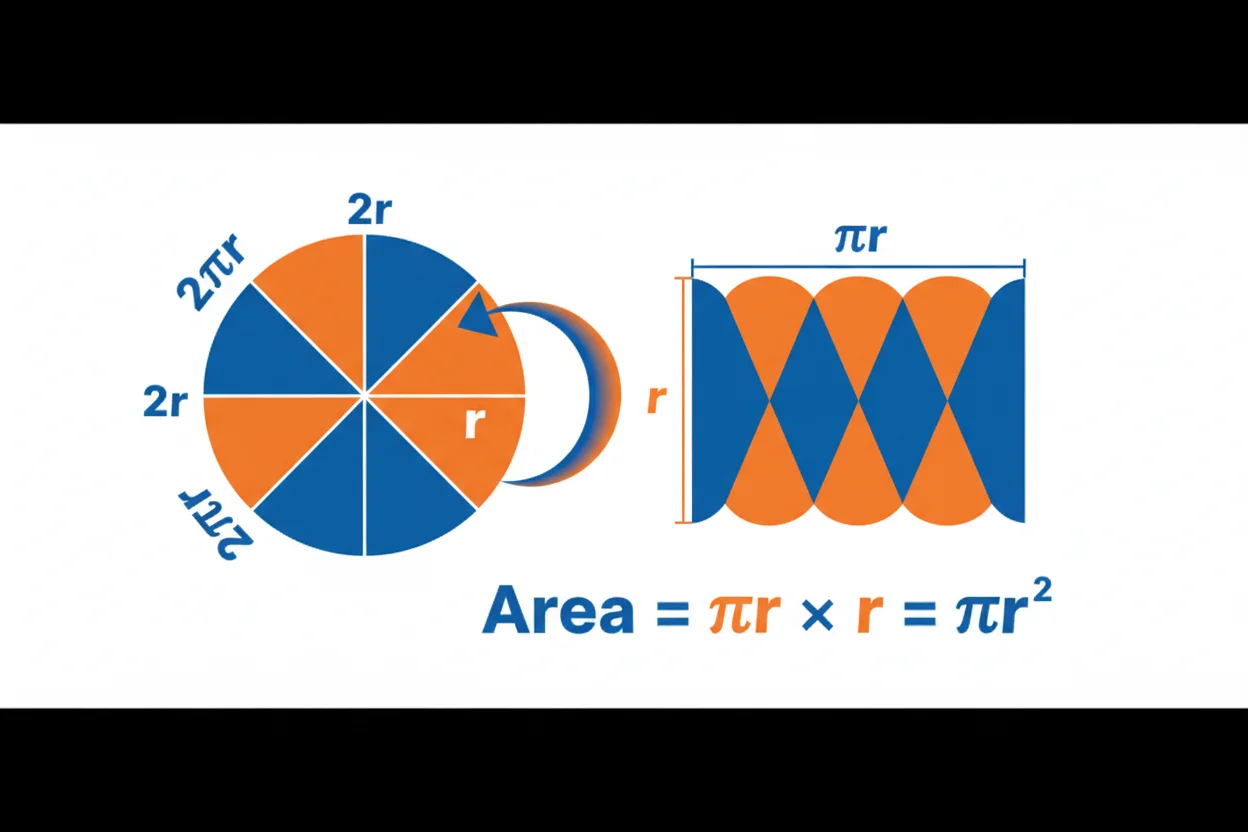

Circle area measures the amount of two-dimensional space inside a circle. For a circle with radius r, the formula is A = πr². If the diameter d is known instead, the same formula can be written A = πd²/4 because r = d/2. Circle area grows with the square of the radius, so doubling the radius makes the area four times as large, while tripling it makes the area nine times as large. The formula can also be reversed to find radius from area using r = √(A/π). Circle area is measured in square units and should not be confused with circumference, which measures boundary length. The same πr² relationship also provides the foundation for semicircle, sector, annulus, cylinder-base, cone-base, and many other geometric calculations.
What Is Circle Area?
A circle is the set of points in a plane that lie a fixed distance from a center.
That fixed distance is the radius:
r
The area is the amount of planar space enclosed by the circular boundary.
The formula is:
A = πr²
where:
A = area
r = radius
π ≈ 3.14159
Circle area belongs to the broader concept of Area and the circle-specific framework in Circles: Radius, Diameter, Area.
Circle Area Formula
The standard formula is:
A = πr²
For:
r = 5
we have:
A = π(5²)
= 25π
Approximately:
A ≈ 78.54
So the circle contains:
25π square units
of area.
Why Radius Is Squared
Area measures two dimensions.
If the circle is scaled so that its radius becomes:
kr
then its area becomes:
A_new = π(kr)²
Therefore:
A_new = k²πr²
so:
A_new = k²A
The squared radius reflects the two-dimensional nature of area.
This is consistent with other Area Formulas, such as:
rectangle: A = lw
where two length dimensions are multiplied.
Circle Area From Diameter
The diameter is:
d = 2r
Therefore:
r = d/2
Substitute into:
A = πr²
to get:
A = π(d/2)²
Thus:
A = πd²/4
This is the direct circle area formula when diameter is known.
Diameter Example
Suppose:
d = 14 cm
Then:
r = 7 cm
Therefore:
A = π(7²)
= 49π cm²
Approximately:
A ≈ 153.94 cm²
Using 14 directly as the radius would incorrectly make the area four times too large.
Find Radius From Circle Area
Start with:
A = πr²
Divide by π:
r² = A/π
Take the nonnegative square root:
r = √(A/π)
The positive root is used because radius is a geometric distance.
Radius From Area Example
Suppose:
A = 81π
Then:
r = √(81π/π)
= √81
= 9
Therefore:
r = 9 units
The diameter is:
d = 18 units
Find Diameter From Area
Since:
d = 2r
and:
r = √(A/π)
we have:
d = 2√(A/π)
Suppose:
A = 36π
Then:
d = 2√36
= 12
The circle’s radius is 6 and its diameter is 12.
Circle Area From Circumference
The Circle Circumference formula is:
C = 2πr
Solve for radius:
r = C/(2π)
Substitute into:
A = πr²
Then:
A = π[C/(2π)]²
Simplify:
A = C²/(4π)
Therefore:
A = C²/(4π)
allows circle area to be calculated directly from circumference.
Circumference Example
Suppose:
C = 20π
Then:
A = (20π)²/(4π)
= 400π²/(4π)
= 100π
Alternatively:
r = 20π/(2π) = 10
so:
A = π(10²) = 100π
Both methods agree.
Find Circumference From Area
Starting with:
r = √(A/π)
and:
C = 2πr
we get:
C = 2π√(A/π)
This can also be simplified to:
C = 2√(πA)
For:
A = 25π
we obtain:
C = 2√(25π²)
= 10π
Circle Area and Circumference Are Different
Circle area measures interior space:
A = πr²
Circumference measures boundary length:
C = 2πr
Area uses square units.
Circumference uses linear units.
For a radius of:
5 cm
we have:
A = 25π cm²
while:
C = 10π cm
The formulas are related through r but measure fundamentally different quantities.
Circle Area and Chord Length
A Chord Length connects two points on the circle with a straight segment.
If radius r and central angle θ are known:
c = 2r sin(θ/2)
The circle’s full area remains:
πr²
regardless of which chord is selected.
However, a chord can divide the circle into:
a minor segment
and:
a major segment
whose areas depend on the chord’s corresponding central angle.
Circle Area and Arc Length
For central angle θ in radians, Arc Length is:
s = rθ
The full circumference occurs when:
θ = 2π
giving:
s = 2πr
Arc length measures part of the boundary, whereas circle area measures the entire enclosed region.
The central angle can be used to calculate the corresponding fraction of both quantities.
Semicircle Area
A semicircle contains half the area of a full circle:
A = πr²/2
For:
r = 8
we have:
A = 64π/2
= 32π
Approximately:
A ≈ 100.53
If the problem asks for the perimeter of the semicircle, the diameter must be added to the curved semicircular arc.
Quarter-Circle Area
A quarter circle contains:
1/4
of the full area.
Therefore:
A = πr²/4
For:
r = 10
we obtain:
A = 100π/4
= 25π
This corresponds to a central angle of:
90°
or:
π/2 radians
Sector Area
A sector is the region bounded by two radii and the arc between them.
For θ measured in degrees:
A_sector = (θ/360°)πr²
For θ in radians:
A_sector = r²θ/2
The specialist Sector Area formula is therefore a fractional extension of full circle area.
Sector Example
Suppose:
r = 12
θ = 60°
Then:
A_sector = (60/360)π(12²)
= (1/6)(144π)
Therefore:
A_sector = 24π
The sector contains one-sixth of the full circle because:
60°/360° = 1/6
Sector Area From Arc Length
Since:
s = rθ
for θ in radians, substitute:
θ = s/r
into:
A_sector = r²θ/2
Then:
A_sector = rs/2
For:
r = 10
and:
s = 8
we get:
A_sector = 10(8)/2
= 40
This is useful when radius and arc length are known but the central angle is not.
Annulus Area
An annulus is the region between two concentric circles.
Let:
R = outer radius
r = inner radius
Then:
A_annulus = πR² − πr²
so:
A_annulus = π(R² − r²)
For:
R = 10
r = 6
we obtain:
A = π(100 − 36)
= 64π
The formula subtracts the inner circle’s area from the outer circle’s area.
Annulus Formula Is Not π(R − r)²
Suppose:
R = 10
r = 6
Correct:
π(R² − r²)
= 64π
Incorrect:
π(R − r)²
= 16π
The second expression calculates the area of a separate circle with radius 4, not the area of the annular ring.
Square each radius first, then subtract.
Circle Area and Circle Equation
A circle with center:
(h, k)
and radius r has Circle Equation:
(x − h)² + (y − k)² = r²
If an equation is written:
(x − 2)² + (y + 3)² = 49
then:
r² = 49
so:
r = 7
Therefore:
A = 49π
The center location does not affect area; only the radius does.
Circle Area From a General Equation
Consider:
x² + y² − 6x + 4y − 12 = 0
Complete the square:
x² − 6x + y² + 4y = 12
Add:
9
and:
4
to both sides:
(x − 3)² + (y + 2)² = 25
Thus:
r = 5
and:
A = 25π
Rewriting the equation into center-radius form reveals the required radius.
Circle Area From Two Endpoint Coordinates of a Diameter
Suppose diameter endpoints are:
A = (1, 2)
B = (7, 10)
Find the diameter using the Distance Formula:
d = √[(7 − 1)² + (10 − 2)²]
= √(36 + 64)
= 10
Therefore:
r = 5
and:
A = 25π
This combines coordinate geometry with the circle area formula.
Circle Center From Diameter Endpoints
The center is the midpoint of a diameter.
For endpoints:
(x₁, y₁)
and:
(x₂, y₂)
the Midpoint Formula gives:
center = ((x₁ + x₂)/2, (y₁ + y₂)/2)
Although the center coordinates do not directly change the area, finding the center can help establish the circle equation and radius from coordinate data.
Circle Area and Scaling
Suppose one circle has radius r and another has radius:
kr
Then:
A₁ = πr²
and:
A₂ = π(kr)²
Therefore:
A₂/A₁ = k²
So area scales with the square of the radius ratio.
If radius doubles:
area × 4
If radius triples:
area × 9
If radius is halved:
area × 1/4
Area Ratio of Two Circles
For radii r₁ and r₂:
A₁/A₂ = r₁²/r₂²
Suppose:
r₁ : r₂ = 3 : 5
Then:
A₁ : A₂ = 9 : 25
Thus a circle with 5/3 the radius has 25/9 the area.
The relationship is quadratic, not linear.
Example: Radius Increases by 20%
Suppose radius increases from r to:
1.2r
The new area is:
A_new = π(1.2r)²
= 1.44πr²
Therefore:
A_new = 1.44A_old
The area increases by:
44%
A 20% increase in radius does not mean a 20% increase in area.
Example: Area Doubles
Suppose:
A_new = 2A_old
Then:
πr_new² = 2πr_old²
Cancel π:
r_new² = 2r_old²
Therefore:
r_new = √2 r_old
So doubling circle area requires multiplying the radius by:
√2 ≈ 1.414
not by 2.
Circle Area and Diameter Scaling
Since:
A = πd²/4
area is also proportional to:
d²
If diameter doubles:
area quadruples
If diameter increases by factor 3:
area increases by factor 9
This is expected because diameter and radius scale by the same linear factor.
Circle Area and Similar Figures
All circles are similar.
Therefore their corresponding linear dimensions have the same scale ratio.
If circumference ratio is:
k
then radius ratio is also:
k
and area ratio is:
k²
For example, if one circle’s circumference is twice another’s, its area is four times as large.
Area From Circumference Ratio
Suppose:
C₁/C₂ = 3/2
Since:
C = 2πr
we also have:
r₁/r₂ = 3/2
Therefore:
A₁/A₂ = (3/2)²
= 9/4
Thus circumference and radius scale linearly, while area scales quadratically.
Circle Area and Regular Polygons
A regular polygon inscribed in a circle approximates the circle more closely as the number of polygon sides increases.
Likewise, circumscribed polygons can approximate the circle from outside.
This provides one geometric route toward understanding why the circle’s area is proportional to:
r²
and why the proportionality constant is π.
The exact result is:
A = πr²
Rearranged-Sector Interpretation
Imagine dividing a circle into many narrow sectors.
Arrange them alternately with one sector pointing upward and the next downward.
As the number of sectors increases, the shape approaches a rectangle-like form.
Its approximate height is:
r
and its approximate width is half the circumference:
πr
Therefore:
A ≈ (πr)(r)
giving:
A = πr²
in the limiting geometric interpretation.
Circle Area and Perimeter
The Perimeter of a circle is usually called circumference.
It equals:
2πr
For composite figures that include semicircular or quarter-circular boundaries, the perimeter calculation may combine:
straight segments
and:
arc lengths
Area instead combines the two-dimensional regions enclosed by those boundaries.
Composite Area With a Circle
Suppose a square has side:
10
and contains a circular hole of radius:
3
Square area:
10² = 100
Circle area:
9π
Remaining area:
100 − 9π
Approximately:
71.73
square units.
This subtraction method is part of the broader Area Formulas approach to composite figures.
Circle Inscribed in a Square
If a circle is inscribed in a square with side s, the circle’s diameter equals:
s
Therefore:
r = s/2
Circle area:
A_circle = πs²/4
Square area:
A_square = s²
The fraction of the square occupied by the circle is:
π/4
or approximately:
78.54%
This ratio is independent of the square’s size.
Square Inscribed in a Circle
If a square is inscribed in a circle of radius r, the square’s diagonal equals the circle’s diameter:
d = 2r
If square side is s:
s² + s² = (2r)²
Therefore:
2s² = 4r²
so:
s² = 2r²
Thus the square’s area is:
2r²
while the circle area is:
πr²
The area ratio is:
2/π
for square to circle.
Circle Area and the Pythagorean Theorem
The Pythagorean Theorem often helps find a radius indirectly.
Suppose a chord has half-length a and lies distance d from the center.
Then:
r² = a² + d²
Once r² is known:
A = πr²
For example, if:
a = 12
d = 5
then:
r² = 144 + 25
= 169
Therefore:
A = 169π
Circle Area From Chord and Center Distance
If a full chord has length c and its perpendicular distance from the center is d:
r² = (c/2)² + d²
Therefore:
A = π[(c/2)² + d²]
For:
c = 24
d = 5
we get:
A = π(12² + 5²)
= 169π
The Chord Length geometry therefore provides another route to circle area.
Circle Area and Tangent Geometry
A radius drawn to a point of tangency is perpendicular to the tangent line.
That right angle can create a right triangle whose unknown radius is found using the Pythagorean theorem.
Once r is known:
A = πr²
This pattern frequently appears when external points, tangent lengths, and center distances are supplied.
Circle Area and Units
Circle area always uses squared length units.
If:
r = 7 cm
then:
A = 49π cm²
If:
r = 7 m
then:
A = 49π m²
The numerical coefficient can be identical while the physical area differs greatly because the measurement units differ.
Converting Circle Area Units
Since:
1 m = 100 cm
then:
1 m² = 10,000 cm²
Suppose:
A = 2.5 m²
Then:
A = 25,000 cm²
Area conversions require squaring the linear conversion factor.
Exact and Approximate Circle Area
If radius is exact, an answer containing π is exact.
For:
r = 6
the exact area is:
36π
Using:
π ≈ 3.14159
gives:
A ≈ 113.10
Unless a decimal is specifically required, keeping π in the answer preserves exactness.
Circle Area and Measurement Error
Because:
A = πr²
small errors in radius affect area more strongly.
For small changes:
relative area change ≈ 2 × relative radius change
For example, a radius measurement about 1% too large produces an area approximately 2% too large for sufficiently small errors.
This follows from the squared relationship.
Common Circle Area Mistakes
The most common error is confusing radius with diameter.
If diameter is given:
r = d/2
before using:
A = πr²
Another mistake is forgetting to square the radius.
Circle area uses square units, while circumference uses linear units.
When solving for radius, use:
r = √(A/π)
rather than:
A/π
For annuli, subtract:
πR² − πr²
not:
π(R − r)²
When calculating sectors, use the appropriate fraction of the complete circle.
Finally, avoid rounding π or intermediate measurements too early when a precise final value is required.
Frequently Asked Questions
What is the circle area formula?
A = πr²
What does r represent?
r is the radius: the distance from the circle’s center to its boundary.
What is the area formula using diameter?
A = πd²/4
How do you find radius from area?
r = √(A/π)
How do you find diameter from area?
d = 2√(A/π)
How do you find area from circumference?
A = C²/(4π)
What is the area of a semicircle?
A = πr²/2
What is the area of a quarter circle?
A = πr²/4
What is sector area in degrees?
A_sector = (θ/360°)πr²
What is sector area in radians?
A_sector = r²θ/2
What is annulus area?
A = π(R² − r²)
If radius doubles, what happens to area?
Area becomes four times as large.
If circle area doubles, does radius double?
No. Radius is multiplied by:
√2
Is circle area the same as circumference?
No. Area measures interior space in square units; circumference measures boundary length in linear units.
How can I check a circle area answer?
Confirm that you used the radius rather than diameter, squared the radius, included π, and reported square units. If circumference or a circle equation is available, use it to verify the radius independently.