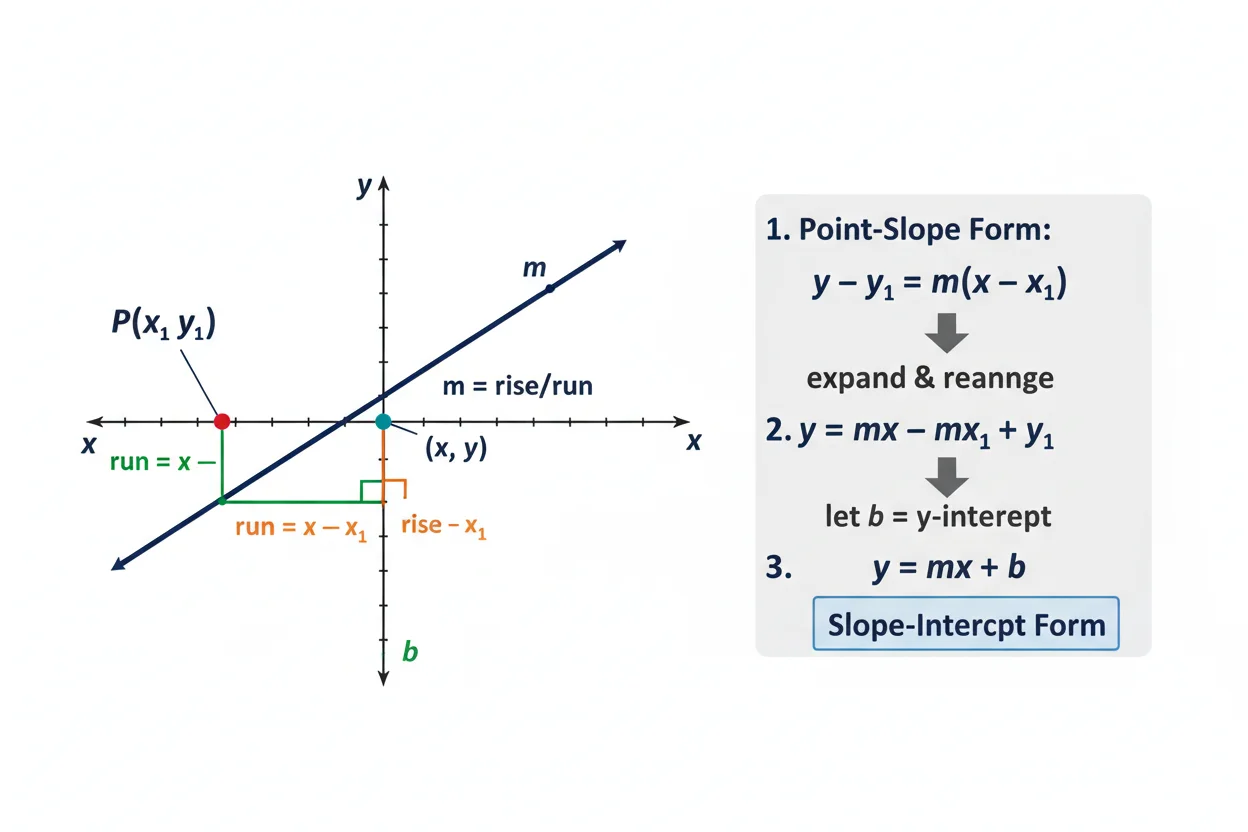
Point-slope form is a way to write the equation of a nonvertical straight line when its slope and one point are known. The formula is y − y₁ = m(x − x₁), where m is the slope and (x₁, y₁) is any point on the line. It is especially useful because it lets you construct a line directly without first calculating the y-intercept. If two points are known instead, calculate m = (y₂ − y₁)/(x₂ − x₁) and then substitute either point into point-slope form. The equation can later be converted to slope-intercept form, standard form, or another equivalent representation. Horizontal lines work naturally with m = 0, while vertical lines require the separate equation x = constant because their slope is undefined. Point-slope form is widely used for coordinate geometry, parallel and perpendicular lines, tangents, modeling constant rates, polygon edges, and line-intersection problems.
Point-Slope Form Formula
The formula is:
y − y₁ = m(x − x₁)
where:
m = slope
(x₁, y₁) = known point on the line
(x, y) = any other point on the line
The formula describes every nonvertical line passing through the chosen point with slope m.
Basic Point-Slope Form Example
Suppose a line has:
slope = 3
and passes through:
(2, 5)
Substitute:
m = 3
x₁ = 2
y₁ = 5
Then:
y − 5 = 3(x − 2)
This is the line in point-slope form.
Expand:
y − 5 = 3x − 6
Add 5:
y = 3x − 1
So the same line in slope-intercept form is:
y = 3x − 1
Why Point-Slope Form Works
Slope is defined by:
m = (y − y₁)/(x − x₁)
for any second point (x, y) on a nonvertical line.
Multiply both sides by:
x − x₁
Then:
y − y₁ = m(x − x₁)
This is point-slope form.
The equation therefore comes directly from the definition of Slope.
Understanding the Formula
The left side:
y − y₁
represents vertical change.
The right-side factor:
x − x₁
represents horizontal change.
Multiplying horizontal change by slope gives vertical change:
vertical change = slope × horizontal change
So point-slope form can also be read as:
change in y = rate of change × change in x
This interpretation makes the formula useful far beyond textbook coordinate diagrams.
Point-Slope Form With Positive Slope
Suppose:
m = 2
and the line passes through:
(4, 1)
Then:
y − 1 = 2(x − 4)
Expand:
y − 1 = 2x − 8
Therefore:
y = 2x − 7
Because the slope is positive, the line rises from left to right.
Point-Slope Form With Negative Slope
Suppose:
m = −3
and:
(x₁, y₁) = (2, 8)
Then:
y − 8 = −3(x − 2)
Expand:
y − 8 = −3x + 6
Therefore:
y = −3x + 14
A negative slope means the line decreases as x increases.
Point-Slope Form With Fractional Slope
Suppose:
m = 3/4
and the line passes through:
(−2, 5)
Then:
y − 5 = (3/4)(x + 2)
because:
x − (−2) = x + 2
This equation may be left in point-slope form or expanded.
Multiply by 4:
4y − 20 = 3x + 6
Rearrange:
3x − 4y = −26
This is an equivalent standard-form equation.
Be Careful With Negative Coordinates
Suppose the known point is:
(−4, −7)
Then point-slope form is:
y − (−7) = m[x − (−4)]
which simplifies to:
y + 7 = m(x + 4)
A frequent error is losing one of the negative signs.
Parentheses around negative coordinates prevent this.
Point-Slope Form From Two Points
If two points are given, first calculate the slope:
m = (y₂ − y₁)/(x₂ − x₁)
Then use either point in:
y − y₁ = m(x − x₁)
This is the standard method developed further in Line From Two Points.
Two-Point Example
Find the equation through:
A = (1, 4)
B = (5, 12)
Slope:
m = (12 − 4)/(5 − 1)
= 8/4
= 2
Using A:
y − 4 = 2(x − 1)
Expand:
y − 4 = 2x − 2
Therefore:
y = 2x + 2
Using the Other Point
Using B instead:
y − 12 = 2(x − 5)
Expand:
y − 12 = 2x − 10
Therefore:
y = 2x + 2
Both points produce the same line.
Point-slope form does not depend on which known point is selected.
Check an Equation With the Original Point
Suppose:
y − 5 = 3(x − 2)
Set:
x = 2
Then:
y − 5 = 3(0)
so:
y = 5
The known point:
(2, 5)
is therefore on the line.
A correct point-slope equation automatically passes through the point used to construct it.
Check a Second Point
For:
y = 3x − 1
test:
(4, 11)
Substitute:
11 = 3(4) − 1
11 = 11
Therefore the point lies on the line.
If the equality fails, the point is not on that line.
Point-Slope Form to Slope-Intercept Form
Slope-intercept form is:
y = mx + b
Starting with:
y − y₁ = m(x − x₁)
expand:
y − y₁ = mx − mx₁
Add y₁:
y = mx + y₁ − mx₁
Therefore:
b = y₁ − mx₁
So every nonvertical point-slope equation can be converted to slope-intercept form.
Conversion Example
Start with:
y − 7 = −2(x − 3)
Expand:
y − 7 = −2x + 6
Add 7:
y = −2x + 13
Thus:
m = −2
b = 13
Point-Slope Form to Standard Form
Standard form is commonly written:
Ax + By = C
Start with:
y − 5 = (2/3)(x − 4)
Multiply by 3:
3y − 15 = 2x − 8
Rearrange:
2x − 3y = −7
The fractions disappear, which often makes standard form convenient for elimination or Line Intersection calculations.
Horizontal Lines
A horizontal line has:
m = 0
Suppose it passes through:
(3, 8)
Point-slope form gives:
y − 8 = 0(x − 3)
Therefore:
y − 8 = 0
so:
y = 8
Every point on the line has the same y-coordinate.
Vertical Lines
A vertical line has undefined slope.
If it passes through:
(5, −2)
its equation is:
x = 5
Point-slope form:
y − y₁ = m(x − x₁)
cannot use an ordinary real value for m because vertical slope would require division by zero.
So vertical lines must be handled separately.
Why Vertical Slope Is Undefined
Suppose two points on a vertical line are:
(4, 2)
and:
(4, 9)
The slope would be:
m = (9 − 2)/(4 − 4)
= 7/0
Division by zero is undefined.
The line equation is simply:
x = 4
Finding a Parallel Line
Parallel nonvertical lines have equal slopes.
If a line has slope:
m = 3/2
then every nonvertical line parallel to it also has:
m = 3/2
Suppose a parallel line must pass through:
(4, −1)
Use:
y + 1 = (3/2)(x − 4)
That is the required parallel line.
Parallel Line Example
Given:
y = −2x + 7
find a parallel line through:
(3, 5)
The original slope is:
−2
Therefore:
y − 5 = −2(x − 3)
Expand:
y − 5 = −2x + 6
So:
y = −2x + 11
The slopes are equal, but the intercepts differ, so the lines are distinct and parallel.
Finding a Perpendicular Line
For nonvertical, nonhorizontal lines, perpendicular slopes satisfy:
m₁m₂ = −1
So:
m₂ = −1/m₁
If the original slope is:
3/4
the perpendicular slope is:
−4/3
A perpendicular line through point:
(2, 5)
is:
y − 5 = −(4/3)(x − 2)
Perpendicular Example
Find the line perpendicular to:
y = 2x + 1
through:
(4, 3)
Original slope:
m₁ = 2
Perpendicular slope:
m₂ = −1/2
Therefore:
y − 3 = −(1/2)(x − 4)
Expand:
y − 3 = −x/2 + 2
So:
y = −x/2 + 5
Horizontal and Vertical Perpendicular Lines
A horizontal line:
y = c
is perpendicular to a vertical line:
x = a
For example:
y = 6
and:
x = 2
intersect at:
(2, 6)
at a right angle.
The negative-reciprocal slope rule is not applied numerically because the vertical line has undefined slope.
Perpendicular Bisector
The perpendicular bisector of a segment:
- passes through the segment’s midpoint;
- has slope perpendicular to the segment.
Suppose endpoints are:
A = (2, 2)
B = (8, 6)
The Midpoint Formula gives:
M = (5, 4)
Segment slope:
m = (6 − 2)/(8 − 2)
= 2/3
Perpendicular slope:
−3/2
Therefore the perpendicular bisector is:
y − 4 = −(3/2)(x − 5)
Why the Perpendicular Bisector Matters
Every point on the perpendicular bisector of segment AB is equidistant from A and B.
That makes the construction important in:
circle centers
triangle circumcenters
symmetry
locus problems
Point-slope form supplies the line immediately once the midpoint and perpendicular slope are known.
Point-Slope Form and Circle Geometry
A tangent line to a circle is perpendicular to the radius at the point of tangency.
Suppose a circle center is:
C = (0, 0)
and the tangent point is:
P = (3, 4)
Radius slope:
m_r = 4/3
Tangent slope:
m_t = −3/4
The tangent line through P is:
y − 4 = −(3/4)(x − 3)
This connects point-slope form with Circle Equation geometry.
Tangent-Line Check
The radius from:
(0,0)
to:
(3,4)
has length:
5
and direction slope:
4/3
The tangent slope:
−3/4
satisfies:
(4/3)(−3/4) = −1
Therefore the two lines are perpendicular, as required.
Point-Slope Form and Direction Angles
If a nonvertical line makes angle θ with the positive x-axis:
m = tanθ
So if θ is known:
y − y₁ = tanθ(x − x₁)
For example:
θ = 45°
gives:
m = 1
A line through:
(2,3)
is:
y − 3 = x − 2
Therefore:
y = x + 1
Degrees and Radians
The angle θ can be expressed in degrees or radians.
For example:
45° = π/4
Therefore:
tan45° = tan(π/4) = 1
The angle-unit conversion rules in Degrees and Radians matter whenever slope is calculated from an angle.
Point-Slope Form and Polar Direction
A line direction can also be described using an angle θ from the positive x-axis.
In Polar and Rectangular Form, the direction components are related to:
cosθ
and:
sinθ
For a nonvertical line:
m = sinθ/cosθ
Therefore:
m = tanθ
Point-slope form then converts that directional information into a Cartesian line equation through a known point.
Example From a Direction Angle
Suppose a line passes through:
(−1, 4)
and has direction:
θ = 30°
Then:
m = tan30°
= √3/3
Therefore:
y − 4 = (√3/3)(x + 1)
This is the exact point-slope equation.
Line Intersection From Point-Slope Equations
Suppose two lines are:
y − 2 = 2(x − 1)
and:
y − 5 = −(x − 4)
Simplify:
y = 2x
and:
y = −x + 9
Set equal:
2x = −x + 9
Therefore:
x = 3
Then:
y = 6
The lines intersect at:
(3,6)
Point-slope form describes the lines; the line-intersection calculation finds their shared point.
Point-Slope Form and Polygon Edges
If two adjacent polygon vertices are known, the line containing the side can be written from those coordinates.
For example:
A = (1,2)
B = (5,6)
Slope:
m = 1
Side line:
y − 2 = x − 1
The same procedure can describe every side of a coordinate polygon.
Polygon Diagonals
A Polygon Diagonals problem normally counts diagonals with:
D = n(n − 3)/2
But if actual polygon vertices are supplied as coordinates, each individual diagonal also lies on a line through two nonadjacent vertices.
Point-slope form can therefore describe that diagonal’s supporting line.
Counting diagonals and finding a diagonal’s equation are separate tasks.
Diagonal Equation Example
Suppose a quadrilateral has opposite vertices:
A = (0,1)
C = (6,7)
Slope AC:
m = (7 − 1)/(6 − 0)
= 1
Therefore diagonal AC lies on:
y − 1 = x
or:
y = x + 1
If the other diagonal equation is known, their intersection can be calculated.
Parallelogram Geometry
Opposite sides of a parallelogram are parallel.
Suppose one side has slope:
2/3
Then the opposite side also has slope:
2/3
If that opposite side passes through point:
(5,8)
its equation is:
y − 8 = (2/3)(x − 5)
Coordinate line equations can therefore help verify parallelogram structure before calculating Parallelogram Area.
Parallelogram Example
Suppose:
A = (0,0)
B = (6,2)
D = (1,5)
Line AB has slope:
2/6 = 1/3
The opposite side through D must have:
m = 1/3
Therefore:
y − 5 = (1/3)(x − 1)
Likewise, AD has slope:
5
so the side through B parallel to AD is:
y − 2 = 5(x − 6)
Their intersection identifies the fourth vertex.
Point-Slope Form and Perimeter
A Perimeter problem defined by coordinate boundary lines may require finding vertices first.
Point-slope equations can describe the boundary lines.
Their intersections produce vertices.
The distance formula then gives finite side lengths.
Perimeter is the sum of those lengths, not the sum of line slopes or intercepts.
Coordinate Boundary Example
Suppose one side of a polygon lies on:
y − 1 = 2(x − 3)
and another side lies on:
y + 2 = −x
Their intersection can be found by simplifying both equations.
That intersection becomes a polygon vertex.
Repeating this for neighboring boundary lines can reconstruct the full polygon before its perimeter is calculated.
Point-Slope Form and Midpoints
A midpoint can serve as the known point in a line equation.
For example, a line through midpoint:
M = (4,6)
with slope:
−2
is:
y − 6 = −2(x − 4)
This occurs frequently with:
perpendicular bisectors
medians
symmetry axes
diagonal constructions
The midpoint supplies the point; the geometry supplies the slope.
Triangle Median Equation
Suppose triangle vertex:
A = (0,6)
and midpoint of opposite side:
M = (2,0)
Slope AM:
m = (0 − 6)/(2 − 0)
= −3
Therefore the median from A is:
y − 6 = −3x
or:
y = −3x + 6
The Triangle Medians meet at the centroid.
Point-Slope Form and Slope From Distance Data
Distance alone does not determine slope.
Two points could be a fixed distance apart in many different directions.
But if coordinate differences are known:
Δx
Δy
then:
m = Δy/Δx
while the Distance Formula gives:
d = √[(Δx)² + (Δy)²]
The same displacement components provide both direction and length.
Point-Slope Form in Linear Models
Suppose a quantity y changes at constant rate m relative to x.
If one known observation is:
(x₁,y₁)
then:
y − y₁ = m(x − x₁)
provides the complete linear model.
This is often more natural than first computing an intercept that may have no practical interpretation.
Linear Model Example
Suppose a measured quantity equals:
45
when:
x = 10
and increases by:
6
for every one-unit increase in x.
Then:
m = 6
and:
(x₁,y₁) = (10,45)
So:
y − 45 = 6(x − 10)
At:
x = 13
we get:
y − 45 = 18
Therefore:
y = 63
Interpolation With Point-Slope Form
Suppose two measurements are:
(2,10)
(8,40)
Slope:
m = 30/6
= 5
The line is:
y − 10 = 5(x − 2)
For:
x = 5
we obtain:
y − 10 = 15
Therefore:
y = 25
Because x = 5 lies between the known x-values, this is linear interpolation.
Extrapolation
Using the same model at:
x = 12
gives:
y − 10 = 5(10)
so:
y = 60
Mathematically the line extends indefinitely.
Whether extrapolation remains realistic depends on whether the underlying relationship truly continues at the same constant rate.
Equivalent Point-Slope Equations
A single line can have infinitely many point-slope representations because every point on the line can be used.
For:
y = 2x + 1
points include:
(0,1)
(1,3)
(2,5)
So equivalent point-slope forms include:
y − 1 = 2x
y − 3 = 2(x − 1)
y − 5 = 2(x − 2)
All describe exactly the same line.
Common Point-Slope Form Mistakes
A common mistake is writing:
y + y₁ = m(x + x₁)
The standard formula is:
y − y₁ = m(x − x₁)
Signs only become plus signs when the coordinate itself is negative.
Another error is using the x-coordinate as slope.
The known point and slope are separate pieces of information.
When slope comes from two points, keep subtraction order consistent.
Vertical lines cannot use a finite m.
For perpendicular lines, use the negative reciprocal rather than merely changing the sign.
When converting to slope-intercept form, distribute m across the entire parenthesis.
Finally, verify the finished equation by substituting the known point.
Frequently Asked Questions
What is point-slope form?
y − y₁ = m(x − x₁)
What does m represent?
The slope of the line.
What do x₁ and y₁ represent?
The coordinates of any known point on the line.
How do you use point-slope form with two points?
First calculate:
m = (y₂ − y₁)/(x₂ − x₁)
then substitute either point into:
y − y₁ = m(x − x₁)
Can either point be used?
Yes. Both produce the same line.
How do you convert point-slope form to slope-intercept form?
Expand and solve for y.
What is the y-intercept from a point and slope?
b = y₁ − mx₁
Can point-slope form represent a horizontal line?
Yes. Use:
m = 0
Can it represent a vertical line?
Not with a finite slope. Use:
x = constant
instead.
How do you find a parallel line?
Use the same slope and the new specified point.
How do you find a perpendicular line?
For a nonvertical, nonhorizontal line, use:
m_perpendicular = −1/m
How is point-slope form related to the slope formula?
It comes directly from rearranging:
m = (y − y₁)/(x − x₁)
How can I check my equation?
Substitute the known point and verify that both sides are equal. If another point is available, test that point as well.