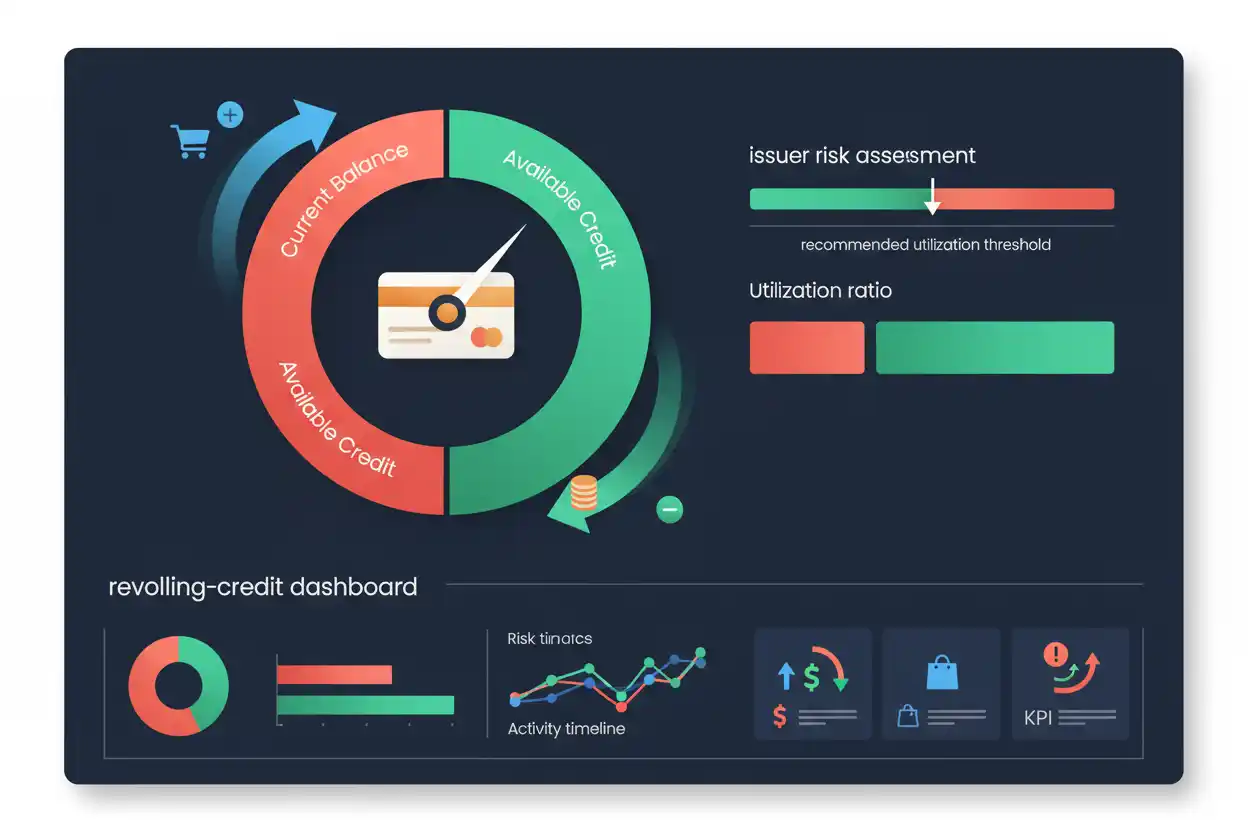

A credit limit is the maximum amount of revolving credit a lender makes available on an account, subject to the account terms.
If a credit card has a $10,000 credit limit, the cardholder does not automatically have $10,000 available to spend at every moment. Existing balances and pending or posted transactions can reduce the amount of unused credit.
The basic relationship is:
Available Credit = Credit Limit − Applicable Outstanding Balance
If the credit limit is $10,000 and the balance is $3,500:
Available Credit = $10,000 − $3,500
Available Credit = $6,500
The calculation is easy. Determining why the issuer chose the $10,000 limit is much more complicated.
There is no universal credit limit formula used by every lender.
What Is a Credit Limit?
A credit limit establishes the maximum amount of credit the issuer is willing to extend on a revolving account under its current terms.
Credit limits can apply to:
credit cards, lines of credit, business credit accounts, home equity lines, and other revolving facilities.
This article focuses primarily on consumer revolving credit cards.
A credit limit is not income.
It is not savings.
It is not a spending recommendation.
It represents borrowed purchasing capacity that must eventually be repaid.
Credit Limit Formula
There is no standard formula that consumers can use to reproduce an issuer’s underwriting decision.
Lenders can consider factors such as:
income, existing debt, repayment history, credit reports, credit scores, account history, product policies, and internal risk models.
However, two useful formulas arise directly from the credit limit.
The first is available credit:
Available Credit = Credit Limit − Outstanding Balance
The second is utilization:
Credit Utilization Ratio = Revolving Balance ÷ Credit Limit × 100
These formulas help explain how the limit affects everyday account management.
Credit Limit Example
Suppose:
Credit limit = $12,000
Current qualifying balance = $4,500
Available credit is:
Available Credit = $12,000 − $4,500
Available Credit = $7,500
Utilization is:
Credit Utilization = $4,500 ÷ $12,000 × 100
Credit Utilization = 37.5%
If the cardholder pays $2,500 and makes no new transactions:
New Balance = $4,500 − $2,500
New Balance = $2,000
Available credit becomes approximately:
Available Credit = $12,000 − $2,000
Available Credit = $10,000
Utilization becomes:
Utilization = $2,000 ÷ $12,000 × 100
Utilization ≈ 16.7%
One payment therefore changes both available credit and utilization.
How Do Credit Card Companies Set Credit Limits?
Issuers use their own underwriting systems.
There is no publicly standardized equation such as:
Credit Limit = Income × Fixed Percentage
Real underwriting is more complex.
Factors that can matter include repayment history, existing debt obligations, income or resources considered under applicable rules, credit report information, existing relationship with the lender, requested product, and internal risk tolerance.
The credit score factors page explains commonly considered scoring variables, but a credit score is only one potential input into a lender’s overall decision.
Credit Limit vs Available Credit
These terms are often confused.
Credit limit is the account’s approved maximum.
Available credit is the unused portion remaining.
For example:
Limit = $15,000
Balance = $9,000
Available Credit = $15,000 − $9,000
Available Credit = $6,000
If the balance rises to $12,000:
Available Credit = $3,000
The limit has not changed.
Only the amount already used has changed.
Credit Limit and Credit Utilization
The credit utilization ratio measures revolving balances relative to revolving limits.
For one account:
Individual Card Utilization = Card Balance ÷ Card Limit × 100
Suppose:
Balance = $2,500
Limit = $10,000
Utilization = $2,500 ÷ $10,000 × 100
Utilization = 25%
If the issuer reduces the limit to $5,000 while the balance stays unchanged:
New Utilization = $2,500 ÷ $5,000 × 100
New Utilization = 50%
Nothing was purchased, yet utilization doubled because the denominator fell.
Total Credit Limit Across Cards
You can also calculate aggregate revolving credit limits.
Suppose:
Card A limit = $5,000
Card B limit = $10,000
Card C limit = $15,000
Total Credit Limit = $5,000 + $10,000 + $15,000
Total Credit Limit = $30,000
If total balances are $6,000:
Aggregate Utilization = $6,000 ÷ $30,000 × 100
Aggregate Utilization = 20%
Individual-card utilization can still differ significantly even when aggregate utilization appears moderate.
Credit Limit and Credit Score Factors
The credit score factors page covers the broader scoring framework.
The amount of available revolving credit being used is one factor that can matter.
Therefore, a credit limit affects scoring indirectly through the relationship between limits and balances.
The limit itself should not be viewed as a score.
Does a Higher Credit Limit Improve Your Credit Score?
Not automatically.
Suppose:
Old limit = $5,000
Balance = $2,000
Old Utilization = 40%
If the limit rises to $10,000 with the balance unchanged:
New Utilization = 20%
That lower utilization can be favorable in models that consider revolving-credit usage.
However, requesting a limit increase can involve other factors, and increased borrowing capacity can create more debt if spending rises.
A higher limit is therefore not inherently financially beneficial.
What Is a Good Credit Limit?
There is no universally good dollar amount.
A $5,000 limit can be more than sufficient for one person’s spending pattern.
Another person might routinely charge reimbursable business travel or large monthly expenses and need substantially more capacity.
The more useful questions are:
Can normal spending remain comfortably below the limit?
Can statement balances be repaid without financial strain?
Does the account provide enough capacity without encouraging unnecessary borrowing?
Credit Limit vs Income
Income and credit limit are not interchangeable.
Suppose a person earns $80,000 annually and receives a $15,000 card limit.
That does not mean the issuer recommends spending $15,000.
Nor does it imply that 18.75% of annual income is a universal underwriting formula.
Issuer decisions depend on multiple variables.
Credit Limit and Minimum Payments
The credit card minimum payment is based primarily on the account balance and issuer formula rather than simply on the total credit limit.
For example:
Credit limit = $10,000
Balance = $8,000
Minimum payment = $240
The cardholder owes the stated minimum even though another $2,000 of nominal credit capacity remains.
Using more available credit does not solve the repayment obligation.
Credit Limit and Credit Card Payoff
A credit card payoff plan reduces the balance while the credit limit can remain unchanged.
Suppose:
Limit = $10,000
Balance falls from $8,000 to $2,000
Available credit rises:
Available Credit = $10,000 − $2,000
Available Credit = $8,000
The temptation to reuse that $8,000 can undermine the payoff.
Available credit should therefore not be interpreted as newly created wealth.
Credit Limit and Grace Period
A credit card grace period determines interest treatment on qualifying purchases.
The credit limit determines borrowing capacity.
Suppose:
Limit = $10,000
Statement balance = $3,000
Paying the applicable statement balance in full can preserve grace-period treatment even though the account’s limit remains unchanged at $10,000.
These are separate contract features.
Credit Limit and Credit Card APR
The credit card APR determines borrowing cost.
Credit limit determines capacity.
Suppose two accounts each have a 24% APR.
Card A limit = $5,000
Card B limit = $20,000
The rate is identical.
The potential dollar exposure differs.
Carrying $15,000 on Card B would generate much more interest than carrying $2,000 on Card A despite the same APR.
Credit Limit and Compound Interest
A compound interest loan framework shows how carrying debt over time can increase cost.
A high credit limit can allow a borrower to accumulate a larger balance.
If that balance remains unpaid and interest compounds, the financing cost can become substantial.
The limit therefore determines capacity but does not reduce the cost of using that capacity.
Credit Limit and Cash Advances
The maximum cash advance amount can be lower than the account’s overall credit limit.
For example:
General credit limit = $10,000
Cash advance limit = $2,000
A cash advance fee and separate APR can also apply.
Therefore:
Credit Limit ≠ Necessarily Cash Advance Limit
Credit Limit and Balance Transfers
A balance transfer can use part of the available revolving credit.
Suppose:
Credit limit = $12,000
Existing balance = $1,000
Potential transfer = $10,000
Transfer fee = 3%
The fee is:
Transfer Fee = $10,000 × 3% = $300
Potential new balance:
New Balance = $1,000 + $10,000 + $300
New Balance = $11,300
That transaction would consume most of the $12,000 limit.
The balance transfer fee therefore matters when calculating how much capacity a transfer will actually require.
Why Credit Limits Increase
An issuer can increase a limit when its underwriting supports greater credit exposure.
Possible factors include positive payment history, higher verified income or financial capacity, lower perceived credit risk, longer account history, and issuer account-management policies.
An increase should not be interpreted as permission to increase discretionary spending.
Why Credit Limits Decrease
Issuers can also reduce credit limits.
Possible reasons can include risk-management decisions, changes in credit profile, account inactivity, broader economic conditions, or changes in the issuer’s lending strategy.
A reduced limit can immediately increase utilization even when the balance does not change.
Credit Limit Increase Example
Suppose:
Current limit = $6,000
Current balance = $2,400
Current Utilization = $2,400 ÷ $6,000 × 100
Current Utilization = 40%
If the issuer raises the limit to $10,000:
New Utilization = $2,400 ÷ $10,000 × 100
New Utilization = 24%
The balance has not changed, but utilization has fallen by 16 percentage points.
Credit Limit Decrease Example
Now reverse the situation.
Limit falls from $10,000 to $5,000.
Balance remains $2,400.
New Utilization = $2,400 ÷ $5,000 × 100
New Utilization = 48%
A limit change alone can therefore materially alter revolving-credit utilization.
Does Closing a Credit Card Affect Credit Limits?
Closing a revolving account removes that account’s available limit from your active revolving-credit capacity.
Suppose:
Card A limit = $10,000
Card B limit = $10,000
Total balance = $4,000
Before closing:
Aggregate Utilization = $4,000 ÷ $20,000 × 100
Aggregate Utilization = 20%
If Card B is closed and only $10,000 of available limit remains:
Aggregate Utilization = $4,000 ÷ $10,000 × 100
Aggregate Utilization = 40%
The precise credit-score effect depends on the scoring model and broader credit profile, but the utilization math is straightforward.
Credit Limit vs Loan Principal
A revolving credit limit differs fundamentally from a fixed principal balance.
A loan typically advances a defined principal and then reduces that principal as payments are made.
A credit card allows repeated borrowing and repayment up to the available limit.
This revolving structure is why paying down a card creates new borrowing capacity.
Credit Limit vs Loan-to-Income Ratio
The loan-to-income ratio compares a loan amount with income.
It is not a credit-limit formula.
Issuers can consider income and existing obligations, but the approved limit should not be reverse-engineered from one universal income ratio.
Credit Limit vs Debt-to-Income Ratio
The debt-to-income ratio compares monthly debt payments with gross monthly income.
Credit limit measures potential revolving borrowing capacity.
A person can have large credit limits while carrying little debt.
Conversely, someone with lower limits can still have substantial payment obligations if those accounts are heavily utilized.
Common Credit Limit Mistakes
The most important mistake is treating available credit as available income.
Another is assuming a higher limit should be used simply because the issuer approved it.
Cardholders can also overlook how limit decreases affect utilization.
A fourth mistake is requesting multiple increases solely to manipulate a credit score without considering inquiries, spending behavior, and the broader credit profile.
Finally, the maximum available balance should never replace a household spending limit based on actual income and cash flow.
Frequently Asked Questions
What is a credit limit?
A credit limit is the maximum amount of revolving credit an issuer currently makes available on an account under its terms.
Is there a formula for calculating my credit limit?
No universal formula exists. Issuers use proprietary underwriting models and multiple financial and credit factors.
How do I calculate available credit?
Available Credit = Credit Limit − Outstanding Balance
subject to pending transactions, holds, fees, and issuer processing.
What is the difference between credit limit and available credit?
The limit is the maximum approved capacity. Available credit is the unused portion remaining.
How does a credit limit affect utilization?
Utilization = Balance ÷ Credit Limit × 100
A higher limit can reduce utilization when the balance stays unchanged.
Does a higher credit limit improve credit scores?
It can reduce utilization if balances remain unchanged, but credit scores depend on multiple factors.
Can a credit-card company lower my limit?
Yes. Issuers can change account limits according to their policies, account terms, and applicable requirements.
Why did my credit limit increase?
Possible reasons include account history, updated financial information, credit profile, or issuer risk-management decisions.
Is a credit limit based only on income?
No. Income can matter, but underwriting generally considers multiple factors.
Does paying my card increase available credit?
Usually, as the payment is processed and reduces the balance, more unused credit becomes available.
Is my cash advance limit the same as my credit limit?
Not necessarily. Cards can impose a lower separate cash-advance limit.
Should I use my entire credit limit?
The limit represents maximum borrowing capacity, not a recommended spending amount.
Final Takeaway
A credit limit determines how much revolving credit an issuer is willing to make available, but there is no universal formula consumers can use to calculate the limit an issuer should approve.
Once the limit exists, two important calculations are straightforward:
Available Credit = Credit Limit − Balance
and:
Credit Utilization Ratio = Balance ÷ Credit Limit × 100
With a $12,000 credit limit and $4,500 balance, available credit is $7,500 and utilization is 37.5%.
If the balance falls to $2,000, available credit rises to $10,000 and utilization falls to approximately 16.7%.
The credit limit itself is therefore best understood as borrowing capacity—not income, savings, or a spending target.