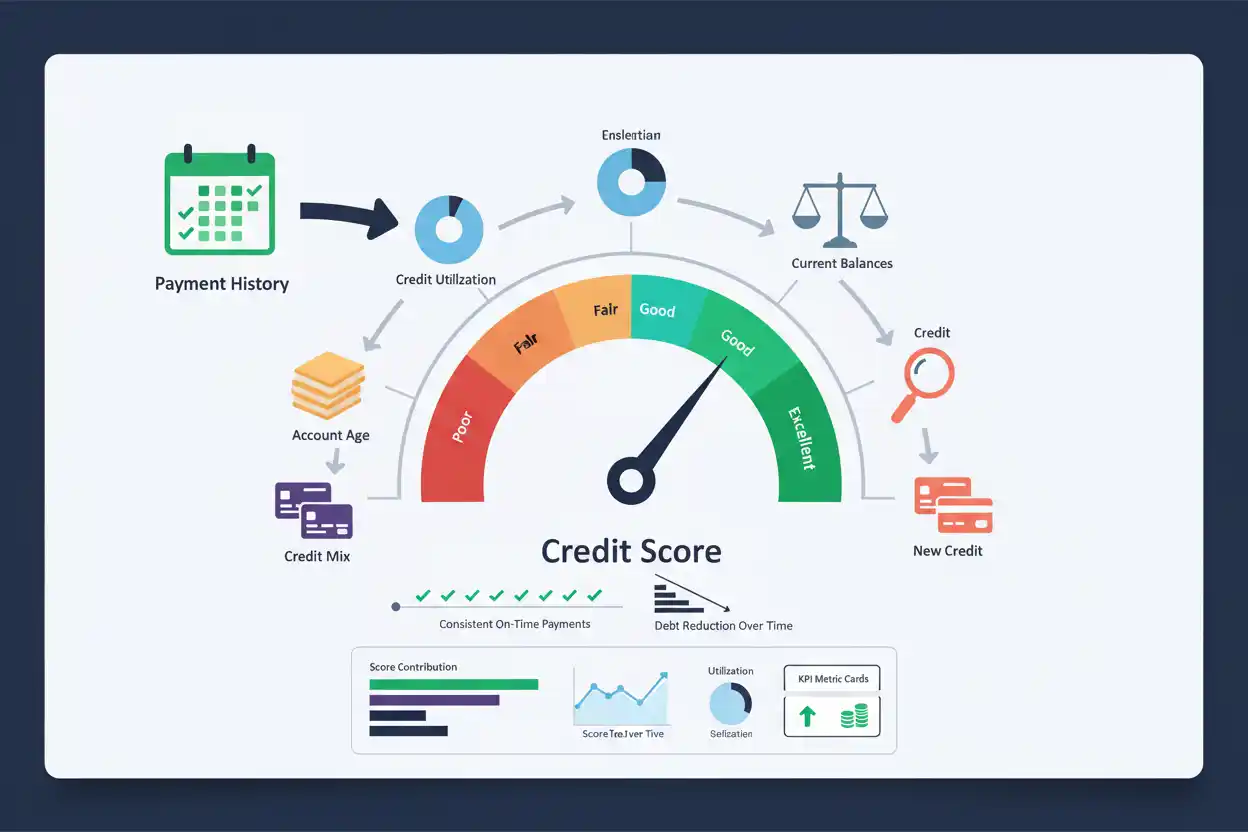

Credit score factors are the pieces of credit-report information that a scoring model uses to estimate how likely a borrower is to repay credit as agreed.
There is no single universal credit score formula that applies to every person, lender, and credit product.
Different scoring models can weigh information differently. The score can also vary depending on which credit report is used, when the score is calculated, and which version of the scoring model a lender requests.
That means statements such as “payment history is exactly X% of every credit score” should not be treated as universal mathematical rules.
The more useful approach is to understand the major categories of information that commonly influence credit scores and how borrower behavior affects those categories over time.
What Are Credit Score Factors?
Credit score factors are variables derived from information contained in a consumer’s credit reports.
Common factors can include:
- repayment history,
- revolving balances relative to limits,
- amounts owed,
- age and history of accounts,
- recent applications or new accounts,
- types of credit accounts,
- serious negative credit events.
The exact formula belongs to the scoring model.
A credit score itself can be understood conceptually as:
Credit Score = Scoring Model(Credit Report Information)
This is not a consumer-calculable equation. It simply illustrates that a score is generated from report data using a model.
Credit Scores Are Predictions, Not Account Balances
A credit score is designed to estimate credit risk.
It is not a measure of:
income, wealth, savings, net worth, or how much money someone has in a bank account.
Two people with identical incomes can have very different credit scores because their credit histories differ.
Likewise, a person with substantial savings can still have a limited or weak credit history.
The broader Loans & Credit framework explains how lenders use credit-related information alongside rates, limits, loan terms, and repayment capacity.
Payment History
Repayment history is one of the most important pieces of credit information.
It can include whether accounts were paid according to their terms and whether payments became delinquent.
The basic principle is straightforward:
Consistent On-Time Repayment Generally Supports Stronger Credit History
while repeated missed payments can indicate greater repayment risk.
However, no simple formula allows a consumer to calculate the exact number of score points gained or lost from one payment.
The effect depends on the scoring model and the rest of the credit file.
One Late Payment Does Not Have a Universal Point Cost
Suppose two borrowers each become late on one account.
Borrower A has a long history containing many otherwise positive accounts.
Borrower B has a short file with several existing delinquencies.
The same new event does not necessarily produce the same score change.
Credit scoring is contextual.
This is why statements such as “one late payment always costs 50 points” are unreliable.
Credit Utilization
One of the most measurable credit score factors is revolving-credit utilization.
The credit utilization ratio compares revolving balances with revolving limits.
Credit Utilization Ratio = Revolving Balance ÷ Revolving Credit Limit × 100
Suppose:
Credit card balance = $2,000
Credit limit = $10,000
Then:
Credit Utilization = $2,000 ÷ $10,000 × 100
Credit Utilization = 20%
If the balance rises to $8,000:
Credit Utilization = $8,000 ÷ $10,000 × 100
Credit Utilization = 80%
The borrower is now using a much larger share of available revolving credit.
Individual vs Overall Utilization
Credit scoring can consider utilization from more than one perspective.
Suppose you have:
Card A: $4,000 balance / $5,000 limit
Card B: $0 balance / $15,000 limit
Overall balances:
Total Balance = $4,000
Overall limits:
Total Limit = $20,000
Aggregate utilization:
Overall Utilization = $4,000 ÷ $20,000 × 100
Overall Utilization = 20%
But Card A itself is:
Card A Utilization = $4,000 ÷ $5,000 × 100
Card A Utilization = 80%
A moderate overall ratio can therefore coexist with very high utilization on an individual account.
Is 30% a Magic Credit Utilization Number?
No universal cliff exists where 29% is automatically good and 31% automatically bad.
Lower revolving utilization generally indicates less reliance on available revolving credit, all else equal.
A commonly cited guideline is to avoid using a large percentage of available revolving credit, but consumers should not treat one percentage as a guaranteed scoring threshold.
From a debt-cost perspective, paying balances down further can also reduce credit card APR interest when the account carries debt.
Credit Limit
A credit limit affects utilization because it forms the denominator of the calculation.
Suppose:
Balance = $3,000
Limit = $6,000
Utilization = 50%
If the issuer raises the limit to $10,000 and the balance stays unchanged:
Utilization = $3,000 ÷ $10,000 × 100
Utilization = 30%
The borrower has not repaid any debt, yet utilization has fallen because available revolving credit increased.
Conversely, a limit reduction can increase utilization without new spending.
Age of Credit Accounts
Credit scoring models can consider the history and age of accounts.
A longer established credit record gives a scoring model more information about past borrowing behavior.
Relevant measurements can include:
age of oldest account, average account age, and time since particular accounts were opened.
However, the precise treatment differs by scoring system.
Closing an account also does not necessarily erase its history immediately from a credit report.
New Credit
Opening several credit accounts within a short period can indicate changing borrowing behavior.
Credit scoring models may consider:
recent applications, hard inquiries, newly opened accounts, and time since recent credit activity.
Again, there is no universal formula such as:
One Inquiry = Exactly X Score Points
Different borrowers can experience different effects.
Hard Inquiry vs Soft Inquiry
A hard inquiry generally occurs when a lender accesses credit information as part of an application for credit.
A soft inquiry can occur for reasons that do not represent a new credit application, such as certain account reviews or consumer checks.
Not every credit-report inquiry therefore has the same scoring significance.
Consumers should review why an inquiry occurred rather than assuming every appearance on a report means an application reduced their score.
Credit Mix
Scoring models can consider experience with different kinds of credit.
Examples include:
revolving credit cards, installment loans, mortgages, auto loans, and other account types.
This does not mean consumers should take out unnecessary debt solely to create a more diverse credit file.
Paying interest just to influence credit mix can create a real financial cost for an uncertain scoring benefit.
Amounts Owed
Credit utilization is one part of the broader amounts-owed picture.
A scoring model can also evaluate:
outstanding installment balances, number of accounts with balances, remaining balances relative to original amounts, and other debt information.
A $5,000 revolving balance and a $5,000 installment balance therefore do not necessarily have identical scoring implications.
Their structures differ.
Credit Card Payoff and Credit Scores
A credit card payoff can reduce revolving balances.
Suppose:
Total card limits = $20,000
Total balances = $12,000
Utilization = $12,000 ÷ $20,000 × 100
Utilization = 60%
If the cardholder pays balances down to $4,000:
New Utilization = $4,000 ÷ $20,000 × 100
New Utilization = 20%
The reduction changes a measurable credit score factor while also reducing potential interest expense.
Minimum Payments and Credit History
Making the required credit card minimum payment by the due date can help avoid a missed-payment event on that account.
However, minimum payments can leave high revolving balances outstanding.
Therefore, two separate credit factors can be moving differently:
payment history may remain current while utilization stays high.
This is why simply saying “I always pay on time” does not describe the entire credit profile.
Daily Simple Interest Loans and Credit Scores
A daily simple interest loan determines interest from the outstanding principal and elapsed days.
Its interest calculation is separate from credit scoring.
However, repayment behavior on the loan can contribute information to a credit report when the lender reports the account.
The loan’s mathematical interest method and the scoring model therefore serve different purposes.
Account Balances and Reporting Dates
A credit score normally uses information appearing in the credit report at the time the score is generated.
That can create a timing difference between:
the balance in your banking app today and the balance currently appearing on your credit report.
For example, you may pay a $5,000 card balance down to $500 today.
If the issuer has not yet reported the lower balance, a scoring model may temporarily still see the older amount.
This is one reason score changes do not always occur immediately after a payment.
Credit Scores Can Differ
A consumer does not have only one permanent credit score.
Different lenders can obtain different scores because they may use:
different scoring models, different model versions, different credit-reporting agencies, different product-specific models, or reports generated on different dates.
Therefore:
Credit Score A ≠ Necessarily Credit Score B
even when both scores are legitimate.
Credit Score vs Credit Report
A credit report contains information about credit accounts and borrowing history.
A credit score is a numerical result produced by applying a scoring model to report information.
The report is therefore an important underlying data source.
Incorrect report information can potentially affect scores generated from that information.
Regular report review can help identify inaccurate accounts, balances, or payment history.
Income and Credit Scores
Income itself is generally not a component contained in the traditional credit-report information used to generate common credit scores.
However, lenders can separately consider income and debts during underwriting.
For example, the debt-to-income ratio compares monthly debt obligations with gross monthly income.
That ratio can influence lending decisions even though it is not the same thing as a credit score.
Credit Score vs Loan Approval
A strong score does not guarantee loan approval.
Lenders can also consider:
income, debt, collateral, loan amount, employment or business information where applicable, product eligibility, down payment, and internal underwriting rules.
The score is one input rather than the entire lending decision.
Credit Score vs Interest Rate
Credit scores can influence the rates borrowers are offered.
A lender may view a stronger credit profile as lower risk and offer better terms.
However, the rate also depends on market conditions, loan type, collateral, term, lender policy, and other variables.
Therefore:
Credit Score Does Not Alone Determine Interest Rate
Credit Score vs APR
APR measures borrowing cost.
A credit score helps lenders evaluate borrower risk.
The two can interact because a stronger credit profile may qualify for a lower interest rate or APR.
Still, they are fundamentally different concepts.
How to Strengthen the Factors You Can Control
The most practical approach is not to chase individual score points.
Instead, focus on financially sound behaviors that also tend to support credit quality:
make required payments on time, keep revolving balances manageable, avoid unnecessary applications, review credit reports for errors, and allow positive account history to develop.
Borrowing money solely to improve a score generally creates unnecessary cost.
Common Credit Score Factor Mistakes
One common mistake is believing there is one universal scoring formula.
Another is treating the 30% utilization guideline as a magical boundary.
Consumers also sometimes carry credit-card debt because they believe paying interest improves a score. Carrying interest-bearing debt is not required simply to demonstrate account activity.
Another mistake is closing several cards solely to increase a score without considering the effect on total available revolving credit.
Finally, consumers sometimes interpret small score fluctuations as evidence of a major financial change even though reporting timing and model differences can cause normal variation.
Frequently Asked Questions
What are the main credit score factors?
Common factors include payment history, revolving utilization, amounts owed, account history, recent credit activity, and types of credit.
Is there one official credit score formula?
No. Multiple scoring models exist, and different lenders can use different scores.
What is the most important credit score factor?
Payment history and existing debt usage are generally important, but exact weightings depend on the scoring model.
Does credit utilization affect credit scores?
Yes. Scoring models commonly consider how much revolving credit you are using relative to available limits.
Is 30% utilization a hard cutoff?
No. It is a commonly cited guideline rather than a universal mathematical scoring boundary.
Does paying a credit card in full help?
Paying balances down can reduce utilization and avoids ongoing interest when applicable.
Does carrying a balance improve a credit score?
You do not need to pay interest or maintain revolving debt merely to establish positive payment history.
Does income affect a credit score?
Traditional credit scores are based primarily on credit-report information. Lenders can separately consider income when making lending decisions.
Does checking my own credit score hurt it?
Consumer credit checks are generally different from lender-initiated hard inquiries associated with new credit applications.
Why are my credit scores different?
Different scoring models, report sources, dates, and loan-specific versions can produce different scores.
Does closing a card improve my score?
Not necessarily. Closing a card can reduce available revolving credit and potentially increase utilization.
How quickly can a credit score change?
A score can change when new information reaches the credit report and a new score is generated, but reporting schedules and scoring models vary.
Final Takeaway
Credit score factors are the pieces of credit-report information that scoring models use to estimate repayment risk.
There is no single consumer formula that accurately reproduces every credit score.
One factor you can calculate directly is revolving utilization:
Credit Utilization Ratio = Revolving Balance ÷ Revolving Credit Limit × 100
A $2,000 balance on a $10,000 limit produces 20% utilization, while an $8,000 balance produces 80% utilization.
Payment history, account age, recent credit activity, debt balances, and credit mix can also influence scores.
The most effective long-term approach is not to optimize one mysterious scoring formula. It is to maintain accurate credit reports, pay obligations as agreed, control revolving debt, and apply for new credit deliberately.