The debt service coverage ratio, or DSCR, measures how much qualifying income or cash flow is available relative to required debt service.
The core formula is:
Debt Service Coverage Ratio = Cash Flow Available for Debt Service ÷ Total Debt Service
For income-producing real estate, the numerator is commonly net operating income:
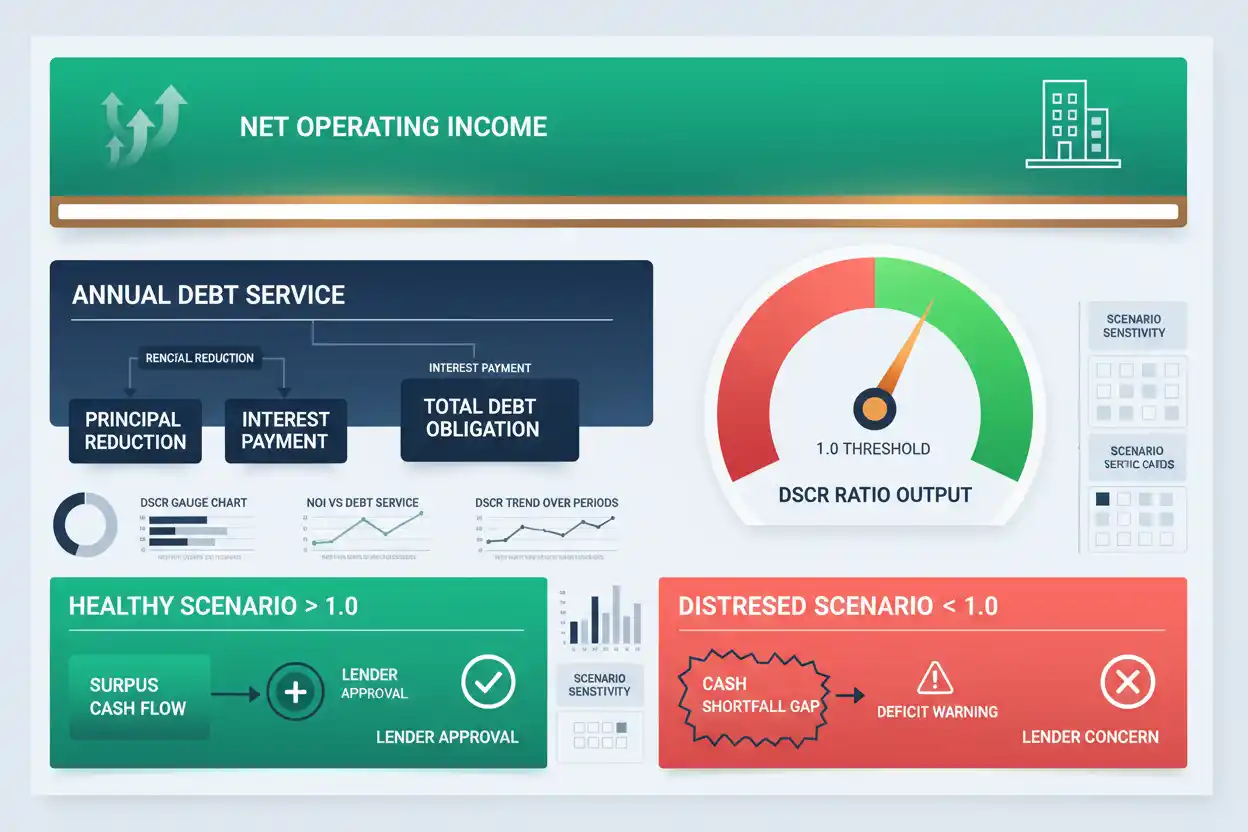
DSCR = Net Operating Income ÷ Annual Debt Service
If a property generates $150,000 of annual net operating income and requires $120,000 of annual principal and interest payments:
DSCR = $150,000 ÷ $120,000
DSCR = 1.25
A 1.25 DSCR means the income measure used in the calculation equals 1.25 times the required debt service.
The ratio is widely useful, but the numerator must be defined carefully. A property-level DSCR using NOI is not automatically identical to a company-level DSCR using operating cash flow or another lender-defined cash-flow measure.
What Is Debt Service Coverage Ratio?
Debt service coverage ratio measures repayment capacity.
It compares:
cash or income available for debt repayment
with:
principal and interest obligations that must be paid.
Conceptually:
DSCR > 1.0 = Available Cash Flow Exceeds Debt Service
DSCR = 1.0 = Available Cash Flow Equals Debt Service
DSCR < 1.0 = Available Cash Flow Is Below Debt Service
That interpretation is simple.
What counts as “available cash flow” can vary substantially by lending context.
DSCR Formula
A general formula is:
DSCR = Cash Flow Available for Debt Service ÷ Total Debt Service
For commercial real estate:
DSCR = NOI ÷ Annual Principal and Interest Debt Service
For a business, a lender may instead use a defined measure based on operating cash flow, earnings adjusted for noncash expenses, owner compensation, taxes, or other items.
There is no reason to assume every lender calculates business DSCR from exactly the same numerator.
DSCR Example
Suppose a commercial property produces:
Rental and other qualifying operating revenue = $500,000
Operating expenses = $320,000
Net operating income:
NOI = $500,000 − $320,000
NOI = $180,000
Annual debt payments:
Principal = $70,000
Interest = $65,000
Total debt service:
Debt Service = $70,000 + $65,000
Debt Service = $135,000
Now calculate DSCR:
DSCR = $180,000 ÷ $135,000
DSCR = 1.33
The property’s NOI is approximately 1.33 times its annual debt service.
What Does a DSCR of 1.33 Mean?
A 1.33 ratio means:
Available Income = 133% of Required Debt Service
The excess coverage is:
Coverage Cushion = $180,000 − $135,000
Coverage Cushion = $45,000
As a percentage of debt service:
Cushion = $45,000 ÷ $135,000 × 100
Cushion ≈ 33.3%
That does not mean the investment earns a 33.3% return.
It simply describes the amount by which the income measure exceeds the specified debt service.
DSCR of 1.0
Suppose:
NOI = $120,000
Debt service = $120,000
Then:
DSCR = $120,000 ÷ $120,000
DSCR = 1.00
The income measure exactly equals scheduled debt service.
There is no cushion in the calculation for a decline in income or unexpected cost.
DSCR Below 1.0
Suppose:
Cash flow available = $90,000
Debt service = $120,000
DSCR = $90,000 ÷ $120,000
DSCR = 0.75
The business or property produces only $0.75 of qualifying cash flow for every $1.00 of debt service.
The implied shortfall is:
Debt Service Shortfall = $120,000 − $90,000
Shortfall = $30,000
Other cash, asset sales, new borrowing, owner contributions, or another source would be required to cover the difference.
What Counts as Debt Service?
Debt service typically includes the principal and interest payments required during the measurement period.
A simplified annual calculation is:
Annual Debt Service = Annual Principal Payments + Annual Interest Payments
Suppose:
Monthly principal-and-interest payment = $10,000
Then:
Annual Debt Service = $10,000 × 12
Annual Debt Service = $120,000
Other lender definitions can include additional fixed obligations, so the exact loan analysis should follow the lender’s methodology.
DSCR and Amortizing Loans
An amortizing loan requires scheduled principal as well as interest.
That means DSCR should generally consider the complete required debt payment rather than only interest when the applicable definition calls for full debt service.
A business can easily cover interest while still struggling to repay principal.
This is why DSCR provides a different view from the interest coverage ratio.
DSCR vs Interest Coverage Ratio
Interest coverage focuses on interest expense.
A common formula is:
Interest Coverage Ratio = EBIT ÷ Interest Expense
DSCR is broader because debt service can include principal.
Suppose:
Operating income measure = $200,000
Interest expense = $50,000
Principal payments = $70,000
Interest coverage:
Interest Coverage = $200,000 ÷ $50,000 = 4.0
DSCR using the same $200,000 as an illustrative numerator:
DSCR = $200,000 ÷ ($50,000 + $70,000)
DSCR = $200,000 ÷ $120,000
DSCR ≈ 1.67
Both ratios describe debt capacity, but they do not measure the same obligation.
DSCR vs Debt-to-Income Ratio
The debt-to-income ratio is commonly used in consumer lending.
DTI = Monthly Debt Payments ÷ Gross Monthly Income × 100
DSCR is generally more common in business and property lending.
The direction also differs:
Higher DSCR generally indicates more coverage.
Lower DTI generally indicates less debt burden.
Therefore, a “high ratio” is not always interpreted the same way across debt metrics.
DSCR and Debt Consolidation Loans
A debt consolidation loan for a business can change annual debt service.
Suppose a business currently pays:
Loan A = $5,000 monthly
Loan B = $4,000 monthly
Total:
Monthly Debt Service = $9,000
Annual:
Annual Debt Service = $108,000
If refinancing replaces them with one $7,500 monthly payment:
New Annual Debt Service = $7,500 × 12
New Annual Debt Service = $90,000
If qualifying cash flow remains unchanged, DSCR improves because the denominator has fallen.
But a longer refinancing term can increase total interest even when DSCR improves.
DSCR and Debt Consolidation
The broader debt consolidation strategy should therefore consider both:
cash-flow coverage and financing cost.
A refinancing transaction that reduces the monthly payment can improve short-term DSCR.
That does not prove it reduces total cost.
DSCR and Debt Payoff Strategy
A debt payoff strategy can reduce debt obligations over time.
For a business, eliminating one loan can increase future debt-service coverage because required payments fall.
However, aggressively paying debt early can also consume cash needed for working capital.
Coverage analysis should therefore be combined with liquidity planning.
DSCR and Debt Snowball
The debt snowball is primarily a consumer-oriented payoff sequencing strategy.
DSCR is a coverage ratio.
They should not be combined into one formula.
The connection is simply that eliminating debt can eventually reduce required debt service.
Business Loan Payments and DSCR
Business loan payments determine the contractual periodic obligation.
DSCR tests whether available business cash flow can cover that obligation.
Suppose:
Monthly business loan payment = $8,000
Annual debt service:
$8,000 × 12 = $96,000
Available cash flow = $144,000
Then:
DSCR = $144,000 ÷ $96,000
DSCR = 1.50
Business Loan APR vs DSCR
Business loan APR measures annualized borrowing cost.
DSCR measures repayment capacity.
A low-APR loan can still create a weak DSCR when principal is large or repayment is compressed into a short term.
Conversely, a longer-term loan can improve DSCR by reducing annual payments while increasing lifetime interest.
Cost and coverage should therefore be evaluated separately.
DSCR and Working Capital
Working capital represents short-term operating resources relative to current liabilities.
DSCR measures the ability of defined income or cash flow to cover debt service.
A business can have a DSCR above 1.0 and still experience liquidity pressure if cash is tied up in inventory or receivables.
That is why lenders and managers do not rely on one ratio alone.
DSCR and Operating Cash Flow
Operating cash flow can provide insight into actual cash generation.
However, a lender’s DSCR numerator may adjust operating cash flow differently.
Always identify whether the calculation uses:
NOI, EBITDA-based cash flow, operating cash flow, net income plus adjustments, or another defined measure.
DSCR and Free Cash Flow
Free cash flow can also differ from the DSCR numerator.
Free cash flow may deduct capital expenditures and other investments that a particular lender’s coverage calculation treats differently.
Therefore:
Free Cash Flow ≠ Automatically DSCR Numerator
The definitions should be reconciled explicitly.
DSCR and Cash Flow Forecasting
Historical DSCR tells you what happened.
A cash flow forecast can estimate whether future debt service remains covered.
Suppose historical DSCR is 1.40.
If next year’s operating cash flow is projected to fall 20% while payments remain unchanged, forward DSCR can decline materially.
Lending decisions therefore often require both historical and projected analysis.
DSCR Sensitivity Analysis
Suppose:
NOI = $180,000
Debt service = $135,000
DSCR = 1.33
If NOI falls 10%:
New NOI = $180,000 × 90%
New NOI = $162,000
New DSCR:
DSCR = $162,000 ÷ $135,000
DSCR = 1.20
If NOI falls 20%:
New NOI = $144,000
DSCR = $144,000 ÷ $135,000
DSCR ≈ 1.07
The original 1.33 coverage can therefore deteriorate quickly when income weakens.
What Is a Good DSCR?
There is no universal DSCR target for every lender, industry, borrower, and loan.
A lender may require a cushion above 1.0 because actual cash flow can fluctuate.
The appropriate threshold depends on:
business volatility, collateral, loan structure, industry risk, historical performance, guarantees, and lender policy.
Therefore, a ratio such as 1.25 should not be treated as a universal approval rule.
DSCR for Seasonal Businesses
Annual DSCR can hide seasonal cash shortages.
Suppose a business earns most of its cash in the fourth quarter but makes debt payments monthly.
Annual cash flow may comfortably exceed annual debt service.
Yet the company could still experience liquidity stress in spring or summer.
Monthly or quarterly cash-flow analysis can reveal this timing risk.
DSCR and Variable-Rate Loans
A fixed vs variable interest rate loan can change future debt service.
Suppose a variable-rate loan currently requires $100,000 per year.
If rates rise and debt service increases to $120,000 while cash flow stays at $150,000:
Old DSCR:
$150,000 ÷ $100,000 = 1.50
New DSCR:
$150,000 ÷ $120,000 = 1.25
Interest-rate changes can therefore reduce coverage even when business performance is unchanged.
Common DSCR Mistakes
One common mistake is comparing NOI with interest expense only when the required denominator should include principal.
Another is mixing monthly cash flow with annual debt service.
A third is assuming every lender defines available cash flow identically.
Analysts also sometimes rely on one historical year while ignoring a decline in projected cash flow.
Finally, DSCR should not be interpreted as profitability, return on investment, or liquidity. It is specifically a debt-coverage measure.
Frequently Asked Questions
What does DSCR stand for?
DSCR stands for debt service coverage ratio.
What is the debt service coverage ratio formula?
DSCR = Cash Flow Available for Debt Service ÷ Total Debt Service
How is property DSCR commonly calculated?
A common property-level formula is:
DSCR = Net Operating Income ÷ Annual Debt Service
What does a DSCR of 1.25 mean?
It means the defined cash-flow measure equals 1.25 times required debt service.
What does DSCR below 1 mean?
It indicates the defined cash flow is less than required debt service for the measurement period.
Is a higher DSCR better?
Generally, a higher ratio indicates a larger debt-service cushion, although the underlying cash-flow quality still matters.
Is DSCR the same as interest coverage?
No. Interest coverage focuses on interest, while DSCR can include both principal and interest payments.
Is DSCR the same as DTI?
No. DTI is generally a consumer debt-payment-to-income measure, while DSCR is commonly used for businesses and income-producing assets.
What counts as debt service?
Typically required principal and interest payments, although lender definitions can include additional obligations.
Is 1.25 DSCR required by every lender?
No. Required coverage levels vary by lender, loan type, borrower risk, and underwriting policy.
Can refinancing improve DSCR?
Yes, when refinancing reduces required periodic debt service while available cash flow remains unchanged.
Why should DSCR be forecast?
Future cash flow and future debt payments can differ from historical amounts, so projected coverage can reveal risks that a historical ratio misses.
Final Takeaway
The debt service coverage ratio measures how much qualifying cash flow is available relative to required debt payments.
The core formula is:
Debt Service Coverage Ratio = Cash Flow Available for Debt Service ÷ Total Debt Service
If annual NOI is $180,000 and annual principal-and-interest debt service is $135,000:
DSCR = $180,000 ÷ $135,000 = 1.33
The business or property therefore produces approximately $1.33 of the specified income measure for every $1.00 of debt service.
A DSCR above 1.0 indicates positive coverage, but the real strength of the ratio depends on the quality and stability of the numerator, the completeness of the debt-service denominator, future rate changes, and the lender’s specific underwriting definition.