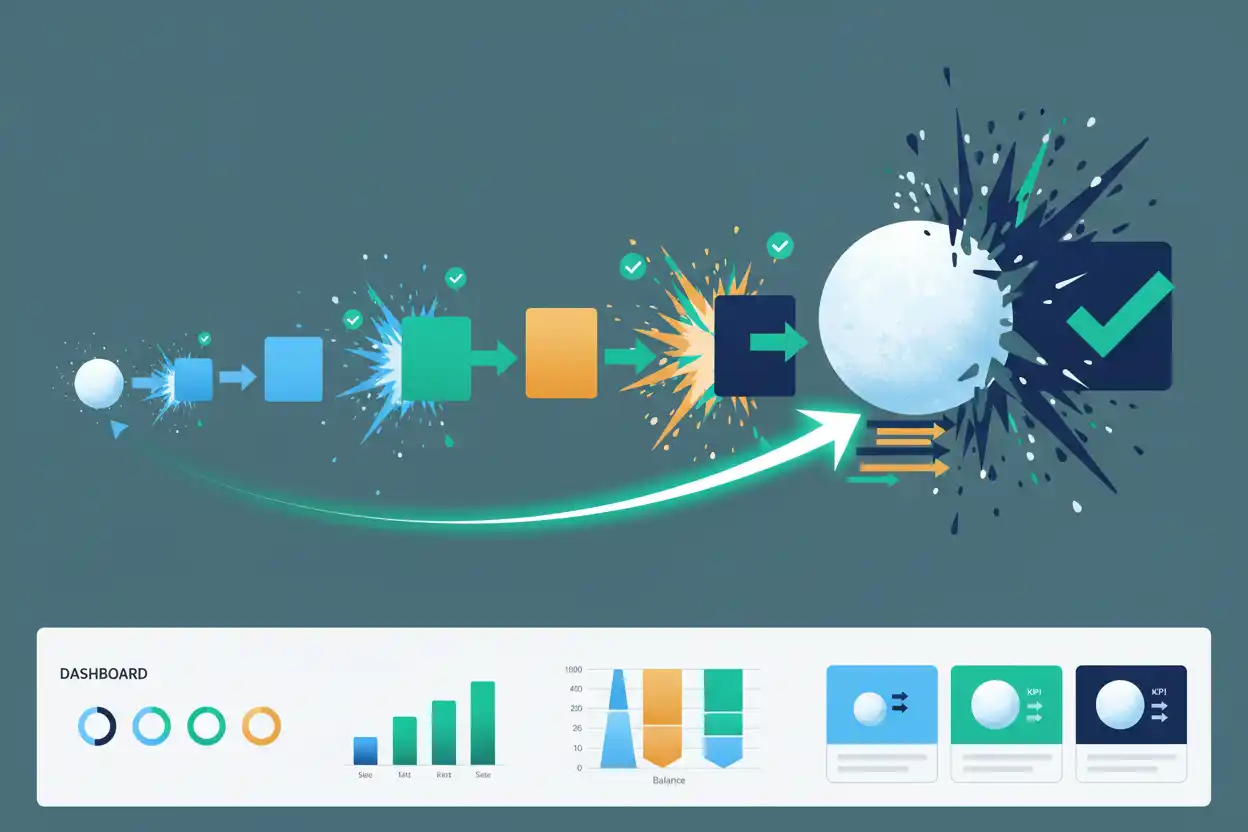

The debt snowball is a repayment strategy that focuses extra money on the smallest debt balance first, regardless of interest rate.
You continue making required payments on every other debt.
When the smallest balance reaches zero, the entire payment that had been going to it rolls into the next-smallest debt.
The priority rule is:
Debt Snowball Priority = Smallest Outstanding Balance First
The method is called a snowball because the targeted payment grows as each debt disappears.
It is not designed primarily to minimize interest. The debt avalanche usually has the mathematical advantage when interest rates differ.
The snowball’s strength is different: it can produce faster account closures and increasingly large payments as the process continues.
What Is the Debt Snowball?
The debt snowball is a multi-debt payoff method.
The process is:
- list debts from smallest balance to largest;
- continue required payments on all debts;
- send every available extra dollar to the smallest balance;
- eliminate that debt;
- roll its entire payment into the next-smallest debt;
- repeat until all targeted balances are zero.
The order is determined by balance rather than APR.
Debt Snowball Formula
The extra amount available for the target debt is:
Extra Snowball Payment = Total Debt Budget − Required Payments on All Debts
The total amount sent to the current target is:
Target Payment = Target Minimum Payment + Extra Snowball Payment
After a target debt is eliminated:
Next Target Payment = Existing Next-Debt Payment + Former Target Payment
That is how the snowball grows.
Debt Snowball Example
Suppose you have:
| Debt | Balance | APR | Minimum |
|---|---|---|---|
| Card A | $800 | 16% | $40 |
| Card B | $2,500 | 27% | $90 |
| Personal Loan | $5,000 | 12% | $160 |
| Card C | $7,000 | 22% | $210 |
Required payments total:
Minimum Payments = $40 + $90 + $160 + $210
Minimum Payments = $500
Suppose your total debt budget is $800.
Extra amount:
Snowball Extra = $800 − $500
Snowball Extra = $300
The smallest balance is Card A at $800.
Therefore:
Card A Payment = $40 + $300
Card A Payment = $340
The other debts receive only their required payments during this stage.
After Card A Is Paid Off
Once Card A reaches zero, its $340 payment becomes available.
The next-smallest balance is Card B.
Card B already requires $90.
Its new payment becomes:
Card B Payment = $90 + $340
Card B Payment = $430
The overall household debt budget remains $800.
Nothing new has been added.
The existing payment has simply been redirected.
Third Stage
After Card B is eliminated, the $430 going to Card B joins the $160 payment on the personal loan.
Personal Loan Payment = $160 + $430
Personal Loan Payment = $590
Card C continues receiving its $210 required payment.
Again:
$590 + $210 = $800
The entire debt budget remains in use.
Final Stage
Once the personal loan is repaid, its $590 payment rolls into Card C:
Final Card Payment = $210 + $590
Final Payment = $800
At that point, the entire original debt budget attacks the final balance.
That growing payment is the snowball effect.
Why Small Balances Come First
The snowball does not claim that small debts are the most expensive.
It prioritizes them because they can often be eliminated relatively quickly.
Closing an account balance can create:
- a visible milestone,
- one fewer payment to manage,
- one less outstanding debt,
- and a larger payment available for the next target.
For borrowers who struggle to maintain a long repayment plan, these milestones can be valuable.
Debt Snowball vs Debt Avalanche
The debt payoff strategy page compares both approaches directly.
The core difference is:
Snowball = Smallest Balance First
Avalanche = Highest APR First
In the example above, Card A has the smallest balance at $800 but only a 16% APR.
Card B carries a higher 27% APR.
The snowball targets Card A.
The avalanche targets Card B.
Which Method Saves More Interest?
The avalanche generally saves more interest when all other variables remain equal because it removes higher-cost debt first.
Suppose:
Debt A = $1,000 at 10%
Debt B = $5,000 at 30%
Snowball targets Debt A.
Avalanche targets Debt B.
Every extra dollar applied to the 30% debt prevents more interest than the same dollar applied to 10% debt over the same period.
The snowball knowingly gives up some mathematical efficiency in exchange for balance-elimination speed.
When Snowball and Avalanche Have the Same Order
Sometimes both methods produce the same priority.
Suppose:
Debt A = $1,000 at 29%
Debt B = $3,000 at 20%
Debt C = $7,000 at 12%
The smallest debt also has the highest rate.
Both methods therefore target:
Debt A → Debt B → Debt C.
In this situation, there is no strategic conflict.
Debt Snowball and Minimum Payments
The snowball requires every contractual credit card minimum payment or loan payment to remain current.
Suppose the target card receives $340.
That does not mean payments on the other debts stop.
Skipping required payments can create fees, additional interest, or other account consequences that undermine the strategy.
Debt Snowball and Credit Card Payoff
A credit card payoff calculation can estimate how quickly a target card will disappear at the snowball payment.
Suppose:
Balance = $2,500
APR = 27%
Snowball payment = $430
The payoff calculation can estimate how many months are required.
The snowball itself determines why that card is currently receiving the $430: it is the smallest remaining balance.
Debt Snowball and Debt-to-Income Ratio
The debt-to-income ratio compares monthly debt payments with gross monthly income.
During an active snowball, the borrower normally keeps the same overall repayment budget even after a debt disappears.
That means cash-flow relief is deliberately postponed until all debts are repaid.
However, if the borrower needed to stop the strategy after eliminating one debt, the contractual required monthly payments would be lower because that account is gone.
Debt Snowball and DSCR
The debt service coverage ratio is primarily a business or property debt-capacity measure.
It is not part of the snowball formula.
Still, a business using a balance-priority debt strategy must ensure that aggressive extra repayments do not weaken cash reserves needed to operate.
Debt Snowball and EMI
EMI refers to an equated monthly installment.
An installment debt can participate in a snowball alongside credit cards.
Its outstanding balance determines its position in the snowball sequence.
The EMI itself remains the required payment until that debt becomes the target and receives additional principal.
Debt Snowball and Debt Consolidation Loans
A debt consolidation loan can eliminate the need for a snowball by replacing several balances with one loan.
However, consolidation has its own tradeoffs.
The new loan can contain fees, a longer term, or a rate that is not sufficiently lower.
A snowball does not require new borrowing.
Debt Snowball and Debt Consolidation
Debt consolidation restructures obligations.
The snowball keeps the existing obligations and changes only the order of extra payments.
A borrower who does not qualify for attractive consolidation terms can still use the snowball.
Daily Simple Interest Debt
If one debt uses daily simple interest, extra principal payments reduce its future daily interest when the lender applies them to principal.
However, a pure snowball does not move that loan ahead in the order merely because its interest accrues daily.
Balance remains the priority rule.
Credit Utilization and Snowball Order
The credit utilization ratio does not determine snowball priority.
Suppose:
Card A balance = $500 on a $10,000 limit
Card B balance = $2,000 on a $2,500 limit
The snowball targets Card A because $500 is smaller.
Yet Card B has 80% utilization.
A borrower who wants to prioritize utilization may choose a hybrid approach rather than a pure snowball.
Credit Score Factors
The credit score factors framework should not be confused with debt payoff mathematics.
The snowball primarily seeks behavioral momentum and debt elimination.
As revolving balances decline, utilization can improve.
Consistent payments also preserve payment history.
Those are secondary effects rather than the snowball’s selection rule.
Credit Limits and the Snowball
A credit limit also does not determine which debt comes first.
A $500 balance on a $20,000-limit card still ranks ahead of a $1,500 balance on a $2,000-limit card in a strict snowball.
Only outstanding balance determines the order.
Promotional APR Debt
Suppose:
Card A = $1,000 at 0% for nine months
Card B = $1,500 at 25%
A strict snowball targets Card A.
However, that can sacrifice significant interest savings because Card B is expensive while Card A temporarily costs nothing.
This is a situation where a hybrid or avalanche strategy can be financially stronger.
Fixed vs Variable Rates
A fixed vs variable interest rate difference does not change a pure snowball’s order because balance, not rate, determines priority.
But a rapidly rising variable rate can make the extra interest cost of sticking rigidly to the snowball larger.
Borrowers should understand what they are trading for the motivational advantage.
Prepayment Penalties
Before sending a large snowball payment to an installment loan, check for a prepayment penalty.
If the lender charges a significant fee for early repayment, the strategy may need adjustment.
Should Emergency Savings Come Before the Snowball?
A borrower with no cash reserve can become dependent on credit whenever an unexpected expense occurs.
That can undermine the snowball.
For example:
Pay $1,000 extra toward debt today.
Encounter a $1,000 emergency tomorrow.
Put $1,000 back on a credit card.
Little has been achieved.
The appropriate emergency reserve depends on personal cash-flow risk, essential expenses, insurance, and access to liquidity.
Snowball With Windfalls
Bonuses, tax refunds, asset-sale proceeds, or other one-time cash can accelerate the target balance.
Suppose the current snowball debt is $2,000 and a $1,200 windfall is available.
Applying it to the target immediately can remove a large portion of principal and potentially advance the next snowball stage by several months.
Common Debt Snowball Mistakes
One mistake is ranking debts by monthly payment rather than balance.
Another is failing to roll the old payment into the next debt after a balance is eliminated.
Borrowers can also continue adding new balances while following the strategy.
A fourth mistake is ignoring extremely high interest rates or expiring promotional offers even when they create a compelling reason to modify the order.
Finally, paying off a small loan with a major prepayment penalty can produce unnecessary cost.
Frequently Asked Questions
What is the debt snowball?
It is a payoff strategy that sends extra money to the smallest outstanding debt first.
What is the debt snowball formula?
The targeting rule is:
Target Debt = Smallest Outstanding Balance
and:
Target Payment = Minimum Payment + Available Extra Payment
Do interest rates matter in the debt snowball?
Not for the strict priority order. Balance size determines which debt is targeted.
Does the snowball save the most interest?
Usually not when rates differ. The debt avalanche generally has the mathematical interest-saving advantage.
Why use the snowball?
It can create quick payoff milestones and simplify the debt list sooner.
What happens after the smallest debt is paid?
Its entire payment is rolled into the next-smallest debt.
Do I keep paying minimums on other debts?
Yes. Required payments continue on every debt.
Can loans and credit cards both be included?
Yes, assuming extra repayment is permitted and any prepayment terms have been considered.
What if the smallest debt has a 0% promotional rate?
A strict snowball still targets it, but a hybrid or avalanche approach may save more interest.
Does the snowball improve credit utilization?
It can as card balances fall, but utilization is not the priority rule.
Can I use a balance transfer with a snowball?
Yes, but transferring debt changes balances, rates, and potentially the best repayment order.
Is debt snowball better for everyone?
No. Borrowers prioritizing minimum interest cost may prefer the avalanche.
Final Takeaway
The debt snowball prioritizes one variable:
Smallest Balance First
If required payments total $500 and your total debt budget is $800, the extra snowball payment is:
$800 − $500 = $300
If the smallest debt has a $40 minimum payment:
Target Payment = $40 + $300 = $340
Once that debt disappears, the full $340 moves to the next-smallest balance, causing the payment to grow.
The debt snowball may not minimize interest, but it can simplify the debt list quickly and create visible repayment milestones. Its success depends on keeping required payments current, avoiding new debt, and continuing to roll every freed payment forward until the final balance reaches zero.