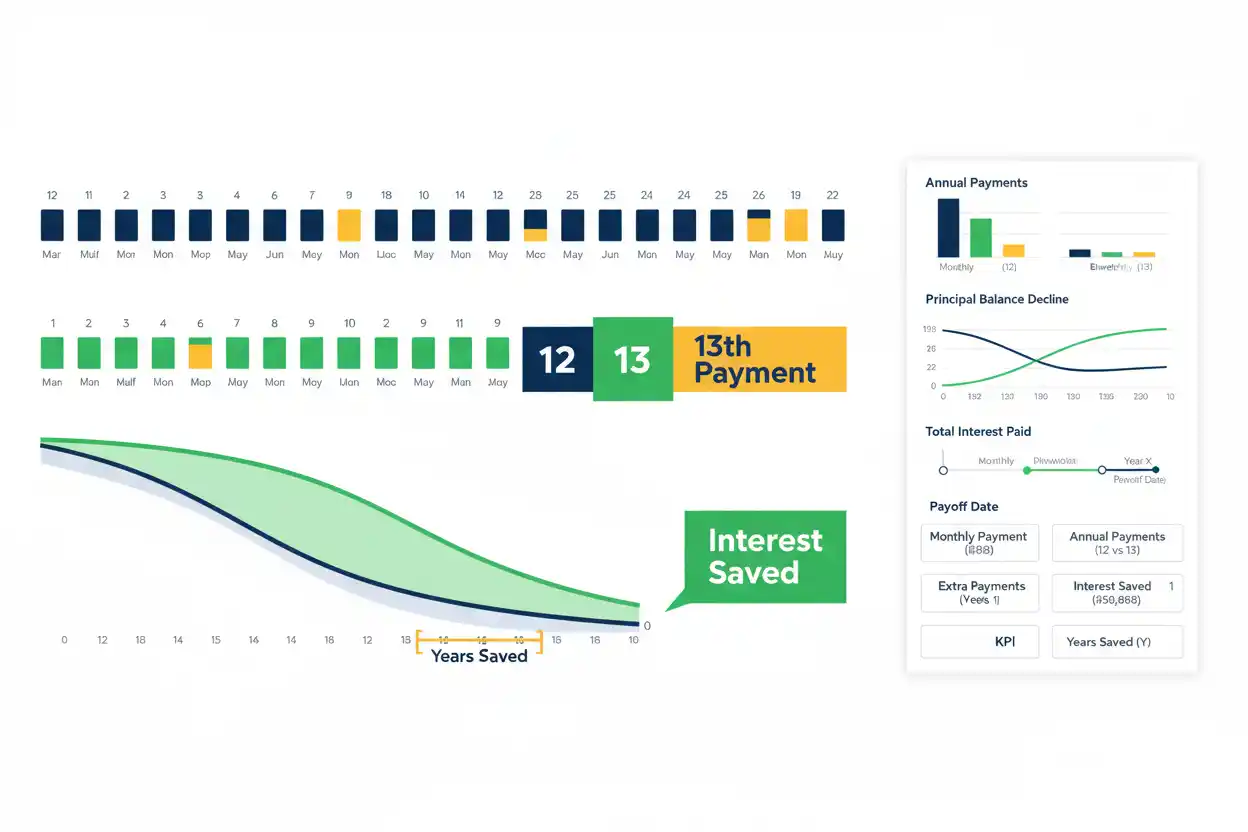

Biweekly mortgage payments are a repayment strategy in which mortgage payments are made every two weeks rather than once per month.
The most common version divides the normal monthly principal-and-interest payment in half.
Because a year has approximately 52 weeks:
Biweekly Payments per Year = 52 ÷ 2
Biweekly Payments per Year = 26
Twenty-six half-payments equal:
26 ÷ 2 = 13 Full Monthly Payments
A normal monthly schedule contains only 12 payments.
Therefore, a true biweekly schedule can result in the equivalent of one additional monthly payment per year.
That extra principal reduction can shorten the mortgage and reduce interest.
However, the benefit depends on how the mortgage servicer accepts and applies payments. CFPB materials have specifically warned consumers about third-party biweekly programs that charged substantial fees or misrepresented how payments were applied, so borrowers should verify the servicing mechanics rather than assuming every commercial “biweekly program” produces the advertised savings.
How Biweekly Mortgage Payments Work
Suppose your normal monthly principal-and-interest payment is:
$1,800
Half is:
Biweekly Payment = $1,800 ÷ 2
Biweekly Payment = $900
Across 26 payments:
Annual Biweekly Payments = $900 × 26
Annual Payments = $23,400
A normal monthly schedule would produce:
Annual Monthly Payments = $1,800 × 12
Annual Payments = $21,600
Difference:
Extra Annual Payment = $23,400 − $21,600
Extra Annual Payment = $1,800
The extra amount equals one full regular monthly payment.
Biweekly Mortgage Payment Formula
For a standard half-payment strategy:
Biweekly Payment = Monthly Mortgage Payment ÷ 2
Annual payment amount:
Annual Biweekly Amount = Biweekly Payment × 26
Which simplifies to:
Annual Biweekly Amount = Monthly Payment × 13
Normal monthly annual payment:
Annual Monthly Amount = Monthly Payment × 12
Therefore:
Extra Annual Amount = One Monthly Payment
This is the core arithmetic behind the strategy.
Biweekly Mortgage Example
Suppose:
Mortgage principal = $300,000
Interest rate = 6%
Term = 30 years
The standard fixed principal-and-interest payment is:
Monthly Payment ≈ $1,798.65
Half-payment:
Biweekly Payment ≈ $1,798.65 ÷ 2
Biweekly Payment ≈ $899.33
Annual biweekly total:
$899.33 × 26 ≈ $23,382.47
Normal annual total:
$1,798.65 × 12 ≈ $21,583.82
Difference:
Approximately $1,798.65
The borrower effectively contributes one additional monthly payment during each full year.
Standard Mortgage Interest Cost
Without additional payments:
Total Scheduled Payments ≈ $1,798.65 × 360
Total Payments ≈ $647,514.57
Total interest:
Total Interest ≈ $647,514.57 − $300,000
Total Interest ≈ $347,514.57
That is the baseline against which additional-payment strategies can be compared.
Monthly-Equivalent Extra-Payment Approximation
Actual biweekly servicing can depend on precisely when payments are credited.
For a clean illustration, we can approximate the same annual extra amount by dividing one extra monthly payment across 12 months.
Monthly extra:
Extra Monthly Amount = $1,798.65 ÷ 12
Extra Monthly Amount ≈ $149.89
Total monthly payment:
$1,798.65 + $149.89
≈ $1,948.54
Under this simplified monthly-equivalent model, the $300,000 mortgage is repaid in approximately:
295 Months
rather than 360 months.
That is approximately:
24 Years and 7 Months
instead of 30 years.
Approximate Interest Savings
Under the monthly-equivalent extra-payment model:
Approximate total interest ≈ $273,849.21
Standard total interest ≈ $347,514.57
Estimated savings:
Interest Savings ≈ $347,514.57 − $273,849.21
Interest Savings ≈ $73,665.36
This is an illustrative amortization result.
Actual biweekly savings can differ because of:
payment-crediting dates, servicer procedures, rounding, fees, escrow treatment, and how partial payments are held or applied.
Why the Strategy Saves Interest
The strategy is not magical.
It works because more principal is paid sooner.
The fundamental relationship is:
Lower Principal Earlier → Less Future Interest
The mortgage principal page explains the balance mechanics.
Once extra payments reduce principal, the next interest calculation begins from a smaller balance.
True Biweekly vs Twice-Monthly Payments
Biweekly means every two weeks.
Twice monthly means two payments each calendar month.
These are not the same.
Biweekly:
26 Half-Payments per Year
Twice monthly:
24 Half-Payments per Year
Twenty-four half-payments equal exactly 12 full payments.
Therefore:
Twice-Monthly Payment Schedule ≠ Automatically One Extra Payment
The additional annual principal is created by the 26-payment structure.
Biweekly Payments vs One Extra Annual Payment
Instead of paying every two weeks, a borrower can often create similar annual principal acceleration by making one additional mortgage payment each year.
For example:
Regular monthly payment = $1,798.65
One extra payment:
Annual Extra Principal Target ≈ $1,798.65
Whether the exact savings match biweekly timing depends on when the additional principal reaches the loan.
Earlier principal reduction generally saves slightly more interest than waiting until year-end.
Biweekly Payments vs Monthly Extra Principal
Another alternative is:
Monthly Extra = Monthly Payment ÷ 12
For the example:
$1,798.65 ÷ 12 ≈ $149.89
The borrower could simply pay approximately $149.89 extra toward principal each month if the servicer permits it.
This can be simpler than enrolling in a third-party biweekly service.
Servicer Application Matters
Mortgage servicers may have procedures governing partial payments and extra principal.
CFPB guidance notes that borrowers who make additional payments should verify that extra money is actually applied to principal if that is their goal.
If a servicer holds half-payments until enough money is available to satisfy a full periodic payment, the timing benefit can differ from a theoretical every-two-weeks amortization model.
Biweekly Mortgage Payments and Balloon Mortgages
A balloon mortgage leaves a substantial balance due at maturity.
Additional principal payments can reduce that balloon.
Suppose one extra full payment is made each year for seven years.
The borrower can arrive at the balloon date with materially less principal outstanding than the original schedule projected.
However, the balloon does not automatically disappear unless sufficient extra principal has been paid.
Biweekly Payments and Adjustable-Rate Mortgages
An adjustable-rate mortgage can also benefit from principal reduction.
A smaller balance before a rate reset means the new rate applies to less principal.
However, the actual payment can still increase if the interest-rate adjustment is large.
Biweekly payments reduce balance risk, not rate-reset risk.
Biweekly Payments and Bridge Loans
A bridge loan is generally too short-term and structurally different for a conventional 30-year-style biweekly payoff strategy to be the central concern.
Bridge financing often focuses on:
short duration, sale proceeds, interest expense, fees, and final settlement.
The biweekly strategy is primarily relevant to longer-term amortizing mortgages.
Biweekly Payments and Cash-Out Refinance
A cash-out refinance can increase mortgage principal.
A borrower who extracts equity and then begins biweekly payments may reduce the new balance faster.
However, the refinance itself can reset the term and rate.
Extra payments should not distract from the fact that the borrower may have increased the total debt secured by the home.
Biweekly Payments and CLTV
The combined loan-to-value ratio measures property-secured debt relative to property value.
Paying down the first mortgage can reduce CLTV over time if other balances and property value remain unchanged.
Suppose:
First mortgage falls from $300,000 to $280,000
HELOC balance = $20,000
Property value = $400,000
Old CLTV:
($300,000 + $20,000) ÷ $400,000 × 100 = 80%
New CLTV:
($280,000 + $20,000) ÷ $400,000 × 100 = 75%
Additional principal can therefore improve leverage metrics as well as reduce interest.
Biweekly Payments and Mortgage Amortization
Mortgage amortization is the underlying reason additional payments accelerate payoff.
Under the normal schedule:
interest is highest early because principal is highest.
Adding principal payments early attacks the part of the amortization curve where future interest exposure is greatest.
Biweekly Payments and Mortgage Term
The mortgage term is shortened when extra principal is paid without reducing the required contractual payment.
In the example, the monthly-equivalent strategy shortened the payoff period from 360 to approximately 295 months.
That is a reduction of about:
65 Months
or:
5 Years and 5 Months
Biweekly Payments and Mortgage Recast
A mortgage recast does something different.
Extra principal without recasting:
generally shortens the effective payoff period if the normal payment continues.
A recast:
can formally lower the required future payment after a substantial principal reduction on an eligible mortgage.
The borrower should decide whether the objective is:
faster payoff or lower required payment.
Biweekly Payments and Refinancing
Refinancing can lower the interest rate but introduces closing costs and potentially a new term.
Biweekly payments require no new mortgage if the existing loan permits appropriate extra payments.
For a borrower already holding a favorable rate, accelerating principal can sometimes be simpler than refinancing.
Biweekly Payments and Mortgage Payoff Strategies
Mortgage payoff strategies includes biweekly payments as one of several approaches.
Alternatives include:
monthly extra principal, annual lump sums, windfalls, shortened refinance terms, or one-time principal reductions.
Mathematically, the benefit comes from the amount and timing of extra principal.
Biweekly Payments and Mortgage Payoff Amount
The mortgage payoff amount reflects the actual balance and accrued amounts on a particular date.
A theoretical biweekly calculator does not replace the servicer’s payoff quote.
When the mortgage is nearly repaid, request the actual settlement amount.
Biweekly Payments and Mortgage Escrow
Mortgage escrow can complicate the apparent payment.
Suppose the total monthly mortgage payment is:
Principal and interest = $1,798.65
Escrow = $500
Total = $2,298.65
Simply dividing $2,298.65 in half and paying it 26 times would also create additional escrow contributions.
A biweekly principal-acceleration plan should identify exactly how the servicer handles escrow and additional money.
Biweekly Payments vs Investing Extra Cash
Paying additional mortgage principal creates a predictable reduction in future mortgage interest.
Keeping or investing the extra cash preserves liquidity and may offer a higher return—but with different risk.
The correct choice depends on:
mortgage rate, taxes, investment opportunities, emergency savings, risk tolerance, and liquidity needs.
The fastest mortgage payoff is not automatically the optimal use of every dollar.
Third-Party Biweekly Programs
A borrower does not necessarily need a paid third-party service to create additional principal payments.
CFPB enforcement history shows why fees and advertising claims deserve scrutiny.
Before enrolling, determine:
setup fees, transaction fees, payment timing, whether funds are held before being sent to the servicer, and whether the claimed savings come from additional principal rather than a proprietary financial trick.
Common Biweekly Mortgage Payment Mistakes
One mistake is confusing biweekly with twice monthly.
Another is calculating 24 rather than 26 half-payments.
Borrowers also assume every half-payment is credited immediately.
A fourth mistake is paying unnecessary third-party fees for something the servicer may allow directly.
Finally, borrowers can accidentally pay extra escrow rather than extra principal if they do not specify payment application correctly.
Frequently Asked Questions
What are biweekly mortgage payments?
They are mortgage payments made every two weeks, often using half of the normal monthly payment.
How many biweekly payments occur each year?
52 Weeks ÷ 2 = 26 Payments
How many full monthly payments is that equivalent to?
26 Half-Payments = 13 Full Payments
Why does biweekly repayment save interest?
Because the borrower generally pays the equivalent of one additional monthly payment each year, reducing principal faster.
Is biweekly the same as twice monthly?
No. Twice monthly produces 24 half-payments, while biweekly produces 26.
How much is a biweekly payment on a $1,800 monthly mortgage?
$1,800 ÷ 2 = $900
Can I get the same effect by paying extra monthly?
Approximately, yes. Divide one monthly payment by 12 and add that amount to principal each month.
Will my servicer accept half-payments?
Policies vary. Confirm how partial payments are handled and credited.
Do I need a third-party biweekly program?
Not necessarily. Check whether your servicer allows direct extra-principal payments before paying an outside company.
Can biweekly payments shorten a 30-year mortgage?
Yes, when the additional annual principal is properly applied.
Can they reduce a balloon payment?
Yes, additional principal can reduce the remaining balance due at balloon maturity.
Should I use biweekly payments if I have higher-interest debt?
The highest-cost debt may deserve priority. Compare mortgage savings with the interest cost of other obligations.
Final Takeaway
Biweekly mortgage payments work because of simple calendar arithmetic:
26 Half-Payments = 13 Full Monthly Payments per Year
instead of 12.
For a $300,000 mortgage at 6% for 30 years, the normal payment is approximately:
$1,798.65 per Month
A half-payment is approximately:
$899.33
Using the equivalent of one additional monthly payment each year can, under a simplified monthly-equivalent model, shorten the mortgage from 360 months to about 295 months and reduce interest by roughly $73,665.
The savings do not come from paying “biweekly” by itself. They come from paying more principal earlier and making sure the servicer actually applies that extra money as intended.