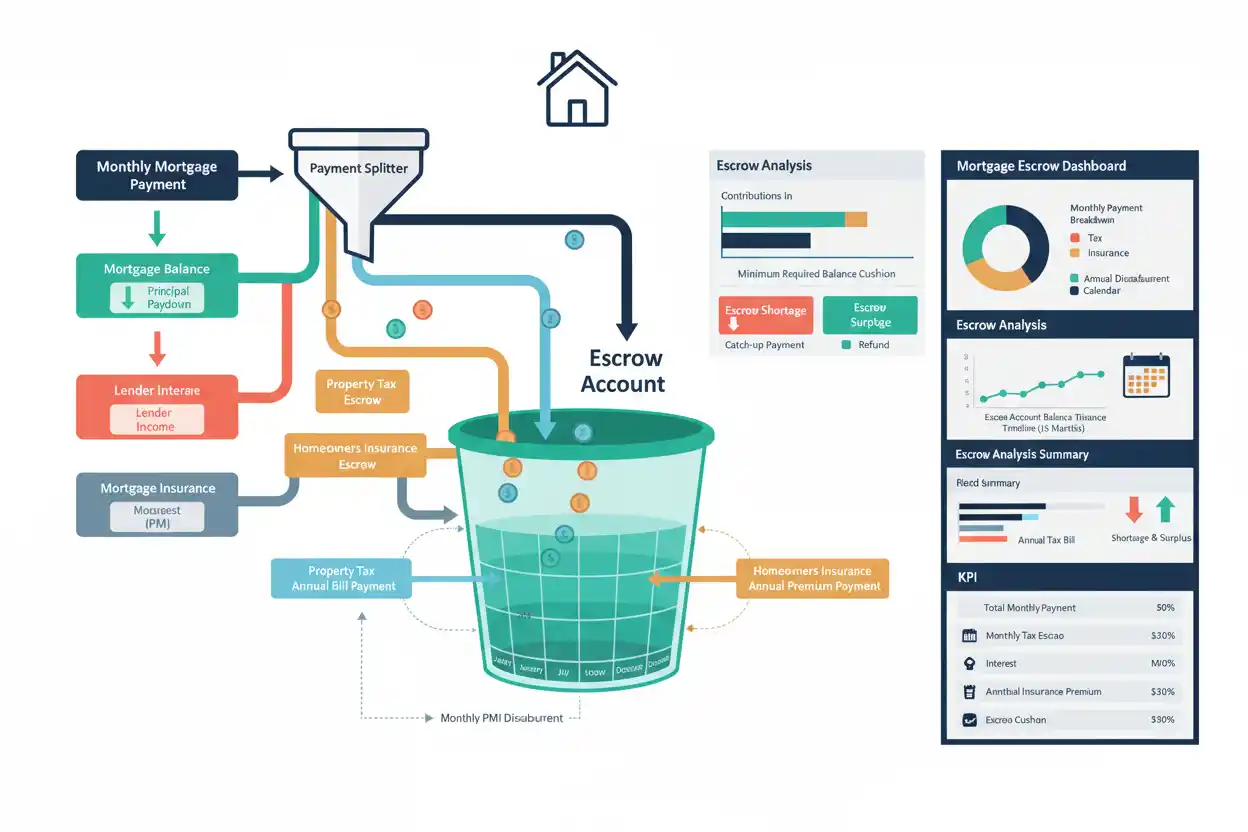

Mortgage escrow is an account used by a mortgage lender or servicer to collect money for specified property-related expenses and pay those expenses when they become due.
Common escrow items include:
property taxes and homeowners insurance.
Depending on the mortgage, other property-related charges can also be collected.
CFPB describes a mortgage escrow or impound account as an account established so part of the borrower’s monthly mortgage payment can be accumulated for property-related expenses rather than requiring the homeowner to fund a large bill once or twice a year.
A basic planning formula is:
Monthly Escrow Deposit ≈ Expected Annual Escrowed Expenses ÷ 12
However, the actual servicer calculation can also account for payment timing, permitted cushions, shortages, surpluses, and the specific escrow analysis required by federal rules.
Mortgage Escrow Example
Suppose annual expenses are:
Property taxes = $7,200
Homeowners insurance = $1,800
Mortgage insurance = $1,200
Total annual escrowed expenses:
$7,200 + $1,800 + $1,200
$10,200
Simplified monthly escrow amount:
$10,200 ÷ 12
$850 per Month
If principal and interest are:
$2,500
then the simplified monthly mortgage payment becomes:
$2,500 + $850
$3,350
before any other charges.
Escrow Does Not Increase the Underlying Tax Bill
Suppose annual property tax is $7,200.
Whether the homeowner pays:
$7,200 directly to the taxing authority
or:
$600 per month into escrow,
the tax itself is still $7,200.
Escrow changes the payment mechanism and timing, not the underlying property-tax obligation.
Escrow Payment Formula
For simple planning:
Monthly Escrow = (Annual Taxes + Annual Insurance + Other Escrowed Items) ÷ 12
If annual taxes are $6,000 and homeowners insurance is $2,400:
Monthly Escrow = ($6,000 + $2,400) ÷ 12
$700
Federal RESPA rules for federally related mortgage loans generally permit the servicer to collect one-twelfth of reasonably anticipated annual escrow disbursements each month, subject to the applicable escrow analysis and other limits.
Escrow Cushion
The servicer can also maintain a permitted cushion.
Under RESPA’s escrow rules for federally related mortgage loans, the cushion generally cannot exceed one-sixth of estimated annual escrow disbursements—effectively two months of escrow payments—unless a lower limit applies under law or the mortgage documents.
If annual escrow disbursements equal:
$10,200
maximum one-sixth cushion under that general federal limit is:
$10,200 ÷ 6
$1,700
That does not mean the borrower simply pays an extra $1,700 every year.
The cushion is incorporated into the escrow analysis and target balance.
Initial Escrow Deposit
At closing, the borrower can be required to fund the escrow account so the servicer will have sufficient money when upcoming bills become due.
CFPB explains that this initial amount can cover the timing needed to prevent the account from going negative plus a permitted cushion within applicable limits.
This initial escrow funding contributes to mortgage closing costs and cash to close, but it should not be confused with a lender origination fee.
Why Mortgage Escrow Changes
Escrow payments can change when the underlying expenses change.
CFPB notes that mortgage payments can increase or decrease when escrowed property taxes or insurance premiums change.
Suppose the original annual expenses were:
Taxes = $7,200
Insurance = $1,800
Mortgage insurance = $1,200
Total:
$10,200
Monthly:
$850
Now taxes rise to $7,800 and insurance rises to $2,100.
New total:
$7,800 + $2,100 + $1,200
$11,100
New simplified monthly escrow:
$11,100 ÷ 12
$925
Increase:
$925 − $850
$75 per Month
The mortgage interest rate did not change.
The escrowed expenses did.
Escrow Shortage
An escrow shortage occurs when the escrow balance falls below the target balance determined in the annual analysis.
Suppose:
New required monthly escrow = $925
and the analysis finds a:
$600 Shortage
If the servicer spreads the shortage across 12 months:
Shortage Payment = $600 ÷ 12
$50 per Month
Temporary monthly escrow contribution:
$925 + $50
$975
Federal rules specify how shortages and deficiencies can be handled, including circumstances where shortages can be repaid through equal monthly payments over at least 12 months.
Escrow Surplus
A surplus means the escrow account contains more than the target balance.
Under RESPA rules, if the borrower is current and the annual escrow analysis shows a surplus of at least $50, the servicer generally must refund it within 30 days; smaller surpluses can be refunded or credited according to the rule.
A refund does not necessarily mean the previous monthly escrow calculation was improper.
Actual taxes and insurance can differ from earlier estimates.
Annual Escrow Analysis
For covered escrow accounts, the servicer performs an analysis to project the next year’s activity and determine whether a:
surplus, shortage, or deficiency
exists.
The servicer also provides an annual escrow statement showing account activity and projected future activity under applicable rules.
That statement is the best place to understand why the escrow component of a mortgage payment changed.
Mortgage Escrow vs Principal and Interest
Suppose monthly payment is:
Principal and interest = $2,500
Escrow = $925
Total:
$3,425
Only part of the $2,500 P&I payment reduces mortgage principal.
The $925 escrow component does not amortize the mortgage.
It is reserved for property-related expenses.
Mortgage Escrow and Mortgage Interest
The mortgage interest calculation is based on the mortgage balance and contractual rate.
Property taxes collected through escrow do not become mortgage interest.
Homeowners insurance does not become mortgage interest either.
The account simply combines multiple cash flows into one servicing process.
Mortgage Escrow and Mortgage Insurance
The mapped mortgage insurance premium can be included in a borrower’s monthly mortgage payment.
Depending on the loan and servicing structure, relevant mortgage-insurance amounts can interact with the total payment alongside taxes and homeowners insurance.
Mortgage insurance and homeowners insurance protect different parties and risks.
Mortgage Escrow and Mortgage DTI
The mortgage debt-to-income ratio generally needs to consider the complete qualifying housing obligation rather than principal and interest alone.
Suppose:
P&I = $2,500
Escrowed taxes and insurance = $925
Housing obligation:
$3,425
Using $2,500 in the DTI calculation would materially understate the actual housing payment.
Mortgage Escrow and Mortgage APR
Mortgage APR should not be calculated by simply adding escrow payments to financing charges.
Property taxes and homeowners insurance are property expenses rather than ordinary lender interest.
APR follows specific finance-charge rules.
Escrow and APR therefore answer different questions.
Mortgage Escrow and Closing Costs
Initial escrow funding can materially increase mortgage closing costs or, more precisely, cash required at closing.
Suppose:
Initial escrow deposit = $4,000
That $4,000 needs to be funded, but it is intended for future taxes and insurance.
Treat it differently from a $4,000 nonrefundable lender fee when performing refinance economics.
Mortgage Escrow and Break-Even
The mortgage break-even point can be distorted if the borrower treats every initial escrow dollar as a permanent refinance cost.
Suppose:
New escrow deposit = $3,000
Old servicer later returns $2,700
Net temporary funding difference is much smaller than $3,000.
A careful break-even calculation adjusts for this.
Mortgage Escrow and Fixed-Rate Mortgages
A fixed-rate mortgage can still have a changing total payment because escrow expenses can change.
CFPB specifically identifies property-tax and homeowners-insurance changes as common reasons the monthly mortgage payment changes.
Therefore:
Fixed Rate ≠ Fixed Escrow
Mortgage Escrow and Property Taxes
Property-tax assessments can change because of:
tax rates, assessed values, exemptions, reassessments, or other local rules.
The mortgage servicer does not necessarily control the underlying tax bill.
When the bill rises, more money generally needs to be collected through escrow.
Mortgage Escrow and Homeowners Insurance
The same principle applies to homeowners insurance.
If the annual premium rises from:
$1,800 to $2,400
the monthly amount required to fund that expense rises by approximately:
$600 ÷ 12 = $50
before considering the complete escrow analysis.
Mortgage Escrow and Mortgage Payoff
When the mortgage payoff amount is paid and the mortgage is closed, the remaining escrow balance is handled separately under applicable servicing rules.
Borrowers should not assume the mortgage payoff amount and escrow balance are one interchangeable figure.
Can You Avoid Escrow?
Not every mortgage requires an escrow account.
CFPB notes that escrow is not mandatory for every loan, although some mortgage categories can require it for specified periods or under program rules.
If escrow is waived, the borrower becomes directly responsible for budgeting and paying applicable property bills when due.
Common Mortgage Escrow Mistakes
One mistake is believing escrow is an additional tax.
Another is assuming a fixed-rate mortgage guarantees a fixed total monthly payment.
Borrowers also confuse an escrow shortage with an increase in mortgage principal.
A fourth mistake is treating initial escrow funding as economically identical to a lender fee.
Finally, homeowners should review annual escrow statements rather than assuming every payment change was caused by the mortgage interest rate.
Frequently Asked Questions
What is mortgage escrow?
It is an account used by a lender or servicer to collect funds for specified property-related expenses such as taxes and insurance.
What is the basic escrow formula?
Monthly Escrow ≈ Annual Escrowed Expenses ÷ 12
What is $10,200 of annual escrow expense per month?
$850 per Month
Can escrow payments change?
Yes, especially when property taxes or insurance premiums change.
What is an escrow shortage?
It is an amount by which the account falls below the target balance determined through the escrow analysis.
What is an escrow surplus?
It is an amount by which the escrow balance exceeds the target balance.
Can a servicer keep a cushion?
For covered federally related mortgages, RESPA generally allows a cushion no greater than one-sixth of estimated annual escrow disbursements, subject to lower applicable limits.
Does escrow reduce mortgage principal?
No.
Is escrow the same as mortgage insurance?
No. Escrow is an account; mortgage insurance is an insurance cost.
Why did my fixed mortgage payment increase?
Escrowed taxes or insurance can increase even when principal and interest remain fixed.
Is escrow always required?
No, although certain mortgages or circumstances can require it.
Where can I see my escrow calculations?
Your servicer’s initial and annual escrow statements provide the relevant projections and account activity.
Final Takeaway
Mortgage escrow converts large periodic property bills into smaller amounts collected with the mortgage payment.
A simple estimate is:
Monthly Escrow = Annual Taxes + Insurance + Other Escrowed Expenses ÷ 12
For annual expenses of:
Taxes = $7,200
Homeowners insurance = $1,800
Mortgage insurance = $1,200
the simplified monthly escrow amount is:
$850
If those annual expenses later rise to $11,100:
New Monthly Estimate = $925
A $600 shortage spread across 12 months could temporarily add another:
$50 per Month
The crucial point is that escrow is not mortgage principal and not a new tax. It is a servicing mechanism for collecting property-related expenses whose amounts can change independently of the mortgage interest rate.