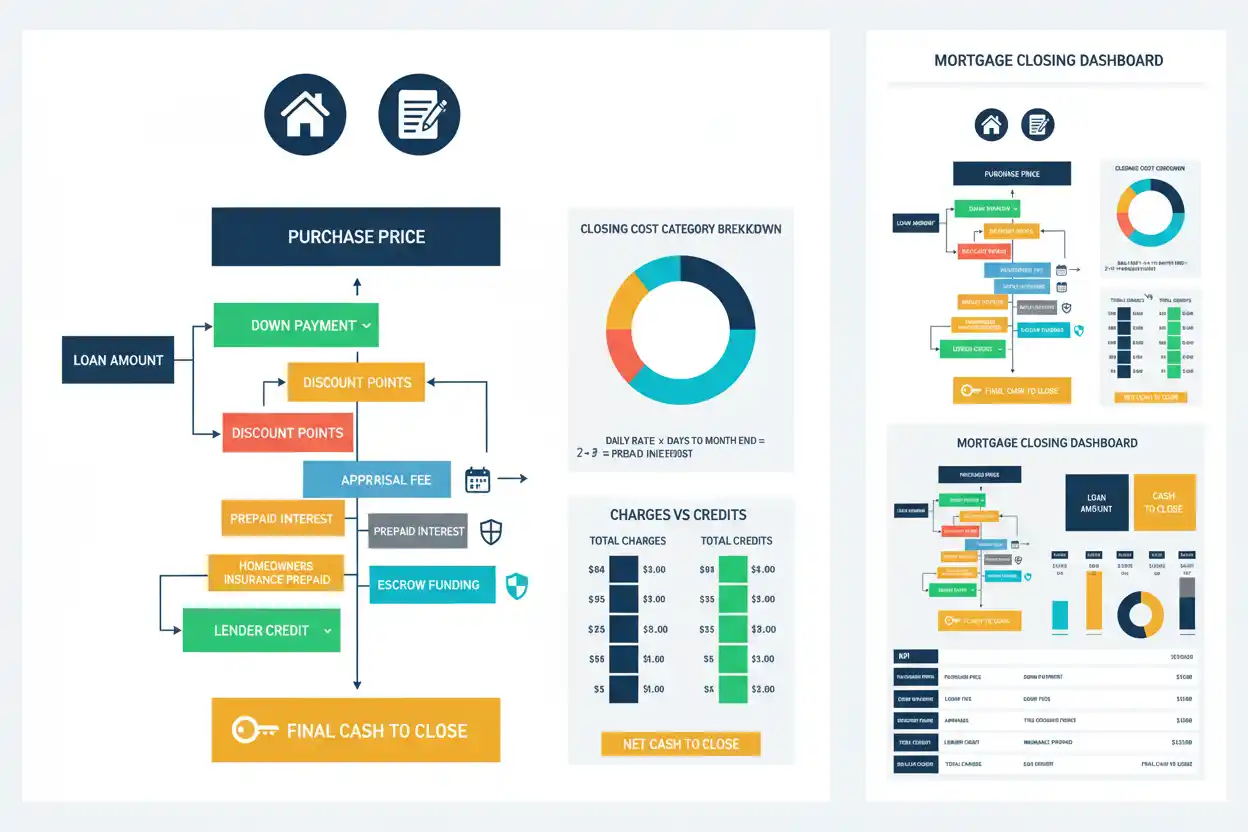

Mortgage closing costs are the upfront charges and transaction expenses associated with obtaining a mortgage and completing a real-estate closing.
They are separate from the mortgage principal itself and generally separate from the buyer’s down payment.
CFPB describes closing costs, or settlement costs, as upfront costs charged to obtain the loan and transfer ownership of the property. The final figures appear on the Closing Disclosure, while estimated mortgage costs appear earlier on the Loan Estimate.
A useful simplified formula is:
Total Cash to Close = Down Payment + Closing Costs + Prepaids + Initial Escrow Funding − Deposits − Seller/Lender Credits
The exact Closing Disclosure calculation can contain additional transaction-specific adjustments, so this formula is best used for planning rather than reproducing the disclosure line by line.
What Are Mortgage Closing Costs?
Mortgage closing costs can include several different types of expense.
Some compensate the lender or mortgage broker.
Others pay third parties involved in evaluating, insuring, recording, or transferring the property.
Additional amounts can fund future expenses in advance.
CFPB lists examples including appraisal fees, title insurance, government charges, prepaid property expenses, homeowners insurance, and prepaid interest.
This page owns the mortgage closing costs intent. The mortgage APR page explains annualized borrowing cost, while mortgage escrow explains funds collected for future property expenses.
Mortgage Closing Cost Example
Suppose:
Purchase price = $500,000
Down payment = 10%
Mortgage = $450,000
Down payment:
Down Payment = $500,000 × 10%
Down Payment = $50,000
Now assume these illustrative costs:
Origination charge = $4,500
Discount points = $2,250
Appraisal = $650
Credit/reporting-related charge = $100
Title and settlement charges = $3,100
Recording/government charges = $850
Prepaid interest = $1,200
Initial homeowners insurance = $1,800
Initial escrow funding = $3,000
Total:
Closing-Related Costs = $17,450
These figures are examples, not standard industry prices.
Actual costs depend on the lender, property, jurisdiction, loan, service providers, closing date, insurance, taxes, and transaction terms.
Add the Down Payment
Down payment:
$50,000
Closing-related costs:
$17,450
Gross cash requirement:
$50,000 + $17,450
$67,450
Now suppose:
Earnest-money deposit already paid = $10,000
Seller credit = $3,000
Estimated remaining cash to close:
$67,450 − $10,000 − $3,000
$54,450
This demonstrates why the buyer’s final cash requirement is not simply:
Down Payment + Headline Fee Percentage
Credits, deposits, prepaids, and escrow funding all affect the final number.
Down Payment Is Not a Closing Cost
The down payments amount is cash used to reduce the purchase price that must be financed.
Closing costs pay for:
financing, settlement, services, government charges, and other transaction items.
Both affect cash needed at closing, but they serve different economic purposes.
Loan Costs vs Other Costs
The Loan Estimate and Closing Disclosure organize mortgage expenses into categories.
Loan-related expenses can include:
origination charges and services associated with obtaining the mortgage.
Other costs can include:
taxes, government fees, prepaids, insurance, and escrow funding.
CFPB’s Loan Estimate and Closing Disclosure resources are designed specifically to help consumers compare these categories and identify differences between estimated and final costs.
Origination Charges
A mortgage origination fee can be quoted as a percentage or dollar amount.
If the charge is 1% of a $450,000 mortgage:
Origination Fee = $450,000 × 1%
$4,500
A borrower should distinguish this from points paid specifically to change interest-rate pricing.
Discount Points
Discount points are upfront costs paid in exchange for lower mortgage pricing when offered by the lender.
Suppose:
Mortgage = $450,000
Points = 0.5
Point Cost = $450,000 × 0.5%
$2,250
Points increase cash at closing but can reduce the future mortgage payment.
Their value depends on the mortgage break-even point.
Appraisal Charges
The property appraisal helps determine a value used in mortgage underwriting.
The appraisal cost is typically paid as part of the transaction rather than becoming home equity.
If the appraisal comes in below the purchase price, the financing structure can also change because the loan-to-value ratio may be different from what the buyer originally expected.
Title and Settlement Costs
Title-related costs can include services used to examine ownership interests, facilitate settlement, and insure specified title risks.
The exact charges and who pays them vary by transaction and jurisdiction.
Do not assume a fee quoted in one state or county is representative of another.
Recording and Government Charges
Real-estate transfers and mortgages can involve recording charges, transfer taxes, or other government assessments.
These amounts vary considerably by location.
They should therefore be based on the actual Loan Estimate and Closing Disclosure rather than an internet percentage estimate.
Prepaid Interest
Mortgage interest can accrue between closing and the beginning of the normal payment cycle.
Suppose:
Mortgage = $450,000
Rate = 6.5%
Daily interest using a simple 365-day estimate:
Daily Interest ≈ $450,000 × 6.5% ÷ 365
≈ $80.14 per Day
If 15 days of prepaid interest apply:
≈ $1,202
This is close to the illustrative $1,200 used in the example.
The exact day-count convention and closing schedule control the real figure.
Prepaid Homeowners Insurance
A lender can require evidence that the property will be adequately insured.
That can mean paying some insurance premium before or at closing.
This cost should not be confused with mortgage insurance.
Homeowners insurance protects against specified property-related risks.
Mortgage insurance primarily protects the lender against specified borrower-default risk.
Initial Escrow Funding
If the mortgage uses mortgage escrow, part of cash to close can fund the escrow account.
That money is intended for future expenses such as taxes and insurance rather than being a lender fee.
For federally related mortgage loans subject to RESPA’s escrow limits, federal rules limit the amount a servicer can require in connection with escrow funding.
Why Escrow Funding Should Be Separated in Break-Even Analysis
Suppose:
Refinance closing statement shows $5,000 of lender/title costs and $3,000 of initial escrow deposits.
Treating the full $8,000 as a permanent transaction expense can overstate the refinance mortgage break-even point.
The $3,000 escrow deposit represents funding for future property expenses that would still need to be paid.
Its cash-flow timing matters, but its economics differ from a lender fee.
Lender Credits
A lender credit reduces upfront closing cash in exchange for mortgage pricing that can include a higher rate.
That creates a tradeoff:
Lower Closing Cost Now ↔ Potentially Higher Borrowing Cost Later
A borrower expecting to keep the mortgage briefly may prefer lower upfront expense.
A long-term borrower may prefer paying more upfront for lower pricing.
The actual mortgage APR and break-even period help evaluate the tradeoff.
Seller Credits
A seller can agree to pay specified buyer closing costs when permitted by the purchase agreement and mortgage program.
A seller credit reduces cash needed at closing.
However, financing guidelines can restrict allowable contributions.
Use the lender’s actual approved transaction rather than assuming any negotiated credit can automatically be applied to every cost.
“No-Closing-Cost” Mortgages
CFPB explains that mortgages marketed as “no closing cost” still involve costs; those costs can instead be recovered through a higher interest rate or other loan pricing.
Therefore:
No Cash Closing Cost ≠ No Economic Cost
Compare the alternative’s rate, APR, payment, and holding period.
Closing Costs and Mortgage APR
Some charges affect mortgage APR, while others do not enter the APR calculation in the same way.
That is why you should not calculate APR as:
Interest Rate + Closing Costs ÷ Mortgage
APR follows specific finance-charge and cash-flow rules.
Closing Costs and DTI
The mapped mortgage debt-to-income ratio primarily measures recurring qualifying monthly obligations rather than one-time cash-to-close amounts.
A borrower can therefore have:
acceptable DTI but insufficient closing cash.
Conversely, a borrower can have abundant savings but excessive monthly debt obligations.
Closing Costs and Mortgage Amortization
Mortgage amortization tracks principal repayment after closing.
If closing costs are added to mortgage principal where permitted, the amortization schedule begins from a higher balance.
Suppose:
Mortgage before financed costs = $450,000
Financed costs = $5,000
New principal:
$455,000
The borrower now pays interest on that additional financed amount.
Closing Costs and Mortgage Affordability
Mortgage affordability has two separate dimensions:
monthly affordability and upfront affordability.
A buyer can comfortably support the mortgage payment but lack sufficient cash for:
down payment, closing costs, and post-closing reserves.
Both constraints matter.
Comparing Loan Estimates
CFPB recommends comparing multiple Loan Estimates because the form provides standardized information about mortgage rate, monthly payment, estimated closing costs, taxes, insurance, and other key terms.
When comparing lenders, focus especially on differences in costs the lender controls rather than assuming every third-party charge will remain identical.
Closing Disclosure
The Closing Disclosure provides the final details of the selected mortgage, including loan terms, projected payments, and closing costs.
Compare it against the latest Loan Estimate.
If significant figures changed, determine why before completing the closing.
Common Mortgage Closing Cost Mistakes
One mistake is assuming the down payment includes every closing expense.
Another is using a generic percentage without checking the actual property and loan.
Borrowers also treat prepaid taxes or escrow deposits as though they are identical to lender fees.
A fourth mistake is choosing a “no-closing-cost” mortgage without examining the higher rate.
Finally, financing costs into the mortgage can reduce cash needed today while increasing long-term interest.
Frequently Asked Questions
What are mortgage closing costs?
They are upfront costs associated with obtaining the mortgage and completing the property transaction.
Are closing costs the same as the down payment?
No.
What is a simplified cash-to-close formula?
Cash to Close = Down Payment + Closing Costs + Prepaids + Escrow Funding − Deposits − Credits
What closing costs can occur?
Examples include lender fees, appraisal, title-related charges, government charges, prepaid interest, insurance, and escrow funding.
Where can I see estimated closing costs?
On the Loan Estimate.
Where can I see final closing costs?
On the Closing Disclosure.
Are discount points closing costs?
Yes, when paid as part of the mortgage transaction.
Is initial escrow funding a lender fee?
No. It funds future escrowed property expenses.
Are no-closing-cost mortgages really free?
No. Costs can be shifted through loan pricing rather than eliminated.
Can closing costs be financed?
Some costs can sometimes be financed depending on the transaction and program, but doing so increases mortgage principal.
Why can my final costs differ from the Loan Estimate?
Some mortgage costs can change under permitted circumstances, while regulatory rules limit changes to certain other charges.
Should I compare closing costs or interest rates?
Compare both, along with APR, monthly payment, cash to close, and expected holding period.
Final Takeaway
Mortgage closing costs are the expenses required to obtain the financing and complete the transaction.
A useful planning formula is:
Cash to Close = Down Payment + Closing-Related Costs − Deposits − Credits
In the example:
Purchase price = $500,000
Down payment = $50,000
Illustrative closing-related costs = $17,450
Prior deposit = $10,000
Seller credit = $3,000
Estimated remaining cash:
$54,450
The important step is to separate down payment, lender fees, points, third-party services, prepaids, escrow funding, and credits. They can all appear around closing, but they do not represent the same type of cost or affect mortgage economics in the same way.