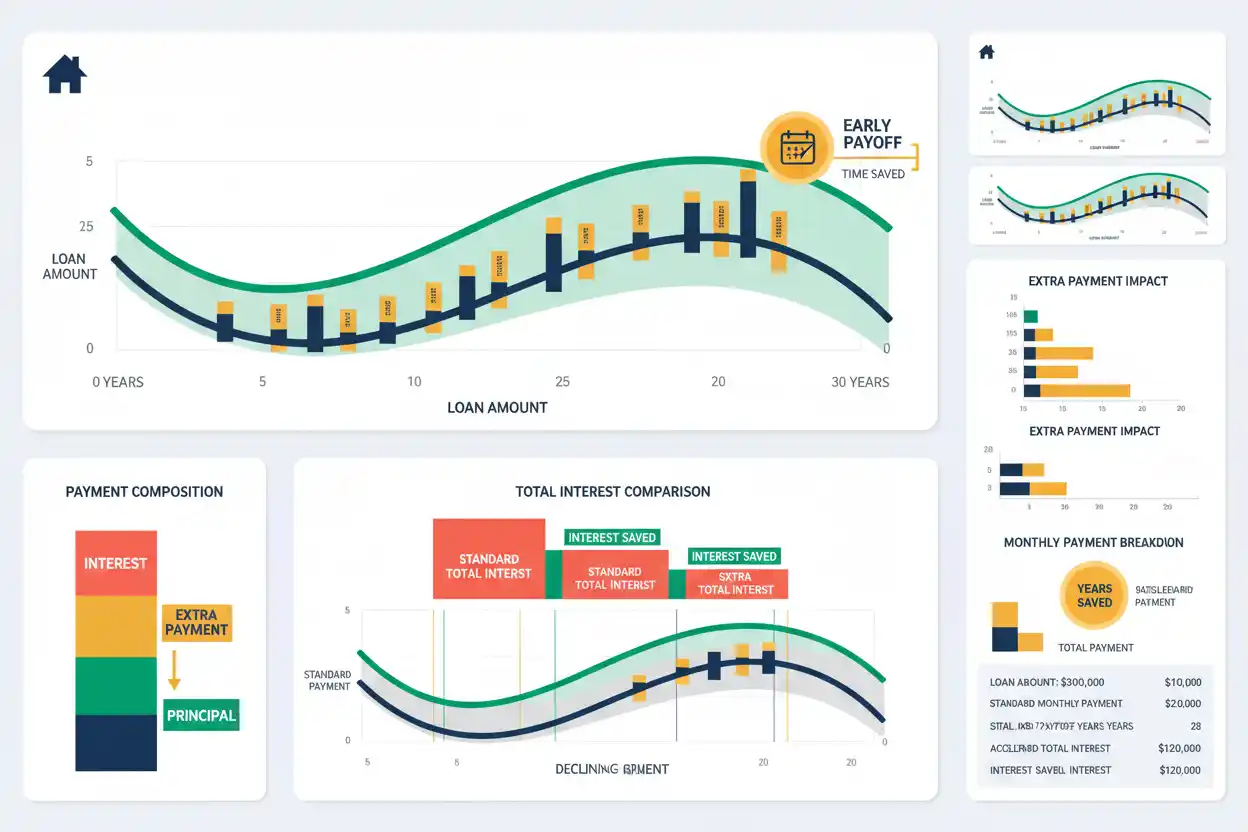

Mortgage payoff strategies are methods for reducing mortgage principal faster than the original repayment schedule requires.
The most direct strategy is simple:
Scheduled Mortgage Payment + Extra Principal Payment
When extra money is correctly applied to principal, the balance falls faster. Because future mortgage interest is calculated from a smaller balance, the borrower can also reduce total interest.
CFPB notes that borrowers may be allowed to make extra principal payments and that doing so can help repay a mortgage sooner with less interest. It also recommends verifying that extra amounts are actually applied to principal.
Basic Mortgage Payoff Formula
For each payment period:
Interest = Beginning Principal × Periodic Interest Rate
Then:
Scheduled Principal = Scheduled Payment − Interest
With an extra payment:
Total Principal Reduction = Scheduled Principal + Extra Principal
Finally:
New Mortgage Balance = Beginning Principal − Total Principal Reduction
This is the mathematical engine behind most mortgage payoff strategies.
Mortgage Payoff Example
Suppose:
Mortgage = $400,000
Fixed rate = 6.5%
Term = 30 years
The normal principal-and-interest payment is approximately:
$2,528.27 per Month
Without extra payments:
Scheduled Term = 360 Months
and total scheduled interest is approximately:
$510,177.95
Now suppose the borrower adds:
$300 Extra Principal per Month
Total monthly principal-and-interest cash flow becomes:
$2,528.27 + $300
$2,828.27
Under the simplified model, the mortgage is paid off in approximately:
269 Months
instead of 360.
That shortens repayment by approximately:
91 Months
or about:
7 Years and 7 Months
Estimated lifetime interest falls to approximately:
$360,596.62
Interest savings:
$510,177.95 − $360,596.62
≈ $149,581.33
A $300 monthly principal increase therefore creates a substantial change because it reduces principal early enough to prevent future interest from accumulating on that amount.
Why Early Extra Payments Matter More
Suppose you pay an extra $10,000 in year two.
That $10,000 no longer generates mortgage interest for most of the remaining term.
If you wait until year 28, the same $10,000 has far fewer months remaining in which to save interest.
Therefore:
Earlier Principal Reduction Usually Creates More Lifetime Interest Savings Than the Same Reduction Made Much Later
assuming the mortgage remains outstanding.
Strategy 1: Fixed Monthly Extra Payment
This is usually the easiest strategy to model.
Suppose:
Regular payment = $2,528.27
Extra principal = $200
Total:
$2,728.27
For the $400,000, 6.5%, 30-year example, adding $200 monthly shortens payoff to roughly:
293 Months
instead of 360.
That eliminates approximately:
67 Payments
and reduces lifetime interest by roughly:
$111,891
under the simplified model.
The advantage is consistency.
The borrower does not need a large lump sum.
Strategy 2: Annual Lump-Sum Payments
Some borrowers receive:
bonuses, tax refunds, commissions, or other irregular cash.
Suppose the mortgage balance is:
$375,000
and the borrower applies:
$15,000
directly to principal.
New balance:
$375,000 − $15,000
$360,000
Future mortgage interest is then calculated from the smaller principal.
A lump sum can create strong savings without increasing every month’s required budget.
Strategy 3: One Extra Monthly Payment Per Year
A borrower can also make the equivalent of one additional normal payment toward principal each year.
For a $2,528.27 payment:
Annual Extra Amount = $2,528.27
One way to budget it monthly is:
Monthly Saving for Extra Payment = $2,528.27 ÷ 12
≈ $210.69
The borrower can then apply the accumulated amount to principal once a year.
Alternatively, the borrower can add roughly $210.69 monthly if the servicer permits and properly applies the additional principal.
Strategy 4: Biweekly Payment Equivalent
A true biweekly schedule involves 26 half-payments per year.
Because:
26 Half-Payments = 13 Full Monthly Payments
the borrower effectively makes the equivalent of one additional monthly payment annually.
CFPB describes this same arithmetic but advises borrowers to review the mortgage terms and servicing arrangement before using a biweekly plan.
However, a fee-based third-party biweekly program is not required to reproduce the basic mathematics.
You can often create the same annual principal reduction yourself by making extra principal payments directly, subject to mortgage terms and servicer procedures.
Strategy 5: Recast After a Large Principal Payment
Suppose you receive:
$100,000
and apply it to principal.
If your mortgage is eligible, a mortgage recast can recalculate the required monthly payment from the reduced balance while keeping the existing mortgage rather than replacing it.
This is different from simply paying extra and continuing the old required payment.
Continuing the old payment usually accelerates payoff more aggressively.
Recasting prioritizes a lower required monthly payment.
Strategy 6: Refinance Into a Shorter Term
A borrower can also consider refinancing into a shorter mortgage term.
For example:
30-year mortgage → 15-year mortgage.
This can accelerate principal dramatically.
However, refinancing introduces a new rate, mortgage origination fee, other closing costs, and potentially a new amortization schedule.
Do not refinance solely because the new loan pays off faster.
Compare total cost.
Strategy 7: Keep the Existing Mortgage and Voluntarily Pay It Like a Shorter Loan
Suppose a 30-year mortgage requires:
$2,528.27
but the household can afford:
$3,500
You can potentially pay:
$971.73 Extra Principal
without replacing the mortgage.
That preserves the lower contractual required payment while voluntarily accelerating repayment.
This can provide more cash-flow flexibility than formally taking a shorter mortgage term.
Payoff Strategy vs Mortgage Payoff Amount
The mortgage payoff amount is the amount required to completely satisfy the loan on a particular date.
Mortgage payoff strategies answer:
How Can I Reach That Final Payoff Earlier?
The payoff amount answers:
How Much Do I Need to Pay Today to Finish?
They are related but distinct search intents.
Extra Payments and Mortgage Principal
The mortgage principal balance is the key variable.
If:
Principal = $300,000
Extra payment = $10,000
New principal:
$290,000
At 6.5%, approximate monthly interest immediately falls from:
$300,000 × 6.5% ÷ 12 = $1,625
to:
$290,000 × 6.5% ÷ 12 ≈ $1,570.83
Immediate interest difference:
≈ $54.17 per Month
As future principal continues declining, the cumulative savings build.
Extra Payments and Mortgage Points
The mapped mortgage points page creates an interesting alternative.
Suppose you have $5,000 of extra cash.
You might use it to:
pay points at closing for a lower rate, or reduce principal after closing.
The better choice depends on:
rate reduction, expected holding period, mortgage balance, and point break-even.
A dollar spent on principal reduces debt immediately.
A dollar spent on points buys a lower rate.
Those are different financial mechanisms.
Payoff Strategy and Mortgage Preapproval
If you intend to buy another property, reducing an existing mortgage can change your overall debt position before a future mortgage preapproval.
However, aggressively paying down a mortgage can also reduce liquid savings.
Mortgage qualification and personal financial resilience therefore require balancing debt reduction against cash reserves.
Do Extra Payments Change the Required Payment?
Usually, making an ordinary extra principal payment does not automatically reduce the required monthly principal-and-interest payment on a standard fixed mortgage.
Instead:
the mortgage finishes sooner.
A formal recast can change the required payment if the mortgage qualifies.
This distinction is important.
Prepayment Penalties
Some mortgages can contain prepayment penalties, although CFPB notes that such penalties do not normally apply to small extra principal payments. Borrowers should still check their actual mortgage terms before making a large early payoff.
Never assume every mortgage can be prepaid in exactly the same way.
Should You Pay Off a Low-Rate Mortgage Early?
Mathematics can calculate the guaranteed interest avoided.
The financial decision is broader.
Suppose:
Mortgage rate = 3%
while the borrower has:
credit-card debt at 20%.
Paying down the higher-rate debt first can produce much larger interest savings per dollar.
Similarly, using every dollar of emergency savings to accelerate a mortgage can create liquidity risk.
Opportunity Cost
Every extra mortgage payment has an alternative use.
Possible alternatives include:
emergency reserves, retirement contributions, high-interest debt repayment, business investment, or other financial goals.
Therefore:
Mortgage Interest Saved Is Not Automatically the Same as Maximum Financial Benefit
The borrower should compare risk-adjusted alternatives.
Common Mortgage Payoff Strategy Mistakes
One mistake is sending extra money without confirming it is applied to principal.
Another is paying a third party for a strategy that can be reproduced directly.
Borrowers also refinance into a lower payment but longer term and call it an accelerated payoff.
A fourth mistake is exhausting emergency cash.
Finally, early payoff calculations should consider any applicable prepayment provisions.
Frequently Asked Questions
What is the fastest simple mortgage payoff strategy?
Consistently applying additional money directly to principal accelerates payoff mathematically.
Does an extra $100 per month help?
Yes. Even modest extra principal payments can shorten the term and reduce interest. CFPB specifically notes that additional principal may help borrowers repay sooner with less interest.
What happens if I pay $300 extra monthly in the example?
The $400,000 mortgage at 6.5% falls from 360 scheduled months to approximately 269 months.
How much interest does that save?
Approximately:
$149,581
under the stated assumptions.
Is biweekly payment better than monthly?
The main benefit comes from making the equivalent of an extra payment each year, not from the label itself.
Can I make one annual lump-sum payment?
Potentially, subject to the mortgage terms and correct principal application.
Does extra principal lower my required payment?
Not ordinarily unless the loan is formally recast or otherwise modified.
Should I refinance into a 15-year mortgage?
It can accelerate payoff, but compare the new rate, closing costs, payment, and break-even first.
Can I pay off my mortgage early without a penalty?
Many borrowers can, but some mortgages can contain prepayment penalties under specified terms.
Should I pay off the mortgage before higher-interest debt?
Not automatically. Compare interest rates, risk, and liquidity.
Do mortgage points accelerate payoff?
Not directly. Points lower the rate when offered; principal payments reduce the balance.
How do I know my exact final payoff?
Request the current mortgage payoff amount from the servicer.
Final Takeaway
The core mortgage payoff strategy is:
Reduce Principal Earlier
For a $400,000, 6.5%, 30-year mortgage, the normal payment is approximately:
$2,528.27
Adding:
$300 per Month
reduces the modeled payoff period from:
360 Months to About 269 Months
and cuts estimated lifetime interest by roughly:
$149,581
The best strategy is not necessarily the most aggressive one. A sound plan balances interest savings, cash reserves, higher-rate debts, mortgage terms, prepayment rules, and other financial priorities.