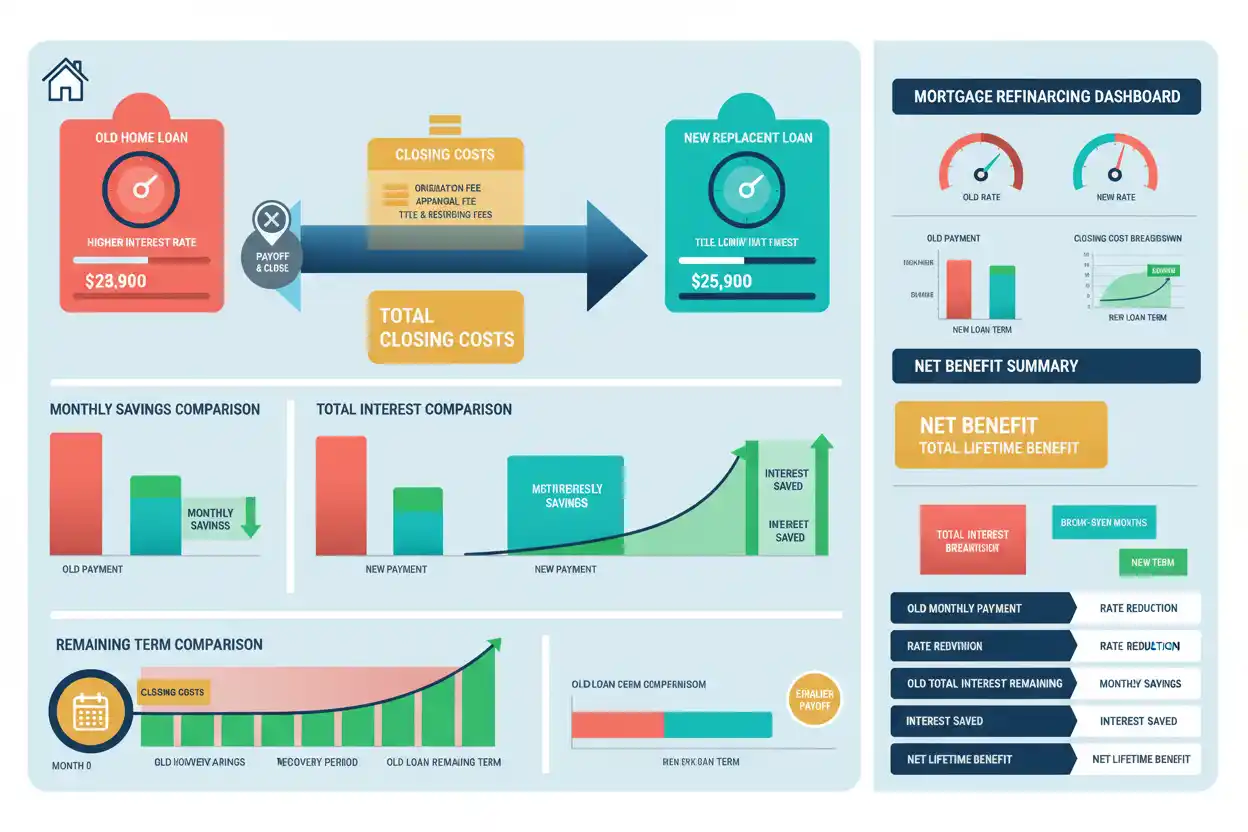

Refinancing means replacing an existing mortgage with a new mortgage.
Homeowners commonly refinance to:
lower the interest rate, lower the monthly payment, change the mortgage term, move to a different rate structure, or obtain additional funds.
CFPB defines mortgage refinancing as taking out a new loan to pay off and replace the existing loan and cautions borrowers to distinguish payment reductions created by lower interest rates from those created simply by extending the repayment term.
The most useful refinancing formula is:
Monthly Savings = Existing Mortgage Payment − New Mortgage Payment
Then:
Refinance Break-Even Months = Net Refinance Costs ÷ Monthly Savings
Refinancing Example
Suppose:
Current mortgage balance = $320,000
Current rate = 7.5%
Remaining term = 27 years
Current principal-and-interest payment:
≈ $2,306.35
Now suppose the homeowner can refinance:
New mortgage = $320,000
New rate = 6.25%
New term = 27 years
Closing costs = $8,000
New payment:
≈ $2,046.98
Monthly savings:
$2,306.35 − $2,046.98
≈ $259.37
Refinancing Break-Even
Break-Even = $8,000 ÷ $259.37
≈ 30.8 Months
That is roughly:
2 Years and 7 Months
If the homeowner expects to keep the replacement mortgage for eight more years, there is substantial time after break-even.
If the homeowner expects to sell next year, the transaction probably does not recover its costs through payment savings alone.
Five-Year Savings Example
Five years:
60 Months
Gross payment savings:
$259.37 × 60
≈ $15,561.97
Subtract closing costs:
Simplified Net Savings ≈ $15,561.97 − $8,000
≈ $7,561.97
A more precise analysis should also compare remaining mortgage balances after five years.
Long-Term Interest Comparison
Continue old mortgage for 27 years:
Approximate remaining interest:
$427,256.84
New 6.25% mortgage over the same 27 years:
Approximate interest:
$343,222.23
Difference:
≈ $84,034.61
After $8,000 of costs:
Simplified Long-Term Difference ≈ $76,034.61
Again, this assumes the new mortgage survives for the full 27-year horizon.
Why Holding Period Matters
Refinancing requires paying costs today to change future cash flows.
The mortgage break-even point therefore answers a critical question:
Will I Keep the New Mortgage Long Enough to Recover the Cost?
That expected period ends not only when you sell the home.
It also ends when you refinance again or pay the mortgage off.
Rate-and-Term Refinancing
A rate-and-term refinance primarily changes:
interest rate, mortgage term, or both
without making substantial equity extraction the central purpose.
Fannie Mae’s current limited-cash-out framework, for example, permits refinancing to modify rate and/or term and distinguishes it from cash-out refinancing.
This is often the cleanest refinance structure for evaluating pure mortgage savings.
Cash-Out Refinancing
A cash-out refinance intentionally converts part of the homeowner’s equity into additional mortgage borrowing.
Suppose:
Existing mortgage payoff = $320,000
New mortgage = $400,000
The borrower has increased secured debt by approximately:
$80,000
before transaction costs and settlement adjustments.
A higher resulting payment should not be interpreted as evidence that refinancing itself is expensive; the borrower also took on additional debt.
Refinancing and Mortgage Term
The mapped mortgage term is one of the biggest sources of misleading refinance comparisons.
Suppose:
Current mortgage has 15 years remaining.
New refinance term:
30 Years
The payment can fall dramatically even with only a modest rate improvement.
CFPB specifically warns that a lower refinance payment may partly result from a longer repayment term.
Term Reset Example
Suppose:
Old payment = $2,700
New payment = $2,000
Apparent savings:
$700 per Month
If the old mortgage had only 15 years left and the new one has 30 years:
the borrower has doubled the remaining scheduled repayment period.
The $700 should therefore not be treated as pure savings.
Refinancing and Closing Costs
Mortgage closing costs are central to refinancing.
Relevant expenses can include:
lender charges, appraisal or valuation costs, title-related services, points, and other transaction costs.
Some cash-to-close items, such as new escrow funding, should be analyzed separately from permanent transaction costs.
No-Closing-Cost Refinancing
A “no-closing-cost” refinance does not necessarily mean no economic cost.
The lender can recover costs through:
a higher interest rate, lender pricing, or financing mechanisms.
Always compare:
rate, APR, payment, and total borrowing cost.
Financing Refinance Costs
Suppose the earlier $8,000 costs are added to the mortgage.
New principal:
$328,000
At 6.25% over 27 years:
New Payment ≈ $2,098.16
Monthly savings versus the old mortgage:
$2,306.35 − $2,098.16
≈ $208.19
Cash needed today is lower.
But the borrower now has:
$8,000 More Principal
and pays interest on it.
Refinancing and Mortgage APR
The mortgage APR provides another comparison layer.
Suppose:
Offer A = lower note rate, high points
Offer B = slightly higher rate, low fees
The lowest interest rate does not always produce the best result over the homeowner’s actual holding period.
APR and break-even analysis complement each other.
Refinancing and Mortgage Points
Mortgage points can reduce the new rate in exchange for more cash upfront.
Suppose:
Additional point cost = $4,000
Additional monthly savings = $70
Point-specific break-even:
$4,000 ÷ $70
≈ 57 Months
If you expect another refinance in three years, those points probably will not recover their cost through payment savings.
Refinancing and Private Mortgage Insurance
The mapped private mortgage insurance can change because the replacement mortgage receives a new underwriting analysis.
For example:
New conventional mortgage = $350,000
Accepted property value = $500,000
LTV:
70%
A new loan at that leverage can have different PMI economics from the old mortgage.
But do not refinance solely to eliminate PMI without measuring closing costs and rate differences.
Refinancing and Mortgage Recast
A mortgage recast can be an alternative for homeowners who:
have a large lump sum, want a lower required payment, and want to preserve the existing rate.
Recasting does not provide the lower market rate that refinancing can provide.
Refinancing does not preserve the old mortgage.
Refinancing and Renting vs Buying
The mapped renting vs buying decision can change after refinancing.
A lower mortgage cost can make continued ownership financially more attractive.
However, if the homeowner expects to move soon, paying thousands of dollars to refinance shortly before selling can reduce the financial advantage.
Expected occupancy period matters.
Refinancing and Reverse Mortgages
A reverse mortgage is a distinct home-equity product and should not be treated as ordinary refinancing.
An older homeowner evaluating a traditional refinance versus a reverse mortgage is comparing fundamentally different repayment structures, eligibility rules, costs, and long-term consequences.
The reverse-mortgage page should own those specialist mechanics.
Refinancing From an ARM to Fixed Rate
A homeowner can refinance an adjustable-rate mortgage into a fixed-rate mortgage.
Even when today’s new payment is not dramatically lower, the borrower may value reducing future rate uncertainty.
Savings are not always purely about the first month’s payment.
Risk structure matters too.
Refinancing From a 30-Year to a 15-Year Mortgage
Suppose refinancing creates:
higher monthly payment but much shorter mortgage term.
That transaction can still generate major lifetime interest savings.
A good refinance analysis therefore asks two separate questions:
What Happens to Monthly Cash Flow?
and:
What Happens to Total Debt Cost and Payoff Date?
Refinancing and Home Equity
Refinancing eligibility and pricing can depend on property value and mortgage leverage.
Suppose:
Home value = $500,000
Mortgage balance = $450,000
LTV:
90%
If home value rises to:
$600,000
with the same mortgage balance:
LTV = 75%
That can materially change available refinancing options.
Refinancing and Credit
The borrower is applying for a new mortgage.
Therefore, current qualification matters.
The fact that the existing mortgage was approved years ago does not guarantee approval for the new one.
Income, debts, credit, property value, and current mortgage-program rules can all matter.
When Refinancing Makes Sense
Refinancing can make sense when:
the new mortgage provides meaningful rate savings, the homeowner expects to keep it beyond break-even, the new term supports financial goals, or the transaction removes an undesirable loan feature.
It can also be useful for deliberately shortening the repayment horizon.
When Refinancing Can Backfire
Refinancing can be unfavorable when:
closing costs are high, the rate improvement is too small, the homeowner will sell soon, the term is unnecessarily extended, valuable old mortgage pricing is surrendered, or cash-out proceeds create excessive secured debt.
Common Refinancing Mistakes
One mistake is refinancing simply because the new rate is lower.
Another is ignoring closing costs.
Borrowers also compare a 15-year-remaining mortgage with a new 30-year loan using payment alone.
A fourth mistake is repeatedly paying points and fees through frequent refinances.
Finally, cash-out refinancing should not be evaluated like a pure rate reduction because the amount borrowed has changed.
Frequently Asked Questions
What is refinancing?
Mortgage refinancing means taking out a new loan to pay off and replace the existing mortgage.
Why do homeowners refinance?
Common objectives include lowering the rate or payment, changing the term, changing mortgage structure, or borrowing additional money.
What is the refinancing break-even formula?
Break-Even Months = Net Refinance Costs ÷ Monthly Savings
What is the break-even in the example?
Approximately:
31 Months
What are the monthly savings?
Approximately:
$259.37
Is refinancing worth it for a 0.25% rate reduction?
It depends on loan balance, fees, term, monthly savings, and holding period.
Does refinancing restart the mortgage?
A refinance creates a new mortgage and a new amortization schedule.
Can refinancing extend the payoff date?
Yes, particularly when a borrower replaces a partially paid-down mortgage with a new longer term.
Is rate-and-term refinancing different from cash-out refinancing?
Yes.
Can refinancing eliminate PMI?
Potentially, depending on the new mortgage’s LTV and program requirements.
Should I finance the closing costs?
Doing so preserves cash but increases principal and future interest.
Should I refinance if I plan to sell soon?
Only if the benefits expected before the sale justify the transaction costs.
Final Takeaway
Refinancing is valuable only when the new mortgage is better for the period you will actually keep it.
In the example:
Existing mortgage = $320,000 at 7.5%, 27 years remaining
Existing payment ≈ $2,306.35
New mortgage:
$320,000 at 6.25% for 27 Years
New payment:
≈ $2,046.98
Monthly savings:
≈ $259.37
Closing costs:
$8,000
Break-even:
≈ 30.8 Months
Matching the remaining term makes that comparison meaningful. The broader refinancing decision should always test rate, payment, closing costs, APR, remaining principal, PMI, new mortgage term, break-even point, and realistic time until the property or mortgage is likely to change again.