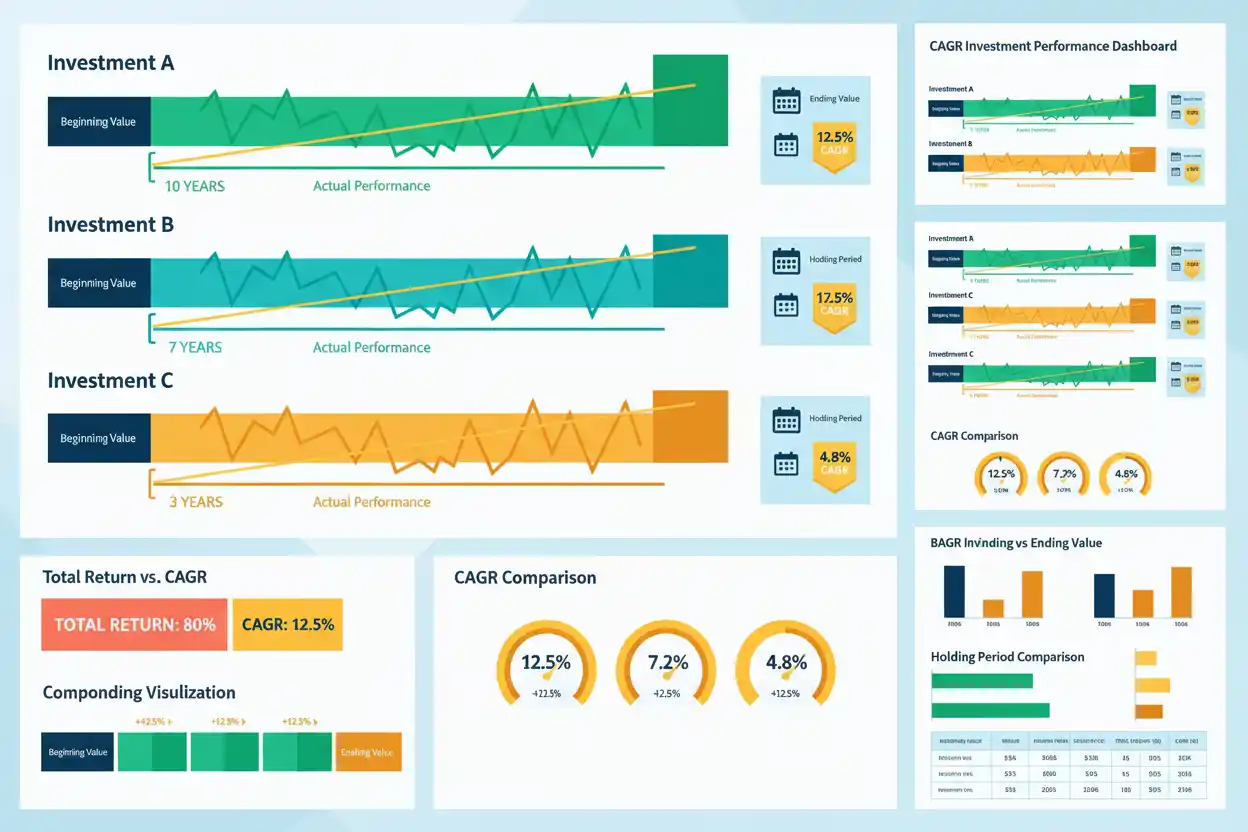

Annualized return converts an investment’s performance over a period longer or shorter than one year into an equivalent yearly rate.
This makes returns measured over different holding periods easier to compare.
Investor.gov defines annual return as investment profit or loss measured over a one-year period and notes that return can be expressed on an annual basis using different calculation methods.
For an investment with no intermediate cash flows, the compound annualized return formula is:
Annualized Return = (Ending Value ÷ Beginning Value)^(1 ÷ Years) − 1
Suppose:
Beginning value = $10,000
Ending value = $14,693.28
Holding period = 5 years
Then:
Annualized Return = ($14,693.28 ÷ $10,000)^(1/5) − 1
Annualized Return ≈ 8%
The investment’s total gain was approximately 46.93%, but its annualized compounded return was 8%.
Why Annualized Return Matters
Suppose:
Investment A gains 20% over two years.
Investment B gains 15% in one year.
Looking only at total returns suggests A performed better.
Annualizing both results can show whether that remains true after adjusting for time.
Investment A:
Annualized Return = 1.20^(1/2) − 1
≈ 9.54%
Investment B:
Annualized Return = 15%
Therefore, Investment B earned the higher rate per year despite its smaller total percentage gain.
Annualized Return Formula for Months
If the holding period is measured in months:
Annualized Return = (Ending Value ÷ Beginning Value)^(12 ÷ Months) − 1
Suppose an investment gains 15% over 18 months.
Growth factor:
1.15
Annualized return:
1.15^(12/18) − 1
≈ 9.77%
The 15% total return becomes approximately 9.77% per year on a compounded annual basis.
Return Held for Less Than One Year
Suppose:
Beginning investment = $10,000
Ending investment = $10,600
Holding period = 6 months
Holding-period return:
6%
Annualized mathematically:
1.06^(12/6) − 1
1.06² − 1
12.36%
This does not mean the investment actually earned 12.36%.
It means that repeating the same six-month compounded performance for a full year would produce approximately 12.36%.
Annualizing very short periods can therefore exaggerate the practical importance of temporary results.
Annualized Return vs Holding Period Return
The holding period return measures actual total return over the entire period.
Formula:
HPR = (Ending Value − Beginning Value + Income) ÷ Beginning Value
Suppose:
Beginning value = $10,000
Ending value = $12,000
Dividends = $500
Holding-period return:
($12,000 − $10,000 + $500) ÷ $10,000
25%
If that occurred over three years, the annualized rate must account for the three-year time span.
Annualized Return vs Average Return
Average return usually refers to an arithmetic average of periodic returns.
Suppose:
Year 1 = +20%
Year 2 = −10%
Average return:
(20% − 10%) ÷ 2
5%
But $100 becomes:
After year 1:
$120
After year 2:
$108
Actual two-year growth:
8%
Annualized compounded return:
1.08^(1/2) − 1
≈ 3.92%
Therefore:
Arithmetic Average Return ≠ Compound Annualized Return
when yearly returns vary.
Annualized Return and CAGR
The compound annual growth rate uses the same beginning-value/end-value geometric formula in many common applications:
CAGR = (Ending Value ÷ Beginning Value)^(1/n) − 1
The intent differs slightly.
CAGR is commonly used to describe the smoothed growth rate of:
revenue, earnings, market value, or an investment.
Annualized return is the broader investment-performance concept.
Annualized Return and Alpha
Alpha requires returns to be measured over compatible periods.
If portfolio return is annualized but market return is monthly, the alpha calculation is invalid.
Before calculating risk-adjusted performance, convert all relevant return inputs to consistent measurement periods.
Annualized Return and 401(k) Growth
401(k) growth involves recurring contributions.
That complicates performance measurement.
If account value rises from:
$100,000 to $130,000
while the employee contributed $20,000 during the year, you cannot simply call the investment return:
30%
because part of the increase came from new money.
Cash-flow-aware methods become more appropriate.
Annualized Return With Contributions
For investments with significant deposits or withdrawals, beginning-to-ending annualized return can be misleading.
The money-weighted return page measures performance while incorporating the timing and size of cash flows.
Time-weighted approaches can instead isolate portfolio-management performance from investor contribution timing.
Use the method that matches the question being asked.
Annualized Return and Annuities
Annuities can contain:
contractual credited rates, variable investment performance, fees, guarantees, and withdrawals.
A single annualized return calculation can be useful for certain accumulation analyses, but it does not fully describe an annuity’s insurance features.
Annualized Return and Annuity Due
An annuity due contains repeated beginning-of-period cash flows.
Because money enters at different times, simple beginning-to-ending annualized return is not always the correct way to evaluate the cash-flow stream.
Future-value or internal-rate methods can be more appropriate.
Annualized Return and Amortization
Amortization measures debt repayment rather than investment performance.
A loan’s 8% annual interest rate is not automatically equivalent to an investor’s 8% annualized return because:
cash-flow timing, fees, compounding, and economic direction differ.
Negative Annualized Return
The annualized formula also works for losses as long as ending value remains positive.
Suppose:
Beginning value = $10,000
Ending value = $8,000
Time = 3 years
Annualized Return = (8,000 ÷ 10,000)^(1/3) − 1
≈ −7.17%
The investment lost 20% in total.
That corresponds to an annualized compounded decline of approximately:
7.17% per Year
A 50% Loss Requires More Than a 50% Gain
Suppose an investment falls from:
$100 to $50
Loss:
50%
To return from $50 to $100:
Required Gain = ($100 ÷ $50) − 1
100%
This asymmetric compounding effect is why average returns can obscure the actual wealth path.
Annualized Return and Investment Fees
Suppose:
Gross annualized return = 8%
Annual costs reduce performance by approximately 1%
Approximate net rate:
≈ 7%
Over long periods, that one-percentage-point gap can create a large difference in final value.
Investor.gov emphasizes that fees reduce returns and their impact compounds over time.
Annualized Return and Inflation
An annualized nominal return should often be compared with inflation.
Suppose:
Nominal annualized return = 8%
Inflation = 3%
Exact real return:
Real Return = (1.08 ÷ 1.03) − 1
≈ 4.85%
The inflation page focuses on how rising prices affect purchasing power.
Comparing Investments Correctly
Annualized return is most meaningful when comparison periods and calculation conventions are consistent.
For example:
Investment A = annualized total return after fees
Investment B = gross price appreciation excluding dividends
Those are not directly comparable even if both are stated as annual percentages.
Annualized Return Does Not Show Risk
Two investments can both have:
8% Annualized Return
while one experiences a maximum drawdown of:
10%
and another:
50%
Return alone cannot describe risk.
Metrics such as maximum drawdown, volatility, beta, and diversification provide additional context.
Common Annualized Return Mistakes
One mistake is dividing total return by the number of years.
For example:
40% total return over four years
does not necessarily mean:
10% Annualized Return
The correct compounded calculation is:
1.40^(1/4) − 1
≈ 8.78%
Other errors include ignoring cash flows, annualizing very short periods without context, and comparing gross returns with net returns.
Frequently Asked Questions
What is annualized return?
It expresses investment performance as an equivalent yearly rate.
What is the annualized return formula?
Annualized Return = (Ending Value ÷ Beginning Value)^(1 ÷ Years) − 1
What is the annualized return on $10,000 growing to $14,693.28 over five years?
Approximately:
8%
Is annualized return the same as total return?
No. Total return covers the entire holding period; annualized return adjusts it for time.
Is annualized return the same as average return?
No. Annualized return generally uses geometric compounding.
Is annualized return the same as CAGR?
The formula is often identical for a simple beginning-to-ending growth calculation, though the terms can be used in different contexts.
Can I annualize a six-month return?
Yes mathematically, but the result assumes that performance could be repeated and should be interpreted cautiously.
How do contributions affect the calculation?
Significant deposits and withdrawals require a return method that accounts for cash-flow timing.
Can annualized return be negative?
Yes.
Does annualized return include dividends?
It should if you are calculating annualized total return and your ending value/cash flows properly include them.
Does annualized return show investment risk?
No.
Why should returns be annualized?
It allows performance over different time periods to be compared on a common yearly basis.
Final Takeaway
Annualized return converts multi-period investment growth into an equivalent yearly compound rate:
Annualized Return = (Ending Value ÷ Beginning Value)^(1 ÷ Years) − 1
If:
$10,000 → $14,693.28 in 5 Years
then:
Annualized Return ≈ 8%
A 15% gain over 18 months annualizes to approximately:
9.77%
Annualization is powerful because it normalizes time. However, it does not automatically account for contributions, withdrawals, risk, inflation, taxes, or fees. Use it alongside the return measure and cash-flow structure that actually match the investment being analyzed.