
An annuity due is a series of equal payments made at the beginning of each payment period.
That timing makes it different from an ordinary annuity, where payments occur at the end of each period.
Because every annuity due payment arrives one period earlier:
Annuity Due Value = Ordinary Annuity Value × (1 + Periodic Rate)
This simple adjustment applies to both present-value and future-value calculations when the other assumptions are identical.
Future Value of an Annuity Due
The formula is:
FV Due = C × [((1 + r)ⁿ − 1) ÷ r] × (1 + r)
Where:
C = periodic payment
r = periodic rate
n = number of payments
Suppose:
Monthly payment = $500
Annual return = 7%
Time = 20 years
Payments occur at the beginning of each month
Monthly rate:
r = 7% ÷ 12
r ≈ 0.00583333
Number of payments:
n = 20 × 12
n = 240
Future value:
FV Due ≈ $261,982.70
Total contributions:
$500 × 240
$120,000
Modeled growth:
$261,982.70 − $120,000
≈ $141,982.70
The assumed 7% return is illustrative rather than guaranteed.
Compare With an Ordinary Annuity
The same $500 contributions made at the end of every month produce:
Ordinary Annuity FV ≈ $260,463.33
Annuity due:
≈ $261,982.70
Difference:
$261,982.70 − $260,463.33
≈ $1,519.37
Nothing changed except payment timing.
Every annuity due contribution had one extra month to compound.
Why Multiply by (1 + r)?
Take one ordinary-annuity payment.
If it is moved from the end of the month to the beginning:
it earns one additional month’s return.
Therefore:
Beginning-of-Period Value = End-of-Period Value × (1 + r)
Because every payment shifts the same way, the entire ordinary-annuity value receives the same adjustment.
Present Value of an Annuity Due
The ordinary-annuity present-value formula is:
PV Ordinary = C × [1 − (1 + r)⁻ⁿ] ÷ r
For an annuity due:
PV Due = C × [1 − (1 + r)⁻ⁿ] ÷ r × (1 + r)
Suppose:
Monthly payment = $2,000
Annual discount rate = 5%
Number of payments = 240
Ordinary-annuity present value:
≈ $303,050.63
Annuity-due present value:
≈ $304,313.34
Difference:
≈ $1,262.71
Payments are worth more today when they occur sooner.
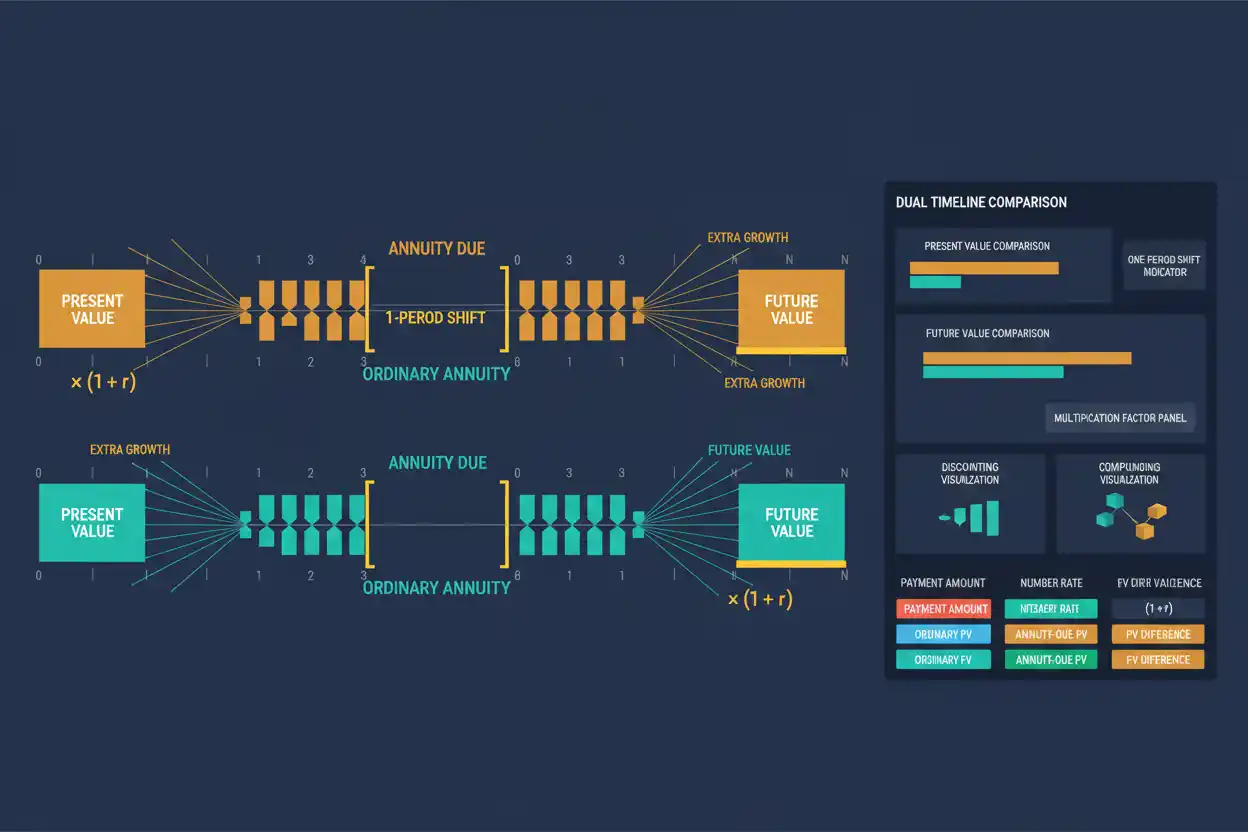
Annuity Due Timeline
Suppose there are four annual payments.
An annuity due pays at:
Time 0, 1, 2, and 3
An ordinary annuity pays at:
Time 1, 2, 3, and 4
The annuity due does not create an additional payment.
It shifts each existing payment one period earlier.
Annuity Due vs Ordinary Annuity
The broader annuities article explains both structures.
The core difference is:
Annuity Due = Beginning of Period
Ordinary Annuity = End of Period
The dedicated ordinary annuity page owns the end-of-period calculation.
Rent as an Annuity Due Example
Rent is often paid at the start of the period being occupied.
Suppose:
Monthly rent = $2,000
The first payment occurs immediately.
Then additional payments occur at the beginning of each following month.
That payment timing resembles an annuity due.
This does not mean every rental contract is literally a financial annuity product.
It means the cash-flow timing follows the same mathematical structure.
Savings Contributions at the Beginning of the Month
Suppose Investor A deposits:
$500 on the First Day of Every Month
Investor B deposits:
$500 on the Last Day of Every Month
Assuming identical returns and 240 deposits:
Investor A’s cash flows form an annuity-due pattern.
Investor B’s form an ordinary-annuity pattern.
Investor A ends with more money because each contribution receives one additional period of growth.
Annuity Due and APY
The mapped APY page measures annual yield after compounding.
An annuity-due calculation instead values a stream of payments.
If an account quotes an APY, you still need an appropriate periodic rate for the cash-flow calculation.
Do not automatically divide APY by 12 without checking the underlying rate convention.
Annuity Due and Annualized Return
Annualized return measures investment performance over time.
An annuity due measures the value of repeated beginning-of-period payments.
If an account receives regular contributions, a simple beginning-to-ending annualized return can be misleading because deposits affect the final balance.
Cash-flow-aware return methods can be more appropriate.
Annuity Due and Annuity Payouts
The annuity payouts page focuses on estimating periodic payments from accumulated capital.
If payments begin immediately rather than one period later, annuity-due mathematics can become relevant to certain simplified payout models.
Actual insurance-annuity contracts can require more complex actuarial calculations.
Annuity Due and Amortization
The mapped amortization page generally models payments made at the end of each payment period.
If a loan contract instead requires payments at the beginning, ordinary amortization assumptions need adjustment.
The payment timing changes present value.
Annuity Due and Future Value
The future value concept explains why beginning-of-period payments produce larger accumulated value.
Each payment gets an extra period of:
Compounding
Therefore, even though contributions are identical, timing changes the result.
Annuity Due and Compound Interest
Compound interest is what magnifies the timing difference over many periods.
A one-month advantage seems small.
Repeated 240 times across a 20-year savings schedule, it becomes meaningful.
Present Value Example With Annual Payments
Suppose you must make:
$10,000 per Year for 10 Years
at the beginning of every year.
Discount rate:
6%
Ordinary-annuity PV first:
PV Ordinary = $10,000 × [1 − (1.06)⁻¹⁰] ÷ 0.06
≈ $73,600.87
Annuity-due PV:
$73,600.87 × 1.06
≈ $78,016.92
The same ten payments are worth more today because each occurs one year sooner.
Future Value Example With Annual Contributions
Suppose:
Annual contribution = $10,000
Return = 6%
Years = 10
Contribution occurs at beginning of each year
Ordinary-annuity future value:
$10,000 × [((1.06)¹⁰ − 1) ÷ 0.06]
≈ $131,807.95
Annuity due:
$131,807.95 × 1.06
≈ $139,716.43
Difference:
≈ $7,908.48
Again, timing alone caused the difference.
Solving for the Payment
Sometimes the value is known but the required beginning-of-period payment is unknown.
Rearrange the present-value formula:
Payment = PV ÷ {[1 − (1 + r)⁻ⁿ] ÷ r × (1 + r)}
Suppose:
Required present value = $100,000
Rate = 5% annually
Payments = 10 annual beginning-of-year payments
The required payment is approximately:
$12,333.72
Changing payments to end-of-year would require a larger payment because each cash flow arrives later.
Why Annuity Due Values Are Always Higher When r > 0
If:
r > 0
then:
1 + r > 1
Therefore:
Annuity Due Value = Ordinary Value × Number Greater Than 1
So, with identical payment, rate, and number of periods:
Annuity Due PV > Ordinary Annuity PV
and:
Annuity Due FV > Ordinary Annuity FV
When the periodic rate is zero, the values become equal because timing produces no interest difference.
What Happens With a Negative Rate?
If the periodic rate is negative but above −100%, then:
1 + r < 1
In that unusual mathematical case, the beginning-of-period multiplier can be less than one.
The normal “annuity due is worth more” intuition assumes a positive discount or growth rate.
Payment Frequency Must Match the Rate
Suppose payments are monthly.
The interest rate in the formula must also be expressed on an appropriate monthly basis.
Do not combine:
monthly payments with an annual rate directly in r.
For a nominal 6% rate compounded monthly:
Periodic Rate = 6% ÷ 12
0.5% per Month
Rate and payment periods must match.
Common Annuity Due Mistakes
The most common error is using the ordinary-annuity formula without the:
× (1 + r)
adjustment.
Another is accidentally counting an additional payment.
A third is mixing annual rates with monthly periods.
A fourth is applying an annuity-due formula to end-of-period cash flows.
Finally, the formula should not be used as though it automatically captures the guarantees, fees, mortality assumptions, or surrender provisions of an insurance annuity.
Frequently Asked Questions
What is an annuity due?
It is a series of equal payments occurring at the beginning of each period.
What is the future-value formula?
FV Due = C × [((1 + r)ⁿ − 1) ÷ r] × (1 + r)
What is the present-value formula?
PV Due = C × [1 − (1 + r)⁻ⁿ] ÷ r × (1 + r)
How is annuity due different from ordinary annuity?
Annuity-due payments occur at the beginning of the period; ordinary-annuity payments occur at the end.
Why do you multiply by 1 + r?
Each payment occurs one period earlier and receives one additional period of compounding or less discounting.
Does an annuity due contain an extra payment?
No. The same number of payments is shifted one period earlier.
What does $500 monthly become over 20 years at 7%?
Approximately:
$261,982.70
when modeled as an annuity due with monthly compounding.
What would the ordinary-annuity value be?
Approximately:
$260,463.33
Is monthly rent an annuity due?
When rent is paid at the beginning of each month, its payment timing resembles an annuity due.
Can savings deposits be an annuity due?
Yes, when equal deposits occur at the beginning of each period.
Can annuity due be used for loans?
It can model beginning-of-period payment structures, but the actual loan contract controls repayment mechanics.
Does annuity due always have a higher value?
With identical cash flows and a positive periodic rate, yes.
Final Takeaway
An annuity due differs from an ordinary annuity by one detail:
Payments Occur at the Beginning of Each Period
That changes the formulas to:
FV Due = FV Ordinary × (1 + r)
and:
PV Due = PV Ordinary × (1 + r)
For $500 monthly contributions at an illustrative 7% for 20 years:
Ordinary-annuity future value:
≈ $260,463.33
Annuity-due future value:
≈ $261,982.70
Difference:
≈ $1,519.37
The number of contributions is identical. The annuity due ends higher because every contribution receives one additional compounding period.