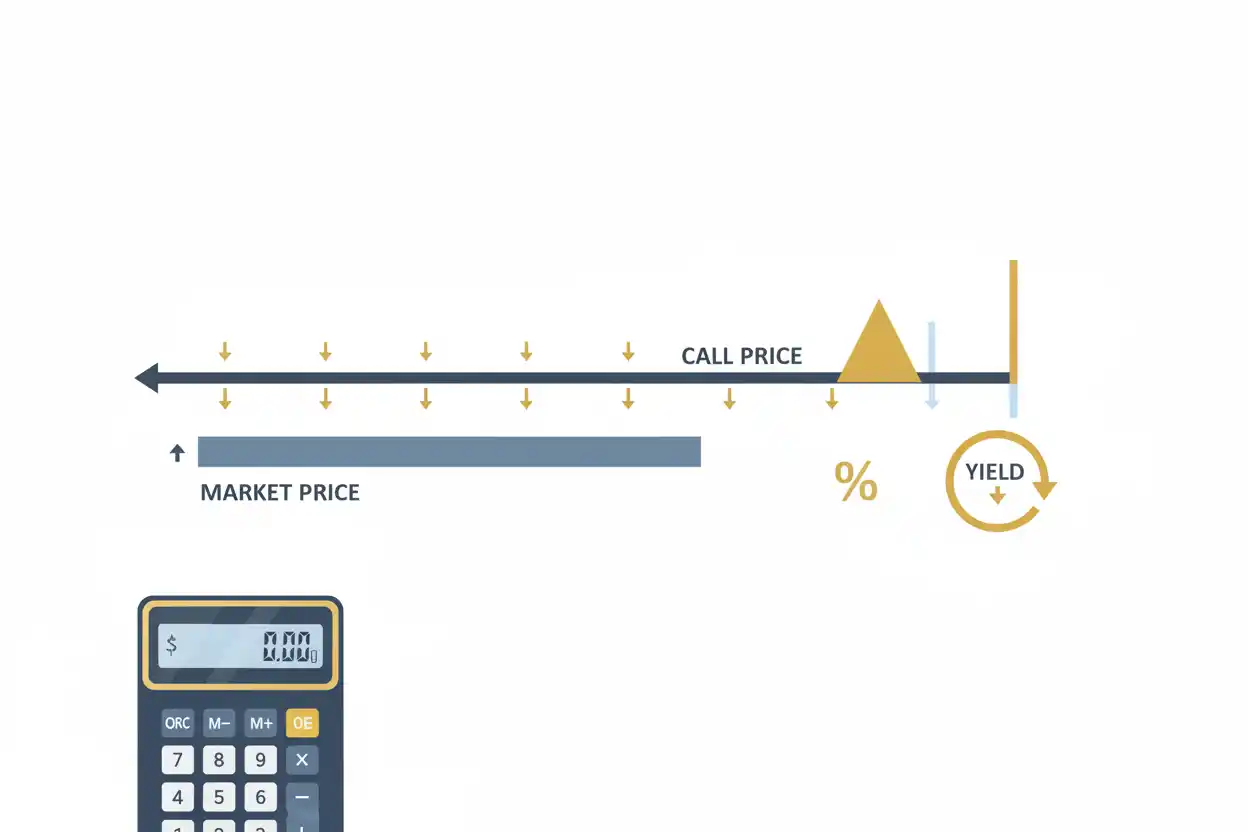

Yield to call estimates the annualized return a callable bond could produce if the issuer redeems it on a specified call date rather than allowing it to remain outstanding until maturity.
Suppose a bond has:
- $1,000 face value;
- 6% annual coupon;
- $1,020 market price;
- $1,010 call price;
- three years until the assumed call date.
Its approximate yield to call is about 5.58%, while solving the full discounted-cash-flow equation produces an annual YTC of approximately 5.57% under annual coupon assumptions.
Yield to call matters because a callable bond may stop paying coupons years before its scheduled maturity.
What Is Yield to Call?
Yield to call, or YTC, is the discount rate that equates:
- the bond’s current market price;
with:
- coupon payments received until the assumed call date;
- the call price received when the bond is redeemed.
Conceptually, it asks:
What return would I earn if I buy this bond today and it is called on the specified call date?
Callable Bond Basics
A callable bond gives the issuer the contractual right to redeem the bond before final maturity under specified terms.
The bond may have:
- one call date;
- several possible call dates;
- different call prices at different dates.
The relevant yield depends on which call scenario is being evaluated.
Exact Yield to Call Equation
For annual coupons:
Bond Price = C ÷ (1 + y) + C ÷ (1 + y)² + … + (C + Call Price) ÷ (1 + y)^n
Where:
- C = annual coupon;
- y = yield to call;
- n = periods until the call date.
There is generally no simple algebraic solution for y when several periods are involved.
Financial calculators, spreadsheets, or numerical methods are typically used.
Yield to Call Example
Suppose:
- face value = $1,000;
- annual coupon rate = 6%;
- coupon = $60;
- market price = $1,020;
- call price = $1,010;
- call date = 3 years away.
The cash flows are:
Year 1
$60
Year 2
$60
Year 3
$60 Coupon + $1,010 Call Price
= $1,070
We need the discount rate that makes these cash flows worth $1,020 today.
Exact YTC Equation
$1,020 = $60 ÷ (1 + y) + $60 ÷ (1 + y)² + $1,070 ÷ (1 + y)³
Solving numerically gives:
Yield to Call ≈ 5.57%
More precisely, under these assumptions:
YTC ≈ 5.573%
Approximate Yield to Call Formula
A useful estimation formula is:
Approximate YTC = [Annual Coupon + (Call Price − Market Price) ÷ Years to Call] ÷ [(Call Price + Market Price) ÷ 2]
Using the example:
Approximate YTC = [$60 + ($1,010 − $1,020) ÷ 3] ÷ [($1,010 + $1,020) ÷ 2]
Price adjustment:
($1,010 − $1,020) ÷ 3
= −$3.33 per year
Numerator:
$60 − $3.33 = $56.67
Average value denominator:
($1,010 + $1,020) ÷ 2
= $1,015
Then:
Approximate YTC = $56.67 ÷ $1,015
≈ 5.58%
The approximation is close to the exact 5.57% result.
Why YTC Is Below the Coupon Rate Here
The coupon rate is:
6%
but the bond is purchased for:
$1,020
and called for:
$1,010
The investor experiences a $10 capital loss if the call occurs:
$1,010 − $1,020 = −$10
That loss reduces the return produced by the $60 annual coupon payments.
Therefore YTC falls below 6%.
Discount Bond Example
Suppose the same callable bond trades for:
$970
with call price:
$1,010
If called, the investor receives a $40 capital gain in addition to coupon income.
That can cause YTC to exceed the coupon rate.
The relationship between:
- purchase price;
- call price;
is therefore important.
Call Price Above Face Value
Some callable bonds specify a call price above par.
For example:
Face Value = $1,000
Call Price = $1,030
The extra $30 can partially compensate the investor for early redemption.
As later call dates approach, call premiums may decline depending on the bond’s terms.
Yield to Call vs Yield to Maturity
Yield to maturity assumes the bond remains outstanding through final maturity.
Yield to call assumes earlier redemption on a call date.
For a callable bond, these can produce very different returns.
A bond may show:
YTM = 6.8%
but:
YTC = 5.4%
If the issuer calls the bond, the maturity yield would not be realized under the original holding assumptions.
Why Issuers May Call Bonds
An issuer may have an incentive to call higher-coupon debt when market financing becomes cheaper.
For example, if a company issued bonds at 8% and later can borrow at 5%, refinancing may reduce interest expense.
Whether a specific bond is actually called depends on its contract, economics, and issuer decisions.
Yield to call is a scenario—not a prediction.
Reinvestment Risk
Suppose a bond paying a relatively attractive 7% coupon is called.
The investor receives principal back earlier than expected.
If comparable new bonds now yield only 4%, reinvesting the proceeds at the old rate may be impossible.
This is reinvestment risk.
Callability can therefore be particularly relevant when market rates decline.
Yield to Call and Turnover Ratio
A bond fund’s turnover ratio measures portfolio trading activity.
If managers expect bonds to be called or identify better alternatives, they may trade before the call date.
Turnover and YTC remain separate metrics:
- turnover = trading activity;
- YTC = bond return under a call scenario.
Yield to Call and Treynor Ratio
The Treynor ratio measures excess portfolio return per unit of beta.
Yield to call measures a callable bond’s internal cash-flow return under a specific redemption assumption.
A high YTC does not automatically mean a strong Treynor ratio because market risk and portfolio structure are separate questions.
Yield to Call and Total Return
Total return measures actual or projected economic performance including income and capital change.
If a callable bond is actually redeemed, realized total return will depend on:
- purchase price;
- coupons received;
- call price;
- holding period;
- reinvestment of interim cash flows where relevant.
YTC summarizes those scheduled cash flows as an annualized discount rate.
Yield to Call and Time-Weighted Return
A portfolio holding callable bonds can also be evaluated using time-weighted return.
TWR measures actual portfolio performance over time.
YTC is a forward-looking bond yield assumption based on a specific call date.
One should not be substituted for the other.
Multiple Call Dates
Suppose a bond can be called:
- in year 2 at $1,030;
- year 3 at $1,020;
- year 4 at $1,010.
Each call date can produce a different yield.
The investor can calculate:
YTC₂
YTC₃
YTC₄
rather than assuming one universal call yield.
Yield to Worst
For callable bonds, investors sometimes compare the yield under multiple contractual redemption scenarios.
The lowest relevant calculated yield can be particularly important when evaluating downside from issuer optionality.
Yield to worst is a related but distinct concept and should not be confused with one specific yield-to-call calculation.
Semiannual Coupons
Many bonds pay coupons more frequently than annually.
If coupons are semiannual:
- coupon cash flow must be converted to a six-month amount;
- number of periods must be doubled;
- periodic yield must correspond to six-month periods.
The quoted annualized yield then depends on the bond-market convention being used.
Accrued Interest
A bond’s quoted clean price and actual settlement amount can differ because of accrued interest.
A precise YTC calculation should use cash flows and price inputs consistent with the market convention.
A simplified example using $1,020 as the full purchase value ignores this additional settlement detail.
YTC Is Not Guaranteed
A bond may:
- not be called;
- be called on a later date;
- default;
- be sold before the call date.
Therefore:
Calculated YTC ≠ Guaranteed Realized Return
It is a conditional return measure.
Market Price Sensitivity
Suppose all contractual terms remain unchanged.
If the bond price rises:
Yield to Call generally falls
If the price falls:
Yield to Call generally rises
Price and yield move inversely, all else equal.
Common Yield to Call Mistakes
One mistake is using face value instead of the contractual call price.
Another is using years to maturity instead of years to the call date.
People may also assume the bond will definitely be called.
A further mistake is comparing YTC with a YTM calculated using different compounding conventions.
Frequently Asked Questions
What is yield to call?
It is the annualized return implied if a callable bond is purchased at its current price and redeemed on a specified call date.
What cash flows are included?
Coupons until the call date plus the contractual call price.
Is there an exact closed-form YTC formula?
Usually not for multi-period bonds. The yield is typically solved numerically.
What is the approximate formula?
Approximate YTC = [Coupon + (Call Price − Price) ÷ Years] ÷ [(Call Price + Price) ÷ 2]
Why can YTC differ from the coupon rate?
Because the investor may experience a capital gain or loss between the purchase price and call price.
Why can YTC differ from YTM?
YTC assumes early redemption; YTM assumes maturity.
Is a bond guaranteed to be called?
No.
Why might an issuer call a bond?
One possible reason is the opportunity to refinance debt at a lower cost.
Can a bond have several YTC values?
Yes, if it has several possible call dates or prices.
Does YTC include market risk?
It is a cash-flow yield calculation, not a complete portfolio-risk measure.
Does a high YTC guarantee high realized return?
No. The call may not occur and other risks remain.
Why calculate yield to call?
It helps investors evaluate the return consequences of early redemption when comparing callable securities within broader Savings & Investing analysis.