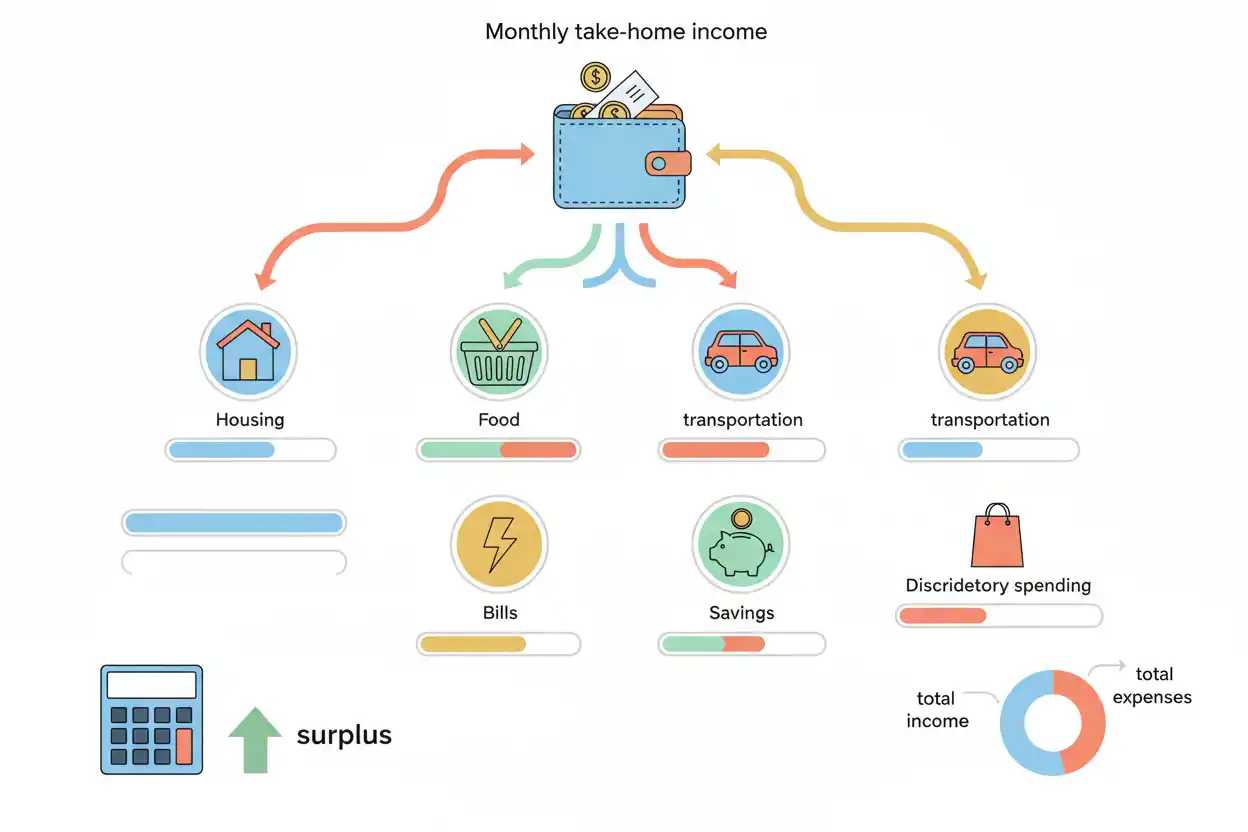

Budgeting compares the money coming into a household with the money going out.
If monthly take-home income is $5,200 and total planned expenses are $4,450, the budget has a $750 monthly surplus.
If expenses exceed income, the budget has a deficit.
The arithmetic is straightforward:
Budget Surplus or Deficit = Income − Expenses
The more important work is making sure the income and expense figures are complete, realistic, and measured over the same period.
What Is Budgeting?
A budget is a financial plan for income and spending across a defined period.
A monthly household budget commonly starts with:
Net Income
and allocates it among:
Expenses + Savings + Debt Payments + Other Goals
Budgeting is not simply restricting spending.
It is deciding intentionally where available money should go.
Basic Budget Formula
Budget Balance = Total Income − Total Outflows
If the result is positive:
Surplus
If it is negative:
Deficit
If it equals zero:
Income Has Been Fully Assigned
A zero-based budget can intentionally assign every dollar while still including savings and investments as planned uses of money.
Monthly Budget Example
Suppose monthly take-home income is:
$5,200
Monthly outflows are:
Housing:
$1,700
Food:
$650
Transportation:
$600
Insurance and healthcare:
$450
Utilities and communications:
$400
Savings:
$350
Other spending:
$300
Total:
$1,700 + $650 + $600 + $450 + $400 + $350 + $300
= $4,450
Budget surplus:
$5,200 − $4,450
= $750
The household has $750 of unallocated monthly cash.
Annual Effect of a Monthly Surplus
If the $750 surplus remains consistent:
Annual Surplus = $750 × 12
= $9,000
A seemingly modest monthly difference can therefore become meaningful over a year.
Deficit Example
Suppose:
Monthly Income = $4,500
and:
Monthly Outflows = $4,900
Then:
Budget Balance = $4,500 − $4,900
= −$400
The household is running a $400 monthly deficit.
Annualized:
$400 × 12 = $4,800
Without a change, the deficit may need to be financed from existing savings or borrowing.
Start With Take-Home Income
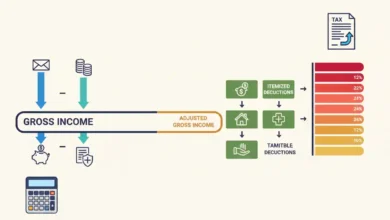
For day-to-day budgeting, take-home pay is usually more useful than gross salary.
Suppose annual salary is:
$78,000
Monthly gross equivalent:
$6,500
But monthly take-home income is:
$4,900
The budget should not assume $6,500 is available for ordinary expenses.
The difference has already been allocated to withholding and payroll deductions.
Budgeting With Biweekly Pay
People receiving biweekly pay often have two checks in most months and three in some months.
Suppose net biweekly pay is:
$2,000
Annual net income:
$2,000 × 26 = $52,000
Average monthly net:
$52,000 ÷ 12
≈ $4,333.33
A household can either smooth income at approximately $4,333 per month or build ordinary spending around two checks and deliberately assign the extra-paycheck months.
Budgeting Variable Commission Income
Commission pay can make monthly income less predictable.
Suppose income over six months is:
$4,200, $5,100, $3,900, $6,000, $4,600, $5,000
Average:
($4,200 + $5,100 + $3,900 + $6,000 + $4,600 + $5,000) ÷ 6
= $4,800
Using a multi-month average can provide better context than budgeting from the strongest month.
A more conservative plan may use an amount below the average for recurring commitments.
Bonus Income in a Budget
A bonus can improve annual cash flow, but it may be uncertain.
Suppose regular monthly expenses are sustainable from salary alone and a $6,000 net bonus arrives.
The household can make a deliberate one-time allocation rather than using the expected bonus to support permanent monthly commitments before it is received.
This reduces dependence on variable income.
Fixed Expenses
Fixed expenses are amounts that remain relatively stable over the budgeting period.
Examples often include rent, contractual debt payments, and some subscriptions or insurance costs.
The purpose of identifying fixed expenses is not to imply they can never change.
It is to distinguish costs that are less flexible in the short term.
Variable Expenses
Variable expenses change with activity or consumption.
Food, electricity, fuel, and discretionary spending can vary from month to month.
Instead of pretending these costs are fixed, a budget can use realistic averages and maintain room for normal variation.
Irregular Expenses
Some expenses are predictable but do not occur every month.
Suppose annual irregular expenses total:
$3,600
Monthly reserve:
$3,600 ÷ 12
= $300
Saving $300 monthly converts a large annual obligation into a manageable recurring budget item.
Why Annual Costs Should Be Monthlyized
Suppose car insurance costs:
$1,200 every six months
A budget that only records the payment in the month it occurs makes the other months look artificially inexpensive.
Monthly equivalent:
$1,200 ÷ 6
= $200
Setting aside $200 per month makes the true recurring burden visible.
Budget Percentages
Budget categories can be expressed as a percentage of income.
Suppose monthly take-home income is:
$5,200
and essential spending is:
$3,200
Essential-spending ratio:
$3,200 ÷ $5,200 × 100
≈ 61.54%
If discretionary spending is $900:
$900 ÷ $5,200 ≈ 17.31%
If savings are $1,100:
$1,100 ÷ $5,200 ≈ 21.15%
The percentages sum to 100%.
Budget Ratios Are Descriptive, Not Universal Rules
A percentage framework can make a budget easier to analyze.
However, one household may spend much more on housing while another spends more on childcare or healthcare.
A budget should reflect actual priorities and obligations rather than forcing every household into the same template.
Income vs Expenses
The central comparison is:
Income ≥ Expenses and Planned Goals
If planned outflows continually exceed available income, one of three things must eventually happen:
Income rises, spending falls, or savings/debt finance the difference.
A recurring structural deficit cannot be solved by arithmetic alone.
Savings Should Be Part of the Budget
Savings are often treated as whatever remains after spending.
Another approach assigns savings deliberately.
Suppose:
Monthly Net Income = $5,000
and desired savings are:
$750
Then only:
$5,000 − $750 = $4,250
remains for spending.
This makes saving an intentional allocation rather than an accidental leftover.
Emergency Fund Contributions
Suppose the household wants to build:
$12,000 Emergency Savings
in 18 months.
Ignoring interest:
Monthly Contribution = $12,000 ÷ 18
≈ $666.67
That contribution can be inserted into the monthly budget as a defined goal.
Debt Payments
Debt payments should be included in cash-flow planning.
Suppose:
Minimum Debt Payments = $600 per month
Ignoring them because they are “not living expenses” would overstate available cash.
A complete budget tracks every material recurring obligation.
Budgeting and Capital Gains
Selling an investment can create cash, but investment gains are not the same as recurring employment income.
Potential tax effects belong under capital gains tax.
A household should be cautious about funding ordinary monthly spending from one-time asset sales unless that is part of a deliberate financial plan.
Sinking Funds for Predictable Costs
Suppose a household expects a $4,800 vacation one year from now.
Monthly amount:
$4,800 ÷ 12
= $400
Rather than treating the trip as a surprise $4,800 expense, the budget can reserve $400 monthly.
The same approach can be used for vehicle replacement, annual fees, or home repairs.
Budgeting for Seasonal Utilities
Suppose electricity ranges from:
$120 to $300 per month
A budget using the lowest month will repeatedly underestimate costs.
One solution is to estimate the annual total and divide by 12.
That creates a smoother monthly planning amount even though the actual bill still varies.
Budgeting With a Pay Raise
Suppose take-home income rises:
$5,000 → $5,400
Monthly increase:
$400
If spending rises only $150:
Additional Monthly Surplus = $250
Annual additional surplus:
$250 × 12 = $3,000
Income growth improves the budget most when spending does not automatically rise by the full amount.
Lifestyle Inflation
Lifestyle inflation occurs when spending rises alongside income.
Suppose income increases by $500 monthly and spending also increases by $500.
Budget surplus does not improve.
There is nothing inherently wrong with spending more as income rises, but the tradeoff should be intentional.
Budgeting for a Salary Reduction
Suppose monthly net income falls:
$5,200 → $4,700
Difference:
$500
If the old budget used the full $5,200, the household must now reduce planned outflows by $500 or use another funding source.
A budget should be recalculated when income changes materially.
Household Surplus Rate
A simple surplus rate is:
Surplus Rate = Budget Surplus ÷ Net Income × 100
Using:
Surplus = $750
Income = $5,200
Then:
$750 ÷ $5,200 × 100
≈ 14.42%
This provides another way to track improvement through time.
Monthly vs Annual Budgeting
Monthly budgets are useful for day-to-day cash management.
Annual budgets help capture:
- irregular expenses;
- bonuses;
- annual insurance;
- travel;
- seasonal costs.
Using both views can prevent an apparently balanced monthly plan from overlooking large annual obligations.
Budget Variance
After the month ends, compare actual spending with planned spending.
Suppose:
Food Budget = $600
Actual:
$675
Variance:
$675 − $600 = $75 Unfavorable
If transportation is budgeted at $500 but actual is $430:
$430 − $500 = −$70
That represents $70 less spending than planned.
Tracking variance improves future estimates.
A Budget Should Change
A budget is not a permanent document.
It should be updated when:
- income changes;
- housing changes;
- debt is repaid;
- dependents change;
- financial goals change.
A realistic budget evolves with the household.
Common Budgeting Mistakes
One common mistake is budgeting from gross pay instead of spendable income.
Another is ignoring annual and irregular expenses.
People also underestimate variable costs, count uncertain bonuses as guaranteed income, or use asset sales to hide a recurring monthly deficit.
Frequently Asked Questions
What is budgeting?
Budgeting is the process of planning how income will be allocated among expenses, savings, debt payments, and other financial goals.
What is the basic budgeting formula?
Budget Balance = Income − Expenses and Planned Outflows
What does a positive result mean?
It means the budget has a surplus.
What does a negative result mean?
It means planned outflows exceed available income.
Should I budget from gross salary?
For ordinary household cash flow, take-home income is generally more useful.
How do I budget biweekly income?
You can annualize 26 paychecks and divide by 12 or plan around two regular checks while assigning extra-paycheck months separately.
How should variable income be handled?
Using a multi-month average or conservative baseline can reduce dependence on unusually strong months.
Should savings count as an expense?
Savings can be treated as a planned allocation so that it is funded intentionally.
How do I budget annual expenses?
Divide the expected annual cost by 12 and reserve that amount monthly.
What is budget variance?
It is the difference between planned and actual income or spending.
Should a budget stay the same every year?
No. It should change as income, expenses, and financial goals change.
Why is budgeting important?
It connects compensation, taxes, spending, and financial goals by showing where actual cash goes within the broader Taxes & Pay.