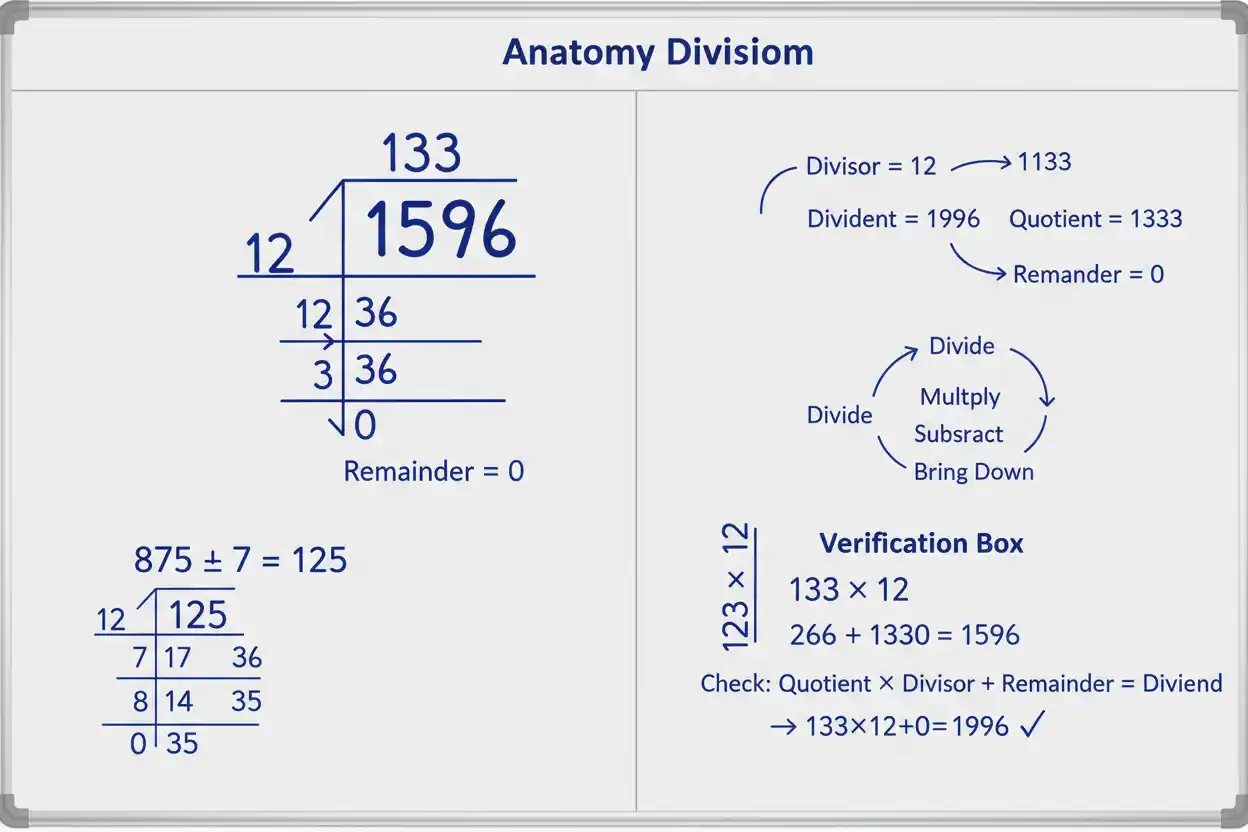

Long division is a step-by-step method for dividing numbers when the quotient cannot be found conveniently in one mental calculation. The process repeatedly divides, multiplies, subtracts, and brings down the next digit.
For example:
1,596 ÷ 12 = 133
because:
12 × 133 = 1,596
When a division is not exact, long division can also produce a remainder or continue into decimal places.
The underlying division relationship is:
Dividend = Divisor × Quotient + Remainder
with:
0 ≤ Remainder < |Divisor|
For example:
157 = 12 × 13 + 1
Therefore:
157 ÷ 12 = 13 remainder 1
Long division provides a systematic way to discover that quotient and remainder.
What Is Long Division?
Long division breaks a large division problem into a sequence of smaller ones.
Suppose you need to calculate:
936 ÷ 6
Instead of solving the entire problem at once, long division processes the dividend from left to right.
The cycle is commonly summarized as:
Divide → Multiply → Subtract → Bring down
Then repeat until every digit has been processed.
Long division is an extended form of ordinary division and uses the same quotient-and-remainder relationship.
Parts of a Long Division Problem
A division problem contains four important quantities.
For:
157 ÷ 12 = 13 remainder 1
the:
Dividend is:
157
Divisor is:
12
Quotient is:
13
Remainder is:
1
They satisfy:
157 = 12 × 13 + 1
A correct long-division result should always satisfy this equation.
Long Division Formula
The fundamental relationship is:
a = bq + r
where:
a = dividend
b = divisor
q = quotient
r = remainder
with:
b ≠ 0
and, for positive-divisor elementary division:
0 ≤ r < b
For example:
725 = 8 × 90 + 5
Therefore:
725 ÷ 8 = 90 remainder 5
The dedicated remainders topic develops remainder rules in greater detail.
The Four Long Division Steps
For each stage of long division:
- Divide the current portion of the dividend by the divisor.
- Multiply the quotient digit by the divisor.
- Subtract the product from the current portion.
- Bring down the next dividend digit.
Repeat until no digits remain.
A useful check at every stage is that the temporary remainder must be smaller than the divisor before another digit is brought down.
Example: 936 ÷ 6
Calculate:
936 ÷ 6
Start with the first digit:
9 ÷ 6 = 1
Write 1 in the quotient.
Multiply:
1 × 6 = 6
Subtract:
9 – 6 = 3
Bring down the next digit, 3:
33
Now:
33 ÷ 6 = 5
because:
6 × 5 = 30
Subtract:
33 – 30 = 3
Bring down 6:
36
Then:
36 ÷ 6 = 6
So the quotient is:
156
Check:
156 × 6 = 936
Therefore:
936 ÷ 6 = 156
Example: 1,596 ÷ 12
Start with:
15 ÷ 12 = 1
Multiply:
1 × 12 = 12
Subtract:
15 – 12 = 3
Bring down 9:
39
Then:
39 ÷ 12 = 3
because:
12 × 3 = 36
Subtract:
39 – 36 = 3
Bring down 6:
36
Now:
36 ÷ 12 = 3
Therefore:
1,596 ÷ 12 = 133
Check:
133 × 12 = 1,596
Long Division With a Remainder
Calculate:
847 ÷ 6
Start:
8 ÷ 6 = 1
Multiply:
1 × 6 = 6
Subtract:
8 – 6 = 2
Bring down 4:
24
Then:
24 ÷ 6 = 4
Multiply:
4 × 6 = 24
Subtract:
0
Bring down 7:
7
Then:
7 ÷ 6 = 1
Multiply:
6
Subtract:
1
Therefore:
847 ÷ 6 = 141 remainder 1
Check:
6 × 141 + 1
= 846 + 1
= 847
Remainder Rule
A valid remainder must satisfy:
0 ≤ r < divisor
for a positive divisor.
For example, a result written:
29 ÷ 4 = 6 remainder 5
cannot be correct because:
5 ≥ 4
The quotient can be increased by 1:
4 × 7 = 28
leaving:
1
So the correct answer is:
29 ÷ 4 = 7 remainder 1
When the Divisor Does Not Fit Into the First Digit
Consider:
432 ÷ 12
The divisor 12 does not fit into 4.
Therefore examine the first two digits:
43
Now:
43 ÷ 12 = 3
because:
12 × 3 = 36
Subtract:
43 – 36 = 7
Bring down 2:
72
Then:
72 ÷ 12 = 6
Therefore:
432 ÷ 12 = 36
You begin with enough leading dividend digits to form a value at least as large as the divisor.
Zero in the Quotient
Zeros in a quotient must not be skipped.
Consider:
408 ÷ 4
First:
4 ÷ 4 = 1
Bring down 0.
Now:
0 ÷ 4 = 0
so the quotient needs a zero in that position.
Bring down 8:
8 ÷ 4 = 2
Therefore:
408 ÷ 4 = 102
Writing 12 would give the wrong place value.
Example: 6,024 ÷ 6
Calculate from left to right.
6 ÷ 6 = 1
Next digit:
0 ÷ 6 = 0
Next:
2 ÷ 6 = 0
Since 6 does not fit into 2, write 0 and bring down 4, making:
24
Then:
24 ÷ 6 = 4
Therefore:
6,024 ÷ 6 = 1,004
Check:
1,004 × 6 = 6,024
The two zeros in the quotient preserve the correct place values.
Long Division With Decimal Answers
A remainder does not always have to remain a remainder.
Consider:
7 ÷ 4
Integer division gives:
1 remainder 3
To continue as a decimal, write:
7.000…
Place a decimal point in the quotient after the whole-number quotient.
The remainder 3 becomes:
30 tenths
Then:
30 ÷ 4 = 7 remainder 2
Next:
20 ÷ 4 = 5
Therefore:
7 ÷ 4 = 1.75
The calculation transitions naturally from integer division to decimal arithmetic.
Example: 13 ÷ 8 as a Decimal
First:
13 ÷ 8 = 1 remainder 5
Add a decimal point and zero:
50 ÷ 8 = 6 remainder 2
Bring down another zero:
20 ÷ 8 = 2 remainder 4
Bring down another zero:
40 ÷ 8 = 5
Therefore:
13 ÷ 8 = 1.625
This is equivalent to the improper fraction:
13/8
and mixed number:
1 5/8
Long Division With a Repeating Decimal
Consider:
1 ÷ 3
3 does not fit into 1 as a positive whole number, so the whole-number part is:
0
Continue with decimals:
10 ÷ 3 = 3 remainder 1
The same remainder 1 returns.
Bringing down another zero again gives:
10 ÷ 3 = 3 remainder 1
This repeats forever.
Therefore:
1 ÷ 3 = 0.333…
A repeated remainder creates a repeating decimal pattern.
Why Repeating Decimals Occur
For division by a positive integer b, the possible nonzero remainders are:
1, 2, …, b – 1
There are only finitely many possibilities.
If a remainder becomes zero, the decimal terminates.
If a previous nonzero remainder occurs again, the same future division steps repeat, creating a repeating decimal.
This is why fractions of integers produce decimal expansions that either terminate or eventually repeat.
Long Division and Fractions
Every fraction:
a/b
with:
b ≠ 0
represents division:
a ÷ b
For example:
17/5
means:
17 ÷ 5
Long division gives:
3.4
Therefore:
17/5 = 3.4
The same calculation can also be represented as:
3 2/5
using mixed numbers.
Improper Fractions and Long Division
An improper fraction can be converted to a mixed number through integer long division.
For example:
47/6
Divide:
47 ÷ 6 = 7 remainder 5
Therefore:
47/6 = 7 5/6
The quotient becomes the whole-number component, and the remainder becomes the numerator of the fractional component.
Long Division and Fraction Simplification
Long division can determine the decimal value of a fraction, but fraction simplification answers a different question.
For example:
18/24
can be reduced to:
3/4
Then:
3 ÷ 4 = 0.75
The simplification preserves the exact rational value, while long division produces its decimal representation.
Long Division and Logarithms
logarithms can involve numerical quotients, particularly through the change-of-base formula:
log_b(x) = ln(x) / ln(b)
Once the logarithm values have been approximated, their quotient may require ordinary division.
However, long division does not calculate the logarithms themselves; it only performs the division step when numbers are supplied.
Long Division and Least Common Multiple
The least common multiple is found through integer divisibility relationships rather than long division alone.
However, long division can verify a proposed result.
If:
LCM(18,24) = 72
check:
72 ÷ 18 = 4
and:
72 ÷ 24 = 3
Because both quotients are integers, 72 is a common multiple.
The separate least-common-multiple calculation establishes that it is the smallest positive one.
Long Division and LCM
The shorter LCM concept likewise depends on exact divisibility.
A candidate common multiple m must satisfy:
m ÷ a = integer
m ÷ b = integer
Long division can verify those exact divisions when the numbers are inconvenient to calculate mentally.
Long Division and the Euclidean Algorithm
The Euclidean algorithm repeatedly uses quotient-and-remainder division.
For example:
252 = 105 × 2 + 42
105 = 42 × 2 + 21
42 = 21 × 2 + 0
Each line is fundamentally a division step.
Long division can supply those quotients and remainders when necessary.
The Euclidean algorithm then uses the remainder structure to determine the GCD.
Long Division and Divisibility
If long division ends with:
remainder 0
then the divisor divides the dividend exactly.
For example:
924 ÷ 7 = 132
with no remainder.
Therefore:
7 is a factor of 924
This connects long division with divisibility rules and factors.
A divisibility rule may predict exact division quickly; long division can confirm it and determine the quotient.
Long Division With Negative Numbers
Sign rules should be handled separately from the magnitude calculation.
For example:
-936 ÷ 6
First divide magnitudes:
936 ÷ 6 = 156
Since the signs differ:
-936 ÷ 6 = -156
Similarly:
-936 ÷ -6 = 156
The underlying long-division digits are the same; integer operations determine the final sign.
Dividing by a One-Digit Divisor
A one-digit divisor often makes long division relatively direct.
Example:
3,276 ÷ 7
Start:
32 ÷ 7 = 4 remainder 4
Bring down 7:
47 ÷ 7 = 6 remainder 5
Bring down 6:
56 ÷ 7 = 8
Therefore:
3,276 ÷ 7 = 468
Check:
468 × 7 = 3,276
Dividing by a Two-Digit Divisor
Consider:
4,368 ÷ 24
Start with:
43 ÷ 24 = 1
Subtract:
43 – 24 = 19
Bring down 6:
196
Now:
196 ÷ 24 = 8
because:
24 × 8 = 192
Subtract:
196 – 192 = 4
Bring down 8:
48
Then:
48 ÷ 24 = 2
Therefore:
4,368 ÷ 24 = 182
Estimating Quotient Digits
With a multi-digit divisor, estimate each quotient digit before multiplying.
Suppose:
958 ÷ 23
Since:
23 × 4 = 92
and:
23 × 5 = 115
the first relevant quotient digit is likely 4 when dividing 95.
Use:
95 – 92 = 3
Bring down 8:
38
Then:
38 ÷ 23 = 1
Therefore:
958 ÷ 23 = 41 remainder 15
Check:
23 × 41 + 15
= 943 + 15
= 958
Correcting an Overestimate
Suppose you estimate a quotient digit too high.
If multiplying the divisor by that digit produces a number larger than the current dividend portion, reduce the quotient digit.
For example, dividing:
87 by 19
trying 5 gives:
19 × 5 = 95
which is too large.
Try 4:
19 × 4 = 76
This fits.
The temporary remainder is:
87 – 76 = 11
Since:
11 < 19
the quotient digit 4 is valid.
Long Division and Place Value
Every quotient digit corresponds to a place value determined by its position.
In:
1,248 ÷ 4 = 312
the quotient digits represent:
3 hundreds
1 ten
2 ones
Skipping a zero or placing a quotient digit one position too far left or right changes the result by a factor of 10.
Careful vertical alignment is therefore essential.
Checking Long Division With Multiplication
If:
Dividend ÷ Divisor = Quotient
with no remainder, verify:
Divisor × Quotient = Dividend
For example:
3,456 ÷ 12 = 288
Check:
288 × 12
= 288 × (10 + 2)
= 2,880 + 576
= 3,456
Therefore the quotient is correct.
Checking a Remainder Result
If:
1,007 ÷ 16 = 62 remainder 15
check:
16 × 62 + 15
= 992 + 15
= 1,007
Also verify:
15 < 16
Both conditions are satisfied.
Common Long Division Mistake: Forgetting to Bring Down a Digit
Every dividend digit must eventually be processed.
If a digit is skipped, the quotient and remainder will be wrong.
After subtraction, always identify the next unprocessed dividend digit before continuing.
Common Mistake: Omitting a Zero in the Quotient
In:
804 ÷ 4
the correct answer is:
201
The middle zero matters because 4 fits into the tens-stage zero exactly zero times.
Writing:
21
would destroy the place-value structure.
Common Mistake: Remainder Larger Than the Divisor
A result such as:
52 ÷ 7 = 6 remainder 10
cannot be complete.
Since:
10 ≥ 7
another 7 can be removed.
The correct result is:
52 ÷ 7 = 7 remainder 3
Common Mistake: Placing the Decimal Point Incorrectly
When extending whole-number long division into decimals, place the quotient’s decimal point directly above the dividend’s decimal point.
For:
7.00 ÷ 4
the result begins:
and continues:
75
giving:
1.75
Incorrect decimal placement changes the magnitude of the result.
Common Mistake: Dividing by Zero
Long division cannot be performed with:
divisor = 0
For example:
50 ÷ 0
is undefined.
The restriction is fundamental to division, not merely a limitation of the written algorithm.
Frequently Asked Questions
What is long division?
Long division is a systematic method that solves division by repeatedly dividing, multiplying, subtracting, and bringing down digits.
What is the long division formula?
The underlying relationship is:
Dividend = Divisor × Quotient + Remainder
or:
a = bq + r
What are the steps in long division?
The repeating cycle is:
Divide → Multiply → Subtract → Bring down
What is a remainder?
A remainder is the amount left after the largest possible whole-number multiple of the divisor has been removed.
Can long division produce decimals?
Yes. Add decimal zeros to the dividend and continue the process after placing a decimal point in the quotient.
Why do some long-division decimals repeat?
A nonzero remainder eventually repeats. Once the same remainder returns, the following quotient digits repeat as well.
How do I know if my remainder is valid?
For a positive divisor:
0 ≤ remainder < divisor
How do you check long division?
Use:
divisor × quotient + remainder = dividend
Can the quotient contain zero?
Yes. Zeros must be written wherever place value requires them.
Can long division be used with fractions?
A fraction a/b is a division problem, so long division can convert many fractions into decimal form.
Can you divide by zero using long division?
No. Division by zero is undefined.
Final Example
Calculate:
7,349 ÷ 23
Start with:
73 ÷ 23 = 3
because:
23 × 3 = 69
Subtract:
73 – 69 = 4
Bring down 4:
44
Then:
44 ÷ 23 = 1
Multiply:
23 × 1 = 23
Subtract:
44 – 23 = 21
Bring down 9:
219
Now:
219 ÷ 23 = 9
because:
23 × 9 = 207
Subtract:
219 – 207 = 12
Therefore:
7,349 ÷ 23 = 319 remainder 12
Verify:
23 × 319 + 12
= 7,337 + 12
= 7,349
and:
12 < 23
The answer is valid.
Long division works because every stage preserves the same division relationship while reducing a large problem into manageable quotient-and-remainder steps.