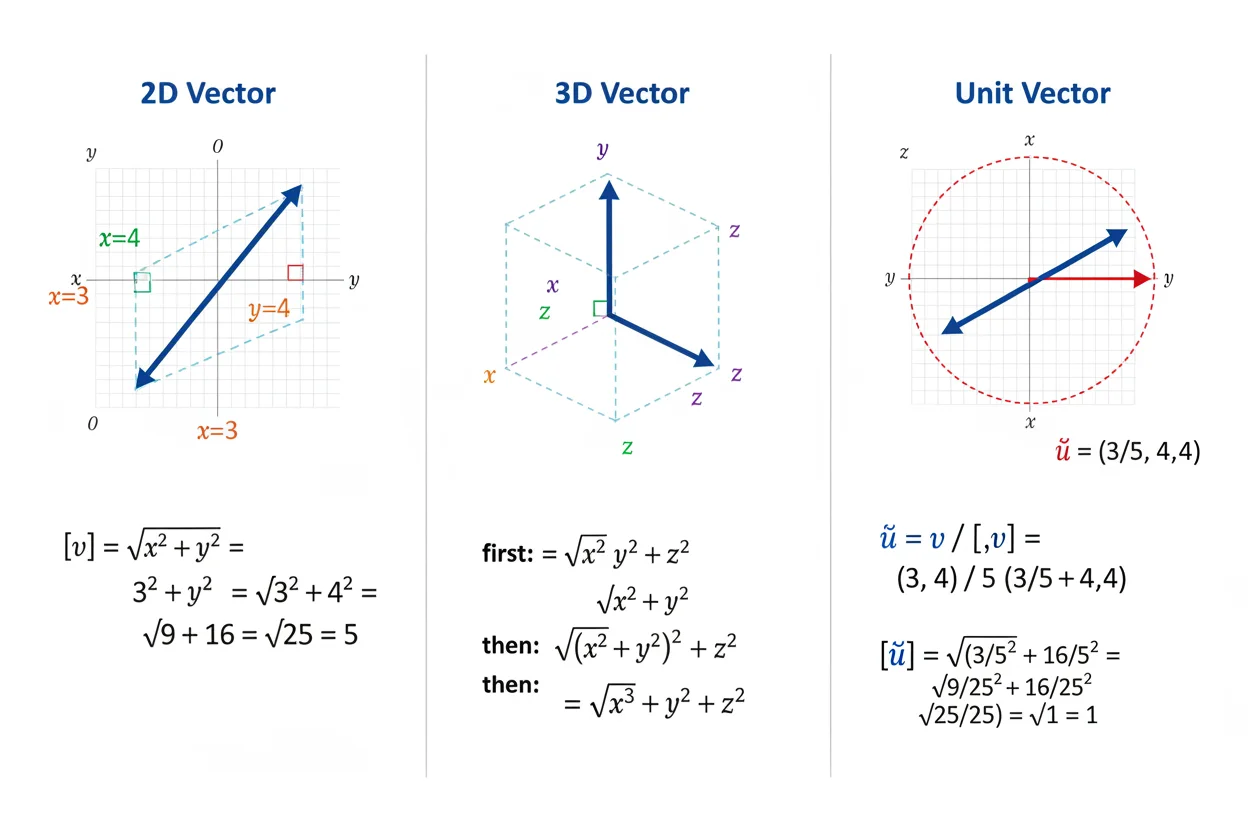
Vector magnitude is the nonnegative length or size of a vector. For a two-dimensional vector v = (a, b), its magnitude is |v| = √(a² + b²). For a three-dimensional vector v = (a, b, c), the formula becomes |v| = √(a² + b² + c²). More generally, the Euclidean magnitude of an n-dimensional vector is the square root of the sum of the squares of all its components. Vector magnitude does not describe direction; vectors pointing in different directions can have the same magnitude. The zero vector has magnitude zero, while every nonzero vector has positive magnitude. Magnitude is used to calculate distance, normalize vectors, construct unit vectors, find projections, measure velocities and forces, calculate curve length, and interpret geometric relationships through the dot product. Because the formula is based on the Pythagorean theorem, vector magnitude provides a direct bridge between coordinate components and geometric length.
What Is Vector Magnitude?
A vector contains both:
magnitude
and:
direction
For example:
v = (3, 4)
has two coordinate components.
Its magnitude is:
|v| = √(3² + 4²)
= √(9 + 16)
= √25
= 5
So:
v = (3, 4)
has magnitude:
5
The direction comes from the component ratio and orientation, while the magnitude tells only how long the vector is.
Vector Magnitude Formula
For a two-dimensional vector:
v = (v₁, v₂)
the formula is:
|v| = √(v₁² + v₂²)
For a three-dimensional vector:
v = (v₁, v₂, v₃)
use:
|v| = √(v₁² + v₂² + v₃²)
In n dimensions:
v = (v₁, v₂, …, vₙ)
then:
|v| = √(v₁² + v₂² + … + vₙ²)
This quantity is also called the Euclidean norm.
Why the Magnitude Formula Works
Consider:
v = (a, b)
The horizontal component has length:
|a|
and the vertical component has length:
|b|
These form perpendicular sides of a right triangle.
By the Pythagorean theorem:
|v|² = a² + b²
Therefore:
|v| = √(a² + b²)
The positive square root is used because geometric length cannot be negative.
In three dimensions, apply the Pythagorean relationship again to include the third perpendicular component.
Basic 2D Vector Magnitude Example
Find the magnitude of:
v = (6, 8)
Apply:
|v| = √(6² + 8²)
= √(36 + 64)
= √100
= 10
Therefore:
|v| = 10
This is another scaled version of the familiar 3-4-5 right triangle.
Example With Negative Components
Find the magnitude of:
v = (−5, 12)
Then:
|v| = √[(−5)² + 12²]
= √(25 + 144)
= √169
= 13
The negative x-component affects direction but not length because it is squared.
Thus:
(5, 12)
and:
(−5, 12)
have the same magnitude.
3D Vector Magnitude Example
Let:
v = (2, −3, 6)
Then:
|v| = √[2² + (−3)² + 6²]
= √(4 + 9 + 36)
= √49
= 7
Therefore the vector’s magnitude is:
7
The sign of each component disappears after squaring, but the components still determine the vector’s direction.
Example With an Irrational Magnitude
Find:
|(1, 2, 3)|
Calculate:
√(1² + 2² + 3²)
= √(1 + 4 + 9)
= √14
Since 14 is not a perfect square, the exact magnitude is:
√14
An approximate decimal is:
√14 ≈ 3.742
When an exact radical is simple, retaining it is generally more precise than immediately rounding.
Zero Vector Magnitude
The zero vector is:
0 = (0, 0)
or in three dimensions:
0 = (0, 0, 0)
Its magnitude is:
|0| = 0
The zero vector is the only vector with magnitude zero.
Every nonzero vector satisfies:
|v| > 0
This distinction matters when normalizing vectors because division by the magnitude of the zero vector is impossible.
Magnitude Is Always Nonnegative
For any vector v:
|v| ≥ 0
This follows because each squared component is nonnegative:
vᵢ² ≥ 0
Their sum is therefore nonnegative, and its principal square root is also nonnegative.
A vector may contain negative components, but its magnitude cannot be negative.
Vector Magnitude and Vector Operations
Magnitude is one of the fundamental quantities used throughout Vector Operations.
Operations such as addition, subtraction, scalar multiplication, dot products, projections, and normalization can all interact with vector length.
For example, adding two vectors can increase or decrease the resultant magnitude depending on their directions:
|u + v|
is not generally equal to:
|u| + |v|
The relative directions matter.
Magnitude After Scalar Multiplication
If c is a scalar:
|cv| = |c| |v|
For example, let:
v = (3, 4)
so:
|v| = 5
Multiply by:
c = −2
Then:
cv = (−6, −8)
Its magnitude is:
√(36 + 64)
= 10
The formula gives:
|−2| · 5 = 10
The negative scalar reverses direction, while its absolute value scales length.
Magnitude of the Negative Vector
For every vector:
|−v| = |v|
because:
−v
reverses direction but preserves length.
For:
v = (2, −5)
we have:
−v = (−2, 5)
Both magnitudes equal:
√29
This illustrates the separation between a vector’s direction and its size.
Unit Vector
A unit vector has magnitude:
1
Given a nonzero vector v, normalize it using:
u = v/|v|
Then:
|u| = 1
This process preserves the original direction but changes the vector’s length to one.
Unit vectors are useful whenever a calculation needs direction without the original vector’s scale.
Normalizing a Vector Example
Let:
v = (3, 4)
First:
|v| = 5
Then:
u = v/5
So:
u = (3/5, 4/5)
Check:
|u| = √[(3/5)² + (4/5)²]
= √(9/25 + 16/25)
= √1
= 1
Therefore:
(3/5, 4/5)
is the unit vector pointing in the same direction as (3, 4).
Unit Vector in Three Dimensions
Let:
v = (1, 2, 2)
Its magnitude is:
|v| = √(1 + 4 + 4)
= 3
Therefore the normalized vector is:
u = (1/3, 2/3, 2/3)
Check:
|u|² = 1/9 + 4/9 + 4/9
= 1
so:
|u| = 1
Vector Magnitude From the Dot Product
The Dot Product of a vector with itself is:
v · v
For:
v = (v₁, v₂, …, vₙ)
we have:
v · v = v₁² + v₂² + … + vₙ²
Therefore:
|v| = √(v · v)
or equivalently:
|v|² = v · v
This formula is fundamental because it connects geometric length with an algebraic vector operation.
Dot Product Example
For:
v = (2, −1, 4)
calculate:
v · v
= 2² + (−1)² + 4²
= 4 + 1 + 16
= 21
Therefore:
|v| = √21
The same result comes from the component magnitude formula directly.
Vector Magnitude and Distance
The distance between points:
P = (x₁, y₁)
and:
Q = (x₂, y₂)
can be interpreted as the magnitude of the displacement vector:
PQ = (x₂ − x₁, y₂ − y₁)
Therefore:
distance(P, Q)
= |PQ|
= √[(x₂ − x₁)² + (y₂ − y₁)²]
The ordinary distance formula is therefore a vector magnitude formula.
Distance Example
Let:
P = (1, 2)
and:
Q = (5, 5)
Then:
PQ = (4, 3)
Its magnitude is:
√(4² + 3²)
= 5
Therefore:
distance(P, Q) = 5
Direction would distinguish PQ from QP, but both displacement vectors have the same magnitude.
Distance in Three Dimensions
For:
P = (x₁, y₁, z₁)
and:
Q = (x₂, y₂, z₂)
the displacement vector is:
PQ = (x₂ − x₁, y₂ − y₁, z₂ − z₁)
and the distance is:
√[(x₂ − x₁)² + (y₂ − y₁)² + (z₂ − z₁)²]
This is simply the three-dimensional vector magnitude formula applied to the difference of two position vectors.
Magnitude of a Vector Sum
There is no general formula:
|u + v| = |u| + |v|
Instead:
|u + v|²
= (u + v) · (u + v)
Expand:
= |u|² + 2u·v + |v|²
The dot product term depends on the angle between the vectors.
This explains why direction influences the magnitude of a resultant vector.
Example of Vector Addition and Magnitude
Let:
u = (3, 0)
and:
v = (0, 4)
Then:
u + v = (3, 4)
so:
|u + v| = 5
But:
|u| + |v|
= 3 + 4
= 7
Thus:
5 ≠ 7
The resultant magnitude is smaller than the sum because the vectors point in perpendicular directions.
Triangle Inequality
Vector magnitude satisfies:
|u + v| ≤ |u| + |v|
This is the triangle inequality.
Geometrically, traveling directly along the resultant vector cannot be longer than traveling along u and then v separately.
Equality occurs when the vectors point in the same direction with compatible orientation.
This property is one of the defining characteristics of a mathematical norm.
Reverse Triangle Inequality
Another useful relationship is:
||u| − |v|| ≤ |u − v|
This expresses the idea that the difference between two vector lengths cannot exceed the distance between the vectors themselves.
Although less frequently used in elementary calculations, it is important in analysis and error estimation.
Vector Magnitude and Projection
A Vector Projection uses magnitude to measure how much of one vector lies in the direction of another.
The vector projection of a onto nonzero b is:
proj_b a = (a·b / |b|²)b
The denominator:
|b|²
normalizes the directional scaling.
The scalar component along b can be written:
comp_b a = a·b / |b|
Thus magnitude is built directly into projection formulas.
Projection Example
Let:
a = (3, 4)
and:
b = (1, 0)
Since:
|b|² = 1
and:
a·b = 3
the projection is:
proj_b a = 3(1, 0)
= (3, 0)
Its magnitude is:
3
This is exactly the horizontal component length of a.
Magnitude and Angles Between Vectors
The dot product formula is:
u·v = |u||v| cosθ
Therefore:
cosθ = (u·v) / (|u||v|)
for nonzero vectors.
Vector magnitude is required to isolate the directional relationship from the vectors’ lengths.
Without normalization by both magnitudes, the dot product includes both size and angular information.
Angle Example
Let:
u = (1, 0)
and:
v = (1, 1)
Then:
u·v = 1
Also:
|u| = 1
|v| = √2
Therefore:
cosθ = 1/√2
so:
θ = 45°
The magnitude terms convert the raw dot product into a pure angle measure.
Magnitude and the Cross Product
For three-dimensional vectors, the Cross Product satisfies:
|u × v| = |u||v| sinθ
The cross-product magnitude measures the area of the parallelogram formed by the vectors.
Thus vector magnitude appears in both major geometric products:
dot product → cosθ
cross product → sinθ
Together they describe important angular and area relationships.
Magnitude and Directional Derivatives
The Directional Derivative is normally calculated using a unit direction vector.
If a problem provides:
v
rather than a unit vector, first calculate:
|v|
and normalize:
u = v/|v|
Then:
Dᵤf = ∇f · u
Using the unnormalized vector would scale the result by the vector’s length and would no longer represent change per unit distance.
Magnitude of a Gradient
The Gradient of a scalar function is a vector:
∇f
Its magnitude:
|∇f|
represents the maximum local directional rate of increase when the gradient is nonzero.
The unit direction of steepest increase is:
∇f/|∇f|
Therefore vector magnitude plays two roles:
measuring the maximum rate
and:
normalizing the direction
Gradient Example
Suppose:
∇f = (6, 8)
Then:
|∇f| = √(36 + 64)
= 10
So the maximum directional derivative is:
10
The corresponding unit direction is:
(3/5, 4/5)
The opposite direction gives the steepest local decrease.
Vector Magnitude and Linear Transformations
A Linear Transformation can change vector magnitude.
For example:
T(x, y) = (2x, 2y)
doubles every vector’s magnitude:
|T(v)| = 2|v|
A rotation, by contrast, preserves Euclidean magnitude.
For a rotation matrix R:
|Rv| = |v|
This distinction helps classify transformations as length-preserving or length-changing.
Rotation Example
Take:
v = (3, 4)
Rotate it 90° counterclockwise:
Rv = (−4, 3)
Original magnitude:
√(3² + 4²) = 5
Rotated magnitude:
√[(−4)² + 3²] = 5
The coordinates change while the length remains the same.
Magnitude and Matrix Multiplication
A matrix-vector product:
Av
produces another vector.
Its magnitude:
|Av|
can be larger, smaller, or equal to:
|v|
depending on A and the direction of v.
For example, a projection matrix can reduce magnitude, while a scaling matrix can increase it.
The underlying multiplication is the standard Matrix Multiplication operation.
Vector Magnitude in Arc Length
For a parameterized curve:
r(t)
the derivative:
r′(t)
is the tangent or velocity vector.
The Arc Length formula is:
L = ∫ₐᵇ |r′(t)|dt
The magnitude:
|r′(t)|
represents speed along the curve.
Thus vector magnitude converts a vector derivative into a scalar rate of distance traveled.
Example of Arc-Length Speed
Let:
r(t) = (3t, 4t)
Then:
r′(t) = (3, 4)
so:
|r′(t)| = 5
The curve is a straight line traversed at constant speed 5.
Over:
0 ≤ t ≤ 2
the length traveled is:
∫₀²5 dt
= 10
Vector Magnitude and Line Integrals
A scalar Line Integral often uses:
ds = |r′(t)|dt
Therefore:
∫꜀ f ds
becomes:
∫ f(r(t))|r′(t)|dt
Vector magnitude converts the parameter change dt into actual distance along the path.
This is why the tangent-vector norm appears naturally in curve integration.
Magnitude in Surface Area of Revolution
A parameterized Surface Area Of Revolution can also use:
ds = |r′(t)|dt
The surface formula:
S = 2π∫r ds
becomes:
S = 2π∫ radius(t)|r′(t)|dt
So vector magnitude supplies the local curve-length factor used to generate the surface.
This provides a direct geometric connection between vectors and integral applications.
Magnitude in Cylindrical and Spherical Coordinates
For a position vector:
r = (x, y, z)
its full three-dimensional magnitude is:
√(x² + y² + z²)
In spherical coordinates, this quantity is commonly denoted:
ρ
so:
ρ = |r|
The horizontal magnitude:
√(x² + y²)
is the cylindrical radial coordinate.
These distances appear naturally in a Triple Integral when regions have radial symmetry.
Vector Magnitude and Triple Integrals
Suppose a density depends only on distance from the origin:
ρ_density = f(√(x² + y² + z²))
The expression inside f is the magnitude of the position vector.
Spherical coordinates can then simplify the density to:
f(ρ)
where:
ρ = |r|
This is one reason vector magnitude and three-dimensional integration often interact in radial physical models.
Vector Magnitude in Physics
If a velocity vector is:
v = (vₓ, vᵧ, v_z)
its magnitude is speed:
speed = |v|
If a force vector is:
F = (Fₓ, Fᵧ, F_z)
then:
|F|
is the force magnitude.
Likewise, acceleration, displacement, momentum, electric fields, and many other quantities use vector magnitude to separate total size from direction.
Velocity Example
Suppose:
v = (12, 5) m/s
Then the speed is:
|v| = √(12² + 5²)
= √169
= 13 m/s
The vector says the object moves with components 12 and 5 in perpendicular directions.
The magnitude says its total instantaneous speed is 13 m/s.
Finding an Unknown Component
Suppose:
|v| = 13
and:
v = (5, y)
Then:
√(5² + y²) = 13
Square both sides:
25 + y² = 169
So:
y² = 144
Therefore:
y = ±12
Both:
(5, 12)
and:
(5, −12)
have magnitude 13.
Magnitude alone does not determine the sign or direction of every component.
Finding Magnitude From Direction Components
Suppose:
v = ai + bj + ck
where i, j, and k are the standard coordinate unit vectors.
Then:
|v| = √(a² + b² + c²)
The notation changes, but the calculation is identical to using the coordinate tuple:
(a, b, c)
Magnitude in n Dimensions
For:
v = (v₁, v₂, …, vₙ)
the Euclidean magnitude is:
|v| = √(Σᵢ₌₁ⁿ vᵢ²)
For example:
v = (1, 2, 2, 4)
has:
|v| = √(1 + 4 + 4 + 16)
= √25
= 5
The same geometric idea extends beyond the dimensions we can visualize directly.
Euclidean Magnitude Versus Other Norms
In elementary vector geometry, “vector magnitude” usually means the Euclidean norm:
√(Σvᵢ²)
Other norms can also measure vector size.
For example, the 1-norm is:
Σ|vᵢ|
and the infinity norm is:
max |vᵢ|
These have important applications, but they are not the ordinary geometric magnitude represented by the Pythagorean formula.
Unless another norm is explicitly stated, vector magnitude normally refers to the Euclidean norm.
Magnitude and Vector Projection Versus Components
A vector’s coordinate components depend on the chosen axes.
Its Euclidean magnitude is preserved under rotations and reflections that preserve distance.
A projection, however, typically shortens the vector unless the vector already lies in the projection direction.
This is why Vector Projection distinguishes between:
the full vector magnitude
and:
the magnitude of its component along another direction
Vector Magnitude Versus Separable Differential Equations
A Separable Differential Equation concerns an unknown function governed by a first-order rate relationship.
Vector magnitude is an algebraic and geometric measure of vector length.
They can interact in more advanced models if a differential equation contains a vector field or speed:
|v|
but the core calculations are different.
Magnitude uses squared components and a square root; separation of variables rearranges and integrates a differential equation.
Magnitude Versus Scalar
A vector magnitude is a scalar.
For example:
v = (3, 4)
is a vector, while:
|v| = 5
is a scalar.
The magnitude contains no directional information.
This distinction matters when formulas expect either a vector quantity or an ordinary numerical quantity.
Magnitude Versus Absolute Value
For a real number x:
|x|
is absolute value.
For a vector v:
|v|
or:
‖v‖
represents magnitude or norm.
The notation can look similar, but vector magnitude requires combining all components rather than taking an absolute value component by component.
For:
v = (−3, 4)
the vector magnitude is:
5
not:
(3, 4)
Common Vector Magnitude Mistakes
A common mistake is adding the components directly:
|(3, 4)| ≠ 3 + 4
The correct formula squares the components, sums them, and takes the square root.
Another error is forgetting to square negative components correctly:
(−5)² = 25
not −25.
Students may calculate:
a² + b²
and forget the final square root.
When normalizing, divide every component by the vector’s magnitude.
The zero vector cannot be normalized because its magnitude is zero.
Magnitude should also not be confused with direction, a coordinate component, or a projection.
Finally, preserve exact radicals when useful and round only when a decimal approximation is required.
Frequently Asked Questions
What is vector magnitude?
Vector magnitude is the nonnegative length or size of a vector.
What is the magnitude formula in two dimensions?
For:
v = (a, b)
the magnitude is:
|v| = √(a² + b²)
What is the magnitude formula in three dimensions?
For:
v = (a, b, c)
use:
|v| = √(a² + b² + c²)
Can vector magnitude be negative?
No. Vector magnitude is always nonnegative.
What vector has magnitude zero?
Only the zero vector.
Do negative components make magnitude negative?
No. Components are squared before being added.
How do you create a unit vector?
For nonzero v:
u = v/|v|
How is magnitude related to the dot product?
|v| = √(v·v)
How is distance related to vector magnitude?
The distance between two points is the magnitude of the displacement vector connecting them.
Does multiplying a vector by a scalar change its magnitude?
Yes:
|cv| = |c||v|
Is |u + v| equal to |u| + |v|?
Not generally. Instead:
|u + v| ≤ |u| + |v|
Why is magnitude needed for vector projection?
Projection formulas divide by |v| or |v|² to isolate the amount of one vector lying in another vector’s direction.
How is vector magnitude used in calculus?
It appears in directional derivatives, gradient interpretation, arc length, line integrals, parameterized surface area, and radial coordinate systems.
How can I check a vector magnitude?
Square every component, add the squared values, take the nonnegative square root, and verify the result is at least as large as the absolute value of any individual component.