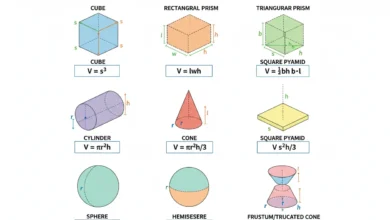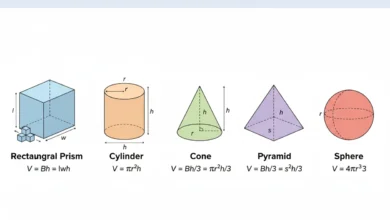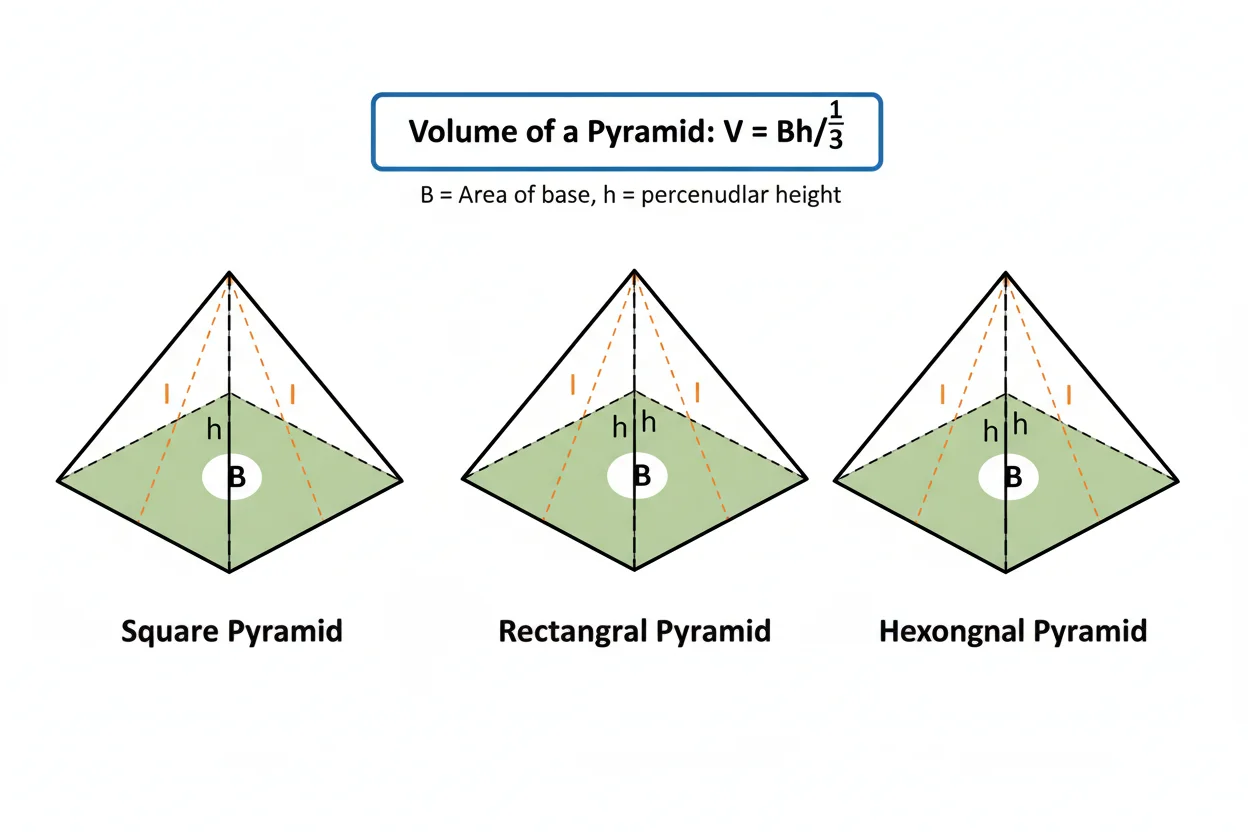
Pyramid volume measures the three-dimensional space inside a pyramid. For any pyramid, the formula is V = Bh/3, where B is the area of the base and h is the perpendicular distance from the apex to the plane of the base. The one-third factor is essential: a pyramid with the same base area and perpendicular height as a prism has exactly one-third of that prism’s volume. Because pyramids can have triangular, rectangular, square, or other polygonal bases, most calculations begin by finding the appropriate base area. The slant height along a face is not normally the h used in the volume formula; if only a slant measurement is known, right-triangle geometry may be needed to recover the perpendicular height first. Pyramid volume is measured in cubic units and the formula can be rearranged to solve for height, base area, side length, or other dimensions.
What Is a Pyramid?
A pyramid is a three-dimensional solid with:
one polygonal base
and triangular lateral faces that meet at a common point called the:
apex
The base can be:
triangular
square
rectangular
pentagonal
hexagonal
or another polygon.
The pyramid’s name is generally based on the shape of its base.
A square pyramid therefore has a square base, while a triangular pyramid has a triangular base.
Pyramid Volume Formula
For any pyramid:
V = Bh/3
where:
V = pyramid volume
B = area of the base
h = perpendicular height from the apex to the base plane
An equivalent form is:
V = 1/3 × base area × height
The formula applies to both right and oblique pyramids when h is measured perpendicular to the base plane.
Basic Pyramid Volume Example
Suppose:
B = 48 cm²
h = 10 cm
Then:
V = Bh/3
= 48(10)/3
= 480/3
Therefore:
V = 160 cm³
The result uses cubic centimeters because an area is multiplied by a length.
Why Pyramid Volume Has a One-Third Factor
Compare a pyramid with a Prism Volume having the same base area B and perpendicular height h.
The prism has:
V_prism = Bh
The corresponding pyramid has:
V_pyramid = Bh/3
Therefore:
V_pyramid = V_prism/3
Three pyramids of appropriate matching dimensions can be arranged conceptually to illustrate this volume relationship.
The one-third factor is not optional.
Square Pyramid Volume
For a square base with side length s:
B = s²
Therefore:
V = s²h/3
Suppose:
s = 6
h = 10
Then:
V = 6²(10)/3
= 36(10)/3
Therefore:
V = 120
cubic units.
Rectangular Pyramid Volume
For a rectangular base:
B = lw
Using the Rectangle Area formula, pyramid volume becomes:
V = lwh/3
where:
l = base length
w = base width
h = perpendicular pyramid height
Rectangular Pyramid Example
Suppose:
l = 12
w = 8
h = 15
Base area:
B = 12(8)
= 96
Then:
V = 96(15)/3
= 480
Therefore:
V = 480
cubic units.
Triangular Pyramid Volume
If the base is a triangle:
B = b h_t/2
where:
b = triangular base side
h_t = perpendicular altitude of the triangular base
Then pyramid volume is:
V = (b h_t/2)h_p/3
Simplify:
V = b h_t h_p/6
where h_p is the perpendicular height of the pyramid.
Triangular Pyramid Example
Suppose the triangular base has:
b = 8
h_t = 6
Then:
B = 8(6)/2
= 24
If pyramid height is:
h_p = 15
then:
V = 24(15)/3
= 120
cubic units.
The base’s altitude and the pyramid’s height are separate measurements.
Base Area From Heron’s Formula
A triangular base may be specified by its three side lengths rather than its altitude.
Then Heron Formula can calculate B:
s = (a + b + c)/2
B = √[s(s − a)(s − b)(s − c)]
Once B is known:
V = Bh/3
Heron Example
Suppose a triangular base has sides:
5, 5, 6
Semiperimeter:
s = 8
Base area:
B = √[8(3)(3)(2)]
= 12
If pyramid height is:
h = 9
then:
V = 12(9)/3
Therefore:
V = 36
cubic units.
Parallelogram Base Pyramid
If the base is a parallelogram:
B = b h_b
where h_b is the perpendicular height inside the base.
The Parallelogram Area result then gives:
V = b h_b h_p/3
where h_p is the perpendicular pyramid height.
Parallelogram Base Example
Suppose:
b = 10
h_b = 7
Therefore:
B = 70
If:
h_p = 12
then:
V = 70(12)/3
= 280
cubic units.
Regular Polygon Base
For a regular polygonal base with apothem a and perimeter P:
B = aP/2
Using Regular Polygon Area, the pyramid volume becomes:
V = aPh/6
This works for regular pentagonal, hexagonal, octagonal, and other regular polygonal bases.
Regular Polygon Pyramid Example
Suppose:
apothem = 5
base perimeter = 48
Then:
B = 5(48)/2
= 120
If:
h = 9
then:
V = 120(9)/3
Therefore:
V = 360
cubic units.
Finding the Base Polygon From Exterior Angles
If a regular base has exterior angle E:
n = 360°/E
For example, if:
E = 45°
then:
n = 8
so the pyramid has an octagonal base.
After identifying the number of sides, enough length information is still needed to determine B.
The Exterior Angles relationship identifies the base shape rather than its scale.
Finding the Base From Polygon Diagonals
The number of Polygon Diagonals can also identify a base polygon.
For an n-gon:
D = n(n − 3)/2
Suppose the base has:
D = 20
Then:
n = 8
so the base is an octagon.
Again, diagonal count alone does not determine base area.
Find Height From Pyramid Volume
Starting with:
V = Bh/3
multiply by 3:
3V = Bh
Then divide by B:
h = 3V/B
Suppose:
V = 200
B = 50
Then:
h = 600/50
Therefore:
h = 12
Find Base Area From Volume
From:
V = Bh/3
solve:
B = 3V/h
Suppose:
V = 420
h = 14
Then:
B = 1260/14
Therefore:
B = 90
square units.
Find Square Base Side From Volume
For a square pyramid:
V = s²h/3
Solve for s²:
s² = 3V/h
Then:
s = √(3V/h)
Use the positive root because side length is nonnegative.
Square Base Side Example
Suppose:
V = 192
h = 9
Then:
s² = 3(192)/9
= 64
Therefore:
s = 8
The square base area is:
64
Find Rectangle Base Length
For a rectangular pyramid:
V = lwh/3
If V, w, and h are known:
l = 3V/(wh)
Suppose:
V = 240
w = 6
h = 10
Then:
l = 720/60
Therefore:
l = 12
Perpendicular Height Versus Slant Height
The height h in:
V = Bh/3
is always perpendicular to the base.
A slant height is measured along a lateral face.
These are generally different lengths.
If a problem supplies slant height instead of perpendicular height, geometric relationships must be used first.
Square Pyramid Slant Height
In a right square pyramid, let:
s = base side length
ℓ = slant height from apex to midpoint of a base side
h = perpendicular pyramid height
A cross section forms a right triangle with legs:
h
and:
s/2
and hypotenuse:
ℓ
Therefore:
ℓ² = h² + (s/2)²
Using the Pythagorean Theorem:
h = √[ℓ² − (s/2)²]
Slant-Height Example
Suppose:
s = 10
ℓ = 13
Then:
s/2 = 5
So:
h = √(13² − 5²)
= √(169 − 25)
= √144
Therefore:
h = 12
Base area:
B = 100
Pyramid volume:
V = 100(12)/3
Therefore:
V = 400
Apex-to-Vertex Edge Is Also Different
A square pyramid can also have a lateral edge e running from the apex to a base vertex.
That is not the same as the face slant height ℓ.
If the base center is directly below the apex, the horizontal distance from base center to a vertex is half the square’s diagonal.
For base side s:
center-to-vertex distance = s√2/2
Then:
e² = h² + s²/2
This provides another way to recover h.
Lateral-Edge Example
Suppose:
s = 6
e = 7
Then the center-to-vertex distance squared is:
s²/2 = 18
Therefore:
h² = 49 − 18
= 31
so:
h = √31
Volume:
V = 36√31/3
Therefore:
V = 12√31
cubic units.
Base Diagonal and Pyramid Height
For a square base:
diagonal d = s√2
Therefore the center-to-vertex distance is:
d/2
If lateral edge e is known:
h = √[e² − (d/2)²]
This is another direct right-triangle relationship.
Rectangle Base Diagonal
For a rectangular base with dimensions:
l
and:
w
the diagonal is:
d = √(l² + w²)
The distance from the rectangle center to a vertex is:
d/2
For a right rectangular pyramid with apex above the center:
e² = h² + (d/2)²
This can recover h from a lateral edge.
Rectangular Pyramid Edge Example
Suppose base dimensions are:
6 × 8
Then:
d = √(36 + 64)
= 10
Center-to-vertex distance:
5
Suppose lateral edge:
e = 13
Then:
h = √(13² − 5²)
= 12
Base area:
48
Therefore:
V = 48(12)/3
= 192
Pyramid Volume Versus Prism Volume
A prism with the same base and perpendicular height has:
V_prism = Bh
The pyramid has:
V_pyramid = Bh/3
Therefore:
V_pyramid/V_prism = 1/3
For:
B = 60
h = 9
prism:
V = 540
pyramid:
V = 180
The prism has three times the volume.
Pyramid Volume Versus Cone Volume
A cone has a circular base.
Its volume is:
V = πr²h/3
This is exactly the pyramid-style relationship:
one-third × base area × height
with:
B = πr²
The Cone Volume formula therefore reflects the same one-third principle for a circular base.
Pyramid Versus Frustum
A pyramid ends at an apex.
A pyramidal frustum is created by cutting the pyramid with a plane parallel to its base and removing the smaller top pyramid.
The Frustum Volume formula is:
V = h(B₁ + B₂ + √(B₁B₂))/3
A pyramid is the limiting case where the smaller base shrinks to zero area.
Frustum-to-Pyramid Limit
Let:
B₂ = 0
Then the frustum formula becomes:
V = h(B₁ + 0 + 0)/3
Therefore:
V = B₁h/3
which is exactly the pyramid volume formula.
Right Pyramid Versus Oblique Pyramid
A right pyramid has its apex directly above a central point of the base appropriate to the symmetry.
An oblique pyramid has the apex shifted sideways.
The volume formula remains:
V = Bh/3
provided h is the perpendicular distance from the apex to the base plane.
The slanted position of the apex does not replace h with a lateral edge.
Oblique Pyramid Example
Suppose an oblique pyramid has:
B = 75
perpendicular height = 8
Although a lateral edge may be much longer, volume is:
V = 75(8)/3
Therefore:
V = 200
cubic units.
Pyramid Volume From Coordinates
A pyramid may be described using coordinate geometry.
If the base lies in a coordinate plane, calculate B from its vertices.
Then determine the perpendicular distance from the apex to the plane containing the base.
Finally:
V = Bh/3
For a base in:
z = 0
and an apex with z-coordinate:
z = h
the perpendicular height is:
|h|
when the coordinate axes are standard.
Coordinate Square Pyramid Example
Suppose the square base has vertices:
(0,0,0)
(6,0,0)
(6,6,0)
(0,6,0)
and apex:
(3,3,9)
Base area:
B = 36
The base lies in:
z = 0
and apex height above it is:
h = 9
Therefore:
V = 36(9)/3
= 108
cubic units.
Coordinate Rectangular Base
Suppose a rectangular base in the xy-plane has opposite corners:
(1,2,0)
and:
(9,7,0)
with sides parallel to the axes.
Length:
9 − 1 = 8
Width:
7 − 2 = 5
Therefore:
B = 40
If apex has z-coordinate:
12
then:
h = 12
and:
V = 40(12)/3
Therefore:
V = 160
Polar Coordinates in Base Geometry
A regular polygonal base centered at the origin can be described with Polar and Rectangular Form.
If all vertices have circumradius R and are equally spaced:
θₖ = θ₀ + 2πk/n
the side length is:
s = 2R sin(π/n)
From that, the regular base area can be calculated.
Then:
V = Bh/3
Polar coordinates therefore help define the base geometry rather than changing the pyramid formula.
Regular Base From Circumradius
For a regular n-gon with circumradius R, divide the base into n congruent isosceles triangles.
Each central angle is:
2π/n
Each triangle has area:
R² sin(2π/n)/2
Therefore:
B = nR² sin(2π/n)/2
Then pyramid volume is:
V = nR²h sin(2π/n)/6
This is useful when circumradius is supplied instead of side length or apothem.
Base Perimeter and Apothem
If a regular base has perimeter P and apothem a:
B = aP/2
Therefore:
V = aPh/6
Suppose:
P = 60
a = 8
h = 15
Then:
V = 8(60)(15)/6
= 1200
cubic units.
Base Area From Side Length and Apothem
For a regular n-gon with side length s:
P = ns
So:
B = ans/2
and:
V = ansh/6
This makes clear that the number of sides, side length, apothem, and pyramid height all affect the final volume.
Pyramid Volume and Similarity
For geometrically similar pyramids, all corresponding linear dimensions scale by the same factor k.
Then:
base area scales by k²
and:
height scales by k
Therefore:
volume scales by k³
So:
V₂/V₁ = k³
Similar Pyramids Example
Suppose two similar pyramids have linear scale factor:
k = 2
If the smaller pyramid volume is:
50
then:
V_large = 2³(50)
= 400
The larger pyramid has eight times the volume.
Volume Ratio From Heights of Similar Pyramids
If similar pyramids have:
h₂/h₁ = 3/2
then:
V₂/V₁ = (3/2)³
Therefore:
V₂/V₁ = 27/8
This works because every corresponding dimension follows the same scale factor.
Cutting a Pyramid Parallel to the Base
If a plane cuts a pyramid parallel to its base, the small pyramid above the cut is similar to the original pyramid.
Suppose the small pyramid’s height is:
1/2
of the original.
Then its volume is:
(1/2)³ = 1/8
of the original pyramid volume.
The remaining frustum therefore has:
7/8
of the original volume.
Parallel-Cut Example
Suppose a pyramid has volume:
640
A smaller similar pyramid is removed from the top, with linear scale factor:
1/2
Removed volume:
640(1/8)
= 80
Remaining frustum volume:
640 − 80
Therefore:
560
Composite Pyramid Solids
A composite solid may consist of a prism and pyramid joined along congruent bases.
If their interiors do not overlap:
V_total = V_prism + V_pyramid
For the same B and pyramid/prism height h when equal:
V_total = Bh + Bh/3
= 4Bh/3
The actual heights may differ in a real problem, so calculate each component separately.
Prism and Pyramid Composite Example
Suppose:
B = 36
Prism height:
10
Pyramid height:
6
Prism volume:
36(10) = 360
Pyramid volume:
36(6)/3 = 72
Total:
V = 432
cubic units.
Pyramid Removed From a Prism
A solid may also be formed by removing a pyramid from a prism.
Then:
V_remaining = V_prism − V_pyramid
Suppose both share:
B = 48
Prism height:
12
Pyramid height:
9
Then:
V_prism = 576
V_pyramid = 144
Therefore:
V_remaining = 432
Surface Area Versus Pyramid Volume
Pyramid volume measures interior space.
Surface area measures the boundary.
For a regular square pyramid, lateral surface area often uses the face slant height ℓ, while volume uses perpendicular height h.
This is a critical distinction:
surface formulas may use ℓ
volume uses h
Do not substitute the slant height into:
V = Bh/3
unless it happens to equal the perpendicular height in a special degenerate configuration.
Slant Height and Volume
Suppose a square pyramid has:
s = 10
ℓ = 13
We found:
h = 12
Using ℓ incorrectly would give:
100(13)/3
which is not the actual volume.
Correctly:
V = 100(12)/3
= 400
The Pythagorean conversion must occur first.
Scaling Pyramid Volume
If every linear dimension is multiplied by k:
V_new = k³V_old
For:
k = 3
volume increases by:
27
times.
This cubic scaling applies whether the pyramid is square, rectangular, triangular, or based on another similar polygon.
Doubling Only Height
If base area remains fixed:
V = Bh/3
so doubling h doubles V.
For example:
B = 60
h = 5
gives:
V = 100
If:
h = 10
then:
V = 200
Doubling All Base Lengths Only
If every linear measurement of a similar base doubles, base area becomes:
4B
If pyramid height remains fixed:
V_new = 4V_old
This differs from doubling every dimension, which would produce an eightfold volume increase.
Units of Pyramid Volume
Pyramid volume is measured in cubic units.
If:
B = 40 cm²
and:
h = 9 cm
then:
Bh
has units:
cm² × cm = cm³
The factor 1/3 is dimensionless.
Therefore the answer is in:
cm³
Converting Cubic Units
If:
1 m = 100 cm
then:
1 m³ = 100³ cm³
Therefore:
1 m³ = 1,000,000 cm³
Volume conversions cube the corresponding linear conversion factor.
Exact and Approximate Volume
Suppose:
V = 12√31
This is an exact answer.
Approximately:
V ≈ 66.81
Keeping radicals or π exactly through intermediate calculations avoids unnecessary rounding error.
Common Pyramid Volume Mistakes
A common mistake is forgetting the factor:
1/3
The correct formula is:
V = Bh/3
Another error is treating B as a side length instead of the complete base area.
For a square base:
B = s²
For a rectangle:
B = lw
For a triangle:
B = bh/2
Do not use slant height instead of perpendicular height.
A lateral edge is also not normally h.
For composite solids, add or subtract component volumes carefully.
When a regular polygonal base is given indirectly through side count, diagonals, angles, or polar coordinates, determine its actual area before multiplying by pyramid height.
Finally, use cubic units.
Frequently Asked Questions
What is the pyramid volume formula?
V = Bh/3
What does B represent?
B is the complete area of the pyramid’s base.
What does h represent?
h is the perpendicular distance from the apex to the base plane.
Why is pyramid volume divided by 3?
A pyramid has one-third the volume of a prism with the same base area and perpendicular height.
What is square pyramid volume?
V = s²h/3
What is rectangular pyramid volume?
V = lwh/3
What is triangular pyramid volume?
V = Bh/3
where B is the triangular base area.
How do you find pyramid height?
h = 3V/B
How do you find base area?
B = 3V/h
Is slant height used in the volume formula?
No. Convert slant height to perpendicular height first when necessary.
How do you find height from square-pyramid slant height?
h = √[ℓ² − (s/2)²]
How is pyramid volume related to prism volume?
For equal base area and height:
V_pyramid = V_prism/3
How is pyramid volume related to cone volume?
Both equal one-third of base area times perpendicular height.
How does pyramid volume scale?
If every length is multiplied by k:
volume is multiplied by k³
Can an oblique pyramid use V = Bh/3?
Yes, provided h is the perpendicular distance to the base plane.
How can I check a pyramid volume answer?
Calculate the base area separately, verify that h is perpendicular rather than slanted, compare with a prism of the same B and h, and confirm that the pyramid volume is exactly one-third of that prism’s volume.