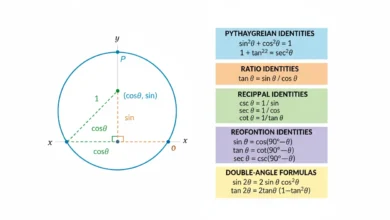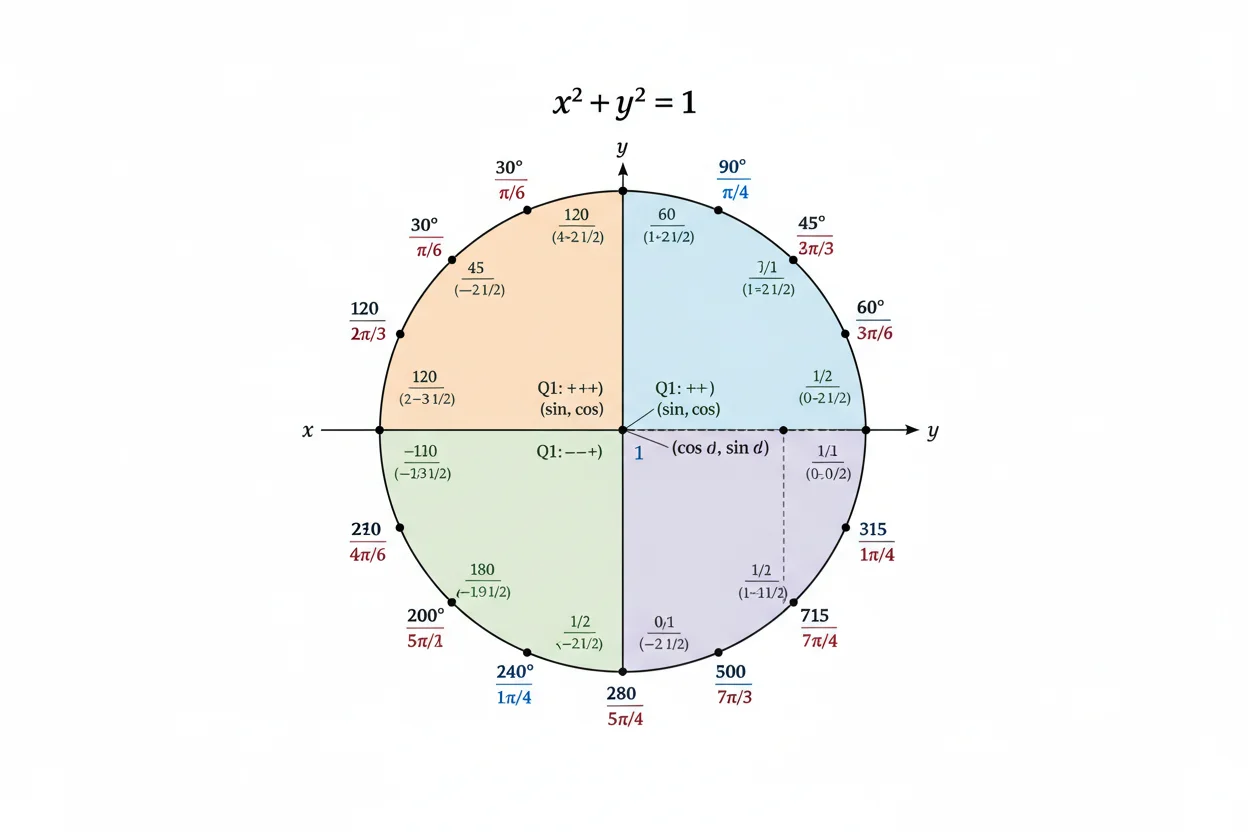
The unit circle is a circle centered at the origin with radius exactly 1. Its equation is x² + y² = 1, and a point reached by rotating through angle θ from the positive x-axis has coordinates (cosθ, sinθ). This single diagram connects circle geometry, coordinates, radians, sine, cosine, tangent, and the other trigonometric functions. The x-coordinate gives cosθ, the y-coordinate gives sinθ, and tanθ = y/x when x ≠ 0. Standard angles such as 0°, 30°, 45°, 60°, and 90° have exact coordinates that can be extended to every quadrant using symmetry and sign rules. Because one full revolution is 2π radians or 360°, the unit circle also makes periodicity and coterminal angles easy to understand.
What Is the Unit Circle?
The unit circle has:
center = (0,0)
and:
radius = 1
Its equation is:
x² + y² = 1
This is a special case of the general Circle Equation:
(x − h)² + (y − k)² = r²
with:
h = 0
k = 0
r = 1
Therefore:
x² + y² = 1
Why It Is Called a Unit Circle
A unit is one standard length.
Since the circle’s radius is exactly:
1
it is called the unit circle.
Its diameter is:
2
Its circumference is:
2π
and its area is:
π
The significance of the circle, however, comes mainly from the fact that radius 1 turns trigonometric ratios directly into coordinates.
Coordinates on the Unit Circle
For angle θ measured from the positive x-axis, the corresponding point is:
P = (cosθ, sinθ)
Therefore:
x = cosθ
y = sinθ
This coordinate representation is the central unit-circle formula.
Why the Coordinates Are Cosine and Sine
Drop a perpendicular from point P to the x-axis.
A right triangle is formed with:
hypotenuse = 1
horizontal leg = x
vertical leg = y
For the angle θ:
cosθ = adjacent/hypotenuse
Since the hypotenuse is 1:
cosθ = x
Similarly:
sinθ = opposite/hypotenuse
so:
sinθ = y
This connects the unit circle directly with Right Triangles.
The Pythagorean Identity
Every unit-circle point satisfies:
x² + y² = 1
Substitute:
x = cosθ
y = sinθ
Then:
cos²θ + sin²θ = 1
Therefore:
sin²θ + cos²θ = 1
This is the fundamental Trigonometric Identities relationship.
Standard Unit Circle Angles
The most frequently used first-quadrant angles are:
0°
30°
45°
60°
90°
In radians they are:
0
π/6
π/4
π/3
π/2
The conversion rules are developed through Degrees and Radians.
Exact First-Quadrant Coordinates
The key points are:
0° → (1, 0)
30° → (√3/2, 1/2)
45° → (√2/2, √2/2)
60° → (1/2, √3/2)
90° → (0, 1)
Since:
point = (cosθ, sinθ)
these coordinates give exact cosine and sine values immediately.
Unit Circle at 0°
At:
θ = 0°
the point is:
(1,0)
Therefore:
cos0° = 1
sin0° = 0
Since:
tanθ = sinθ/cosθ
we get:
tan0° = 0
Unit Circle at 30°
At:
θ = 30°
or:
π/6
the point is:
(√3/2, 1/2)
Therefore:
cos30° = √3/2
sin30° = 1/2
and:
tan30° = (1/2)/(√3/2)
So:
tan30° = √3/3
Unit Circle at 45°
At:
θ = 45°
or:
π/4
the point is:
(√2/2, √2/2)
Therefore:
sin45° = √2/2
cos45° = √2/2
and:
tan45° = 1
The equal coordinates reflect the symmetry of a 45-45-90 triangle.
Unit Circle at 60°
At:
θ = 60°
or:
π/3
the point is:
(1/2, √3/2)
Therefore:
cos60° = 1/2
sin60° = √3/2
and:
tan60° = √3
Unit Circle at 90°
At:
θ = 90°
or:
π/2
the point is:
(0,1)
Therefore:
cos90° = 0
sin90° = 1
Tangent is:
1/0
so:
tan90° is undefined
Where the Exact Values Come From
The 30° and 60° coordinates come from a 30-60-90 triangle whose side ratio is:
1 : √3 : 2
Dividing by the hypotenuse 2 creates a unit hypotenuse:
1/2 : √3/2 : 1
The 45° coordinates come from a 45-45-90 triangle with ratio:
1 : 1 : √2
Dividing by √2 gives:
√2/2 : √2/2 : 1
Thus the standard unit-circle values arise from special right triangles.
Quadrants of the Unit Circle
The coordinate plane has four quadrants.
For a unit-circle point:
(cosθ, sinθ)
the signs are:
Quadrant I: (+,+)
Quadrant II: (−,+)
Quadrant III: (−,−)
Quadrant IV: (+,−)
Therefore the signs of cosine and sine follow directly from x and y.
Trigonometric Signs by Quadrant
Because:
cosθ = x
sinθ = y
tanθ = y/x
we obtain:
Quadrant I: sin +, cos +, tan +
Quadrant II: sin +, cos −, tan −
Quadrant III: sin −, cos −, tan +
Quadrant IV: sin −, cos +, tan −
These sign rules eliminate the need to memorize separate positive and negative tables.
Reference Angles
A reference angle is the positive acute angle between an angle’s terminal side and the x-axis.
For example:
150°
has reference angle:
30°
Therefore its coordinate magnitudes match those at 30°.
Only the signs change according to Quadrant II.
So:
cos150° = −√3/2
sin150° = 1/2
Quadrant II Example
Find the unit-circle point for:
135°
Reference angle:
45°
The 45° magnitudes are:
√2/2, √2/2
Quadrant II has:
x negative
y positive
Therefore:
P = (−√2/2, √2/2)
Quadrant III Example
Find the point for:
240°
Reference angle:
60°
At 60°, coordinate magnitudes are:
1/2, √3/2
Quadrant III makes both negative:
P = (−1/2, −√3/2)
Therefore:
cos240° = −1/2
sin240° = −√3/2
Quadrant IV Example
For:
315°
the reference angle is:
45°
Quadrant IV has positive x and negative y.
Therefore:
P = (√2/2, −√2/2)
So:
cos315° = √2/2
sin315° = −√2/2
Standard Angles Around the Full Circle
A useful sequence in degrees is:
0°, 30°, 45°, 60°, 90°
120°, 135°, 150°, 180°
210°, 225°, 240°, 270°
300°, 315°, 330°, 360°
The corresponding radian sequence is:
0, π/6, π/4, π/3, π/2
2π/3, 3π/4, 5π/6, π
7π/6, 5π/4, 4π/3, 3π/2
5π/3, 7π/4, 11π/6, 2π
Axis Points
The four axis points are especially important:
0° → (1,0)
90° → (0,1)
180° → (−1,0)
270° → (0,−1)
360° → (1,0)
These points determine where sine or cosine becomes:
0
1
or:
−1
Radians on the Unit Circle
Radians measure angle using arc length.
The radian definition is:
θ = s/r
where:
s = arc length
r = radius
For a unit circle:
r = 1
Therefore:
θ = s
Numerically, the angle in radians equals the corresponding arc length on the unit circle.
Why π Radians Equals 180°
A unit circle has circumference:
2π
Half of the circumference is:
π
A half-turn is:
180°
Therefore:
π radians = 180°
Similarly:
2π radians = 360°
This geometric interpretation is one reason radians are fundamental in higher mathematics.
Arc Length on the Unit Circle
The general Arc Length formula in radians is:
s = rθ
For:
r = 1
we get:
s = θ
So an angle:
θ = π/3
cuts off arc length:
π/3
on the unit circle.
Sector Area on the Unit Circle
The Sector Area formula for radians is:
A = r²θ/2
For a unit circle:
r = 1
so:
A = θ/2
Thus a unit-circle sector of angle:
π/2
has area:
π/4
which is one-quarter of the circle.
Coterminal Angles
Angles differing by whole revolutions have the same terminal side.
In radians:
θ + 2πk
is coterminal with θ.
In degrees:
θ + 360°k
is coterminal with θ.
Here k is any integer.
Because the terminal point is identical, all trigonometric values are identical.
Coterminal Example
Angles:
30°
and:
390°
differ by:
360°
Therefore:
sin390° = sin30° = 1/2
cos390° = cos30° = √3/2
tan390° = tan30° = √3/3
Negative Angles
Positive angles are usually measured counterclockwise.
Negative angles are measured clockwise.
For example:
−60°
has the same terminal side as:
300°
Therefore:
cos(−60°) = 1/2
sin(−60°) = −√3/2
Even and Odd Symmetry
The unit circle makes these identities visible:
cos(−θ) = cosθ
because reflection across the x-axis preserves x.
Meanwhile:
sin(−θ) = −sinθ
because y changes sign.
Therefore cosine is even and sine is odd.
Since tangent is y/x:
tan(−θ) = −tanθ
so tangent is also odd.
Sine From the Unit Circle
The Sine function is:
sinθ = y
Therefore sine’s range is:
−1 ≤ sinθ ≤ 1
because no point on the unit circle can have y-coordinate outside:
[−1,1]
Its maximum occurs at:
90° + 360°k
and its minimum at:
270° + 360°k
Cosine From the Unit Circle
Cosine is:
cosθ = x
Therefore:
−1 ≤ cosθ ≤ 1
Its maximum occurs at:
0° + 360°k
and its minimum at:
180° + 360°k
The horizontal coordinate interpretation makes these extrema immediate.
Tangent From the Unit Circle
The Tangent function is:
tanθ = sinθ/cosθ
Therefore:
tanθ = y/x
provided:
x ≠ 0
Tangent is undefined where the unit-circle point has x-coordinate zero:
90° + 180°k
or:
π/2 + kπ
Secant From the Unit Circle
The Secant function is:
secθ = 1/cosθ
Since:
cosθ = x
we obtain:
secθ = 1/x
where:
x ≠ 0
This explains why secant and tangent share the same undefined angles.
Cosecant and Cotangent
Similarly:
cscθ = 1/sinθ = 1/y
and:
cotθ = cosθ/sinθ = x/y
where:
y ≠ 0
Thus all six trigonometric functions can be read from one coordinate pair.
Six Functions From One Point
Suppose the unit-circle point is:
P = (3/5, 4/5)
Then:
cosθ = 3/5
sinθ = 4/5
tanθ = 4/3
secθ = 5/3
cscθ = 5/4
cotθ = 3/4
One point determines every trigonometric ratio, subject to denominator restrictions.
Finding a Missing Coordinate
Suppose a point lies on the unit circle and:
x = 3/5
Use:
x² + y² = 1
Then:
9/25 + y² = 1
So:
y² = 16/25
Therefore:
y = ±4/5
The quadrant determines the sign.
Missing Coordinate Example With Quadrant
Suppose:
x = −5/13
and the point lies in Quadrant II.
Then:
y² = 1 − 25/169
= 144/169
So:
y = ±12/13
Quadrant II has positive y.
Therefore:
y = 12/13
The point is:
(−5/13, 12/13)
Find Trig Values From a Coordinate
Suppose:
P = (−8/17, 15/17)
Then:
cosθ = −8/17
sinθ = 15/17
tanθ = −15/8
secθ = −17/8
cscθ = 17/15
cotθ = −8/15
The point lies in Quadrant II.
Find a Point From Tangent
Suppose:
tanθ = 3/4
and θ is in Quadrant I.
Use a proportional right triangle:
opposite = 3
adjacent = 4
Hypotenuse:
5
Normalize by the hypotenuse:
cosθ = 4/5
sinθ = 3/5
Therefore the unit-circle point is:
(4/5, 3/5)
Find a Point From Secant
Suppose:
secθ = −2
Then:
cosθ = −1/2
Possible unit-circle points have x-coordinate:
−1/2
Therefore within one revolution:
θ = 120°
or:
240°
The points are:
(−1/2, √3/2)
and:
(−1/2, −√3/2)
Additional quadrant information would choose one.
Solving sinθ = 1/2
On the unit circle, sine is the y-coordinate.
The horizontal line:
y = 1/2
intersects the unit circle at two standard points:
30°
and:
150°
Therefore on:
0° ≤ θ < 360°
the solutions are:
θ = 30°, 150°
In radians:
θ = π/6, 5π/6
Solving cosθ = −√2/2
Cosine is the x-coordinate.
The vertical line:
x = −√2/2
meets the unit circle in Quadrants II and III.
Therefore:
θ = 135°
and:
225°
or:
3π/4
and:
5π/4
Solving tanθ = 1
Tangent equals:
y/x
A ratio of 1 occurs when:
y = x
on appropriate unit-circle points.
The standard solutions over one revolution are:
45°
and:
225°
because tangent is positive in Quadrants I and III.
Periodicity From the Unit Circle
One complete revolution returns to the same point.
Therefore:
sin(θ + 2π) = sinθ
cos(θ + 2π) = cosθ
Tangent repeats after only π because opposite unit-circle points have both coordinates negated:
(−x,−y)
and:
(−y)/(−x) = y/x
Therefore:
tan(θ + π) = tanθ
Supplementary Angles
Points at:
θ
and:
π − θ
are reflections across the y-axis.
Their y-coordinates are equal but x-coordinates have opposite signs.
Therefore:
sin(π−θ) = sinθ
cos(π−θ) = −cosθ
tan(π−θ) = −tanθ
The unit circle makes these identities geometric rather than arbitrary.
Angles Differing by π
Points separated by:
π
radians are diametrically opposite.
Therefore:
cos(θ+π) = −cosθ
sin(θ+π) = −sinθ
and:
tan(θ+π) = tanθ
because the two sign changes cancel in the tangent ratio.
Complementary Angles
First-quadrant angles θ and:
π/2 − θ
exchange horizontal and vertical coordinate magnitudes.
Therefore:
sinθ = cos(π/2−θ)
and:
cosθ = sin(π/2−θ)
These are the cofunction relationships.
Unit Circle and Triangle Solving
The mapped Triangle Solving process often uses exact unit-circle values.
For example, if a triangle calculation requires:
sin60°
the unit circle supplies:
√3/2
If it requires:
cos45°
the exact value is:
√2/2
Using exact coordinates can make side calculations simpler than using early decimal approximations.
Unit Circle and Triangle Orthocenter
The mapped Triangle Orthocenter page contains relationships involving trigonometric functions, such as:
AH = 2R cosA
in an acute triangle.
The unit circle provides the cosine values and sign behavior underlying such angle-based triangle-center formulas.
This is particularly useful when an angle is a standard value such as:
30°, 45°, or 60°
Polar Coordinates
The Polar and Rectangular Form conversion is:
x = r cosθ
y = r sinθ
The unit circle is simply the case:
r = 1
Therefore:
x = cosθ
y = sinθ
This makes the unit circle the natural bridge between polar angle and Cartesian coordinates.
General Circle From the Unit Circle
A circle of radius r centered at the origin can be parametrized as:
x = r cosθ
y = r sinθ
Squaring and adding:
x² + y² = r²(cos²θ + sin²θ)
Use:
cos²θ + sin²θ = 1
Therefore:
x² + y² = r²
The unit-circle identity scales directly to every origin-centered circle.
Circle Parametric Example
Suppose:
r = 5
θ = 60°
Then:
x = 5cos60°
= 5/2
and:
y = 5sin60°
= 5√3/2
Check:
x² + y² = 25/4 + 75/4
Therefore:
x² + y² = 25
as required.
Unit Vectors
The vector:
u = (cosθ, sinθ)
has magnitude:
|u| = √(cos²θ + sin²θ)
Therefore:
|u| = 1
So every unit-circle point can also represent a direction vector of unit length.
This connects unit-circle trigonometry with Vector Magnitude.
Direction Components
A vector of magnitude M pointing at angle θ has components:
(M cosθ, M sinθ)
The unit circle supplies the direction proportions:
horizontal fraction = cosθ
vertical fraction = sinθ
Multiplying by M scales the unit vector to the required magnitude.
Direction Example
Suppose:
M = 20
θ = 30°
Then:
x-component = 20cos30°
= 10√3
and:
y-component = 20sin30°
= 10
The component vector is:
(10√3, 10)
Unit Circle and Slope
A ray from the origin through:
(cosθ, sinθ)
has slope:
m = sinθ/cosθ
Therefore:
m = tanθ
when cosine is nonzero.
This provides a direct connection between unit-circle angle and Slope.
Unit Circle and Line Direction
If a line has slope:
1
then:
tanθ = 1
Possible direction angles differ by:
π
A standard inclination is:
45°
The corresponding unit direction vector is:
(√2/2, √2/2)
Unit Circle and Volume Geometry
The unit circle itself is two-dimensional, so it measures neither solid capacity nor three-dimensional space. However, circular cross sections and rotational constructions built from:
x² + y² = 1
can generate solids whose Volume is found by disks, shells, or other methods.
For example, rotating the upper semicircle:
y = √(1−x²)
around the x-axis generates a unit sphere.
Unit Circle and Volume Formulas
The broader Volume Formulas for cylinders, cones, and spheres rely on circular radii and cross-sectional areas.
The unit circle supplies the normalized circular geometry:
r = 1
From there, ordinary scaling converts unit-radius relationships into radius-r formulas.
This is a useful distinction: the unit circle describes planar angular geometry, while solid volume adds a third dimension.
Unit Disk
The unit circle is technically only the boundary:
x² + y² = 1
The filled region inside it is the:
unit disk
described by:
x² + y² ≤ 1
Its area is:
π
Distinguishing circle from disk matters in rigorous geometry.
Unit Circle Circumference
Since:
r = 1
the Circle Circumference is:
C = 2π
This is exactly the arc length corresponding to:
2π radians
which explains the radian scale around one complete revolution.
Unit Circle Area
Since:
r = 1
the Circle Area is:
A = π
A half disk has area:
π/2
A quarter disk has area:
π/4
These values also agree with the sector-area formula.
Symmetry of the Unit Circle
The unit circle is symmetric across:
x-axis
y-axis
origin
This symmetry generates many trigonometric relationships.
Reflection across the x-axis:
(x,y) → (x,−y)
Reflection across the y-axis:
(x,y) → (−x,y)
A half-turn:
(x,y) → (−x,−y)
Memorizing the Unit Circle Efficiently
Rather than memorizing every point independently, remember first-quadrant coordinates:
(1,0)
(√3/2,1/2)
(√2/2,√2/2)
(1/2,√3/2)
(0,1)
Then use quadrant signs and symmetry.
The magnitudes repeat around the circle.
Only their signs and ordering change.
Square-Root Pattern for First-Quadrant Sine
For angles:
0°, 30°, 45°, 60°, 90°
sine values can be remembered as:
√0/2
√1/2
√2/2
√3/2
√4/2
Cosine uses the same sequence in reverse:
√4/2
√3/2
√2/2
√1/2
√0/2
Common Unit Circle Mistakes
A common mistake is reversing sine and cosine coordinates.
Remember:
point = (cosθ, sinθ)
so:
x first → cosine
y second → sine
Another error is assigning first-quadrant signs to every angle.
Check the quadrant.
Do not confuse degrees and radians.
At angles where x = 0, tangent and secant are undefined.
At angles where y = 0, cosecant and cotangent are undefined.
When a square root gives:
±
use quadrant information to select the correct sign.
Finally, remember that a circle refers to the boundary, while the filled region is a disk.
Frequently Asked Questions
What is the unit circle?
A circle centered at the origin with radius 1.
What is the unit circle equation?
x² + y² = 1
What are the coordinates at angle θ?
(cosθ, sinθ)
Which coordinate is sine?
The y-coordinate.
Which coordinate is cosine?
The x-coordinate.
What is tangent on the unit circle?
tanθ = y/x
when:
x ≠ 0
What is secant?
secθ = 1/x
when x ≠ 0.
What is cosecant?
cscθ = 1/y
when y ≠ 0.
What is cotangent?
cotθ = x/y
when y ≠ 0.
What is the fundamental unit-circle identity?
sin²θ + cos²θ = 1
Why are radians especially natural on the unit circle?
Because when r = 1:
arc length s = angle θ
for θ measured in radians.
What is one full revolution?
360° = 2π radians
What is the point at 30°?
(√3/2, 1/2)
What is the point at 45°?
(√2/2, √2/2)
What is the point at 60°?
(1/2, √3/2)
What are coterminal angles?
Angles differing by:
360°k
or:
2πk
for integer k.
How do you find a missing coordinate?
Use:
x² + y² = 1
and choose the sign from the quadrant.
How can I check a unit-circle answer?
Verify x² + y² = 1, confirm the coordinate signs match the quadrant, check that x = cosθ and y = sinθ, and compare the reference-angle magnitudes with the standard first-quadrant values.