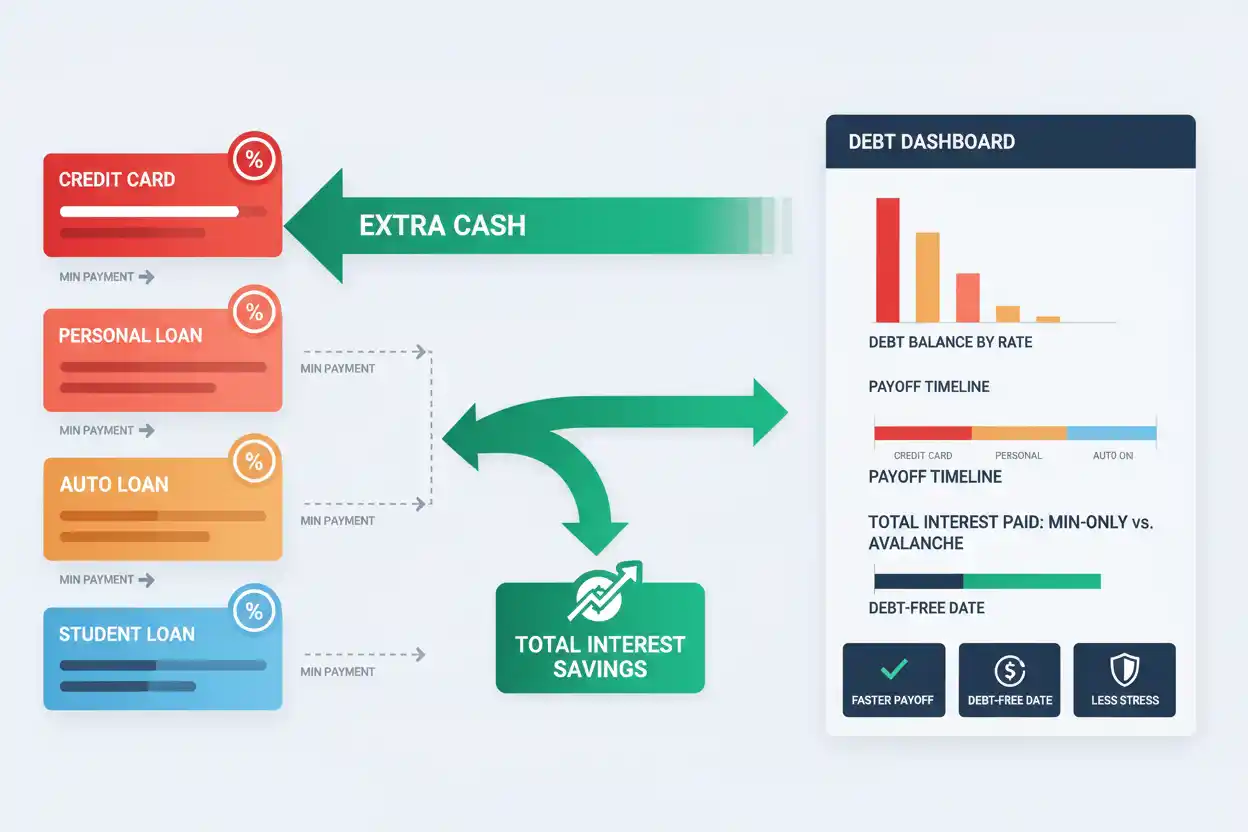

The debt avalanche is a repayment strategy that directs extra money toward the debt with the highest interest rate while maintaining required payments on the other debts.
Once the highest-rate debt is eliminated, the money previously directed to it rolls into the debt with the next-highest rate.
The prioritization rule is:
Debt Avalanche Priority = Highest Interest Rate First
The method is designed to minimize interest cost when compared with alternative payoff orders under otherwise identical assumptions.
It does not necessarily produce the fastest first account closure. That is the key tradeoff between the debt avalanche and balance-focused strategies.
What Is the Debt Avalanche Method?
The debt avalanche ranks debts from highest interest rate to lowest.
Then:
- make every required minimum payment;
- send all available extra repayment money to the highest-rate debt;
- eliminate that debt;
- redirect its former payment plus the extra amount to the next-highest-rate debt;
- continue until all targeted debts are repaid.
The broader Loans & Credit framework connects the debt avalanche with repayment strategies, consolidation, interest calculations, and credit management.
Debt Avalanche Formula
There is no single closed-form formula for an entire multi-debt avalanche because balances, minimum payments, rates, and payoff dates change over time.
However, the allocation rule can be expressed as:
Extra Payment to Target Debt = Total Debt Budget − Required Payments on Non-Target Debts
The target is:
Target Debt = Debt With Highest Applicable Interest Rate
Suppose:
Total monthly debt budget = $1,000
Required payments on non-target debts = $450
Then:
Payment to Target Debt = $1,000 − $450
Payment to Target Debt = $550
Once the target debt disappears, its former required payment becomes available for the next debt.
Debt Avalanche Example
Suppose you have:
| Debt | Balance | APR | Minimum Payment |
|---|---|---|---|
| Credit Card A | $4,000 | 28% | $120 |
| Credit Card B | $6,000 | 21% | $150 |
| Personal Loan | $8,000 | 12% | $180 |
Total minimum payments:
Minimum Payments = $120 + $150 + $180
Minimum Payments = $450
Assume you can spend $750 per month on debt.
Extra amount:
Extra Payment = $750 − $450
Extra Payment = $300
The avalanche target is Credit Card A because it has the highest APR at 28%.
Payment to Card A:
Card A Payment = $120 Minimum + $300 Extra
Card A Payment = $420
Meanwhile:
Card B receives $150.
The personal loan receives $180.
What Happens After the First Debt Is Paid?
Once Credit Card A is eliminated, its $420 monthly allocation is no longer needed there.
The next-highest interest rate is Card B at 21%.
The new payment to Card B becomes:
Card B New Payment = Existing $150 + Freed $420
Card B New Payment = $570
The personal loan continues receiving $180.
Total monthly debt budget remains:
$570 + $180 = $750
Nothing new has to be added to the household budget.
The existing debt payment is simply redirected.
Final Stage
After Card B is eliminated, the entire $750 monthly debt budget can be directed toward the 12% personal loan, subject to its payment and prepayment terms.
The payment grows because previous debts no longer consume part of the budget.
This creates the avalanche effect:
Debt Eliminated → Payment Freed → Next Debt Receives Larger Payment
Why the Debt Avalanche Saves Interest
Interest is a percentage cost applied to debt.
A dollar left outstanding at 28% generally creates more interest than the same dollar left outstanding at 12%.
For a simplified one-year illustration:
$1,000 at 28%:
Annualized Interest Illustration = $1,000 × 28% = $280
$1,000 at 12%:
Annualized Interest Illustration = $1,000 × 12% = $120
Difference:
$280 − $120 = $160
Directing extra principal toward the 28% balance therefore attacks the more expensive dollar of debt first.
Debt Avalanche vs Minimum Payments
The avalanche does not mean skipping payments on lower-rate debts.
Required payments must continue.
The strategy only determines where extra money goes.
Failing to make required payments can create late charges, default consequences, or credit-report problems that overwhelm the intended interest savings.
Debt Avalanche vs Debt Snowball
The debt snowball prioritizes the smallest balance first.
Debt avalanche:
Highest Interest Rate First
Debt snowball:
Smallest Balance First
Suppose:
Debt A = $500 at 10%
Debt B = $5,000 at 30%
The snowball targets Debt A because it is smaller.
The avalanche targets Debt B because it is more expensive.
The avalanche generally minimizes interest under consistent assumptions, while the snowball may produce a faster psychological win by eliminating a small account sooner.
Which Strategy Is Better?
Mathematically, the debt avalanche has the advantage when the goal is minimizing interest and the borrower follows the plan consistently.
Behaviorally, the best strategy is the one the borrower can sustain.
A strategy that theoretically saves $800 but is abandoned after two months may perform worse than a slightly more expensive strategy that the borrower follows to completion.
The broader debt payoff strategy page owns that decision framework.
Debt Avalanche With Equal Interest Rates
Suppose two debts both carry 20% APR.
Interest rate alone no longer determines priority.
The borrower can use a secondary rule such as:
smaller balance, larger required payment, greater cash-flow relief, or personal preference.
From a pure rate perspective, the debts are tied.
Debt Avalanche and Credit Card Payoff
A credit card payoff calculation can determine the payment needed to eliminate an individual card within a specific period.
The debt avalanche instead determines which card gets extra money first when multiple debts exist.
These are complementary calculations.
For example:
Payoff calculation answers: “How much to clear Card A in 12 months?”
Avalanche answers: “Should Card A receive extra money before Card B?”
Debt Avalanche and Credit Utilization
The credit utilization ratio measures revolving balances relative to limits.
An avalanche may improve utilization as credit-card balances fall.
However, the avalanche does not choose debts by utilization.
A 95%-utilized card at 12% could remain behind a 40%-utilized card at 29%.
The strategy is designed around interest cost.
Debt Avalanche and Credit Score Factors
The credit score factors page covers utilization, payment history, account age, and other credit variables.
The avalanche primarily aims to minimize financing cost.
Credit-score changes are a secondary effect.
Paying down revolving balances can reduce utilization, but consumers should not abandon required payments on other accounts merely to target one high-rate balance.
Debt Avalanche and Daily Simple Interest
A daily simple interest loan accrues interest according to outstanding principal and elapsed days.
If such a loan has the highest rate in the debt portfolio, an avalanche can prioritize it.
Reducing principal sooner then reduces future daily interest.
However, compare contractual rates consistently.
An APR containing fees and a simple annual interest rate are not always directly interchangeable without understanding the products.
Debt Avalanche and Debt Consolidation
Debt consolidation changes the structure of the debt portfolio.
Suppose several high-rate cards are replaced by one lower-rate loan.
After consolidation, there may be only one major debt left, eliminating the need for an avalanche among those balances.
However, consolidation only improves the economics when the new loan’s rate, fees, and term produce a genuinely better outcome.
Debt Avalanche and Debt Consolidation Loans
A debt consolidation loan can simplify several balances into one installment payment.
Consider:
Three credit cards = 25%, 22%, and 19%
New consolidation loan = 13%
If fees are reasonable and the repayment period does not unnecessarily extend the debt, consolidation may reduce interest more directly than continuing the original avalanche.
But if the loan is stretched across many years, total interest can still become large.
Debt Avalanche and Balance Transfers
A balance transfer fee can change avalanche priorities.
Suppose a 29% credit-card balance is moved to a 0% promotional offer.
That balance may no longer be the highest-rate target during the promotional period.
However, the promotion has an expiration date.
The payoff strategy should account for the rate that will apply later if the balance remains.
How to Handle Promotional APRs
Suppose:
Card A = $5,000 at 0% for six more months, then 25%
Card B = $4,000 at 20%
A strict current-rate avalanche targets Card B first.
But a more complete strategy considers whether Card A can be eliminated before its promotional rate ends.
This is why real debt optimization can require more than sorting one column in a spreadsheet.
Future rate changes matter.
Debt Avalanche With Variable Rates
If debt uses a fixed vs variable interest rate structure, priorities can change.
For example:
Debt A: 12% fixed
Debt B: 10% variable
If Debt B later rises to 14%, it becomes the higher-rate target.
An avalanche plan should therefore be reviewed when rates change.
Debt Avalanche and Prepayment Penalties
A prepayment penalty can alter the economics of directing extra cash to a loan.
Suppose a 15% loan charges a meaningful penalty for early payoff while a 14% card does not.
The nominal rate alone may not capture the true marginal savings.
Review loan terms before making large extra principal payments.
Building a Debt Avalanche Plan
First, list every targeted debt.
Record:
balance, interest rate, minimum payment, promotional expiration date if relevant, and prepayment restrictions.
Second, total all required payments.
Third, decide how much additional cash can be committed consistently.
Fourth, rank debts from highest rate to lowest.
Finally, redirect each eliminated debt’s entire payment to the next target.
Example Monthly Budget
Suppose:
Available debt budget = $1,200
Required minimum payments = $700
Then:
Monthly Avalanche Extra = $1,200 − $700
Monthly Avalanche Extra = $500
That $500 goes to the highest-rate target.
Once a $100 minimum payment disappears with the first debt:
New Extra Capacity = $500 + $100
New Extra Capacity = $600
The next debt receives increasingly larger payments.
Emergency Savings and Avalanche Payments
An aggressive payoff strategy should still account for cash-flow resilience.
If every available dollar is sent to debt and a necessary expense immediately creates new high-interest borrowing, the plan can become self-defeating.
The appropriate emergency reserve depends on income stability, essential expenses, insurance, and available liquidity.
Common Debt Avalanche Mistakes
One common mistake is sending extra money to the highest-rate debt while missing minimum payments elsewhere.
Another is ranking debts by balance rather than interest rate while calling the strategy an avalanche.
A third is ignoring promotional APR expiration dates.
Borrowers can also overlook prepayment penalties or financing fees.
Finally, continuing to add new credit-card balances while following an avalanche can prevent the total debt from falling.
Frequently Asked Questions
What is the debt avalanche method?
It is a repayment strategy that directs extra cash to the highest-interest debt while required payments continue on all other debts.
What is the debt avalanche formula?
The allocation rule is:
Extra Target Payment = Total Debt Budget − Required Payments on Other Debts
The target is the highest-interest debt.
Does the debt avalanche save money?
Under consistent assumptions, prioritizing the highest-rate debt generally minimizes interest compared with paying lower-rate debt first.
What happens after the first debt is paid?
The money previously used for that debt is redirected to the next-highest-rate balance.
Is debt avalanche better than debt snowball?
The avalanche generally has the mathematical interest-cost advantage. The snowball can provide earlier account-payoff milestones.
Should I stop making minimum payments on other debts?
No. Required payments should continue.
What if two debts have the same APR?
Use a secondary priority such as smaller balance, larger payment, or cash-flow benefit.
Should promotional 0% debt go last?
Often under a current-rate ranking, but the promotion’s expiration date and future rate should be included in planning.
Can I use the avalanche with loans and credit cards together?
Yes, provided rates and contractual terms are compared accurately.
Does debt avalanche improve credit scores?
Paying down revolving balances can improve utilization, but credit scoring is not the primary objective of the method.
What if the highest-rate loan has a prepayment penalty?
Include the penalty in the economic comparison before directing large extra payments there.
How much extra should I pay?
Use the largest amount that is sustainable after required expenses, minimum debt payments, and appropriate cash reserves.
Final Takeaway
The debt avalanche prioritizes debts using one core rule:
Pay Extra Toward the Highest Interest Rate First
If your monthly debt budget is $750 and required minimum payments total $450, you have:
$750 − $450 = $300
of extra avalanche money.
That $300 goes to the highest-rate debt in addition to its normal minimum payment.
Once the first balance disappears, its full payment rolls into the next debt.
The method is mathematically efficient because it attacks the most expensive debt first. Its success, however, depends on consistency: every required payment must continue, new debt must be controlled, and the freed payment from each eliminated balance must keep moving down the avalanche.