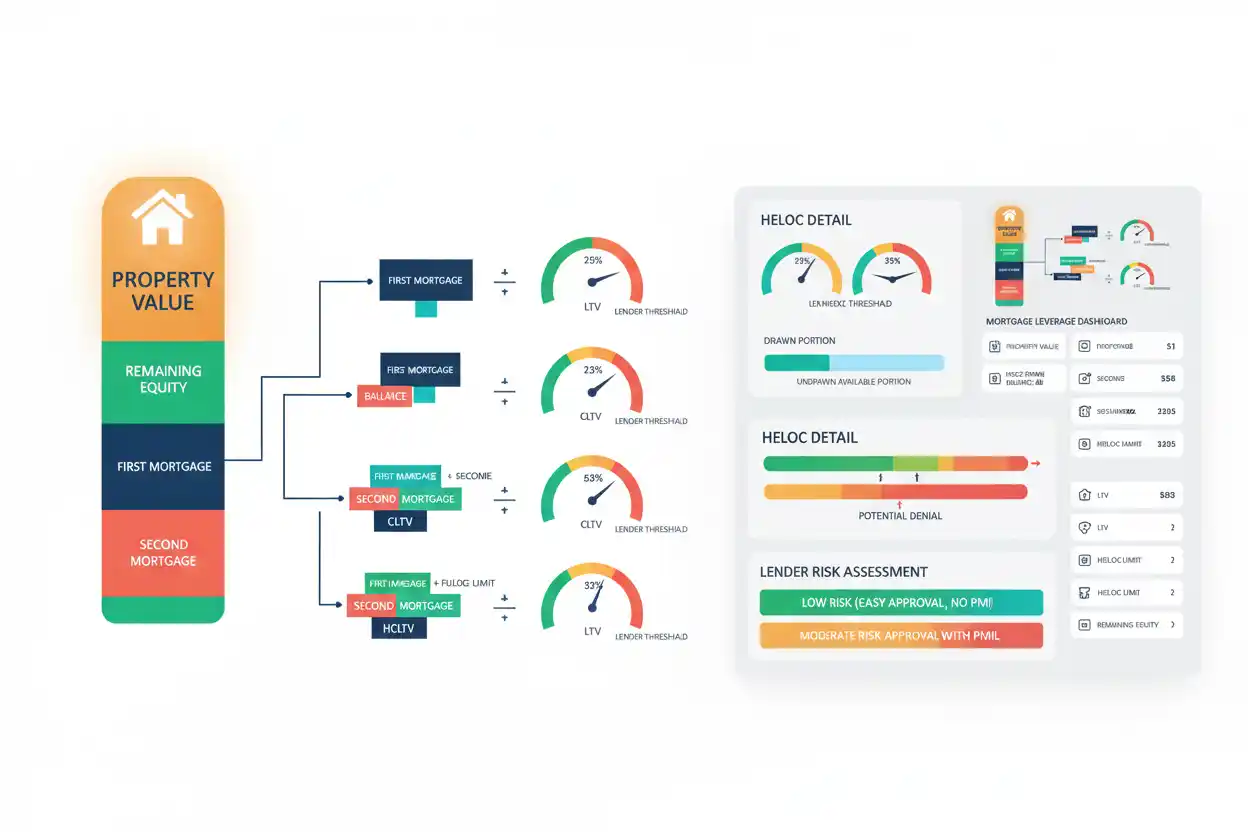
The combined loan-to-value ratio, or CLTV, measures multiple loans secured by the same property relative to the property’s qualifying value.
A simplified formula is:
CLTV = Total Included Property-Secured Debt ÷ Property Value × 100
Suppose a home has:
First mortgage = $320,000
HELOC balance drawn = $30,000
Second mortgage = $20,000
Property value = $500,000
Combined debt:
Combined Debt = $320,000 + $30,000 + $20,000
Combined Debt = $370,000
CLTV:
CLTV = $370,000 ÷ $500,000 × 100
CLTV = 74%
The first mortgage alone has a 64% LTV.
Once subordinate financing is included, total property leverage rises to 74%.
That is precisely why CLTV exists: the first mortgage by itself does not always show the full amount of debt secured by the property.
Fannie Mae’s current Selling Guide defines CLTV for applicable transactions using the first-mortgage amount, the drawn portion of a HELOC, and unpaid principal of other subordinate financing, divided by the applicable property value measure. Exact underwriting definitions and denominator rules can differ by transaction and program, so lender-specific requirements control.
What Is Combined Loan-to-Value Ratio?
CLTV is a property leverage ratio.
It answers:
How much mortgage and subordinate debt is secured by this property relative to its value?
This is different from ordinary loan-to-value ratio, which generally focuses on one mortgage.
Within the broader Mortgages & Home Loans framework, CLTV becomes important whenever the property supports more than one credit obligation.
CLTV Formula
A general analytical formula is:
CLTV = (First Mortgage + Included HELOC Balance + Other Subordinate Loan Balances) ÷ Property Value × 100
For the example:
First mortgage = $320,000
Drawn HELOC = $30,000
Second mortgage = $20,000
Numerator:
$320,000 + $30,000 + $20,000 = $370,000
Denominator:
$500,000
Therefore:
CLTV = 74%
LTV vs CLTV
LTV measures one primary loan:
LTV = First Mortgage ÷ Property Value × 100
CLTV includes additional property-secured debt:
CLTV = Combined Included Secured Debt ÷ Property Value × 100
Using the same example:
First mortgage:
LTV = $320,000 ÷ $500,000 × 100
LTV = 64%
Combined:
CLTV = 74%
Difference:
74% − 64% = 10 Percentage Points
That additional leverage comes from the HELOC and second mortgage.
CLTV vs HCLTV
When a HELOC exists, some mortgage underwriting frameworks also calculate a measure using the full HELOC credit line, not merely the amount currently drawn.
Fannie Mae calls this the home equity combined loan-to-value, or HCLTV, ratio. Its current guide uses the full HELOC amount in that calculation.
Suppose:
First mortgage = $320,000
HELOC credit limit = $80,000
HELOC currently drawn = $30,000
Other second mortgage = $20,000
Property value = $500,000
CLTV numerator:
$320,000 + $30,000 + $20,000 = $370,000
CLTV:
74%
HCLTV numerator:
$320,000 + $80,000 + $20,000 = $420,000
HCLTV:
$420,000 ÷ $500,000 × 100
HCLTV = 84%
The difference reflects the unused $50,000 of HELOC borrowing capacity.
Why HCLTV Can Be Higher
A borrower with a HELOC may be able to increase the balance after mortgage closing.
Therefore, an underwriting framework can consider not only today’s HELOC balance but also the full authorized credit line.
This does not mean HCLTV is the same as current debt.
It is a broader measure of potential home-equity leverage.
Property Value in CLTV
The denominator must follow the relevant underwriting definition.
For purchase transactions, Fannie Mae generally bases its LTV and CLTV calculations on the applicable value methodology, including use of the lower of sales price or appraised value in specified circumstances.
For a general analytical calculation, people often use current estimated property value.
However, lender underwriting can require a specific appraisal or program-defined value.
Do not substitute an online home-value estimate for the lender’s required denominator.
CLTV Purchase Example
Suppose:
Purchase price = $500,000
Appraised value = $490,000
First mortgage = $400,000
Second mortgage = $40,000
If the applicable underwriting denominator is $490,000:
Combined Debt = $440,000
CLTV = $440,000 ÷ $490,000 × 100
CLTV ≈ 89.8%
Using $500,000 instead would produce:
88%
The denominator definition therefore matters.
CLTV and Cash-Out Refinance
A cash-out refinance increases first-mortgage debt to release equity.
Suppose before refinancing:
First mortgage = $220,000
HELOC = $30,000
Home value = $500,000
Current CLTV:
($220,000 + $30,000) ÷ $500,000 × 100
CLTV = 50%
After a $320,000 cash-out refinance that leaves the $30,000 HELOC in place:
New CLTV = ($320,000 + $30,000) ÷ $500,000 × 100
New CLTV = 70%
The refinance increases combined leverage by 20 percentage points.
CLTV and Conforming Loans
A conforming loan can be subject to program-specific LTV, CLTV, or related leverage limits.
Those limits can differ by:
transaction type, property type, occupancy, subordinate financing, and underwriting method.
Fannie Mae and Freddie Mac both publish detailed leverage requirements rather than one universal CLTV threshold.
Therefore:
There Is No Single CLTV Maximum for Every Mortgage
CLTV and HELOC
A HELOC is one of the most common reasons CLTV differs from LTV.
Suppose:
First mortgage = $300,000
HELOC balance = $50,000
Home value = $500,000
LTV:
60%
CLTV:
70%
If the HELOC limit is $100,000, a full-line metric can be higher still.
CLTV and Home Equity Loans
A home equity loan is closed-end subordinate financing.
Its outstanding balance is typically included when calculating combined property leverage under relevant underwriting definitions.
Suppose:
First mortgage = $300,000
Home equity loan = $75,000
Property value = $500,000
CLTV = $375,000 ÷ $500,000 × 100
CLTV = 75%
CLTV and Bridge Loans
A bridge loan can affect property leverage when it is secured by a property already subject to other financing.
Suppose:
Existing mortgage = $250,000
Bridge loan secured by same home = $100,000
Home value = $500,000
Simplified combined leverage:
$350,000 ÷ $500,000 × 100
70%
The precise underwriting treatment depends on the loan and program.
CLTV and Construction Loans
A construction loan can involve changing outstanding balances as construction draws are funded.
That makes leverage analysis more complex than a single static mortgage balance.
The lender may evaluate:
committed loan amount, current draws, completed property value, as-completed value, and other project-specific variables.
The CLTV concept remains useful, but construction-specific rules should control the actual underwriting calculation.
CLTV and Biweekly Mortgage Payments
Biweekly mortgage payments can lower first-mortgage principal faster.
If subordinate balances and property value remain unchanged, lower first-mortgage principal can reduce current combined leverage.
Suppose:
First mortgage falls from $320,000 to $300,000
HELOC = $30,000
Second mortgage = $20,000
Property value = $500,000
New combined debt:
$350,000
Current-balance CLTV:
$350,000 ÷ $500,000 × 100
70%
This is four percentage points below the earlier 74% example.
CLTV and Balloon Mortgages
A balloon mortgage can leave a large principal balance outstanding.
If subordinate financing also exists, CLTV can remain elevated when the balloon becomes due.
That can affect refinancing flexibility.
A borrower expecting to refinance the balloon should therefore monitor total property-secured debt—not only the first mortgage.
CLTV and Adjustable-Rate Mortgages
An adjustable-rate mortgage changes interest-rate risk rather than directly changing CLTV.
However, higher ARM payments can reduce the household’s ability to repay subordinate debt.
Meanwhile, principal reduction can change leverage over time.
CLTV therefore measures collateral leverage, not payment affordability.
CLTV vs Mortgage DTI
The mortgage debt-to-income ratio measures monthly obligations relative to income.
CLTV measures loans relative to property value.
Suppose:
CLTV = 70%
That says nothing about whether the borrower can afford the monthly payments.
Likewise:
DTI = 30%
does not reveal how highly leveraged the property is.
Both dimensions can matter in mortgage underwriting.
CLTV and Mortgage Insurance
Mortgage insurance requirements can depend on mortgage type, first-lien LTV, and program-specific rules.
Do not assume that a particular CLTV automatically creates or removes mortgage insurance.
The relevant program may focus differently on first mortgage LTV and subordinate financing.
CLTV and Private Mortgage Insurance
Similarly, private mortgage insurance calculations should not be inferred from CLTV alone.
First-mortgage LTV, mortgage type, cancellation rules, property type, and loan terms can all matter.
CLTV and Down Payments
A larger down payment reduces the first mortgage and therefore lowers LTV.
However, if the down payment itself is financed with subordinate debt, CLTV may remain high.
Example:
Home price = $500,000
First mortgage = $400,000
Second mortgage = $50,000
Cash contributed = $50,000
First-lien LTV:
80%
CLTV:
90%
The borrower has only 10% of the property’s value represented by unfinanced equity in this simplified example.
CLTV and Refinancing
Refinancing can become more difficult as combined leverage rises.
A borrower with a low first-mortgage LTV but a large HELOC should therefore not assume there is abundant refinance equity.
The second lien also matters.
CLTV and Rate-and-Term Refinance
A rate-and-term refinance may need the subordinate lender to remain in a junior lien position or satisfy other requirements.
Existing HELOC and second-mortgage balances therefore can affect the transaction even if the borrower is not taking additional cash.
CLTV and Mortgage Recast
A mortgage recast can reduce the required first-mortgage payment after a substantial principal reduction when permitted.
That principal reduction can also lower current combined leverage.
The borrower gains both:
a lower balance and potentially a lower required payment.
CLTV and Home Appreciation
Suppose:
Combined debt = $350,000
Home value = $500,000
CLTV = 70%
If the property later rises to $550,000 and debt is unchanged:
CLTV = $350,000 ÷ $550,000 × 100
CLTV ≈ 63.6%
The ratio improves because the denominator increased.
However, underwriting generally requires an accepted property valuation rather than simply assuming appreciation.
CLTV and Falling Property Values
The opposite can happen.
Combined debt = $350,000
Property value falls to $400,000
CLTV = $350,000 ÷ $400,000 × 100
CLTV = 87.5%
No additional borrowing occurred, yet leverage increased sharply.
This demonstrates why property values are a major part of mortgage collateral risk.
CLTV Above 100%
Suppose:
First mortgage = $350,000
Second mortgage = $75,000
Property value = $400,000
Combined debt:
$425,000
CLTV:
$425,000 ÷ $400,000 × 100
CLTV = 106.25%
Combined secured debt exceeds the stated property value.
This is often described as being underwater or having negative equity at the combined-debt level.
CLTV Is Not Home Equity Percentage
Home equity can be approximated as:
Equity = Property Value − Secured Debt
Using:
Property value = $500,000
Combined debt = $370,000
Equity:
$130,000
Equity percentage:
$130,000 ÷ $500,000 × 100
26%
Because CLTV is 74%:
74% + 26% = 100%
in this simplified current-balance example.
CLTV Is Not Credit Utilization
The credit utilization ratio compares revolving balances with credit limits.
CLTV compares property-secured borrowing with property value.
A HELOC can influence both metrics conceptually in different lending analyses, but the denominators are completely different.
Current Balance vs Underwriting CLTV
Consumers often estimate CLTV using today’s balances.
Underwriting definitions can differ.
For example, Fannie Mae’s published CLTV definition specifies the original loan amount of the first mortgage for the applicable transaction and particular treatment of subordinate financing.
Therefore, when qualifying for a mortgage:
use the lender’s official calculation rather than relying solely on a consumer balance estimate.
Common Combined Loan-to-Value Mistakes
One mistake is calculating only the first mortgage.
Another is ignoring a drawn HELOC balance.
Borrowers also confuse CLTV with a metric that uses the full HELOC limit.
A fourth mistake is using an informal property estimate when underwriting requires a different value.
Finally, there is no universal maximum CLTV that applies to every mortgage product.
Frequently Asked Questions
What does CLTV stand for?
CLTV stands for combined loan-to-value.
What is the basic CLTV formula?
CLTV = Combined Included Property-Secured Debt ÷ Property Value × 100
What debts are included?
Typically the first mortgage and applicable subordinate property-secured financing, according to the relevant underwriting definition.
What is the CLTV on $370,000 of combined loans against a $500,000 home?
74%
What is the difference between LTV and CLTV?
LTV generally focuses on one mortgage. CLTV incorporates applicable subordinate financing.
What is HCLTV?
In certain underwriting frameworks, HCLTV incorporates the full HELOC credit line rather than only the amount currently drawn.
Can CLTV be higher than 100%?
Yes, when combined secured debt exceeds property value.
Does a HELOC affect CLTV?
The applicable drawn HELOC balance can be included under relevant CLTV methodologies.
Does an unused HELOC affect CLTV?
Treatment depends on the metric. A full-line measure such as HCLTV can account for the total HELOC limit.
Does paying down the mortgage reduce CLTV?
A current-balance CLTV estimate falls when secured debt declines and property value remains unchanged.
Is there one maximum acceptable CLTV?
No. Limits differ across products, property types, transaction types, and underwriting programs.
Is CLTV the same as DTI?
No. CLTV measures property leverage. DTI measures payment obligations relative to income.
Final Takeaway
Combined loan-to-value ratio reveals property leverage that first-mortgage LTV can miss.
The basic relationship is:
CLTV = Combined Property-Secured Debt ÷ Property Value × 100
For a property worth $500,000 with:
First mortgage = $320,000
Drawn HELOC = $30,000
Second mortgage = $20,000
CLTV is:
$370,000 ÷ $500,000 × 100 = 74%
The first mortgage alone is only 64% LTV.
If the HELOC has an $80,000 total line, a full-line HCLTV-style calculation can reach:
84%
That difference is why mortgage analysis must consider all debt secured by the property and the exact underwriting definition being used, not merely the balance of the first mortgage.