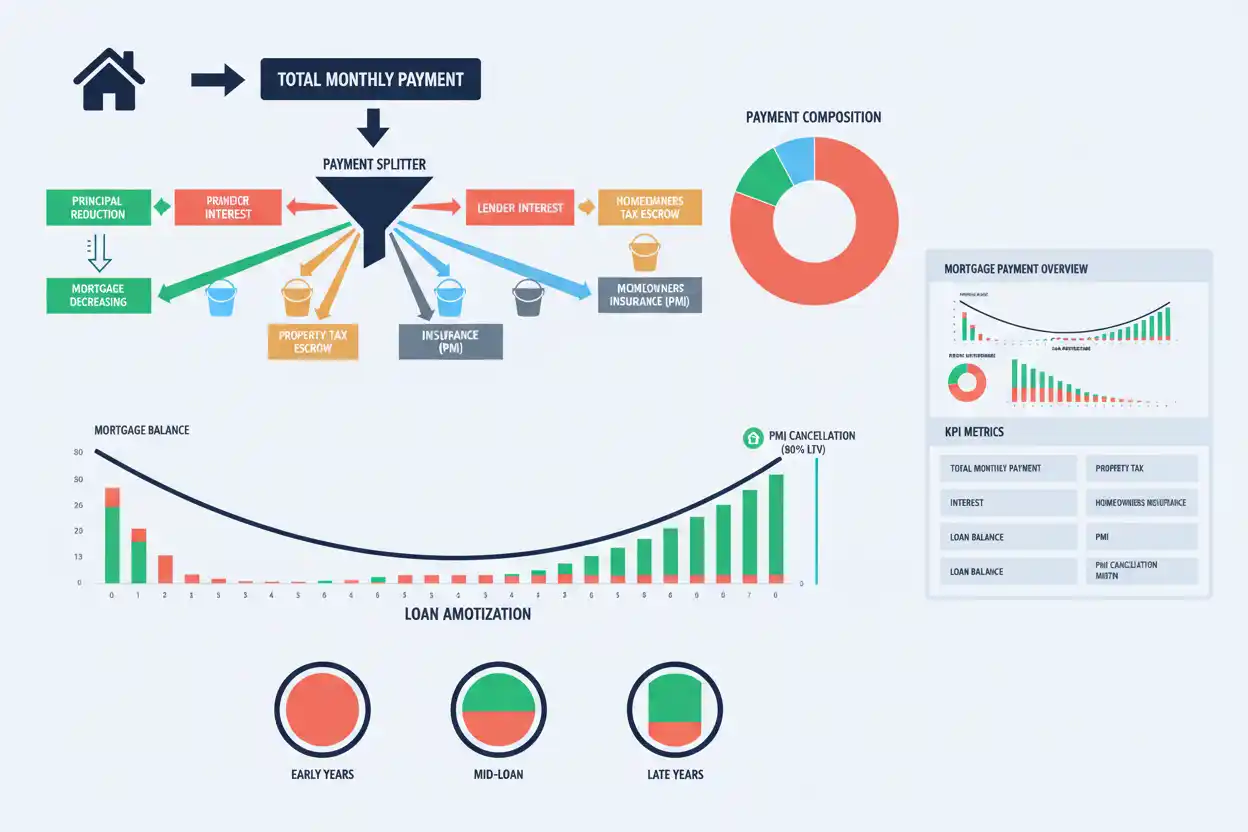

Mortgage payments work by combining the contractual repayment of borrowed principal with the cost of financing that principal.
For many homeowners, the amount sent to the mortgage servicer also includes money for property taxes, homeowners insurance, and sometimes mortgage insurance.
The core relationship is:
Total Mortgage Payment = Principal + Interest + Escrowed Taxes + Escrowed Insurance + Mortgage Insurance + Other Applicable Amounts
For the principal-and-interest portion of a standard fixed-rate fully amortizing mortgage:
Monthly P&I = P × [r(1 + r)ⁿ] ÷ [(1 + r)ⁿ − 1]
CFPB explains that principal and interest usually make up the central portion of a mortgage payment, while the total monthly payment can be higher because of taxes, insurance, and mortgage insurance.
Mortgage Payment Example
Suppose:
Mortgage principal = $400,000
Rate = 6.5%
Term = 30 years
Principal-and-interest payment:
≈ $2,528.27 per Month
Now assume:
Property taxes = $600/month
Homeowners insurance = $150/month
Mortgage insurance = $0
Total mortgage-related payment:
$2,528.27 + $600 + $150
$3,278.27 per Month
The $3,278.27 should not be treated as though every dollar reduces the mortgage balance.
Only the principal portion does.
First Payment Breakdown
Beginning principal:
$400,000
First-month mortgage interest:
$400,000 × 6.5% ÷ 12
$2,166.67
Principal:
$2,528.27 − $2,166.67
$361.61
Ending mortgage balance:
$400,000 − $361.61
$399,638.39
Taxes:
$600
Insurance:
$150
Those tax and insurance dollars do not reduce principal.
What Is Principal?
Principal is the amount of borrowed mortgage debt that remains unpaid.
Suppose the borrower originally finances:
$400,000
After the first payment:
Principal ≈ $399,638.39
The mortgage principal page focuses on tracking this balance separately.
What Is Interest?
Interest is the cost of borrowing principal.
During the first month:
Interest = $2,166.67
That payment does not create home equity.
CFPB notes that principal reduces the amount owed and builds equity, whereas the interest portion does not reduce the balance.
Why Principal and Interest Change
With a typical fixed-rate mortgage, combined principal and interest remain level.
However:
interest declines as principal falls, and principal repayment increases.
CFPB describes this changing allocation as mortgage amortization.
The formulas are:
Interestₜ = Beginning Balanceₜ × Monthly Rate
Principalₜ = Payment − Interestₜ
Ending Balanceₜ = Beginning Balanceₜ − Principalₜ
Second Payment
Beginning balance:
$399,638.39
Interest:
≈ $2,164.71
Principal:
≈ $363.56
Ending balance:
≈ $399,274.83
The total $2,528.27 P&I payment remains essentially unchanged, but slightly more goes toward principal.
Mortgage Amortization
The mortgage amortization schedule repeats this process over hundreds of payments.
After one year in the example:
Balance ≈ $395,529.10
After five years:
Balance ≈ $374,443.91
After ten years:
Balance ≈ $339,104.51
The balance falls progressively faster as interest consumes less of each payment.
How Escrow Works in the Payment
A mortgage escrow account allows the servicer to collect specified property expenses through monthly mortgage payments.
Suppose annual property tax is:
$7,200
Monthly escrow estimate:
$7,200 ÷ 12 = $600
Annual homeowners insurance:
$1,800
Monthly:
$150
Those amounts are then added to principal and interest.
Mortgage Insurance
If the mortgage requires mortgage insurance, that premium can further increase the monthly payment.
Suppose:
P&I = $2,528.27
Taxes = $600
Homeowners insurance = $150
Mortgage insurance = $200
Total:
$2,528.27 + $600 + $150 + $200
$3,478.27
Ignoring mortgage insurance would understate the monthly housing obligation by $200.
Why a Fixed-Rate Mortgage Payment Can Change
A fixed-rate mortgage stabilizes contractual principal and interest.
It does not necessarily stabilize the entire amount sent to the servicer.
Taxes or insurance collected through escrow can increase or decrease. CFPB identified changing escrowed property taxes and insurance premiums as common reasons mortgage payments change even when the underlying rate does not.
Mortgage Payment and Debt-to-Income Ratio
The mortgage debt-to-income ratio often uses a qualifying housing payment broader than principal and interest.
Suppose:
Gross monthly income = $9,000
Housing payment = $3,478.27
Other monthly debts = $700
Total:
$4,178.27
DTI:
$4,178.27 ÷ $9,000 × 100
≈ 46.43%
The lender’s actual qualifying definitions determine the final underwriting figure.
Mortgage Payment and Origination Fee
A mortgage origination fee usually belongs to the upfront financing transaction rather than the normal monthly mortgage payment.
Suppose:
Origination fee = $4,000
If paid in cash:
the scheduled $2,528.27 principal-and-interest payment does not change.
If financing increases the loan balance, however, the resulting mortgage payment can increase.
Mortgage Payment and Interest Deduction
The mapped mortgage interest deduction concerns federal tax treatment of qualifying mortgage interest.
It does not change how the servicer allocates the contractual mortgage payment.
Tax deductibility and payment allocation are separate calculations.
Mortgage Payment and Payoff Amount
The mortgage payoff amount is also different from the next scheduled mortgage payment.
A monthly payment keeps the mortgage on its repayment schedule.
A payoff amount completely satisfies the loan as of a specified date.
CFPB notes that a payoff amount can include principal, interest through the intended payoff date, unpaid fees, and potentially a prepayment penalty where applicable.
Paying Extra Toward Principal
Suppose the normal payment is:
$2,528.27
and the borrower adds:
$500 of Extra Principal
The total sent becomes:
$3,028.27
before escrow amounts.
The additional $500 can reduce principal more quickly when properly applied.
CFPB notes that borrowers may be allowed to make extra principal payments and should make sure additional amounts intended for principal are applied as such.
Extra Payment Example
After the first regular payment:
Balance ≈ $399,638.39
Apply $500 extra principal:
New Balance ≈ $399,138.39
The following month’s interest is calculated from approximately $500 less principal.
That reduces future interest and can shorten the mortgage term.
The dedicated mortgage payoff strategies page owns the broader early-payoff strategy.
Partial Payments
Sending half the required monthly amount does not necessarily mean the servicer immediately applies it like a complete periodic mortgage payment.
Mortgage servicing rules and the servicer’s payment procedures matter.
Borrowers considering unusual payment schedules should verify how the servicer treats partial payments rather than assuming every transfer instantly reduces principal.
Payment on an Adjustable-Rate Mortgage
On an adjustable-rate mortgage, the principal-and-interest payment can change after rate adjustments.
CFPB notes that ARM payments are typically recalculated after the rate adjusts using the new rate and remaining loan term, though exact contract terms govern.
Interest-Only Payments
An interest-only mortgage works differently.
If:
Principal = $400,000
Rate = 6.5%
Interest-only payment:
$2,166.67
Principal repayment:
$0
The low introductory payment therefore does not reduce the $400,000 balance unless additional principal is paid.
Balloon Mortgage Payments
A balloon mortgage can use regular payments that are too small to fully eliminate principal before maturity.
CFPB explains that the remaining balance then becomes a large final balloon payment.
The monthly payment alone therefore does not reveal whether the loan is fully amortizing.
Where to Check Your Mortgage Payment
The Loan Estimate shows projected payment information before closing, and the mortgage statement shows account-specific servicing information after closing.
CFPB’s Loan Estimate guidance encourages borrowers to review monthly principal and interest separately from taxes, insurance, mortgage insurance, and other charges.
Common Mortgage Payment Mistakes
One mistake is assuming the entire monthly amount reduces debt.
Another is ignoring escrow.
Borrowers also confuse a fixed interest rate with a permanently fixed total payment.
A fourth mistake is treating an extra transfer as principal without verifying how the servicer applies it.
Finally, an introductory ARM, balloon, or interest-only payment should not be interpreted as though it describes the mortgage’s entire future payment schedule.
Frequently Asked Questions
What makes up a mortgage payment?
It can include principal, interest, property taxes, homeowners insurance, mortgage insurance, and other applicable amounts.
What is principal?
Principal is the amount borrowed that remains unpaid.
What is interest?
Interest is the lender’s charge for lending the money.
What is the payment on $400,000 at 6.5% for 30 years?
Approximately:
$2,528.27
for principal and interest.
How much of the first payment is principal?
Approximately:
$361.61
in the example.
Why does the principal portion increase later?
Because interest declines as the outstanding balance decreases.
Why can my fixed-rate mortgage payment change?
Escrowed property taxes and insurance can change even when principal and interest remain fixed.
Does escrow reduce principal?
No.
Does mortgage insurance reduce principal?
No.
Can I pay extra principal?
Often yes, subject to the mortgage terms and servicer procedures.
Is my payoff amount the same as one monthly payment?
No. A payoff completely satisfies the mortgage as of a specified date.
Where can I see my payment breakdown?
Your mortgage statement and applicable mortgage disclosures show the payment components.
Final Takeaway
A mortgage payment is not one single economic expense.
It can contain:
Principal + Interest + Taxes + Insurance + Mortgage Insurance
For a $400,000 mortgage at 6.5% for 30 years:
Principal-and-interest payment:
$2,528.27
First-month interest:
$2,166.67
First-month principal:
$361.61
If taxes are $600 per month and homeowners insurance is $150:
Total Simplified Payment = $3,278.27
The crucial distinction is that only principal reduces the mortgage balance. Interest pays for borrowing, while escrowed taxes, insurance, and mortgage-insurance amounts cover separate obligations.