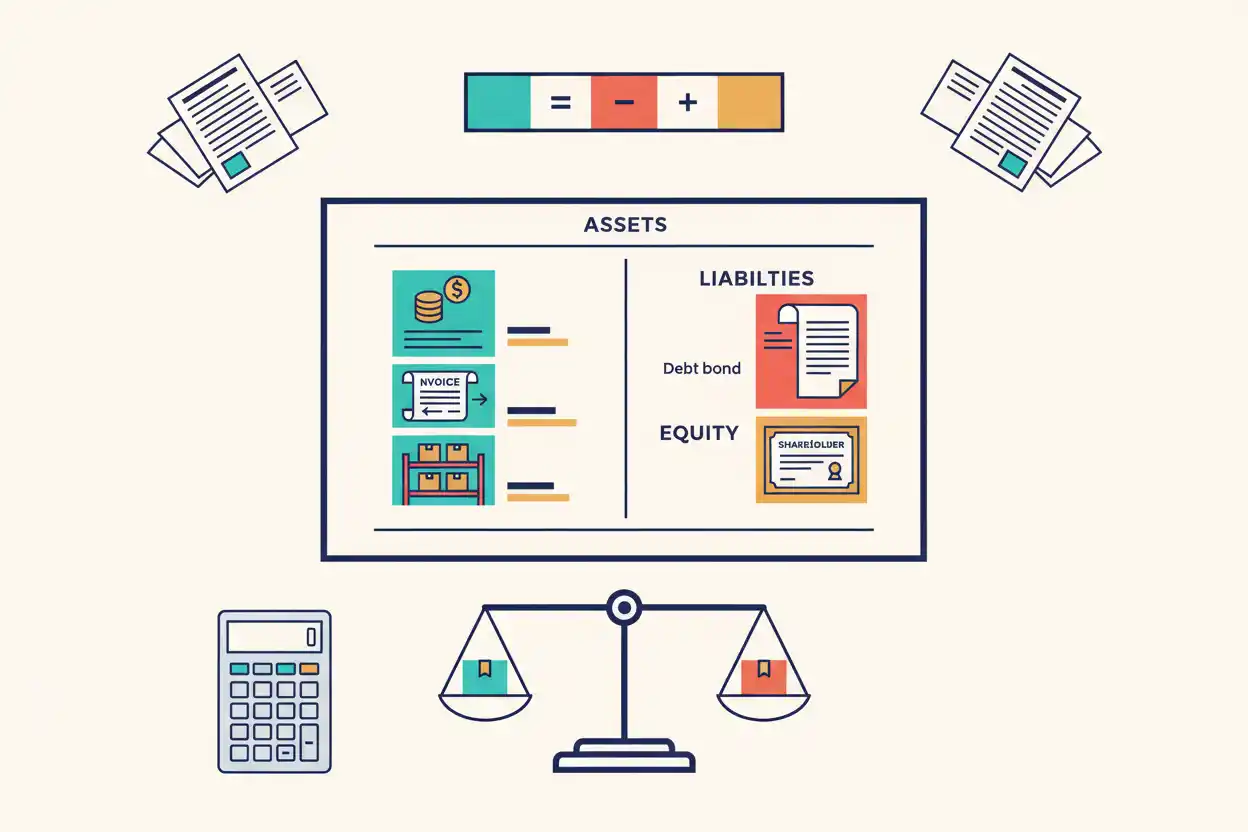

A balance sheet shows what a business owns, what it owes, and the residual accounting value attributable to owners at a specific point in time.
Its core relationship is:
Assets = Liabilities + Equity
Suppose a company reports $600,000 of total assets and $420,000 of total liabilities.
Equity = $600,000 − $420,000
= $180,000
The balance sheet must remain in balance because every recorded transaction affects the accounting equation in a way that preserves the relationship between assets, liabilities, and equity.
What Is a Balance Sheet?
A balance sheet is a statement of financial position.
Unlike an income statement, which measures performance across a period, the balance sheet represents a snapshot at one date.
For example:
Balance Sheet Date: December 31
means the statement reports asset, liability, and equity balances as of that date.
It does not by itself show everything that happened during the entire year.
Balance Sheet Formula
The fundamental formula is:
Assets = Liabilities + Equity
The equation can also be rearranged:
Equity = Assets − Liabilities
or:
Liabilities = Assets − Equity
Each version describes the same accounting relationship.
Simple Balance Sheet Example
Suppose a business has:
Cash:
$80,000
$120,000
Inventory:
$150,000
Equipment and other assets:
$250,000
Total assets:
$600,000
The company also reports:
Accounts payable:
$90,000
Debt and other liabilities:
$330,000
Total liabilities:
$420,000
Therefore:
Equity = $600,000 − $420,000
= $180,000
Check:
$600,000 = $420,000 + $180,000
The balance sheet balances.
Assets
Assets are economic resources controlled by the business that are expected to provide future benefit under the applicable accounting framework.
Common examples include cash, receivables, inventory, prepaid amounts, property, equipment, and qualifying intangible assets.
If a customer owes the company $40,000 for an eligible credit sale, that amount can appear as an asset rather than cash.
The distinction matters because an asset can have value without being immediately spendable.
Current Assets
Current assets generally relate to the near-term operating cycle.
Suppose:
Cash:
$70,000
Accounts receivable:
$100,000
Inventory:
$130,000
Other current assets:
$20,000
Total current assets:
$320,000
This subtotal is useful for assessing short-term liquidity, but each component has different liquidity characteristics.
Cash is available immediately. Receivables still need collection. Inventory may need to be sold before becoming cash.
Noncurrent Assets
Longer-lived assets can include property, equipment, and certain intangible assets.
Suppose an eligible intangible asset originally costs $100,000 and accumulated amortization expense has reached $40,000.
Simplified carrying value:
$100,000 − $40,000
= $60,000
The remaining $60,000 can contribute to total assets under the applicable accounting treatment.
Liabilities
Liabilities represent obligations of the business.
They can include supplier balances, accrued expenses, loans, taxes payable, lease obligations, and other amounts the company is required to settle.
Suppose:
Accounts payable:
$60,000
Accrued liabilities:
$30,000
Short-term debt:
$50,000
Total current liabilities:
$140,000
These obligations can create near-term cash demands even when the company reports substantial accounting profit.
Equity
Equity is the residual accounting interest after liabilities are subtracted from assets.
Equity = Assets − Liabilities
If:
Assets = $900,000
and:
Liabilities = $650,000
then:
Equity = $250,000
This is book equity.
It should not automatically be interpreted as the market value of the company.
A profitable operating business can be worth more or less than its accounting equity.
How a Cash Investment Changes the Balance Sheet
Suppose an owner contributes:
$50,000 Cash
The simplified effect is:
Cash:
+$50,000
Equity:
+$50,000
If the balance sheet originally showed:
Assets = $600,000
Liabilities = $420,000
Equity = $180,000
after the contribution:
Assets = $650,000
Liabilities = $420,000
Equity = $230,000
The accounting equation remains balanced.
Borrowing Money
Suppose the company borrows:
$100,000
Cash rises:
+$100,000
Debt rises:
+$100,000
If the business had:
Assets = $600,000
Liabilities = $420,000
Equity = $180,000
after borrowing:
Assets = $700,000
Liabilities = $520,000
Equity = $180,000
Borrowing increases assets and liabilities but does not create equity merely because cash increased.
Paying Accounts Payable
Suppose the company pays:
$30,000
of supplier invoices.
Cash declines:
−$30,000
Accounts payable declines:
−$30,000
If assets and liabilities were:
$600,000 and $420,000
they become:
Assets = $570,000
Liabilities = $390,000
Equity remains:
$180,000
Paying an existing liability does not reduce equity again when the related expense or asset was already recognized correctly.
Collecting Accounts Receivable
Suppose the company collects:
$25,000
from customers.
Cash:
+$25,000
Accounts receivable:
−$25,000
Total assets do not change.
One asset has simply been converted into another.
This is why cash collection can improve liquidity without changing total assets or creating new revenue.
Accrual Accounting and the Balance Sheet
Accrual accounting creates many balance-sheet accounts because economic activity and cash timing do not always coincide.
Revenue earned before collection can create accounts receivable.
Expenses incurred before payment can create accounts payable or accrued liabilities.
Cash received before revenue is earned can create deferred revenue.
Cash paid before an expense is consumed can create a prepaid asset.
The balance sheet is therefore central to understanding timing differences.
Working Capital
A common balance-sheet calculation is:
Working Capital = Current Assets − Current Liabilities
Suppose:
Current Assets = $320,000
Current Liabilities = $220,000
Then:
Working Capital = $100,000
Positive working capital means current assets exceed current liabilities in accounting terms.
It does not guarantee that every near-term obligation can be paid immediately because some current assets may not be readily convertible into cash.
Current Ratio
Another liquidity measure is:
Current Ratio = Current Assets ÷ Current Liabilities
Using:
$320,000 ÷ $220,000
≈ 1.45
The company reports approximately $1.45 of current assets for every $1 of current liabilities.
A higher ratio is not automatically better. Excess inventory, slow receivables, or inefficient capital use can inflate current assets without improving operations proportionately.
Debt-to-Assets Ratio
A simple solvency measure is:
Debt-to-Assets Ratio = Total Liabilities ÷ Total Assets
Suppose:
Liabilities = $420,000
Assets = $600,000
Then:
$420,000 ÷ $600,000
= 70%
Seventy percent of the asset base is financed through liabilities in this simplified accounting view.
Equity Ratio
The complementary relationship is:
Equity Ratio = Equity ÷ Assets
Using:
$180,000 ÷ $600,000
= 30%
Because:
70% + 30% = 100%
the liabilities and equity together finance the full asset base.
Negative Equity
Suppose:
Assets = $400,000
Liabilities = $475,000
Then:
Equity = $400,000 − $475,000
= −$75,000
Negative book equity means recorded liabilities exceed recorded assets.
That is a significant balance-sheet condition, though the business’s market value and ability to continue operating require broader analysis.
Balance Sheet and Profit
Profit can increase equity when retained in the business.
Suppose beginning equity is:
$180,000
and the company earns:
$50,000
with no owner distributions or other equity changes.
Simplified ending equity:
$230,000
The balance-sheet effect depends on where the corresponding assets and liabilities moved as the profit was generated.
Profit should therefore be linked to both the income statement and changes in financial position.
Balance Sheet and Break-Even Sales
A company can reach break-even sales for the period while still having a weak balance sheet.
For example, sales may cover current operating costs, but the company could still carry substantial debt accumulated in earlier periods.
Break-even analysis answers whether a defined revenue level covers a cost structure.
The balance sheet answers what assets, obligations, and equity remain at a point in time.
Balance Sheet and Budget Variance
A budget variance can help explain why actual balance-sheet balances differ from planned balances.
Suppose budgeted year-end cash was:
$100,000
but actual cash is:
$70,000
Variance:
$70,000 − $100,000
= −$30,000
Management then needs to determine whether the difference came from slower collections, higher purchases, unexpected capital expenditure, debt repayment, lower sales, or another cause.
Comparative Balance Sheets
Looking at two dates reveals movement that one balance sheet cannot show.
Suppose:
| Item | Beginning | Ending |
|---|---|---|
| Cash | $80,000 | $55,000 |
| Accounts Receivable | $100,000 | $145,000 |
| Inventory | $120,000 | $150,000 |
| Accounts Payable | $70,000 | $95,000 |
Cash fell by $25,000 while receivables and inventory increased significantly.
That pattern can indicate working capital absorbing cash.
The exact cause requires deeper operating analysis.
Balance Sheet Growth
Suppose total assets increase:
$500,000 → $650,000
Asset growth:
$150,000
Percentage growth:
$150,000 ÷ $500,000 × 100
= 30%
Growth alone does not tell you whether the company improved financially.
If liabilities grew 50% over the same period, leverage may have increased substantially.
Book Value per Owner Share
If a business has book equity of:
$1,000,000
and:
100,000 Shares
a simplified book value per share is:
$1,000,000 ÷ 100,000
= $10
This is an accounting measure.
It should not be confused with market price per share.
Common Balance Sheet Mistakes
A common mistake is treating assets as though all of them were cash.
Another is assuming a loan increases equity because it increases the bank balance.
Businesses can also record customer collections as new revenue, supplier payments as new expenses, or ignore whether asset and liability changes preserve the accounting equation.
Frequently Asked Questions
What is a balance sheet?
A balance sheet reports a business’s assets, liabilities, and equity at a specific date.
What is the balance sheet formula?
Assets = Liabilities + Equity
How do I calculate equity?
Equity = Assets − Liabilities
Is accounts receivable an asset?
Generally, yes.
Is accounts payable a liability?
Generally, yes.
Does collecting receivables increase total assets?
No. It generally converts receivables into cash.
Does borrowing money increase equity?
No. It normally increases both assets and liabilities.
What is working capital?
Current Assets − Current Liabilities
What is the current ratio?
Current Assets ÷ Current Liabilities
Can equity be negative?
Yes, when recorded liabilities exceed recorded assets.
Is book equity the same as company market value?
No.
Why compare balance sheets across periods?
Changes in cash, receivables, inventory, debt, payables, and equity reveal trends that a single-date snapshot cannot show.