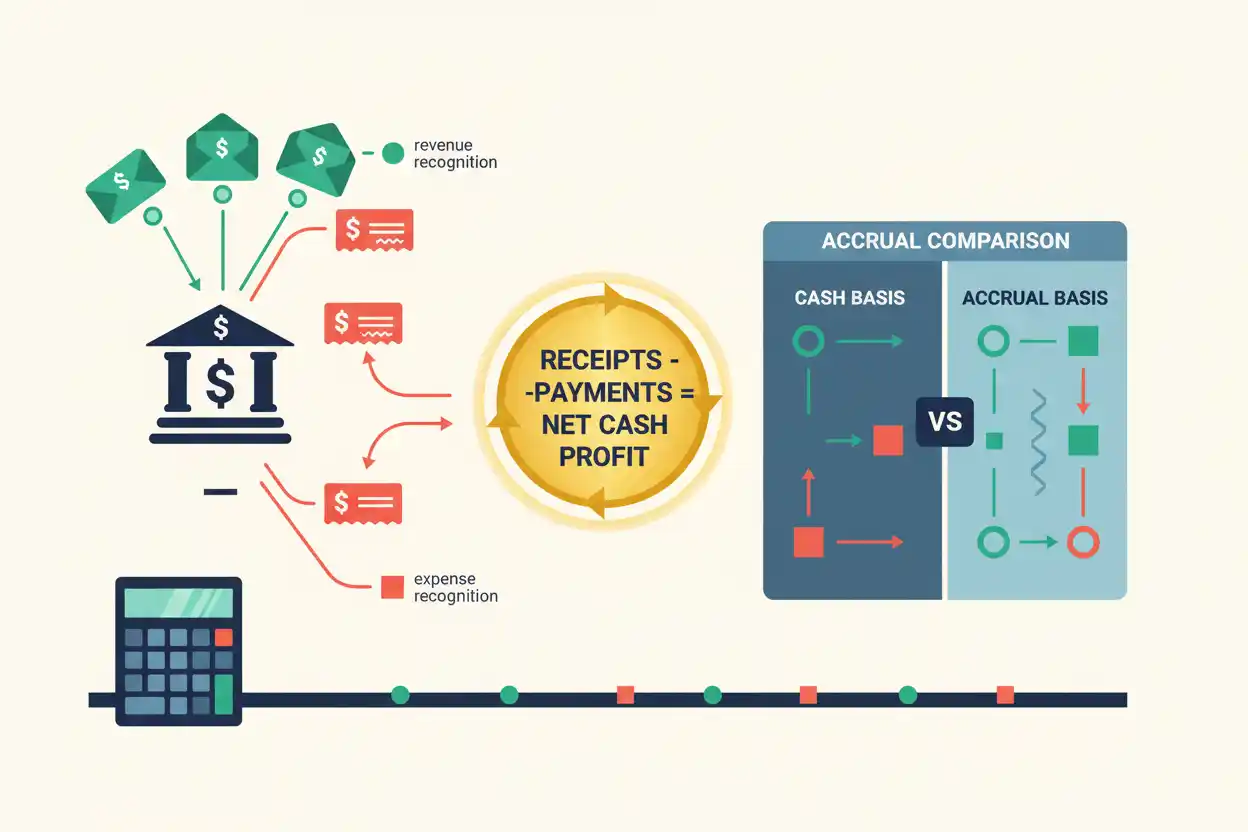
Cash accounting recognizes revenue when cash is received and expenses when cash is paid, rather than focusing primarily on when revenue is earned or expenses are incurred.
Suppose a business receives:
$100,000 Cash From Customers
during a period and pays:
$70,000 of Business Expenses
Under a simplified cash-basis view:
Cash-Basis Profit = $100,000 − $70,000
= $30,000
If customers still owe the business $20,000 for completed work, that uncollected amount does not enter the simplified cash revenue calculation until cash is received.
This timing approach makes cash accounting intuitive, but it can make period-to-period performance depend heavily on when customers pay and when the business settles its bills.
Cash Accounting Formula
A simple model is:
Cash-Basis Profit = Cash Revenue Received − Cash Expenses Paid
Suppose:
Cash Receipts = $180,000
Cash Expenses = $145,000
Then:
Cash-Basis Profit = $35,000
This formula describes the basic timing logic.
A complete accounting or tax system can still require classifications, exclusions, capital-asset treatment, and other adjustments.
Cash Revenue Example
Suppose a company performs:
$15,000 of Work in December
but collects payment in January.
Under a simplified cash method:
December cash revenue:
$0
January cash revenue:
$15,000
The cash method recognizes the revenue based on receipt timing rather than the period when the work was completed.
Cash Expense Example
Suppose the company receives a vendor service costing:
$8,000
in December but pays the bill in January.
Under a simplified cash method:
December cash expense:
$0
January cash expense:
$8,000
Again, payment timing drives the period in which the amount enters the simplified cash-basis result.
Cash Accounting vs Accrual Accounting
Accrual accounting generally recognizes economic activity based on when revenue is earned and expenses are incurred.
Cash accounting instead focuses on the movement of cash.
Suppose in December:
Work completed:
$20,000
Expenses incurred:
$8,000
but neither amount is settled until January.
Simplified accrual December profit:
$20,000 − $8,000
= $12,000
Simplified cash-basis December result:
$0
January then shows the cash receipts and payments.
Neither number is “wrong” within its defined method. They answer different timing questions.
Timing Can Shift Profit Between Periods
Suppose customers normally pay by December 31 but this year $30,000 of receipts arrive January 2.
Under a cash method, that timing shift can move $30,000 of recognized cash revenue from one year to the next.
The underlying customer activity may be economically similar.
Cash-basis reported results can therefore be sensitive to payment dates around period-end.
Cash Accounting and Accounts Receivable
Under accrual accounting, accounts receivable can record amounts customers owe before cash arrives.
Under a simple cash-basis view, uncollected customer invoices do not create current cash revenue.
Suppose:
Invoices Issued = $100,000
Cash Collected = $75,000
Cash-basis revenue:
$75,000
Uncollected:
$25,000
The $25,000 is economically important, but it does not increase current cash receipts.
Cash Accounting and Accounts Payable
A similar distinction applies to unpaid vendor bills.
Suppose:
Supplier Costs Incurred = $60,000
but:
Cash Paid = $45,000
Under a simplified cash basis:
Cash Expense = $45,000
The remaining $15,000 has not yet reduced cash.
In an accrual system, the unpaid amount can appear in accounts payable or another liability.
Cash Accounting and Budget Variance
A budget variance based on cash receipts can differ substantially from a revenue variance under accrual accounting.
Suppose budgeted monthly customer receipts are:
$100,000
Actual receipts:
$80,000
Cash receipt variance:
−$20,000
Yet customers may still have purchased the expected amount and simply paid more slowly.
Cash timing and sales performance should therefore be separated before management concludes that demand weakened.
Cash Accounting and Capacity Utilization
Capacity utilization measures productive activity rather than payment timing.
Suppose a factory operates at:
90% Capacity
but major customers receive 60-day payment terms.
The business can show high operational utilization while current cash receipts remain weak.
A cash-accounting result should therefore not be interpreted as a direct production-efficiency measure.
Cash Accounting and Cash Flow Statement
A cash flow statement also focuses on cash movement, but it is not simply another name for cash accounting.
A cash flow statement classifies cash flows into categories such as operating, investing, and financing activities under the applicable reporting framework.
Cash accounting determines when revenue and expenses are recognized under the cash method.
The purposes overlap around cash timing but are not identical.
Cash Accounting and Contribution Margin
The contribution margin ratio analyzes how sales revenue contributes toward fixed costs and profit after variable costs.
A cash-basis result can distort short-term contribution analysis when customer receipts and supplier payments occur in periods different from the underlying sales activity.
For operating decisions, management may therefore still analyze economic sales and variable costs even if bookkeeping or tax reporting uses a cash method where permitted.
Beginning and Ending Cash
Cash accounting profit should not be confused with the total change in the bank balance.
Suppose:
Beginning Cash = $50,000
Cash-Basis Operating Profit = $30,000
but the business also:
buys equipment for $20,000 and repays $10,000 of loan principal.
Ending cash:
$50,000 + $30,000 − $20,000 − $10,000
= $50,000
Cash-basis operating profit is $30,000, yet cash ends exactly where it began because other cash transactions occurred.
Cash Received From a Loan Is Not Revenue
Suppose the business borrows:
$100,000
Cash increases by $100,000.
That does not make:
Cash Revenue = $100,000
The loan creates an obligation to repay.
Cash accounting still requires transactions to be classified correctly.
Not every cash receipt is revenue.
Owner Investment Is Not Revenue
Suppose the owner contributes:
$50,000
to the business.
Cash rises:
$50,000
but operating revenue does not automatically rise.
The amount is an owner financing transaction rather than customer income.
Again:
Cash Inflow ≠ Automatically Revenue
Asset Purchase Is Not Always Immediate Expense
A simple cash-basis mindset can create another error: assuming every cash payment is an immediate ordinary expense.
Suppose the company pays:
$100,000
for a long-lived asset.
Depending on the relevant accounting or tax rules, the payment may need to be capitalized and recognized over time rather than fully deducted immediately.
Cash accounting concerns timing, but transaction classification still matters.
Cash Received Before Service
Suppose a customer pays:
$12,000
in advance.
Under a simplified cash method, the receipt can enter cash-basis revenue according to the rules governing the method.
Under accrual accounting, some or all of the amount may remain deferred until the related service is earned.
This can create substantial differences between the two methods.
Cash Payment Before Benefit
Suppose a company prepays:
$24,000
for a future service period.
Under a simplistic pure cash view, payment timing suggests a $24,000 outflow immediately.
Under accrual accounting, the cost can instead be allocated to the periods benefiting from the service.
This is one reason cash accounting can produce more volatile period results.
Monthly Cash-Basis Example
Suppose:
January receipts:
$40,000
January payments:
$30,000
January cash-basis profit:
$10,000
February receipts:
$70,000
February payments:
$25,000
February profit:
$45,000
The large February improvement might come from actual growth, but it could also reflect collection of invoices related to earlier work.
Cash accounting requires careful interpretation when cash timing varies.
Annual Cash-Basis Example
Suppose annual receipts are:
$600,000
and qualifying cash expenses recognized under the simplified model are:
$450,000
Then:
Cash-Basis Profit = $150,000
Margin:
$150,000 ÷ $600,000
= 25%
The 25% margin describes the cash-basis income and expense relationship in the example.
It should not automatically be assumed to equal an accrual operating margin.
Cash Accounting and Seasonality
Suppose a seasonal business receives most customer cash in November and December while paying suppliers throughout the year.
Monthly cash-basis profit can look very weak for much of the year and extremely strong near year-end.
Annual results may be more informative than isolated monthly figures, although year-end payment timing can still matter.
Delaying Payments
Under cash accounting, delaying a qualifying expense payment can move the expense into a later period.
Suppose a $10,000 vendor payment shifts:
December 31 → January 2
The cash-basis reporting period can change.
However, payment timing should not be manipulated without considering legal obligations, supplier terms, tax rules, financing costs, and business relationships.
Accelerating Collections
Similarly, collecting customer balances earlier can increase cash-basis revenue in the current period.
Suppose a $20,000 customer payment moves from January into December.
December cash receipts increase:
$20,000
The underlying sale may not have changed.
This illustrates why payment timing can materially influence cash-basis financial results.
Cash Basis and Business Growth
Cash accounting can be simple for smaller operations, but rapid growth can make outstanding invoices and unpaid obligations increasingly important.
Suppose customer invoices grow from:
$50,000 to $500,000
while cash collection takes 60 days.
A cash-only performance view can make it harder to see how much revenue has been generated but not collected.
Operational management may still need receivable schedules even when formal accounting uses a cash method.
Cash Accounting Does Not Eliminate Recordkeeping
A cash-method business still needs accurate records.
Management should know:
how much customers owe, what suppliers are due, what assets were purchased, which payments relate to which expenses, and which receipts represent loans, owner contributions, or customer income.
Simplicity in recognition timing does not remove the need for transaction classification and controls.
Common Cash Accounting Mistakes
A common mistake is treating every bank deposit as revenue and every withdrawal as an expense.
Another is assuming cash-basis profit equals the change in the bank balance.
Businesses can also ignore unpaid customer invoices, forget outstanding supplier obligations, or compare cash-basis results directly with accrual results without considering timing differences.
Frequently Asked Questions
What is cash accounting?
Cash accounting generally recognizes revenue when cash is received and expenses when cash is paid under the applicable cash-method rules.
What is the basic formula?
Cash-Basis Profit = Cash Revenue Received − Cash Expenses Paid
Is cash accounting the same as accrual accounting?
No.
When does cash accounting recognize a credit sale?
Generally when the related cash is received under the simplified cash-method concept.
When does it recognize an unpaid supplier bill?
Generally when payment occurs under the simplified model.
Is every cash receipt revenue?
No. Loans and owner contributions are examples of cash inflows that are not automatically operating revenue.
Is every cash payment an expense?
No. Asset purchases, debt repayments, owner distributions, and other transactions can require different classification.
Is cash-basis profit the same as bank-account growth?
No.
Why can cash and accrual profit differ?
Revenue collections and expense payments can occur in periods different from when revenue is earned or expenses are incurred.
Does cash accounting make receivables irrelevant?
No. Uncollected customer balances still matter operationally even if they are not current cash-basis revenue.
Can cash timing change reported results?
Yes.
Why is transaction classification still important?
Because cash timing alone cannot determine whether a payment is revenue, expense, asset purchase, financing, owner transaction, or another type of activity.