A cash flow statement shows how cash moved into and out of a business during a specific period. It explains why the company’s cash balance changed even when its reported profit moved differently.
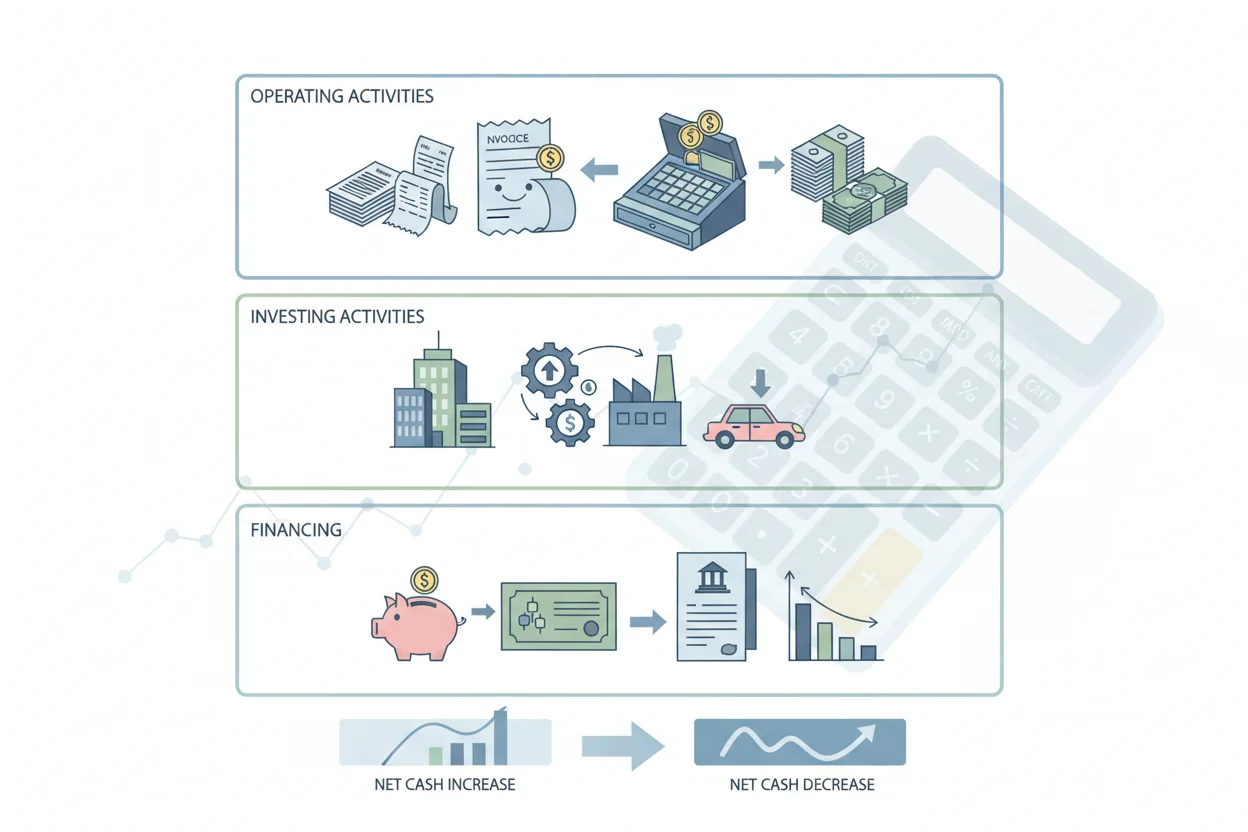
The statement separates cash movements into operating, investing, and financing activities. Together, these sections connect day-to-day business performance with investments, borrowing, repayments, owner distributions, and other transactions that affect cash.
Unlike cash accounting, which determines when certain transactions are recorded under a particular accounting method, the cash flow statement is a financial statement designed to reconcile actual cash movements.
What Is a Cash Flow Statement?
A cash flow statement is one of the primary financial statements used to evaluate a company’s liquidity and cash-generating ability.
It answers a practical question:
Where did the company’s cash come from, and where did it go?
A profitable company can still experience cash pressure if customers have not paid invoices, inventory absorbs significant cash, debt repayments are large, or the business invests heavily in equipment.
Conversely, a company can report a net loss while its cash balance increases because it borrowed money, raised equity, sold assets, or collected previously outstanding receivables.
For that reason, the cash flow statement complements the income statement rather than replacing it.
Cash Flow Statement Formula
At the highest level, the cash flow statement combines three categories of cash movement:
Net Change in Cash = Cash Flow from Operating Activities + Cash Flow from Investing Activities + Cash Flow from Financing Activities
When foreign-currency effects are material, a reconciliation may also include their impact on cash.
The ending cash balance can then be calculated as:
Ending Cash = Beginning Cash + Net Change in Cash
If beginning cash was $40,000 and the company generated a net cash increase of $75,000:
Ending Cash = $40,000 + $75,000 = $115,000
The ending amount should reconcile with the relevant cash and cash-equivalent balance reported on the balance sheet.
The Three Sections of a Cash Flow Statement
Cash Flow from Operating Activities
Operating activities show the cash effects of the company’s core business operations.
Typical operating cash movements include cash collected from customers, payments to suppliers, payroll, rent, taxes, and other operating expenditures.
Under the indirect method, the section usually begins with net income and adjusts it for noncash expenses and changes in operating assets and liabilities.
For example, depreciation reduces accounting profit but does not represent a current-period cash payment, so it is generally added back when reconciling net income to operating cash flow under the indirect method.
Changes in receivables, inventory, and payables also matter because revenue and expenses do not necessarily occur at the same time as the related cash receipts and payments.
The detailed calculation of operating cash flow has its own analytical uses. On a cash flow statement, however, operating cash flow is one component of the broader reconciliation of total cash.
Cash Flow from Investing Activities
Investing activities generally reflect cash spent on or received from long-term assets and investments.
Buying property, machinery, or equipment usually creates an investing cash outflow. Selling those assets generally creates an investing cash inflow.
This means negative investing cash flow is not automatically a warning sign. A growing company may deliberately invest substantial cash in productive assets.
The important question is why cash is being spent and whether those investments are expected to support future operating performance.
Cash Flow from Financing Activities
Financing activities show how a business raises capital and returns capital to lenders or owners.
Common examples include borrowing money, repaying debt principal, issuing shares, repurchasing shares, and paying dividends or owner distributions.
A large positive financing cash flow may indicate that the company raised significant outside capital. A negative financing cash flow may reflect debt repayment, distributions, or share repurchases.
Neither sign is inherently positive or negative without context.
Cash Flow Statement Example
Assume a business starts the year with $40,000 of cash.
During the year, its operating section contains the following adjustments:
| Operating Item | Cash Flow Effect |
|---|---|
| Net income | $120,000 |
| Depreciation expense | +$30,000 |
| Increase in accounts receivable | -$25,000 |
| Increase in inventory | -$10,000 |
| Increase in accounts payable | +$15,000 |
| Net cash from operating activities | $130,000 |
The calculation is:
Operating Cash Flow = $120,000 + $30,000 − $25,000 − $10,000 + $15,000 = $130,000
Now assume the company purchases $80,000 of equipment and receives $10,000 from selling older equipment.
Investing Cash Flow = −$80,000 + $10,000 = −$70,000
During the same period, the company borrows $50,000, repays $20,000 of existing debt principal, and pays $15,000 of dividends.
Financing Cash Flow = $50,000 − $20,000 − $15,000 = $15,000
The total change in cash is therefore:
Net Change in Cash = $130,000 − $70,000 + $15,000 = $75,000
With beginning cash of $40,000:
Ending Cash = $40,000 + $75,000 = $115,000
The cash flow statement therefore explains exactly how the company moved from $40,000 of beginning cash to $115,000 of ending cash.
Why Profit and Cash Flow Can Be Different
Accounting profit and cash flow measure different things.
Suppose a company sells $50,000 of products on credit. The sale can increase revenue before the company actually receives the $50,000 in cash.
Similarly, a business might purchase inventory today but recognize the related cost of goods sold only when the inventory is sold.
These timing differences are why profit cannot be used as a substitute for cash-flow analysis.
Several common items create differences between profit and cash flow:
Credit sales can increase revenue before cash is collected.
Inventory purchases can consume cash before the inventory becomes an expense.
Depreciation reduces accounting income without creating a matching current-period cash outflow.
Capital expenditures use cash but normally are not recorded immediately as a full expense on the income statement.
Debt principal repayments consume cash without generally reducing operating profit.
Understanding these distinctions is central to interpreting the company’s financial statements together.
Direct Method vs. Indirect Method
The operating section of the cash flow statement can generally be presented using either the direct or indirect method.
Direct Method
The direct method presents major categories of operating cash receipts and payments.
For example, it may show cash collected from customers, cash paid to suppliers, cash paid to employees, and cash paid for taxes.
This presentation makes actual operating cash movements relatively intuitive.
Indirect Method
The indirect method begins with net income and reconciles it to operating cash flow.
Adjustments usually include noncash expenses and changes in working-capital accounts.
An increase in accounts receivable, for example, generally reduces operating cash flow relative to net income because some reported revenue has not yet been collected.
An increase in accounts payable can increase operating cash flow relative to net income because expenses have been recognized without all related cash having been paid yet.
These movements are closely connected to working capital.
How to Read a Cash Flow Statement
Reading only the final change in cash can hide important information. The composition of cash flow matters.
A company that generated $1 million of cash from operations and invested $700,000 in new equipment tells a different story from a company that lost $700,000 from operations and borrowed $1.7 million.
Both could show a $300,000 increase in cash, yet their underlying economics are very different.
Start With Operating Cash Flow
Consistently positive operating cash flow generally indicates that the core business is producing cash rather than depending entirely on outside financing.
However, one period should not be interpreted in isolation. Seasonal businesses and rapidly growing companies can experience substantial working-capital fluctuations.
Examine Investing Activity
Determine whether investing outflows represent productive investment, acquisitions, financial investments, or asset purchases that may not recur.
Large capital expenditure can reduce current cash while potentially expanding future capacity. When operational expansion is involved, metrics such as capacity utilization can provide additional context about whether existing resources are already heavily used.
Review Financing Dependence
Financing cash flows help reveal whether the company depends on borrowing or equity funding.
Repeated borrowing to fund persistent operating cash deficits deserves different scrutiny from borrowing used to finance a planned expansion.
Cash Flow Statement vs. Free Cash Flow
The cash flow statement is a complete financial statement covering operating, investing, and financing activities.
Free cash flow is a narrower analytical metric generally intended to estimate cash remaining after specified operating and capital-investment requirements.
They should not be treated as interchangeable.
The cash flow statement explains the entire movement in cash. Free cash flow extracts selected information to answer a more specific financial question.
Cash Flow Statement vs. Income Statement
The income statement measures revenue, expenses, and profit over a period.
The cash flow statement measures cash receipts and cash payments.
A credit sale may increase income before cash arrives. Depreciation may reduce income without requiring a current cash payment. Purchasing equipment can create a major cash outflow without becoming an immediate expense equal to the purchase price.
This is why strong analysis usually considers both statements rather than judging performance from profit or cash alone.
How Budget Variances Can Affect Cash
A budget variance identifies differences between planned and actual results, while the cash flow statement records actual cash movements.
The two can intersect in practical analysis.
Suppose a business budgeted $100,000 for inventory purchases but actually spent $140,000. The unfavorable $40,000 spending difference may contribute to lower cash than originally forecast.
The cash flow statement shows what happened to cash; variance analysis helps explain why actual results differed from the plan.
Contribution Economics and Cash Flow
A positive contribution margin ratio indicates that a portion of each sales dollar remains after variable costs to cover fixed costs and profit.
That does not mean the same percentage immediately becomes cash.
Customer payment timing, inventory purchases, supplier terms, capital spending, debt obligations, and taxes can all cause cash generation to differ substantially from contribution margin.
This distinction prevents operating economics from being confused with liquidity.
Common Cash Flow Statement Interpretation Mistakes
One common mistake is assuming that positive cash flow automatically means the business is profitable. Borrowing or issuing equity can increase cash even when operations are losing money.
Another is assuming that negative investing cash flow is necessarily bad. It may reflect productive long-term investment.
A third is ignoring changes in receivables, inventory, and payables. Rapid revenue growth can place significant pressure on cash if customers pay slowly or inventory requirements increase.
Another mistake is treating every noncash adjustment as permanent cash generation. Adding depreciation back in the operating section does not mean asset replacement is free; businesses may eventually need substantial capital expenditures.
What Does a Healthy Cash Flow Statement Look Like?
There is no single ideal pattern for every business.
A mature company may produce strong positive operating cash flow, invest consistently in assets, and return excess cash through dividends or debt repayment.
A younger company may temporarily have negative operating cash flow while investing aggressively and raising external financing.
Rather than relying on one positive or negative number, evaluate:
- whether core operations are becoming more cash generative;
- whether investment spending has a clear economic purpose;
- whether debt and equity funding are sustainable;
- whether reported profit converts into cash over time; and
- whether ending liquidity is adequate for upcoming obligations.
The pattern across multiple periods usually provides more information than a single statement.
Frequently Asked Questions
What is a cash flow statement in simple terms?
A cash flow statement explains the cash that entered and left a business during a period. It separates those movements into operating, investing, and financing activities and reconciles beginning cash with ending cash.
What is the basic cash flow statement formula?
The core relationship is:
Net Change in Cash = Operating Cash Flow + Investing Cash Flow + Financing Cash Flow
Then:
Ending Cash = Beginning Cash + Net Change in Cash
Certain statements may also show foreign-currency effects separately when applicable.
What are the three parts of a cash flow statement?
The three main sections are operating activities, investing activities, and financing activities.
Operating activities relate primarily to core business activity, investing activities generally cover long-term asset and investment transactions, and financing activities relate to debt and owner financing.
Can a profitable company have negative cash flow?
Yes. A profitable company can experience negative cash flow because of growing receivables, inventory purchases, capital expenditures, debt repayments, or other cash uses.
Profit measures accounting performance; cash flow measures actual cash movement.
Can a company have positive cash flow while losing money?
Yes. Borrowing money, issuing shares, selling investments, or disposing of assets can increase cash even when the company reports a net loss.
That is why the source of cash matters as much as the overall change.
Is depreciation a cash outflow?
Depreciation itself is a noncash accounting expense. Under an indirect cash flow presentation, it is generally added back when reconciling net income to operating cash flow.
The original purchase of the depreciable asset usually involved a separate cash outflow, often classified as an investing activity.
Why does an increase in accounts receivable reduce operating cash flow?
An increase in accounts receivable generally means the company recognized more revenue than it collected in cash during the period.
Under the indirect method, that increase is therefore deducted when reconciling net income to operating cash flow.
Why does an increase in accounts payable increase operating cash flow?
An increase in accounts payable generally means the company recognized expenses or purchases but has not yet paid all of the related cash.
The unpaid amount temporarily preserves cash, so it commonly appears as a positive adjustment under the indirect method.
Is cash flow the same as revenue?
No. Revenue measures sales recognized under the applicable accounting method. Cash flow measures actual cash receipts and payments.
A company can recognize revenue before collecting the related cash.
What is the main purpose of a cash flow statement?
Its primary purpose is to explain changes in cash and help users evaluate liquidity, cash generation, financing requirements, investment activity, and the relationship between reported earnings and actual cash movement.
Within the broader accounting and operations framework, it is one of the clearest ways to see how recorded business activity ultimately affects liquidity.