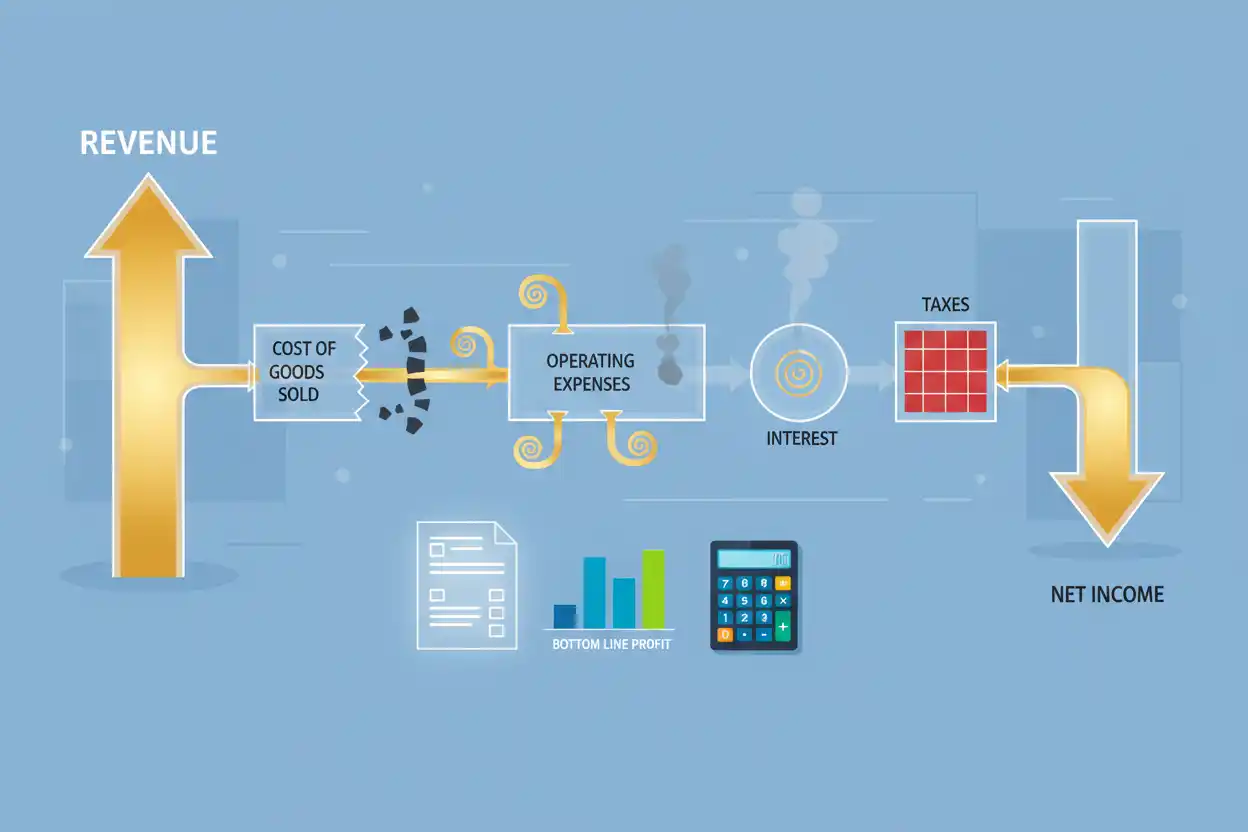
Net income is the profit remaining after all recognized expenses, losses, interest, taxes, and other applicable costs are deducted from revenue and other income for a reporting period. When the final result is negative, the business reports a net loss rather than positive net income.
If a company generates $1,000,000 of revenue and other income while recognizing $900,000 of total expenses and losses, its simplified net income is $100,000.
Net Income = Total Income − Total Expenses
Net Income = $1,000,000 − $900,000 = $100,000
Net income is commonly called the bottom line because it appears near the bottom of the income statement after the major revenue and expense categories have been incorporated.
What Is Net Income?
Net income measures the company’s final accounting profit for a particular period.
It answers:
After all recognized costs and other applicable items are considered, how much profit remains?
A business can generate substantial revenue while having little or no net income if its product costs, payroll, rent, marketing, interest, taxes, or other expenses consume most of that revenue.
Likewise, a company can improve net income even without increasing revenue if it reduces costs sufficiently.
Net income therefore reflects the combined outcome of revenue generation and expense control rather than sales alone.
Net Income Formula
A broad formula is:
Net Income = Total Revenue + Other Income and Gains − Total Expenses − Other Losses − Taxes
A simplified multi-step version can also be expressed as:
Gross Profit = Revenue − Cost of Goods Sold
Operating Income = Gross Profit − Operating Expenses
Then:
Net Income = Operating Income + Non-Operating Income − Non-Operating Expenses − Taxes
The exact structure depends on the company’s business model and the accounting presentation being used.
Net Income Example
Suppose a company reports:
| Item | Amount |
|---|---|
| Revenue | $1,200,000 |
| Cost of goods sold | $700,000 |
| Operating expenses | $300,000 |
| Interest expense | $30,000 |
| Other income | $10,000 |
| Income tax expense | $40,000 |
First calculate gross profit:
Gross Profit = $1,200,000 − $700,000 = $500,000
Then operating income:
Operating Income = $500,000 − $300,000 = $200,000
Add other income and subtract interest:
Income Before Tax = $200,000 + $10,000 − $30,000 = $180,000
Then subtract tax expense:
Net Income = $180,000 − $40,000 = $140,000
The company’s net income is $140,000.
Net Income as the Bottom Line
The income statement begins with revenue or another top-line measure and progressively deducts costs.
Each stage answers a different profitability question.
Revenue shows the scale of sales.
Gross profit shows what remains after product costs.
Operating income shows the result after operating expenses.
Net income incorporates the remaining recognized non-operating expenses, income, taxes, and other applicable items.
Because it reflects the final result of this sequence, net income is often referred to as the bottom line.
Net Income vs. Revenue
Revenue and net income should never be treated as interchangeable.
Suppose:
Revenue = $2,000,000
Total Recognized Expenses = $1,850,000
Then:
Net Income = $2,000,000 − $1,850,000 = $150,000
The business generated $2 million in revenue but retained only $150,000 as accounting profit after expenses.
Net income as a percentage of revenue is:
$150,000 ÷ $2,000,000 × 100 = 7.5%
That percentage is analyzed more directly through net margin.
Net Income vs. Gross Profit
Gross profit is calculated before operating expenses and many other costs.
Suppose:
Revenue = $800,000
Cost of Goods Sold = $480,000
Gross profit is:
$800,000 − $480,000 = $320,000
If operating expenses, interest, and taxes total $250,000:
Net Income = $320,000 − $250,000 = $70,000
The company therefore has $320,000 of gross profit but only $70,000 of net income.
Gross profit evaluates a narrower layer of profitability. Net income measures the final accounting result.
Net Income vs. Operating Income
Operating income focuses on the profitability of business operations before certain financing, tax, and non-operating items.
Net income continues beyond operating income.
Suppose:
Operating Income = $200,000
Interest Expense = $40,000
Other Income = $10,000
Income Tax Expense = $35,000
Then:
Net Income = $200,000 − $40,000 + $10,000 − $35,000
Net Income = $135,000
Operating performance accounts for most of the result, but financing costs and taxes reduce the final profit.
Operating Expenses and Net Income
Operating expenses directly affect net income when all other factors remain unchanged.
Suppose revenue and gross profit remain constant while operating expenses rise from $250,000 to $300,000.
The $50,000 increase reduces operating income by $50,000.
If there are no offsetting changes elsewhere, net income also falls by $50,000 before considering any tax effects tied to the change.
This direct relationship makes operating-cost management an important driver of bottom-line performance.
Net Income and Cost of Goods Sold
For businesses that sell products, cost of goods sold is often one of the largest deductions from revenue.
Suppose revenue remains $1 million.
Scenario A:
COGS = $600,000
Gross Profit = $400,000
Scenario B:
COGS = $650,000
Gross Profit = $350,000
The $50,000 increase in COGS reduces gross profit by $50,000.
If all other expenses remain unchanged, net income will also decline by $50,000 before any related tax effects.
Product cost control can therefore have a substantial influence on bottom-line profitability.
Net Income and Depreciation Expense
Depreciation expense can reduce net income even though recording depreciation does not itself require a current-period cash payment.
Suppose income before depreciation is $180,000 and depreciation expense is $30,000.
Income After Depreciation = $180,000 − $30,000 = $150,000
The accounting profit declines by $30,000 before any related tax effects.
However, cash did not decline by another $30,000 simply because the depreciation entry was recorded.
This is one reason net income should not be used as a substitute for cash flow.
Net Income Is Not Cash Flow
A company can earn net income and still experience a decline in cash.
Suppose a business reports $100,000 of net income but:
- accounts receivable increases by $80,000;
- inventory increases by $60,000; and
- the company purchases $100,000 of equipment.
Those uses of cash can produce substantial cash pressure despite positive accounting earnings.
The cash flow statement explains those actual cash movements separately.
Net income measures accounting profitability.
Cash flow measures cash generation and consumption.
Net Income vs. Net Burn
Net burn is another cash-based measure that should remain distinct from net income.
Suppose a startup reports a $120,000 monthly net loss.
Included in that loss is $50,000 of noncash depreciation.
If other relevant accounting and cash timing differences are ignored for illustration, the cash deficit from those items could be closer to $70,000 rather than $120,000.
Conversely, a profitable retailer could consume cash while rapidly building inventory.
A company can therefore have:
- positive net income and positive net burn;
- negative net income and positive net burn;
- negative net income but positive cash generation; or
- positive net income and positive cash generation.
Accounting earnings and cash consumption should always be analyzed separately.
Net Income and Net Margin
Net income is a dollar amount.
Net margin expresses net income relative to revenue.
Net Margin = Net Income ÷ Revenue × 100
Suppose:
Net Income = $120,000
Revenue = $1,500,000
Then:
Net Margin = $120,000 ÷ $1,500,000 × 100 = 8%
The company earns $0.08 of net income for every $1.00 of revenue.
The dollar amount shows total bottom-line profit, while the ratio makes profitability easier to compare across periods or companies of different sizes.
Net Income Example With a Net Loss
Net income can be negative.
Suppose:
| Item | Amount |
|---|---|
| Revenue | $500,000 |
| Cost of goods sold | $320,000 |
| Operating expenses | $210,000 |
| Interest expense | $15,000 |
| Other income | $5,000 |
Gross profit:
$500,000 − $320,000 = $180,000
Operating result:
$180,000 − $210,000 = −$30,000
After interest and other income:
−$30,000 − $15,000 + $5,000 = −$40,000
Ignoring taxes for this simplified loss example, the company has a:
Net Loss = $40,000
The negative result indicates recognized expenses and losses exceeded revenue and other income.
How Revenue Growth Affects Net Income
Revenue growth can improve net income, but only if the additional revenue produces enough incremental profit to exceed the additional costs required to generate it.
Suppose revenue rises by $200,000.
If related additional expenses rise by only $120,000:
Incremental Pretax Profit = $200,000 − $120,000 = $80,000
Net income can improve.
But if generating the additional $200,000 requires $220,000 of extra costs, profitability deteriorates despite higher revenue.
Growth should therefore be evaluated by its contribution to profit, not revenue alone.
How Cost Reductions Affect Net Income
Suppose a company generates $1 million of revenue and currently earns $80,000 of net income.
Management permanently reduces operating expenses by $25,000 with no effect on revenue or other costs.
Ignoring tax effects for simplicity:
New Net Income = $80,000 + $25,000 = $105,000
The company’s accounting profit improves by $25,000.
However, cost cuts are not automatically beneficial if they reduce product quality, sales capacity, maintenance, or future growth.
Net Income and Labor Productivity
Higher labor productivity can improve net income when the business generates more output without a proportionate increase in labor costs.
Suppose a factory currently produces 100,000 units for $600,000 of labor cost:
Labor Cost per Unit = $600,000 ÷ 100,000 = $6
After process improvements, it produces 120,000 comparable units for the same labor cost:
Labor Cost per Unit = $600,000 ÷ 120,000 = $5
The labor-cost component falls by $1 per unit.
If the additional units are sold profitably and other costs remain controlled, the improvement can increase net income.
However, productivity and profit are different measures. Higher productivity can be offset by lower prices, higher material costs, interest, depreciation, or other expenses.
Net Income and Inventory
Inventory can affect net income through cost recognition.
Suppose a retailer purchases $100,000 of merchandise but sells only goods carrying $60,000 of cost during the period.
The entire $100,000 purchase does not automatically become an income-statement expense.
The unsold inventory generally remains an asset while the cost assigned to goods sold flows into COGS.
This is why inventory errors can distort both the balance sheet and net income.
If ending inventory is overstated, COGS can be understated under a periodic inventory relationship, which can overstate net income.
Inventory Carrying Cost and Net Income
Inventory carrying cost can influence profitability through storage, insurance, shrinkage, obsolescence, handling, financing, and related costs.
Suppose excess inventory generates an additional $40,000 of annual recognized expenses.
If revenue and all other items remain unchanged, those expenses reduce pretax income by $40,000.
However, the management carrying-cost metric can also include opportunity costs that are not recorded as accounting expenses.
The full carrying-cost estimate therefore should not automatically be deducted from net income as though every component were an income-statement expense.
Net Income and Interest Expense
Financing decisions can materially affect the bottom line.
Suppose two otherwise identical companies each generate $200,000 of operating income.
Company A has $10,000 of interest expense:
Pretax Income = $200,000 − $10,000 = $190,000
Company B has $70,000 of interest expense:
Pretax Income = $200,000 − $70,000 = $130,000
The companies have identical operating income but different pretax and net income because their financing structures differ.
This is one reason operating income and net income should both be reviewed.
Net Income and Taxes
Income tax expense can reduce the amount remaining after pretax income.
Suppose:
Income Before Tax = $250,000
Income Tax Expense = $60,000
Then:
Net Income = $250,000 − $60,000 = $190,000
The effective accounting tax relationship in this simplified example is:
$60,000 ÷ $250,000 × 100 = 24%
Actual tax calculations can be more complex than multiplying accounting income by a single tax rate because tax laws, permanent differences, temporary differences, credits, losses, and jurisdictional rules can affect the result.
Net Income With Other Gains and Losses
Net income can include items outside normal operating revenue and expenses.
Suppose a company has:
Operating Income = $150,000
Interest Expense = $20,000
Gain on Asset Sale = $30,000
Tax Expense = $35,000
Then:
Net Income = $150,000 − $20,000 + $30,000 − $35,000
Net Income = $125,000
The gain increases net income even though it does not come from the company’s ordinary sales activity.
Analysts should therefore examine the components of net income rather than assuming all profit came from core operations.
Recurring vs. One-Time Effects
Suppose a business normally earns $500,000 annually but reports a $1 million gain from selling a property.
Reported net income can rise sharply in that year.
That does not necessarily mean recurring operating performance doubled.
Similarly, a large legal settlement or impairment can reduce one year’s net income without representing a normal recurring cost.
Understanding recurring and nonrecurring drivers helps prevent a single bottom-line number from being interpreted without context.
Net Income and Accounting Basis
The timing of revenue and expense recognition affects net income.
Under accrual-based reporting, revenue can be recognized before cash is received and expenses can be recognized before or after the related cash payment.
This is why net income may differ from the change in the company’s bank account during the same period.
Accounting basis, estimates, depreciation, inventory, receivables, payables, and accruals can all influence reported earnings.
Net Income Growth Formula
Changes in net income can be expressed as a growth rate:
Net Income Growth % = (Current Net Income − Prior Net Income) ÷ Prior Net Income × 100
Suppose net income increases from $200,000 to $250,000.
Increase:
$250,000 − $200,000 = $50,000
Growth:
$50,000 ÷ $200,000 × 100 = 25%
Net income grew by 25%.
Growth percentages become less intuitive when the comparison includes losses or crosses from a loss to a profit, so the underlying dollar amounts should also be presented.
Net Income Trend Example
Suppose a company reports:
| Year | Revenue | Net Income |
|---|---|---|
| Year 1 | $2,000,000 | $100,000 |
| Year 2 | $2,400,000 | $144,000 |
| Year 3 | $2,700,000 | $135,000 |
Net income rises in Year 2 but falls in Year 3 despite higher revenue.
Year 2 net margin:
$144,000 ÷ $2,400,000 × 100 = 6%
Year 3 net margin:
$135,000 ÷ $2,700,000 × 100 = 5%
The company is still profitable, but less of each revenue dollar reaches the bottom line.
This suggests costs increased faster than revenue between Years 2 and 3.
Net Income per Dollar of Revenue
Suppose a company generates $5 million of revenue and $500,000 of net income.
$500,000 ÷ $5,000,000 = $0.10
The company earns $0.10 of net income for every $1 of revenue, equivalent to a 10% net margin.
If net income remains $500,000 while revenue increases to $6 million:
$500,000 ÷ $6,000,000 ≈ 8.33%
The company generates more revenue but retains a smaller percentage as final profit.
This demonstrates why net income dollars and net margin percentages should both be monitored.
Net Income and Forecast Variance
Businesses often forecast their expected bottom-line result.
Suppose forecast net income is $300,000 but actual net income is $240,000.
Difference:
$240,000 − $300,000 = −$60,000
Actual net income is $60,000 below forecast.
Management should not stop at the final variance.
It should determine whether the shortfall came from revenue, product costs, operating expenses, financing costs, taxes, or another item.
The income statement provides the layers necessary to identify those drivers.
Can High Net Income Hide Problems?
Yes.
A company can report strong net income while experiencing weaknesses elsewhere.
For example:
- customers may be paying more slowly;
- inventory may be accumulating;
- debt may be rising;
- a large one-time gain may inflate earnings;
- maintenance spending may have been temporarily reduced; or
- capital expenditures may be much larger than depreciation.
Net income is an important profitability measure, but it should be interpreted alongside the balance sheet, cash flow statement, margins, and operating indicators.
Can Low Net Income Be Acceptable?
Low or negative net income can sometimes occur during deliberate investment periods.
A company may spend heavily on product development, hiring, marketing, new facilities, or expansion.
Whether those losses are acceptable depends on available liquidity, expected returns, competitive conditions, and the sustainability of the strategy.
A temporary accounting loss during productive investment is different from a recurring loss caused by an unprofitable underlying business model.
Common Net Income Mistakes
One common mistake is treating net income as cash generated.
Another is comparing companies solely by net income dollars without considering their different revenue sizes.
Businesses can also focus on the bottom line while ignoring whether profit came from recurring operations or unusual gains.
Another error is assuming that every reduction in expenses represents sustainable improvement.
Inventory accounting errors, depreciation estimates, financing costs, and tax items can also materially alter net income.
Finally, a positive bottom line does not guarantee strong liquidity. Cash conversion still matters.
Frequently Asked Questions
What is net income in simple terms?
Net income is the accounting profit remaining after all recognized expenses, losses, taxes, and other applicable costs are deducted from revenue and other income.
What is the net income formula?
A broad formula is:
Net Income = Total Revenue + Other Income − Total Expenses − Other Losses − Taxes
The exact line items depend on the business and its financial statements.
Is net income the same as profit?
Net income is the final or bottom-line form of accounting profit after the applicable recognized costs have been included.
Other profit measures, such as gross profit and operating income, represent earlier levels of the income statement.
What does negative net income mean?
Negative net income means recognized expenses and losses exceeded revenue and other income for the period.
The result is generally called a net loss.
Is net income the same as revenue?
No.
Revenue is income generated before the company’s expenses are deducted.
Net income is what remains after those expenses and other applicable items are accounted for.
Is net income the same as cash flow?
No.
Net income is an accounting measure. Cash flow measures actual cash movements.
Receivables, inventory, depreciation, payables, capital expenditures, and other items can cause the two to differ substantially.
Can net income be positive while cash decreases?
Yes.
The company may have unpaid receivables, inventory purchases, capital expenditures, debt repayments, or other cash uses that exceed incoming cash.
Can net income be negative while cash increases?
Yes.
The company may receive customer prepayments, borrow money, raise equity, sell assets, or benefit from other cash inflows even while reporting an accounting loss.
How does depreciation affect net income?
Depreciation expense reduces accounting income when recognized.
However, recording depreciation does not itself create a current-period cash payment.
How does inventory affect net income?
The cost assigned to inventory generally affects net income when the related goods are sold through cost of goods sold.
Inventory valuation errors can therefore distort reported profit.
What is the difference between net income and net margin?
Net income is a dollar amount.
Net margin expresses net income as a percentage of revenue:
Net Margin = Net Income ÷ Revenue × 100
Does higher revenue always increase net income?
No.
If the costs required to generate additional revenue rise faster than the revenue itself, net income can decline.
Why is net income important?
Net income summarizes the final accounting result after the company’s recognized revenues, expenses, gains, losses, financing effects, and taxes are incorporated. It provides a concise bottom-line measure of profitability, but it is most useful when interpreted together with margins, cash flow, and the operating drivers behind the result.