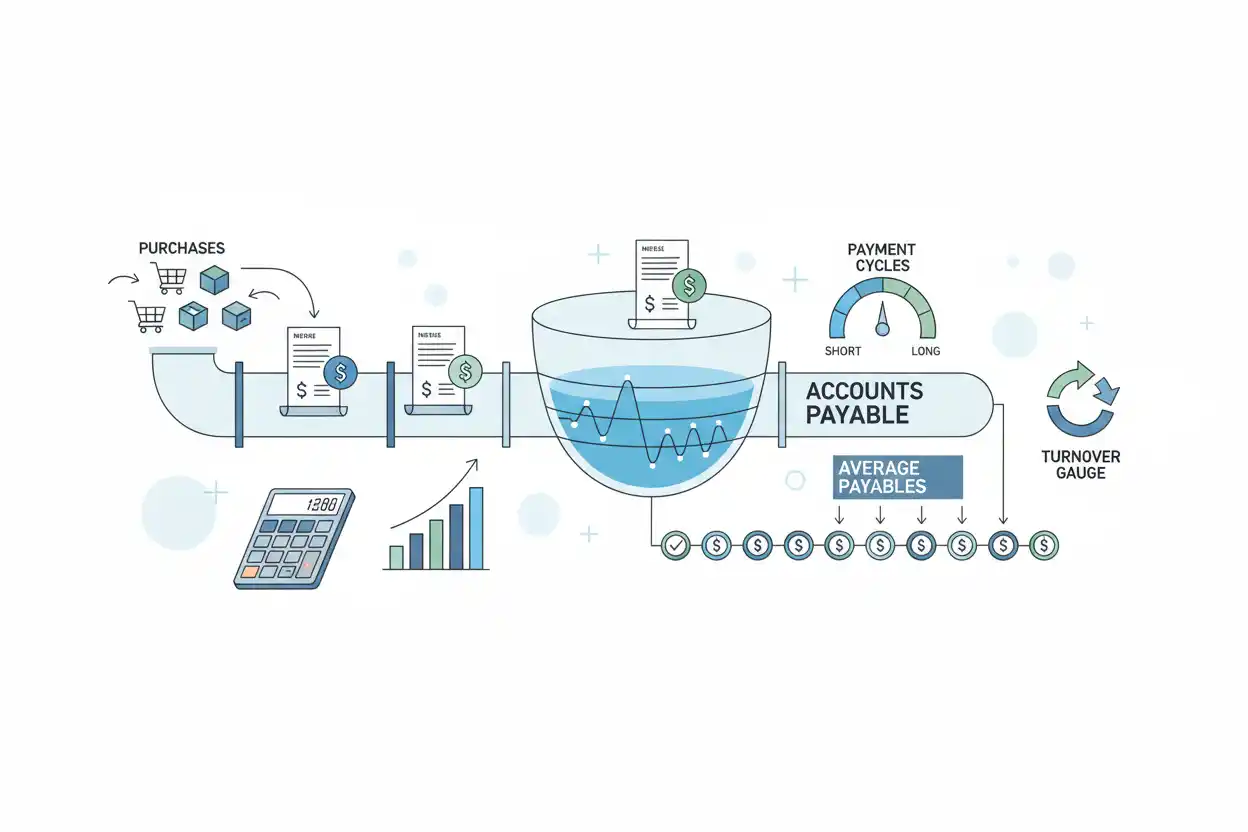

Payables turnover measures how many times a business pays off its average accounts payable balance during a period. It helps show how quickly the company settles qualifying supplier obligations relative to the purchases or cost base that created those payables.
If a company makes $1,200,000 of net credit purchases during a year and maintains average accounts payable of $150,000, its payables turnover is 8 times.
Payables Turnover = Net Credit Purchases ÷ Average Accounts Payable
Payables Turnover = $1,200,000 ÷ $150,000 = 8 Times
A turnover of 8 means the business effectively cycles through an amount equal to its average accounts payable balance about eight times during the year.
The ratio should not be interpreted as simply “higher is better.” Paying suppliers very quickly can indicate strong liquidity, but it can also mean the company is giving up valuable supplier credit. A lower ratio can reflect negotiated payment terms or, less favorably, cash-flow pressure and overdue obligations.
What Is Payables Turnover?
Payables turnover is an efficiency and payment-behavior ratio focused on supplier liabilities.
When a company buys goods or services on credit, it creates accounts payable. When those supplier invoices are paid, accounts payable decreases.
The payables turnover ratio compares the volume of applicable credit purchases with the average payable balance supporting those purchases.
Conceptually:
Higher Turnover = Supplier Balances Repaid More Frequently
Lower Turnover = Supplier Balances Remain Outstanding Longer
That interpretation still requires context.
A business operating on 15-day supplier terms will naturally behave differently from one with negotiated 60-day or 90-day terms.
Seasonality, purchasing growth, supplier mix, early-payment discounts, cash availability, and the timing of large purchases can also affect the ratio.
Payables Turnover Formula
The preferred formula is:
Payables Turnover = Net Credit Purchases ÷ Average Accounts Payable
Where:
Net credit purchases are qualifying purchases made on supplier credit during the period.
Average accounts payable represents the average supplier-payable balance during the same period.
A common simplified average is:
Average Accounts Payable = (Beginning Accounts Payable + Ending Accounts Payable) ÷ 2
Suppose beginning accounts payable is $120,000 and ending accounts payable is $180,000:
Average Accounts Payable = ($120,000 + $180,000) ÷ 2
Average Accounts Payable = $150,000
If net credit purchases equal $1,200,000:
Payables Turnover = $1,200,000 ÷ $150,000 = 8 Times
Payables Turnover Example
Assume a distributor reports:
| Item | Amount |
|---|---|
| Beginning accounts payable | $200,000 |
| Ending accounts payable | $250,000 |
| Net credit purchases | $1,800,000 |
First calculate average accounts payable:
Average Accounts Payable = ($200,000 + $250,000) ÷ 2
Average Accounts Payable = $225,000
Then calculate turnover:
Payables Turnover = $1,800,000 ÷ $225,000
Payables Turnover = 8 Times
The company turns over its average supplier-payable balance approximately eight times per year.
Why Average Accounts Payable Is Used
Using only ending accounts payable can produce a distorted ratio when payable balances changed materially during the year.
Suppose a rapidly growing company begins with $100,000 of accounts payable and ends with $300,000.
Using ending payables alone would produce a denominator of $300,000.
A simple average gives:
Average Accounts Payable = ($100,000 + $300,000) ÷ 2 = $200,000
If credit purchases were $1,600,000:
Using ending AP:
$1,600,000 ÷ $300,000 ≈ 5.33 Times
Using average AP:
$1,600,000 ÷ $200,000 = 8 Times
The difference is substantial.
For highly seasonal businesses, monthly or quarterly average balances can be more representative than a simple beginning-and-ending average.
Example Using Monthly Average Payables
Suppose quarter-end payable balances vary dramatically because of seasonality:
- March: $100,000
- June: $220,000
- September: $350,000
- December: $130,000
Average of the four quarter-end balances:
Average AP = ($100,000 + $220,000 + $350,000 + $130,000) ÷ 4
Average AP = $800,000 ÷ 4 = $200,000
If annual net credit purchases are $1,400,000:
Payables Turnover = $1,400,000 ÷ $200,000 = 7 Times
Using more observations can better reflect the actual payable base when year-end balances are unusually high or low.
What If Net Credit Purchases Are Not Available?
Net credit purchases are theoretically the more direct numerator because accounts payable is created primarily by credit purchases.
However, published financial statements do not always disclose credit purchases separately.
Analysts sometimes use cost of goods sold or another purchasing-related cost measure as a practical proxy.
For example:
Approximate Payables Turnover = Cost of Goods Sold ÷ Average Accounts Payable
Suppose:
COGS = $2,000,000
Average Accounts Payable = $250,000
Then:
Approximate Payables Turnover = $2,000,000 ÷ $250,000 = 8 Times
The result should be labeled appropriately because COGS and credit purchases are not necessarily identical.
COGS can include costs not purchased on supplier credit, while purchases can enter inventory in a different period from when those goods are sold.
Using the same numerator definition consistently is important when comparing periods.
High Payables Turnover
A relatively high payables turnover means the company is paying supplier balances more frequently relative to its purchasing activity.
That can indicate:
- strong liquidity;
- conservative supplier-payment behavior;
- use of early-payment discounts;
- short supplier terms; or
- limited reliance on trade credit.
But high turnover can also indicate inefficient working-capital use.
Suppose suppliers allow 60 days to pay without penalty, yet a company routinely pays within 10 days without receiving a discount.
The company may be surrendering interest-free supplier financing that could otherwise support inventory, payroll, or other operating needs.
The ratio therefore needs to be interpreted against contractual payment terms.
Low Payables Turnover
A lower turnover ratio means payables remain outstanding for longer relative to the purchasing base.
That may be entirely intentional if the business has favorable supplier terms.
For example, a company using negotiated 90-day terms should naturally turn over payables less frequently than a company operating under 15-day terms.
A declining ratio can become concerning when it results from:
- overdue invoices;
- cash shortages;
- supplier disputes;
- deteriorating liquidity;
- intentionally delayed payments outside agreed terms; or
- rapidly increasing unpaid purchases.
The number itself does not reveal which explanation applies.
Payables Turnover Trend Example
Suppose:
| Year | Net Credit Purchases | Average Accounts Payable | Turnover |
|---|---|---|---|
| Year 1 | $1,200,000 | $150,000 | 8.0× |
| Year 2 | $1,400,000 | $200,000 | 7.0× |
| Year 3 | $1,500,000 | $300,000 | 5.0× |
Turnover fell from 8 times to 5 times.
The percentage decline is:
(5 − 8) ÷ 8 × 100 = −37.5%
The business is cycling through its average payable balance substantially less frequently.
That could reflect improved supplier terms—but it could also mean payments are slowing because of cash pressure.
The next step is to inspect supplier agreements, aging schedules, cash flow, purchasing growth, and overdue balances.
Payables Turnover Increasing Example
Now suppose turnover changes from 5 times to 8 times.
Relative increase:
(8 − 5) ÷ 5 × 100 = 60%
The company is paying suppliers much more frequently relative to its purchase base.
Possible explanations include improved cash flow, shorter payment terms, reduced use of supplier financing, or a deliberate strategy to capture discounts.
A higher ratio should therefore prompt the question why payment speed changed, not simply whether the number moved up or down.
Payables Turnover and Supplier Terms
Suppose two businesses each report turnover of 8 times.
Company A receives 30-day supplier terms.
Company B receives 90-day terms.
Although their ratios are identical, their supplier-payment economics can be very different.
Company A may be paying close to contractual expectations.
Company B may be paying much earlier than necessary.
This is why benchmarking payables turnover without understanding supplier terms can produce weak conclusions.
Payables Turnover and Early-Payment Discounts
Sometimes faster supplier payment is economically attractive.
Assume a supplier offers a discount for early payment.
A company should compare the financial benefit of the discount with the value of keeping cash longer.
If the discount creates an attractive effective return, a higher payables turnover can reflect a rational purchasing strategy.
If no discount or operational benefit exists, paying much earlier than required can unnecessarily reduce liquidity.
The turnover ratio provides the payment-speed signal; the commercial terms determine whether that speed is desirable.
Payables Turnover and Price Variance
Supplier-payment behavior can interact with purchasing economics analyzed through price variance.
Suppose a company negotiates a lower input price in return for shorter payment terms.
The lower purchase price can create a favorable price effect, while faster payment can raise payables turnover.
Conversely, extending payment terms might lead a supplier to charge a higher price.
The two measures answer different questions:
Price variance: Did the company pay a different unit price from the benchmark?
Payables turnover: How frequently does the company settle supplier payables?
Both can change because of the same supplier negotiation without becoming the same metric.
Payables Turnover and Reorder Point
Inventory purchasing decisions also affect supplier payables.
A reorder point determines the inventory level at which replenishment should be triggered.
If a company changes its ordering pattern, the timing and size of supplier invoices can change as well.
For example, more frequent replenishment may create more frequent payable transactions, while larger periodic purchases can create larger temporary accounts payable balances.
That operational change can affect payables turnover even when contractual payment terms remain unchanged.
The reorder point determines when inventory should be replenished; payables turnover measures how quickly supplier obligations are settled relative to the cost or purchase base.
Purchasing Growth Can Lower Payables Turnover
Suppose a company is expanding rapidly.
Year 1:
Net Credit Purchases = $1,000,000
Average AP = $125,000
Turnover = 8 Times
Year 2 purchases increase to $1,600,000, but average AP rises even faster to $250,000.
Turnover = $1,600,000 ÷ $250,000 = 6.4 Times
Turnover declined even though the business may still be paying suppliers within agreed terms.
Rapid purchasing growth can increase ending and average payables before the ratio stabilizes.
This is another reason trend changes should not automatically be interpreted as payment distress.
Payables Turnover and Operating Expenses
Supplier payables are not limited to inventory purchases.
Certain operating expenses can also be purchased on credit and remain unpaid at period end.
Examples may include professional services, software, utilities, maintenance, marketing services, or other operating costs billed by suppliers.
If the numerator includes only inventory credit purchases while the accounts payable denominator contains significant non-inventory supplier liabilities, the ratio can become less comparable.
Analysts should therefore understand what transactions are included in both numerator and denominator.
Consistency is more important than forcing one formula onto businesses with different payable structures.
Payables Turnover and Operating Income
Payment timing itself generally does not change operating income once the related expense has been recognized.
Suppose a company incurs a $20,000 operating expense in March but pays the supplier in April.
March operating income can already reflect the expense.
The April payment reduces cash and accounts payable but does not normally create a second $20,000 expense.
However, supplier economics can indirectly affect operating income.
Higher purchase prices, late-payment penalties, lost discounts, or supply disruptions can increase costs and reduce operating profit.
Payables turnover therefore measures payment behavior, while operating income measures profitability.
Payables Turnover and Owner Equity
Owner equity is not directly determined by payables turnover.
Suppose a business pays $50,000 of existing supplier liabilities.
Cash decreases:
Assets −$50,000
Accounts payable decreases:
Liabilities −$50,000
The basic payment itself does not change owner equity:
Owner Equity = Assets − Liabilities
Both assets and liabilities fall by the same amount.
However, if poor payment practices create penalties or higher costs, those expenses can reduce profit and ultimately reduce the earnings retained in equity.
Payables Turnover and Liquidity
Payables are a source of short-term financing.
When suppliers allow a company to purchase now and pay later, the business can use goods or services before cash leaves the company.
Paying more slowly within agreed terms can therefore preserve cash.
But delaying payments beyond contractual terms can damage supplier relationships and create operational risk.
A useful payables strategy balances:
- liquidity;
- supplier trust;
- contractual terms;
- discounts;
- supply continuity; and
- financing needs.
The ideal payables turnover ratio is therefore company-specific.
Payables Turnover and Cash Flow
Suppose a company purchases $100,000 of inventory on credit.
At purchase:
Inventory Increases = $100,000
Accounts Payable Increases = $100,000
No supplier cash payment is required immediately.
When the company later pays:
Cash Decreases = $100,000
Accounts Payable Decreases = $100,000
Extending the payment period can temporarily preserve cash.
That does not make the underlying purchase cheaper, but it changes the timing of the cash outflow.
This timing effect is one reason payable management can materially influence liquidity even though payment timing does not automatically alter current-period profit.
Payables Turnover Using Beginning and Ending AP
Consider a detailed example:
Beginning Accounts Payable = $90,000
Ending Accounts Payable = $150,000
Net Credit Purchases = $960,000
Average AP:
($90,000 + $150,000) ÷ 2 = $120,000
Turnover:
$960,000 ÷ $120,000 = 8 Times
Now suppose an analyst mistakenly uses ending AP only:
$960,000 ÷ $150,000 = 6.4 Times
The result drops from 8 to 6.4 simply because the denominator was measured differently.
When comparing turnover over time, denominator methodology must remain consistent.
Payables Turnover With Negative or Zero Payables
If average accounts payable is zero, the standard formula cannot produce a meaningful ratio because division by zero is undefined.
A business paying suppliers immediately may have little or no accounts payable.
In that case, payables turnover may not be useful.
A negative accounts payable balance is also unusual and may indicate account classification issues, supplier prepayments, debit balances in vendor accounts, or other circumstances requiring investigation before the ratio is calculated.
The formula should not be forced onto data that does not represent ordinary supplier payables.
Seasonal Payables
Seasonal businesses can show misleading year-end turnover if the reporting date falls immediately after a major purchasing season or after most seasonal supplier balances have already been paid.
Suppose a retailer carries $500,000 of payables in October but only $100,000 at year-end.
Using only beginning and ending balances may understate the average payable level experienced during the year.
Monthly averages can provide a better denominator when purchasing is highly seasonal.
The calculation should represent the operating cycle rather than merely whatever happened on two specific reporting dates.
What Is a Good Payables Turnover Ratio?
There is no universal target.
A useful payables turnover ratio depends on:
- supplier payment terms;
- purchasing patterns;
- industry norms;
- use of trade credit;
- available cash;
- early-payment discounts;
- supply-chain bargaining power; and
- whether invoices are being paid on time.
The most useful comparison is often the company’s actual payment behavior against its agreed commercial terms.
A ratio that looks low compared with another company can still be excellent if the business has legitimately negotiated longer terms.
How to Improve Payables Management
Improving payable management does not necessarily mean maximizing or minimizing turnover.
A company can improve by paying according to economically optimal timing.
That may involve negotiating better supplier terms, capturing worthwhile discounts, avoiding late fees, centralizing payment schedules, reconciling disputed invoices quickly, or coordinating purchasing and cash forecasting.
The objective is to use supplier credit efficiently without damaging supplier relationships or creating hidden financing costs.
Common Payables Turnover Mistakes
A common mistake is using total purchases when the numerator should represent qualifying credit purchases.
Another is using ending accounts payable instead of a representative average.
Businesses can also use COGS as though it were identical to credit purchases without acknowledging the approximation.
Another mistake is assuming higher turnover is automatically good. Excessively fast payment can unnecessarily consume cash.
Low turnover is equally ambiguous because it can represent favorable negotiated terms or financial distress.
Another error is comparing businesses with different supplier terms and purchasing structures without adjustment.
Finally, payment timing should not be confused with expense recognition. Settling an existing payable normally does not create the expense a second time.
Frequently Asked Questions
What is payables turnover in simple terms?
Payables turnover measures how many times a business pays off an amount equal to its average supplier-payable balance during a period.
What is the payables turnover formula?
The preferred formula is:
Payables Turnover = Net Credit Purchases ÷ Average Accounts Payable
How do you calculate average accounts payable?
A simple formula is:
Average Accounts Payable = (Beginning AP + Ending AP) ÷ 2
If beginning AP is $100,000 and ending AP is $140,000:
Average AP = $120,000
What does a payables turnover of 8 mean?
It means the company’s applicable annual purchase base is approximately eight times its average accounts payable balance.
Conceptually, the business cycles through its average payable balance about eight times during the period.
Is high payables turnover good?
Not automatically.
It can indicate strong liquidity or use of early-payment discounts, but it can also mean the company is paying sooner than economically necessary.
Is low payables turnover bad?
Not automatically.
It may reflect favorable long supplier terms. It becomes more concerning when invoices are overdue because of cash-flow problems or payment disputes.
Can COGS be used for payables turnover?
COGS is sometimes used as a practical proxy when credit purchases are unavailable.
However, it is not necessarily identical to credit purchases, so the limitation should be recognized.
Why use average accounts payable instead of ending accounts payable?
Payables fluctuate during the year.
A representative average generally provides a better denominator for a period-based turnover calculation than a single ending balance.
Does paying suppliers faster increase payables turnover?
Generally, faster payment reduces the average payable balance and can increase turnover, assuming the numerator remains comparable.
Can buying more inventory change payables turnover?
Yes.
Larger or more frequent credit purchases can change both the numerator and the accounts payable balance.
The net effect depends on purchase growth and payment timing.
Does paying accounts payable reduce owner equity?
Paying an existing payable generally reduces cash and liabilities by equal amounts, so the basic payment itself does not change owner equity.
Does payables turnover measure profitability?
No.
It measures supplier-payment efficiency and timing relative to the applicable purchase or cost base. Profitability measures such as operating income answer a different question.
Why can payables turnover change even when payment terms stay the same?
Purchasing growth, seasonality, supplier mix, invoice timing, discounts, cash availability, and changes in the average payable balance can all change the ratio.
What is the main limitation of payables turnover?
The ratio can be misleading when credit purchases are unavailable, accounts payable includes very different supplier obligations, seasonality is substantial, or businesses being compared operate under different payment terms.