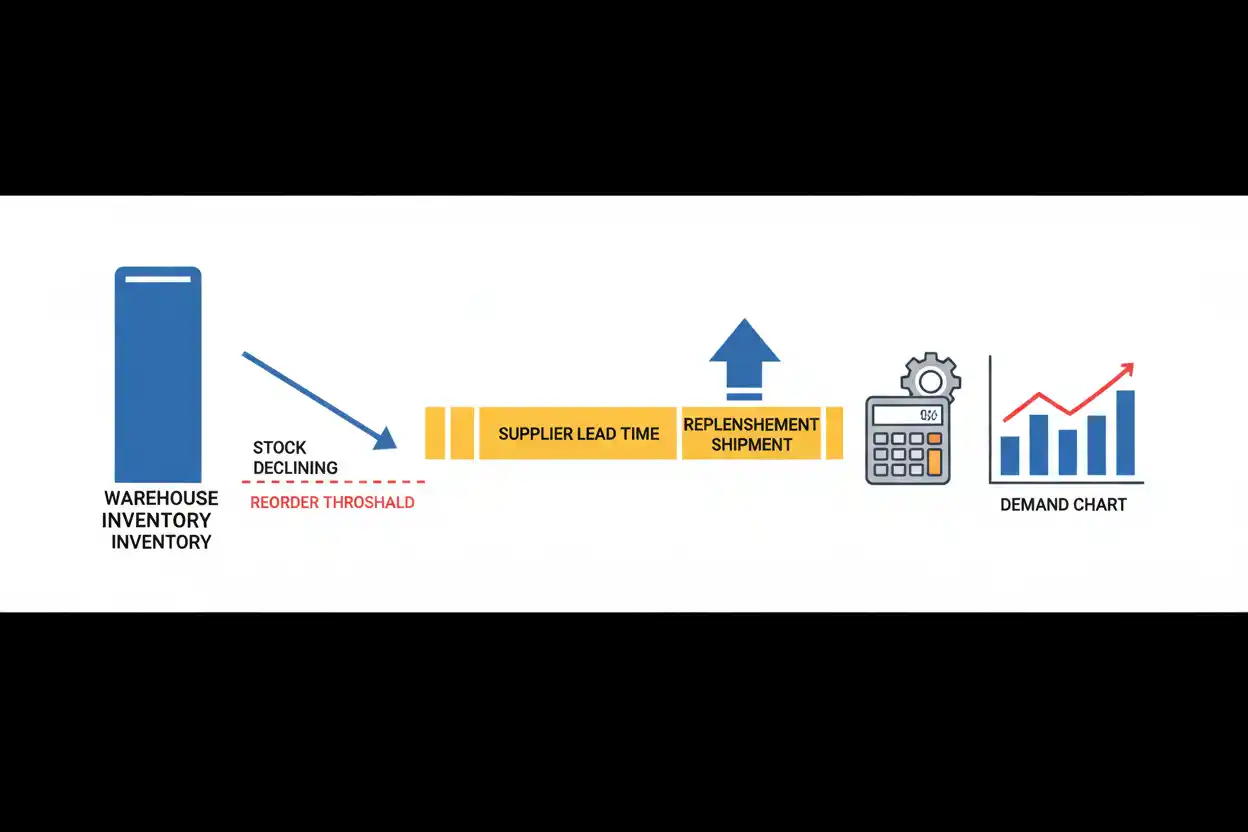

A reorder point is the inventory level at which a business should trigger a replenishment order so new stock can arrive before available inventory runs out.
If a company sells 80 units per day, supplier lead time is seven days, and the company maintains 200 units of safety stock, its reorder point is 760 units.
Reorder Point = Average Demand During Lead Time + Safety Stock
Reorder Point = (80 × 7) + 200 = 760 Units
When the relevant inventory position reaches approximately 760 units, the business should place another order under these assumptions.
The reorder point answers when to order. It does not determine the optimal order quantity. That separate decision is addressed by economic order quantity.
What Is a Reorder Point?
A reorder point establishes a replenishment trigger.
Inventory continues to be consumed while the supplier prepares, ships, and delivers the next order. A business therefore cannot normally wait until stock reaches zero before ordering.
Suppose a company sells 100 units per day and replenishment requires five days.
Expected demand during lead time is:
100 × 5 = 500 Units
If demand and lead time were perfectly predictable and the company carried no additional buffer, it would reorder when inventory reached 500 units.
Those 500 units are expected to cover demand while the replacement stock is in transit.
Where demand or delivery timing is uncertain, the company can maintain additional safety stock and incorporate that buffer into its reorder trigger.
Reorder Point Formula
A common formula is:
Reorder Point = Average Demand per Period × Average Lead Time + Safety Stock
Using symbols:
ROP = d × L + SS
Where:
d = average demand per period
L = supplier or replenishment lead time expressed in the same time unit
SS = safety stock
If no safety stock is used:
Reorder Point = Average Demand per Period × Lead Time
The first part of the formula calculates expected lead-time demand.
The safety-stock component provides an additional buffer for uncertainty.
Reorder Point Example
Suppose a retailer has:
- Average demand: 60 units per day
- Supplier lead time: 8 days
- Safety stock: 150 units
Expected lead-time demand is:
60 × 8 = 480 Units
Add safety stock:
Reorder Point = 480 + 150
Reorder Point = 630 Units
The retailer should trigger replenishment when the relevant inventory position reaches approximately 630 units.
The first 480 units cover expected demand during the eight-day replenishment period.
The remaining 150 units provide the buffer established by the company’s safety-stock policy.
Reorder Point Without Safety Stock
Consider a product with stable demand and highly reliable replenishment.
Suppose:
Average Daily Demand = 40 Units
Lead Time = 6 Days
With no safety stock:
Reorder Point = 40 × 6 = 240 Units
The company places another order when inventory reaches 240 units.
If exactly 40 units are used each day and replenishment arrives exactly six days later, the 240 units cover expected lead-time demand.
In practice, perfect predictability is unusual. Even small demand or supplier delays can create a stockout when no buffer exists.
Reorder Point With Safety Stock
Now assume the same product uses 100 units of safety stock.
Expected Lead-Time Demand = 240 Units
Safety Stock = 100 Units
Then:
Reorder Point = 240 + 100 = 340 Units
The company orders earlier—at 340 units rather than 240—because it wants additional protection against uncertainty.
The 100-unit difference is not extra expected demand. It is a risk buffer.
How that buffer is calculated belongs to safety-stock analysis rather than the core reorder-point calculation.
Lead-Time Demand
Lead-time demand is the amount of inventory expected to be consumed while waiting for replenishment.
The formula is:
Lead-Time Demand = Average Demand per Period × Lead Time
Suppose a warehouse ships 75 units per day and supplier lead time is 10 days.
Lead-Time Demand = 75 × 10 = 750 Units
If safety stock is 250 units:
Reorder Point = 750 + 250 = 1,000 Units
This means the business does not wait until only 250 units remain.
It orders at 1,000 because approximately 750 units are expected to be consumed before the replenishment arrives.
Keep Demand and Lead-Time Units Consistent
A frequent reorder-point error is mixing time units.
If demand is measured daily, lead time should be expressed in days.
If demand is weekly, lead time should be converted into weeks.
Suppose demand is 500 units per week and lead time is 14 days.
Fourteen days equals two weeks.
Correct calculation:
Reorder Point Before Safety Stock = 500 × 2 = 1,000 Units
It would be incorrect to calculate:
500 × 14 = 7,000 Units
because that multiplies weekly demand by a number of days.
Unit consistency is essential.
Converting Annual Demand to Daily Demand
Sometimes the business knows annual demand but needs a daily reorder point.
Suppose annual demand is 24,000 units and the business operates 300 days per year.
Average daily demand is:
Daily Demand = 24,000 ÷ 300
Daily Demand = 80 Units
If lead time is seven operating days:
Lead-Time Demand = 80 × 7 = 560 Units
With 200 units of safety stock:
Reorder Point = 560 + 200 = 760 Units
This is the same example introduced at the beginning.
Operating Days vs. Calendar Days
The time basis should match how demand and supplier lead time are actually measured.
Suppose a business sells only Monday through Friday but a supplier quotes lead time in calendar days.
Simply multiplying “daily business demand” by calendar lead time can create an inconsistent estimate.
For example, if average demand is 100 units per operating day and a seven-calendar-day supplier lead time covers only five selling days:
Expected Lead-Time Demand = 100 × 5 = 500 Units
The calculation should reflect the actual operating calendar.
Businesses with continuous demand, weekend sales, or seven-day production may appropriately use calendar-day demand instead.
Reorder Point and Inventory Position
In many replenishment systems, the reorder decision should consider inventory position, not simply the physical stock visible on the shelf.
A simplified inventory-position relationship is:
Inventory Position = On-Hand Inventory + Inventory On Order − Backorders
Suppose:
- On hand: 500 units
- Already on order: 300 units
- Backorders: 100 units
Then:
Inventory Position = 500 + 300 − 100 = 700 Units
If the reorder point is 650 units, a new order may not yet be required because the inventory position is 700.
Looking only at the 500 units physically on hand could trigger an unnecessary duplicate order.
The exact replenishment logic depends on the inventory system, but outstanding orders should not be ignored.
Reorder Point vs. Economic Order Quantity
Reorder point and EOQ solve different inventory problems.
The reorder point asks:
When should an order be placed?
EOQ asks:
How much should be ordered?
Suppose:
Reorder Point = 600 Units
EOQ = 1,200 Units
The company places an order when inventory reaches its 600-unit trigger.
It then orders approximately 1,200 units under the EOQ policy.
The values do not need to be the same because they measure different aspects of replenishment.
Reorder Point vs. Safety Stock
Safety stock is a buffer.
Reorder point is the trigger that typically includes expected lead-time demand plus that buffer.
For example:
Lead-Time Demand = 500 Units
Safety Stock = 150 Units
Reorder Point = 650 Units
The company does not intentionally expect to use all 650 units during normal lead time.
It expects approximately 500 units of normal demand, while the additional 150 protects against variability.
Confusing safety stock with the reorder point can cause the company to order too late.
Reorder Point vs. Inventory
Inventory is the stock the business holds.
The reorder point is a decision threshold applied to that inventory.
A company might hold several thousand units after a replenishment arrives, gradually consume them, and trigger its next order only when inventory falls to the designated reorder point.
The reorder point is therefore not an inventory valuation measure.
It does not tell the company how much its stock is worth or how much cost should be recognized on the income statement.
It is an operational control for replenishment timing.
Reorder Point and Inventory Carrying Cost
Ordering too early can increase average inventory and inventory carrying cost.
Suppose a business raises its reorder point by 500 units even though demand and lead-time risk have not changed.
If the additional 500 units effectively become permanent extra inventory and annual carrying cost is $4 per unit:
Additional Annual Carrying Cost = 500 × $4
Additional Annual Carrying Cost = $2,000
The higher trigger may provide additional protection, but it has an economic cost.
A reorder policy therefore needs to balance availability against the cost of holding unnecessary stock.
Reorder Point and Inventory Turnover
A company’s inventory turnover can deteriorate if replenishment policies cause excessive average inventory.
Suppose annual COGS remains unchanged while average inventory rises substantially because the company begins ordering too early.
Turnover can fall even though sales volume is unchanged.
That does not mean the reorder point alone determines inventory turnover. Order quantities, safety stock, demand, seasonality, purchasing behavior, and obsolete inventory also affect average stock.
The measures should therefore be interpreted together without treating one as a substitute for the other.
Reorder Point and Revenue
A reorder point can influence revenue indirectly by affecting product availability.
Suppose a retailer sells 50 units per day at $40 each.
Expected daily revenue from the item is:
50 × $40 = $2,000
If poor replenishment causes a three-day stockout and all unavailable demand becomes lost sales:
Potential Lost Unit Sales = 50 × 3 = 150 Units
Potential Lost Revenue = 150 × $40 = $6,000
Actual economic impact depends on whether customers wait, substitute another product, or buy elsewhere.
The example illustrates why ordering too late can have consequences beyond inventory levels.
Reorder Point and Demand Forecasts
A reorder point based on average demand will become less reliable if demand changes materially.
Suppose the original calculation assumes:
Daily Demand = 100 Units
Lead Time = 5 Days
Safety Stock = 100 Units
Original reorder point:
100 × 5 + 100 = 600 Units
Demand later increases to 140 units per day.
If the policy is not updated:
New Expected Lead-Time Demand = 140 × 5 = 700 Units
The old 600-unit reorder point is now below expected lead-time demand.
Even before considering safety stock, the business could run short.
A meaningful forecast variance in demand can therefore signal that replenishment assumptions need recalibration.
Reorder Point and Supplier Lead Time
Supplier performance affects the second major input.
Suppose average demand remains 80 units per day.
At five days of lead time:
Lead-Time Demand = 80 × 5 = 400 Units
At nine days:
Lead-Time Demand = 80 × 9 = 720 Units
The difference is:
720 − 400 = 320 Units
If supplier lead time permanently increases by four days, the business may need to trigger replenishment substantially earlier.
Using an outdated five-day assumption would expose the company to greater stockout risk.
Variable Supplier Lead Time
Average lead time alone can hide risk.
Suppose a supplier delivers in:
- 5 days during one order;
- 7 days during another;
- 12 days during another;
- 6 days during another.
The average is:
(5 + 7 + 12 + 6) ÷ 4 = 7.5 Days
A reorder point based solely on 7.5 days may not protect adequately against the occasional 12-day delivery.
This is one reason businesses facing variable demand or lead times often maintain safety stock rather than treating the average as perfectly reliable.
Reorder Point and Price Variance
Ordering too late can create an unfavorable price variance when the business must make emergency purchases.
Suppose the standard purchase price is $20 per unit.
Because replenishment was triggered too late, the company must buy 1,000 emergency units from another supplier at $24.
Price Variance = ($24 − $20) × 1,000
Price Variance = $4,000 Unfavorable
The price problem originated partly from inventory timing rather than a normal supplier-price change.
A well-designed reorder policy can therefore reduce emergency procurement without making price variance part of the reorder-point formula itself.
Reorder Point and Payables Turnover
Changing replenishment timing can also influence purchasing frequency and supplier invoices, which can affect payables turnover.
Suppose a company moves from infrequent large purchases to smaller, more frequent replenishment orders.
Its average payable balance and invoice timing may change even if annual purchasing volume remains similar.
Payables turnover still measures supplier-payment behavior, not reorder efficiency.
The connection arises because inventory replenishment creates the purchase transactions that can later become accounts payable.
Reorder Point and Working Capital
Inventory requires working capital.
If a company sets reorder triggers far above operational need, stock can arrive sooner and keep more cash tied up in inventory.
Suppose unnecessary early replenishment increases average inventory by $100,000.
That additional $100,000 remains committed to stock until the inventory is sold and converted back into receivables or cash.
An aggressive reorder point may therefore reduce stockout risk while increasing working-capital requirements.
The best policy balances service levels with the cost of capital committed to inventory.
Reorder Point and Owner Equity
The reorder point does not directly change owner equity.
Its effects occur through business performance.
A poor replenishment policy can cause lost sales, emergency purchasing, write-downs, or excessive carrying costs. Those effects can reduce profit.
If lower profits are retained in the business, equity may grow more slowly.
Conversely, an effective inventory policy can support customer availability and reduce avoidable costs.
The relationship is indirect rather than a component of the reorder-point formula.
Reorder Point and Retained Earnings
The same distinction applies to retained earnings.
A company’s reorder point is an operational inventory threshold.
Retained earnings accumulate profits retained by a corporation over time after applicable distributions and adjustments.
If repeated stockouts reduce sales and profit, less income may ultimately be available to increase retained earnings.
But changing a reorder point does not itself create an accounting entry to retained earnings.
Example: Reorder Point After Demand Growth
Suppose a product originally has:
- Average daily demand: 100 units
- Lead time: 6 days
- Safety stock: 200 units
Original reorder point:
ROP = 100 × 6 + 200
ROP = 800 Units
Demand then increases by 25%.
New daily demand:
100 × 1.25 = 125 Units
New lead-time demand:
125 × 6 = 750 Units
Assuming safety stock remains 200 units:
New ROP = 750 + 200 = 950 Units
The reorder point increases from 800 to 950 units.
Increase:
950 − 800 = 150 Units
The purchasing policy needs to adapt because the business is consuming inventory faster.
Example: Reorder Point After Lead-Time Improvement
Now assume demand remains 125 units per day but the supplier reduces lead time from six days to four.
New expected lead-time demand:
125 × 4 = 500 Units
With 200 units of safety stock:
New ROP = 500 + 200 = 700 Units
The improved supplier lead time reduces the reorder point from 950 to 700 units.
That can allow the business to delay replenishment and potentially reduce average inventory without increasing expected stockout risk, assuming the new four-day lead time is reliable.
Reorder Point With Seasonal Demand
Average annual demand can be a poor input for seasonal products.
Suppose a retailer normally sells 20 units per day but sells 100 units per day during December.
A reorder point based on 20 units per day can fail badly during the peak season.
With seven-day lead time and 100 units of safety stock:
Off-season:
ROP = 20 × 7 + 100 = 240 Units
Peak season:
ROP = 100 × 7 + 100 = 800 Units
The operational trigger needs to reflect the demand environment that will exist during the lead time.
Seasonal products often require dynamic rather than static reorder settings.
Reorder Point for Slow-Moving Inventory
Slow-moving items require different judgment.
Suppose a replacement part sells only two units per month and supplier lead time is three months.
Expected lead-time demand is:
2 × 3 = 6 Units
A simple reorder point before safety stock would be six units.
But demand may be intermittent rather than evenly distributed. The company may sell zero units for several months and then receive a request for five at once.
For low-volume items, averages can hide demand variability, so service requirements and actual demand patterns deserve careful review.
Reorder Point for Perishable Inventory
Perishable goods add another constraint.
A high reorder point may reduce stockouts but increase spoilage.
Suppose a food product has a short shelf life. Ordering early enough to maintain a very large buffer could cause products to expire before sale.
The appropriate policy therefore needs to consider:
- lead time;
- demand;
- shelf life;
- waste;
- replenishment frequency; and
- service requirements.
The basic formula remains useful, but operational judgment becomes more important.
Reorder Point and Minimum Order Quantities
A supplier’s minimum order quantity does not directly change the reorder point formula.
It affects how much must be ordered once the trigger is reached.
Suppose:
Reorder Point = 600 Units
The supplier requires a minimum purchase of:
2,000 Units
The company still triggers the order around 600 units under its reorder policy, but the replenishment quantity is constrained to at least 2,000.
That can raise average inventory and carrying costs.
Order timing and order size should therefore be analyzed separately.
Reorder Point With Outstanding Purchase Orders
Suppose the reorder point is 500 units.
The company has:
- 350 units on hand;
- 300 units already ordered;
- 50 customer backorders.
Inventory position is:
350 + 300 − 50 = 600 Units
Because inventory position remains above the 500-unit trigger, another order may not be necessary.
If the outstanding 300-unit purchase were ignored, the company might mistakenly order again simply because physical stock had fallen to 350 units.
Reliable replenishment systems therefore need visibility into both stock and open purchase orders.
How Often Should a Reorder Point Be Updated?
A reorder point should be reviewed when its underlying assumptions materially change.
Relevant changes include:
- sustained changes in demand;
- new supplier lead times;
- changes in demand volatility;
- new service-level requirements;
- different safety-stock policy;
- seasonality;
- new supplier relationships; or
- changes in available inventory data.
A static reorder point can become increasingly inaccurate as the business evolves.
The calculation should represent current operating conditions rather than historical assumptions that are no longer relevant.
Common Reorder Point Mistakes
One common mistake is confusing reorder point with order quantity.
Another is ignoring supplier lead time and waiting until inventory is almost zero.
Businesses can also mix daily demand with weekly or monthly lead times.
Using annual average demand for strongly seasonal products is another source of error.
Companies may trigger orders based only on physical inventory while ignoring stock already on order.
Another mistake is adding excessive safety stock without considering carrying cost.
Finally, a mathematically correct reorder point can still fail if demand or lead-time assumptions are outdated.
Frequently Asked Questions
What is a reorder point in simple terms?
A reorder point is the inventory level that triggers a new replenishment order.
It is designed to provide enough inventory to cover expected demand while the replacement stock is being delivered.
What is the reorder point formula?
A common formula is:
Reorder Point = Average Demand per Period × Lead Time + Safety Stock
How do you calculate a reorder point without safety stock?
Use:
Reorder Point = Average Demand × Lead Time
If demand is 50 units per day and lead time is six days:
ROP = 50 × 6 = 300 Units
How do you calculate a reorder point with safety stock?
Add the safety-stock amount to expected lead-time demand.
If daily demand is 50, lead time is six days, and safety stock is 100:
ROP = (50 × 6) + 100 = 400 Units
What does a reorder point of 500 mean?
It means the business should trigger replenishment when the relevant inventory position reaches approximately 500 units under the assumptions used.
It does not necessarily mean the company should order 500 units.
Is reorder point the same as EOQ?
No.
Reorder point determines when to order.
EOQ estimates how much to order under its model assumptions.
Is reorder point the same as safety stock?
No.
Safety stock is a buffer against uncertainty.
The reorder point usually includes expected lead-time demand plus that safety stock.
Does higher demand increase the reorder point?
Yes, all else equal.
Higher expected demand during supplier lead time means the company needs to order earlier.
Does longer lead time increase the reorder point?
Yes.
A longer replenishment period requires more inventory to cover expected demand before the next shipment arrives.
Can faster suppliers reduce the reorder point?
Yes.
If supplier lead time falls reliably while demand and safety-stock assumptions remain unchanged, expected lead-time demand decreases and the reorder point can fall.
Should inventory already on order be considered?
Usually, replenishment systems should consider inventory position rather than blindly looking only at physical stock.
Ignoring open purchase orders can cause unnecessary duplicate orders.
Can a reorder point be too high?
Yes.
A trigger set too high can cause inventory to arrive unnecessarily early, increasing average stock and carrying costs.
Can a reorder point be too low?
Yes.
A low trigger increases the risk that inventory will run out before replenishment arrives.
Why does the reorder point need regular review?
Demand, supplier lead time, seasonality, service requirements, and inventory variability can all change.
A reorder point based on outdated assumptions may no longer protect the business effectively.