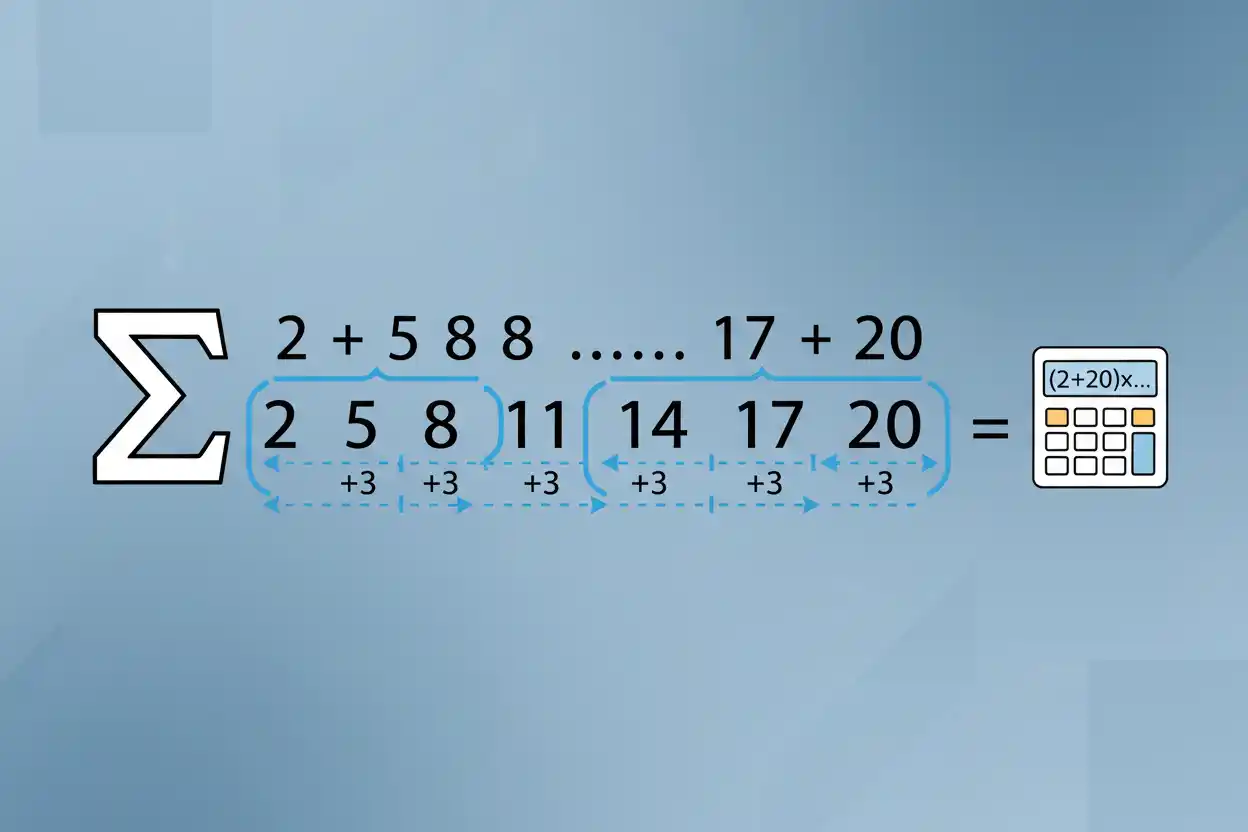

An arithmetic series is the sum of the terms of an arithmetic sequence—a sequence in which consecutive terms differ by the same constant amount.
For example:
3, 7, 11, 15, 19
is an arithmetic sequence because each term increases by:
4
Adding the terms creates the arithmetic series:
3 + 7 + 11 + 15 + 19 = 55
The two most useful arithmetic series formulas are:
Sₙ = n(a₁ + aₙ) ÷ 2
and:
Sₙ = n[2a₁ + (n − 1)d] ÷ 2
where:
(S_n) = sum of the first (n) terms,
(a_1) = first term,
(a_n) = nth or final term,
(d) = common difference,
and (n) = number of terms.
What Is an Arithmetic Series?
An arithmetic series adds the terms of an arithmetic sequence.
Consider:
5, 8, 11, 14, 17
The difference between consecutive terms is:
3
so the sequence is arithmetic.
Its corresponding series is:
5 + 8 + 11 + 14 + 17
The sum is:
55
A sequence is an ordered list of values.
A series is a sum of those values.
That distinction is essential.
Arithmetic Sequence vs. Arithmetic Series
An arithmetic sequence might be written:
2, 5, 8, 11, 14
Its common difference is:
d = 3
The arithmetic series is:
2 + 5 + 8 + 11 + 14
and its sum is:
40
The sequence describes the terms.
The series asks for their total.
Arithmetic Series Formula Using First and Last Terms
When the first term, last term, and number of terms are known:
Sₙ = n(a₁ + aₙ) ÷ 2
Suppose:
a₁ = 5
aₙ = 35
n = 11
Then:
S₁₁ = 11(5 + 35) ÷ 2
= 11(40) ÷ 2
= 220
The sum of the 11 terms is:
220
Arithmetic Series Formula Using Common Difference
When the last term is not already known:
Sₙ = n[2a₁ + (n − 1)d] ÷ 2
Suppose:
a₁ = 5
d = 3
n = 11
Then:
S₁₁ = 11[2(5) + (11 − 1)(3)] ÷ 2
= 11[10 + 30] ÷ 2
= 11(40) ÷ 2
= 220
Both arithmetic series formulas produce the same result.
Formula for the nth Term
The (n)th term of an arithmetic sequence is:
aₙ = a₁ + (n − 1)d
This formula is often used before the sum formula.
For example, suppose:
a₁ = 4
d = 6
n = 20
The 20th term is:
a₂₀ = 4 + (20 − 1)(6)
= 4 + 114
= 118
Then:
S₂₀ = 20(4 + 118) ÷ 2
= 10(122)
= 1,220
Why the Arithmetic Series Formula Works
Consider:
1 + 2 + 3 + 4 + 5
Write the series forward:
1 + 2 + 3 + 4 + 5
and backward:
5 + 4 + 3 + 2 + 1
Add corresponding terms:
6 + 6 + 6 + 6 + 6
There are five identical sums of 6:
5 × 6 = 30
But this counts the original series twice.
Therefore:
30 ÷ 2 = 15
In general, pairing the first and last terms produces:
a₁ + aₙ
and there are (n) such pairings across the doubled series.
Therefore:
2Sₙ = n(a₁ + aₙ)
so:
Sₙ = n(a₁ + aₙ) ÷ 2
Arithmetic Series as Number of Terms × Average Term
Another useful interpretation is:
Arithmetic Series Sum = Number of Terms × Average of First and Last Terms
Because:
Average = (a₁ + aₙ) ÷ 2
we get:
Sₙ = n × Average
For example:
10 + 20 + 30 + 40 + 50
First and last average:
(10 + 50) ÷ 2 = 30
Number of terms:
5
Sum:
5 × 30 = 150
This works because terms in an arithmetic sequence are evenly spaced.
Arithmetic Series Example
Find the sum:
7 + 12 + 17 + 22 + … + 102
First term:
a₁ = 7
Common difference:
d = 5
Last term:
aₙ = 102
First determine (n):
102 = 7 + (n − 1)(5)
Subtract 7:
95 = 5(n − 1)
Divide by 5:
19 = n − 1
Therefore:
n = 20
Now:
S₂₀ = 20(7 + 102) ÷ 2
= 10(109)
= 1,090
Sum of the First 20 Positive Integers
The sequence is:
1, 2, 3, …, 20
Here:
a₁ = 1
a₂₀ = 20
n = 20
Therefore:
S₂₀ = 20(1 + 20) ÷ 2
= 10 × 21
= 210
So:
1 + 2 + 3 + … + 20 = 210
Sum of the First n Positive Integers
For:
1 + 2 + 3 + … + n
we have:
a₁ = 1
aₙ = n
and the number of terms is (n).
Therefore:
Sₙ = n(1 + n) ÷ 2
or:
Sₙ = n(n + 1) ÷ 2
This familiar formula is a special case of the general arithmetic series formula.
Sum of Consecutive Integers
Find:
21 + 22 + 23 + … + 50
First term:
21
Last term:
50
Number of terms:
50 − 21 + 1 = 30
Then:
S = 30(21 + 50) ÷ 2
= 15(71)
= 1,065
The (+1) in the number-of-terms calculation is important because both endpoints are included.
Sum of Consecutive Even Numbers
Find:
2 + 4 + 6 + … + 20
First term:
2
Last term:
20
Common difference:
2
Number of terms:
10
Sum:
S₁₀ = 10(2 + 20) ÷ 2
= 110
More generally, the first (n) positive even integers sum to:
2 + 4 + 6 + … + 2n
Factor out 2:
2(1 + 2 + … + n)
Therefore:
Sum = n(n + 1)
Sum of Consecutive Odd Numbers
Consider:
1 + 3 + 5 + … + (2n − 1)
This is an arithmetic series with:
a₁ = 1
aₙ = 2n − 1
Then:
Sₙ = n[1 + (2n − 1)] ÷ 2
= n(2n) ÷ 2
= n²
Therefore:
1 + 3 + 5 + … + (2n − 1) = n²
For the first five odd numbers:
1 + 3 + 5 + 7 + 9 = 25 = 5²
Arithmetic Series With a Negative Common Difference
Arithmetic series do not need to increase.
Consider:
30 + 26 + 22 + 18 + 14
Here:
a₁ = 30
a₅ = 14
n = 5
and:
d = −4
Sum:
S₅ = 5(30 + 14) ÷ 2
= 5(44) ÷ 2
= 110
A negative common difference simply means the sequence decreases by a constant amount.
Arithmetic Series Containing Negative Terms
Consider:
10 + 5 + 0 − 5 − 10
This is arithmetic with:
d = −5
First term:
10
Last term:
−10
Number of terms:
5
Sum:
5(10 − 10) ÷ 2 = 0
The positive and negative terms cancel symmetrically.
Finding the Number of Terms
Suppose:
4 + 9 + 14 + … + 99
First term:
a₁ = 4
Common difference:
d = 5
Last term:
aₙ = 99
Use:
aₙ = a₁ + (n − 1)d
Substitute:
99 = 4 + 5(n − 1)
95 = 5(n − 1)
19 = n − 1
n = 20
There are 20 terms.
Then:
S₂₀ = 20(4 + 99) ÷ 2
= 1,030
Finding the Last Term Before Summing
Suppose:
a₁ = 8
d = 7
n = 15
Find:
S₁₅
First:
a₁₅ = 8 + (15 − 1)(7)
= 8 + 98
= 106
Then:
S₁₅ = 15(8 + 106) ÷ 2
= 15(114) ÷ 2
= 855
Using the Common-Difference Formula Directly
The same problem can be solved without separately finding (a_{15}):
S₁₅ = 15[2(8) + (15 − 1)(7)] ÷ 2
= 15[16 + 98] ÷ 2
= 15(114) ÷ 2
= 855
Choose whichever formula uses the information already available.
Finding n From the Sum
Suppose:
3 + 7 + 11 + …
has a sum of:
210
How many terms are included?
Here:
a₁ = 3
d = 4
Use:
Sₙ = n[2a₁ + (n − 1)d] ÷ 2
Substitute:
210 = n[6 + 4(n − 1)] ÷ 2
Simplify:
210 = n(4n + 2) ÷ 2
210 = n(2n + 1)
Therefore:
2n² + n − 210 = 0
Factor:
(2n + 21)(n − 10) = 0
Possible roots:
n = 10
or:
n = −21/2
The number of terms must be positive, so:
n = 10
This shows how arithmetic-series problems can lead naturally to a quadratic equation.
Checking the n = 10 Result
The tenth term is:
a₁₀ = 3 + 9(4)
= 39
Sum:
S₁₀ = 10(3 + 39) ÷ 2
= 5(42)
= 210
The result is verified.
Finding the Common Difference From a Sum
Suppose:
a₁ = 5
n = 10
S₁₀ = 230
Find (d).
Use:
230 = 10[2(5) + 9d] ÷ 2
Simplify:
230 = 5(10 + 9d)
46 = 10 + 9d
36 = 9d
d = 4
The sequence is:
5, 9, 13, 17, …
Finding the First Term
Suppose:
n = 8
d = 3
S₈ = 124
Find (a₁).
Use:
124 = 8[2a₁ + 7(3)] ÷ 2
124 = 4(2a₁ + 21)
31 = 2a₁ + 21
2a₁ = 10
a₁ = 5
The sequence begins:
5, 8, 11, …
Sum Between Two Positions
Suppose you want the sum of terms 11 through 20 of an arithmetic sequence.
Instead of summing those ten terms individually:
Sum of Terms 11–20 = S₂₀ − S₁₀
More generally:
Sum From Term m Through Term n = Sₙ − Sₘ₋₁
This is useful when cumulative sums are already known.
Example: Sum From the 6th Through 15th Terms
Consider:
2, 5, 8, 11, …
Here:
a₁ = 2
d = 3
Find (S_{15}):
S₁₅ = 15[4 + 14(3)] ÷ 2
= 15(46) ÷ 2
= 345
Find (S_5):
S₅ = 5[4 + 4(3)] ÷ 2
= 5(16) ÷ 2
= 40
Therefore:
Terms 6 Through 15 Sum = 345 − 40 = 305
Sigma Notation for an Arithmetic Series
An arithmetic series can be written compactly with sigma notation.
For example:
3 + 7 + 11 + … + [3 + (n − 1)4]
can be written:
Σᵏ₌₁ⁿ [3 + (k − 1)4]
The expression inside the summation generates each arithmetic term.
The resulting finite sum can then be evaluated using the arithmetic-series formula rather than adding every term individually.
Example Using Sigma Notation
Evaluate:
Σᵏ₌₁¹⁰ (2k + 1)
The terms are:
3, 5, 7, …, 21
This is arithmetic with:
a₁ = 3
a₁₀ = 21
n = 10
Therefore:
S₁₀ = 10(3 + 21) ÷ 2
= 120
Arithmetic Series vs. Geometric Series
An arithmetic sequence has a constant difference.
Example:
2, 5, 8, 11
Difference:
3
A geometric sequence has a constant ratio.
Example:
2, 6, 18, 54
Ratio:
3
Their sum formulas are different.
A finite geometric series uses:
Sₙ = a₁(1 − rⁿ)/(1 − r)
when:
r ≠ 1
Choosing the wrong series model produces incorrect results.
How to Recognize an Arithmetic Series
Look at consecutive terms.
For:
7, 12, 17, 22
differences are:
5, 5, 5
so the pattern is arithmetic.
For:
2, 6, 18, 54
differences are:
4, 12, 36
not constant.
Ratios are:
3, 3, 3
so the second pattern is geometric rather than arithmetic.
Arithmetic Series and Linear Functions
The terms of an arithmetic sequence can be expressed as:
aₙ = a₁ + (n − 1)d
Expanding:
aₙ = dn + (a₁ − d)
This is linear in (n).
That is why arithmetic sequences have constant first differences.
The relationship resembles the structure of a linear equation and can be represented graphically as discrete points on a straight line.
Function Notation for an Arithmetic Sequence
An arithmetic sequence can also be represented as a function of the term number.
Suppose:
a₁ = 4
d = 3
Then:
a(n) = 4 + (n − 1)3
Simplify:
a(n) = 3n + 1
This function notation makes the input (n) explicit.
For:
n = 10
a(10) = 31
Arithmetic Series and Direct Variation
The sum of a general arithmetic series is not usually a simple direct variation because (S_n) is quadratic in (n) when (dneq0).
Expanding:
Sₙ = n[2a₁ + (n − 1)d] ÷ 2
produces a term involving:
n²
This explains why solving for the number of terms from a known sum can produce a quadratic equation rather than a linear one.
Expanding the Arithmetic Series Formula
Starting from:
Sₙ = n[2a₁ + (n − 1)d] ÷ 2
expand:
Sₙ = n[2a₁ + nd − d] ÷ 2
Then:
Sₙ = (d/2)n² + (a₁ − d/2)n
For fixed (a₁) and (d), the sum is a quadratic function of (n).
This is an important structural connection between sequences and polynomial algebra.
Arithmetic Series and Polynomial Equations
When (S_n) is known and (n) is unknown, rearranging the sum formula often creates a polynomial equation of degree two.
For instance:
210 = n(2n + 1)
becomes:
2n² + n − 210 = 0
You then solve the polynomial and keep only values that make sense for a number of terms.
Arithmetic Series and Factoring
If the resulting equation factors cleanly, factoring quadratics can be faster than using a general formula.
For:
2n² + n − 210 = 0
factor:
(2n + 21)(n − 10) = 0
The positive integer solution is:
n = 10
If factoring is difficult, the quadratic formula provides a general method.
Average of an Arithmetic Sequence
For a finite arithmetic sequence:
Average = (First Term + Last Term) ÷ 2
Example:
10, 15, 20, 25, 30
Average:
(10 + 30) ÷ 2 = 20
Direct calculation confirms:
(10 + 15 + 20 + 25 + 30) ÷ 5 = 20
Then:
Sum = Average × Number of Terms
20 × 5 = 100
This average property is another way to understand the arithmetic-series formula.
Why Middle Terms Balance
Consider:
4, 8, 12, 16, 20
Pairs from opposite ends are:
4 + 20 = 24
8 + 16 = 24
The middle value:
12
is exactly half of 24.
This symmetry exists because terms are equally spaced.
For an odd number of terms, the middle term is the average of the first and last terms.
Arithmetic Series With Decimal Terms
The formulas work with decimals as well.
Consider:
1.5 + 2.0 + 2.5 + … + 6.0
Here:
a₁ = 1.5
d = 0.5
aₙ = 6.0
Find (n):
6 = 1.5 + (n − 1)(0.5)
4.5 = 0.5(n − 1)
9 = n − 1
n = 10
Sum:
S₁₀ = 10(1.5 + 6) ÷ 2
= 37.5
Arithmetic Series With Fractions
Consider:
1/2 + 1 + 3/2 + 2 + 5/2
This is arithmetic with:
d = 1/2
First term:
1/2
Last term:
5/2
Number of terms:
5
Therefore:
S₅ = 5[(1/2) + (5/2)] ÷ 2
= 5(3) ÷ 2
= 15/2
= 7.5
The formulas are not limited to integer terms.
Arithmetic Series in a Savings Example
Suppose someone saves:
$100 in Month 1
and increases the monthly deposit by:
$25 each month
Deposits are:
100, 125, 150, 175, …
After 12 months:
a₁₂ = 100 + 11(25)
= $375
Total contributions:
S₁₂ = 12(100 + 375) ÷ 2
= 6(475)
= $2,850
This is an arithmetic series because the deposit increases by a fixed amount each month.
It does not include interest or investment returns.
Arithmetic Series in Seating Rows
Suppose a theater has:
20 Seats in the First Row
and each subsequent row has:
2 More Seats
With 25 rows:
a₂₅ = 20 + 24(2)
= 68
Total seats:
S₂₅ = 25(20 + 68) ÷ 2
= 25(88) ÷ 2
= 1,100
Arithmetic-series formulas make it unnecessary to add every row individually.
Arithmetic Series in Production
Suppose production begins at:
500 Units in Week 1
and increases by:
50 Units Each Week
For 10 weeks:
a₁₀ = 500 + 9(50)
= 950
Total production:
S₁₀ = 10(500 + 950) ÷ 2
= 7,250 Units
The model assumes the weekly increase is exactly constant.
Arithmetic Series in Staircase Patterns
Suppose a pattern uses:
3 Blocks on Level 1
5 on Level 2
7 on Level 3
and so on.
The number of blocks on each level forms an arithmetic sequence with:
d = 2
For ten levels:
a₁₀ = 3 + 9(2) = 21
Total blocks:
S₁₀ = 10(3 + 21) ÷ 2
= 120
Infinite Arithmetic Series
A nonconstant arithmetic series does not converge to a finite sum as the number of terms approaches infinity.
If:
d > 0
terms increase without bound.
If:
d < 0
terms eventually decrease without bound.
If:
d = 0
the same term repeats indefinitely, and the infinite sum still diverges unless that repeated term is zero.
This is fundamentally different from certain infinite geometric series, which can converge when the common ratio has absolute value less than one.
Arithmetic Series and Other Algebraic Patterns
Arithmetic series concern repeated addition of terms with a constant difference. Other algebraic structures answer different questions.
The binomial theorem expands powers of binomials, while Pascal Triangle provides the associated binomial coefficients.
Those patterns may also involve sequences of numbers, but they should not be mistaken for arithmetic-series formulas unless their consecutive terms actually have a constant difference.
Arithmetic Series vs. Function Composition
An arithmetic series combines terms through addition.
A composite function combines functions by using the output of one as the input of another.
For example:
f(g(x))
is function composition, not a series.
The concepts belong to the same broader algebra framework but solve entirely different types of problems.
Arithmetic Series vs. Complex-Number Topics
Arithmetic-series formulas work perfectly well when the terms are ordinary real numbers. Algebra also extends to complex numbers and complex roots, but those topics concern the number system and polynomial solutions rather than the core finite arithmetic-series calculation.
For ordinary arithmetic-series problems, the key ingredients remain:
a₁, d, n, aₙ, and Sₙ
Choosing the Correct Arithmetic Series Formula
Use:
Sₙ = n(a₁ + aₙ) ÷ 2
when you know the first term, last term, and number of terms.
Use:
Sₙ = n[2a₁ + (n − 1)d] ÷ 2
when you know the first term, common difference, and number of terms.
If the last term is known but (n) is not, first use:
aₙ = a₁ + (n − 1)d
to determine the number of terms.
Choosing the formula that matches the known information reduces unnecessary algebra.
Common Arithmetic Series Mistakes
A common mistake is confusing a sequence with a series.
Another is using the geometric-series formula for a pattern with a constant difference.
Students sometimes use (n) instead of (n-1) in:
aₙ = a₁ + (n − 1)d
This shifts every calculated term.
Another frequent mistake is miscounting consecutive integers. From 21 through 50 there are:
50 − 21 + 1 = 30
terms, not 29.
When solving for (n), negative or non-integer algebraic roots must be rejected if the problem requires a positive whole number of terms.
Signs also matter when the common difference is negative.
Finally, an infinite nonconstant arithmetic series should not be treated as though it has the same convergence behavior as an infinite geometric series.
Frequently Asked Questions
What is an arithmetic series?
An arithmetic series is the sum of the terms of an arithmetic sequence, where consecutive terms differ by a constant amount.
What is the arithmetic series formula?
When the first and last terms are known:
Sₙ = n(a₁ + aₙ) ÷ 2
When the common difference is known:
Sₙ = n[2a₁ + (n − 1)d] ÷ 2
What does Sₙ mean?
(S_n) represents the sum of the first (n) terms.
What does a₁ mean?
(a_1) is the first term of the arithmetic sequence.
What does aₙ mean?
(a_n) is the nth term, often the final term included in a finite arithmetic series.
What does d mean?
(d) is the common difference between consecutive terms.
How do you find the nth term?
aₙ = a₁ + (n − 1)d
How do you find the sum of 1 through n?
1 + 2 + … + n = n(n + 1) ÷ 2
What is the sum of the first 20 positive integers?
20(21) ÷ 2 = 210
How do you find the number of terms?
When the first term, last term, and common difference are known:
n = (aₙ − a₁)/d + 1
provided the terms form the stated arithmetic sequence.
Can an arithmetic series have a negative common difference?
Yes. A decreasing arithmetic sequence has a negative common difference, and its terms can still be summed with the same formulas.
Can an arithmetic series contain negative numbers?
Yes. The terms can be positive, zero, negative, fractional, or decimal as long as consecutive differences remain constant.
What is the difference between an arithmetic sequence and an arithmetic series?
A sequence lists the terms.
A series adds the terms.
What is the difference between an arithmetic series and a geometric series?
An arithmetic pattern has a constant difference.
A geometric pattern has a constant ratio.
Why do you divide by 2 in the arithmetic series formula?
Pairing the sequence forward and backward creates (n) copies of (a_1+a_n), but that process counts the original sum twice. Dividing by 2 corrects the double counting.
Can an infinite arithmetic series have a finite sum?
A nonconstant infinite arithmetic series does not converge to a finite sum. This differs from certain infinite geometric series.
How do you find the sum of only part of an arithmetic sequence?
Use:
Sum From Term m Through n = Sₙ − Sₘ₋₁
Why can solving for n create a quadratic equation?
Because the arithmetic-series formula contains both (n) and (n(n-1)), so expanding it produces an (n²) term.
Why is the arithmetic series formula useful?
It allows a long evenly spaced sequence of terms to be summed directly without adding every term one at a time. The same structure appears in mathematical patterns, cumulative schedules, production models, seating arrangements, savings plans, and many other finite progression problems.