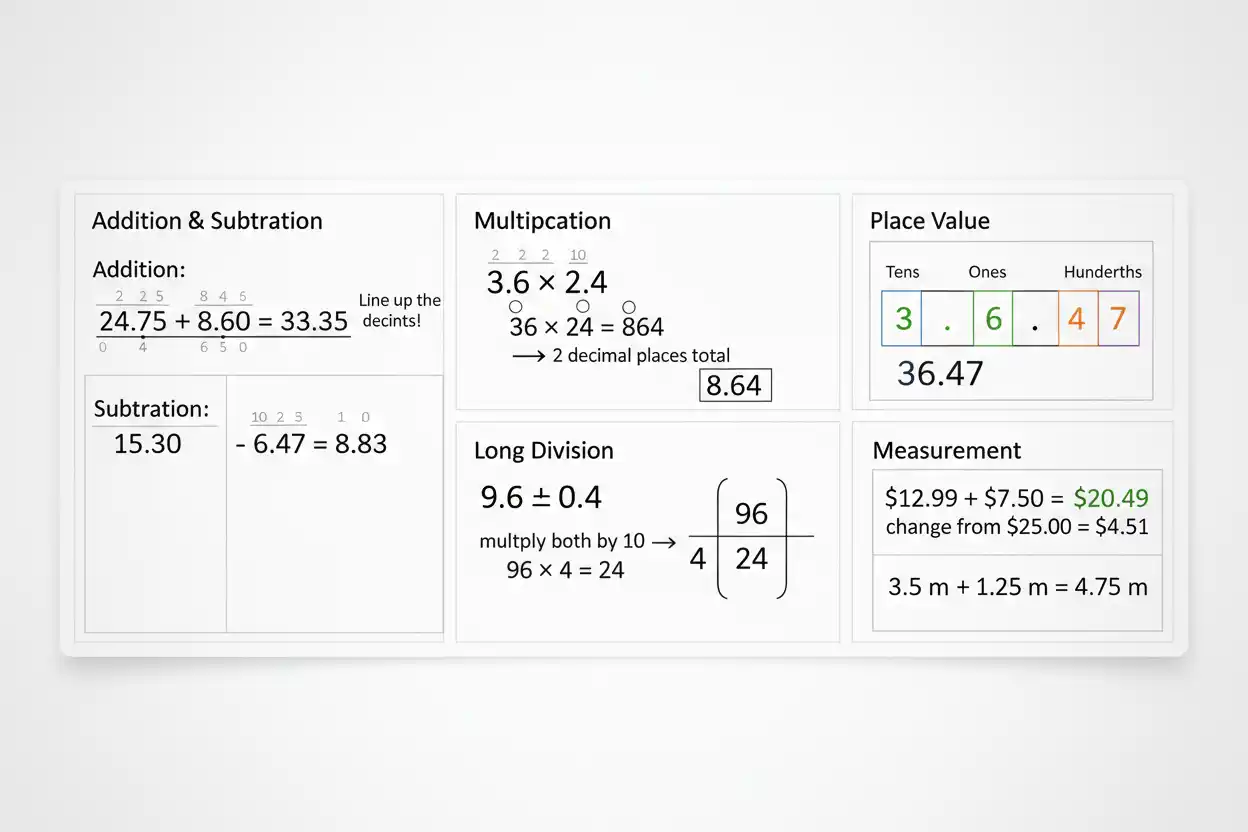

Decimal operations are the rules used to add, subtract, multiply, and divide numbers written in decimal form. The arithmetic principles are the same as for whole numbers, but decimal place value must be handled correctly.
For example:
4.75 + 2.6 = 7.35
8.2 – 3.47 = 4.73
1.5 × 2.4 = 3.6
7.2 ÷ 0.6 = 12
The most important rule changes with the operation. Addition and subtraction require decimal points to be aligned. Multiplication requires the correct scale in the product. Division often becomes easier after converting the divisor to a whole number.
The broader concept of decimal arithmetic explains decimal place value and representation, while this page focuses specifically on performing the four basic decimal operations.
What Are Decimal Operations?
The four basic decimal operations are:
Addition: a + b
Subtraction: a – b
Multiplication: a × b
Division: a ÷ b
where a and b may contain digits to the right of the decimal point.
A decimal digit’s position determines its value. In:
48.735
the digits represent:
4 tens + 8 ones + 7 tenths + 3 hundredths + 5 thousandths
Successful decimal operations depend on preserving those place values.
Decimal Addition Rule
When adding decimals, align the decimal points so digits with the same place value appear in the same column.
For example:
12.46 + 3.7
Rewrite 3.7 as:
3.70
Then:
12.46 + 3.70 = 16.16
So:
12.46 + 3.7 = 16.16
Trailing zeros may be added for alignment because:
3.7 = 3.70
Decimal Addition Example
Calculate:
27.385 + 4.96
Align the decimal places:
27.385
4.960
Now add:
27.385 + 4.960 = 32.345
Therefore:
27.385 + 4.96 = 32.345
A quick estimate gives:
27.4 + 5.0 ≈ 32.4
so 32.345 has a reasonable magnitude.
Adding More Than Two Decimals
The same rule applies when several numbers are added.
Suppose:
4.75 + 12.006 + 0.9
Write:
4.750
12.006
0.900
Then:
4.750 + 12.006 + 0.900 = 17.656
Therefore:
4.75 + 12.006 + 0.9 = 17.656
The number of decimal places does not need to match originally. Alignment creates equivalent forms that make the place values clear.
Decimal Subtraction Rule
Subtraction also requires decimal points to be aligned.
Consider:
15.4 – 6.785
Rewrite the first number as:
15.400
Then:
15.400 – 6.785 = 8.615
Therefore:
15.4 – 6.785 = 8.615
Zeros may be added to the end of a terminating decimal without changing its value.
Decimal Subtraction Example With Borrowing
Calculate:
20.00 – 7.48
Subtract the hundredths and tenths using ordinary regrouping:
20.00 – 7.48 = 12.52
Check:
12.52 + 7.48 = 20.00
The reverse operation confirms the answer.
Subtracting a Larger Decimal From a Smaller One
Suppose:
3.25 – 7.8
The result must be negative because 7.8 is greater than 3.25.
Align:
3.25 – 7.80
The positive difference is:
7.80 – 3.25 = 4.55
Therefore:
3.25 – 7.8 = -4.55
The decimal rules remain the same; only the sign changes.
Decimal Multiplication Rule
Decimal multiplication does not require decimal points to be aligned.
Instead:
- Multiply the digits as though the factors were whole numbers.
- Count the total number of decimal places in both factors.
- Place the decimal point so the product has that many decimal places.
For example:
2.4 × 1.3
Ignoring decimal points:
24 × 13 = 312
The factors contain two decimal places in total:
2.4 has 1
1.3 has 1
Therefore the product needs 2 decimal places:
3.12
So:
2.4 × 1.3 = 3.12
Why the Decimal Multiplication Rule Works
The rule follows directly from fractions.
For example:
2.4 = 24 / 10
and:
1.3 = 13 / 10
Therefore:
2.4 × 1.3 = (24 × 13) / 100
= 312 / 100
= 3.12
The two decimal places in the product come from the denominator:
10 × 10 = 100
This relationship also connects decimal calculation with fraction operations.
Decimal Multiplication Example
Calculate:
4.26 × 3.5
Ignore the decimals:
426 × 35
Calculate:
426 × 30 = 12,780
426 × 5 = 2,130
Add:
12,780 + 2,130 = 14,910
There are three decimal places in the original factors:
4.26 has 2
3.5 has 1
Therefore:
14.910
Simplify the trailing zero:
4.26 × 3.5 = 14.91
Multiplying Decimals Less Than 1
Consider:
0.4 × 0.07
Ignoring the decimal points:
4 × 7 = 28
There are three decimal places altogether:
0.4 has 1
0.07 has 2
Therefore:
0.028
So:
0.4 × 0.07 = 0.028
An estimate based on magnitude is helpful. Since both factors are below 1, their positive product must be smaller than either factor.
A result such as 2.8 would therefore be obviously incorrect.
Multiplying by 10, 100, and 1000
Multiplication by a power of 10 changes place value.
For example:
3.476 × 10 = 34.76
3.476 × 100 = 347.6
3.476 × 1000 = 3476
Each multiplication by 10 makes every digit ten times as valuable.
This is often described as moving the decimal point to the right, although the underlying process is a change in place value.
Decimal Division Rule
Decimal division becomes easier when the divisor is converted to a whole number.
Consider:
8.4 ÷ 0.7
Multiply both numbers by 10:
84 ÷ 7
Then:
84 ÷ 7 = 12
Therefore:
8.4 ÷ 0.7 = 12
Multiplying the dividend and divisor by the same nonzero value does not change the quotient.
The general meaning of quotient and remainder is treated separately under division.
Decimal Division Example
Calculate:
14.52 ÷ 1.2
Multiply both values by 10:
145.2 ÷ 12
Now divide:
145.2 ÷ 12 = 12.1
Therefore:
14.52 ÷ 1.2 = 12.1
Check with multiplication:
12.1 × 1.2 = 14.52
The original dividend is recovered.
Division When the Divisor Has Several Decimal Places
Consider:
3.456 ÷ 0.24
The divisor has two decimal places, so multiply both numbers by 100:
345.6 ÷ 24
Now:
345.6 ÷ 24 = 14.4
Therefore:
3.456 ÷ 0.24 = 14.4
The important rule is not merely to alter the divisor. Both numbers must be scaled by the same power of 10.
Decimal Long Division
When the quotient is not immediately obvious, ordinary long division can be used after the divisor has been converted to a whole number.
For example:
7.25 ÷ 0.4
Multiply both values by 10:
72.5 ÷ 4
Now divide:
72.5 ÷ 4 = 18.125
Therefore:
7.25 ÷ 0.4 = 18.125
Dividing by a Number Less Than 1
Dividing a positive number by a positive decimal smaller than 1 increases the numerical result.
For example:
5 ÷ 0.5 = 10
This makes sense because the question asks:
How many halves fit into 5?
There are 10 halves.
Similarly:
3 ÷ 0.25 = 12
because twelve quarters make 3.
This provides a useful reasonableness check for decimal division.
Dividing by Powers of 10
Examples include:
582.4 ÷ 10 = 58.24
582.4 ÷ 100 = 5.824
582.4 ÷ 1000 = 0.5824
Each division by 10 moves every digit into a place worth one-tenth as much.
Decimal Operations With Negative Numbers
The ordinary sign rules still apply.
For addition:
-3.4 + 1.2 = -2.2
For subtraction:
5.3 – 8.7 = -3.4
For multiplication:
-2.5 × 4 = -10
For division:
-7.2 ÷ 0.9 = -8
If both factors or both numbers in a division are negative:
(-2.5)(-4) = 10
-7.2 ÷ -0.9 = 8
The decimal placement and sign rules are separate parts of the calculation.
Order of Decimal Operations
When several operations occur in one expression, use the usual order of operations.
Consider:
3.5 + 2.4 × 4
Multiply first:
2.4 × 4 = 9.6
Then add:
3.5 + 9.6 = 13.1
Therefore:
3.5 + 2.4 × 4 = 13.1
If parentheses change the expression:
(3.5 + 2.4) × 4
calculate inside the parentheses first:
3.5 + 2.4 = 5.9
Then:
5.9 × 4 = 23.6
The two expressions are not equivalent.
Combined Decimal Operations Example
Evaluate:
18.6 – 2.5 × 3.2
Multiply first:
2.5 × 3.2 = 8.0
Then subtract:
18.6 – 8.0 = 10.6
Therefore:
18.6 – 2.5 × 3.2 = 10.6
A common mistake is subtracting before multiplying simply because subtraction appears first from left to right.
Decimal Operations and Fractions
A terminating decimal can be converted into a fraction and calculated in fractional form when useful.
For example:
0.75 = 3 / 4
and:
0.5 = 1 / 2
Therefore:
0.75 × 0.5
can also be calculated as:
3/4 × 1/2 = 3/8
Convert back:
3/8 = 0.375
So:
0.75 × 0.5 = 0.375
The conversion process itself is covered under decimal to fraction.
Decimal Operations With Rational Numbers
Terminating and repeating decimals represent rational numbers.
For example:
0.125 = 1 / 8
and:
0.333… = 1 / 3
When exactness matters, retaining a fraction may be preferable to truncating or rounding a repeating decimal.
For example:
1/3 × 3 = 1
but using:
0.33 × 3
gives:
0.99
The difference comes from replacing the exact repeating decimal with a rounded approximation.
Decimal Operations and Percentages
Percent calculations often use decimal multiplication.
For example:
15% = 0.15
To find 15% of 80:
0.15 × 80 = 12
Therefore:
15% of 80 = 12
The broader conversion and calculation rules belong to percentage, while decimal operations perform the underlying multiplication.
Example With Money
Suppose three purchases cost:
$14.95
$8.60
$22.35
Add them:
14.95 + 8.60 + 22.35 = 45.90
If $50 is paid:
50.00 – 45.90 = 4.10
Therefore:
Total cost = $45.90
Change = $4.10
Money calculations make decimal alignment especially important because hundredths represent cents.
Example With Measurements
Suppose a board is:
2.75 m
long and another is:
1.48 m
The combined length is:
2.75 + 1.48 = 4.23 m
If the total is divided into three equal lengths:
4.23 ÷ 3 = 1.41 m
Units should remain attached to the numerical result.
Decimal Operations and Cube Roots
Some calculations produce irrational values that are then represented approximately as decimals.
For example:
∛10 ≈ 2.154434…
The cube roots calculation determines the underlying value. If that approximation is later multiplied, divided, added, or subtracted, decimal-operation rules apply to the numerical approximation.
Care is needed because rounding the root too early may affect subsequent results.
Decimal Values in Determinants
Matrices may contain decimal entries, so evaluating determinants can require decimal multiplication and subtraction.
For a 2 × 2 matrix with entries:
a, b
c, d
the determinant has the form:
ad – bc
If those entries are decimals, the individual products and final subtraction still follow ordinary decimal-operation rules.
The determinant calculation itself remains a separate matrix concept.
Decimal Operations and Composite Numbers
Prime and composite classification applies to integers.
For example, composite numbers such as 12 or 18 may appear inside decimal calculations, but a value such as:
12.5
is not classified as prime or composite under the standard definition.
The arithmetic operation and the number classification answer different mathematical questions.
Rounding Decimal Results
Some decimal operations produce more digits than are useful or required.
For example:
10 ÷ 6 = 1.666666…
Rounded to two decimal places:
1.67
The applicable rounding rules determine how the retained digits are adjusted.
Whenever possible, perform rounding after the main calculation rather than repeatedly during intermediate steps.
Decimal Operations and Significant Figures
In measured data, the number of decimal places is not always the only precision consideration.
For example:
12.0
and:
12.000
represent the same exact numerical value in pure arithmetic, but they may communicate different measurement precision.
The rules for reporting significant figures become important in scientific calculations.
Decimal Operations in Scientific Notation
Very large or very small numbers may be expressed using scientific notation.
For example:
0.00045 = 4.5 × 10^-4
Multiplication involving powers of 10 can often be performed more efficiently in scientific notation, although the underlying arithmetic remains consistent with decimal place value.
Common Decimal Addition and Subtraction Mistakes
The most frequent mistake is failing to align decimal points.
For example:
6.4 + 0.28
should be interpreted as:
6.40 + 0.28
not as though 4 and 8 occupied the same place.
The correct answer is:
6.68
Another mistake is forgetting placeholder zeros when subtraction requires regrouping.
For:
10 – 3.275
write:
10.000 – 3.275
which gives:
6.725
Common Decimal Multiplication Mistakes
A common error is placing the decimal point based on where it appears in the written factors rather than on scale.
For example:
0.3 × 0.2
is:
0.06
not:
0.6
because:
3/10 × 2/10 = 6/100
Another useful check is magnitude. Multiplying two positive numbers smaller than 1 produces a result smaller than either original number.
Common Decimal Division Mistakes
The biggest error is multiplying only the divisor by a power of 10.
For example:
4.8 ÷ 0.6
can become:
48 ÷ 6
because both numbers were multiplied by 10.
It must not become:
4.8 ÷ 6
because that changes the quotient.
Division by zero is also undefined:
a ÷ 0
has no defined real-number value.
How to Check Decimal Operations
Addition can be checked with subtraction:
7.45 + 2.8 = 10.25
Check:
10.25 – 2.8 = 7.45
Subtraction can be checked with addition:
9.2 – 3.65 = 5.55
Check:
5.55 + 3.65 = 9.20
Multiplication can be checked approximately with estimation or exactly using division.
Division can be checked with multiplication:
15.75 ÷ 2.5 = 6.3
Check:
6.3 × 2.5 = 15.75
Reverse operations are particularly useful for catching misplaced decimal points.
Frequently Asked Questions
What are the four decimal operations?
They are addition, subtraction, multiplication, and division performed with numbers written in decimal form.
How do you add decimals?
Align the decimal points and add digits occupying the same place values.
For example:
3.45 + 2.7 = 3.45 + 2.70 = 6.15
How do you subtract decimals?
Align decimal points, add trailing zeros where helpful, and subtract using ordinary regrouping.
Do decimal points need to align when multiplying?
No. Multiply the digits and then place the decimal according to the combined scale of both factors.
How do you divide by a decimal?
Multiply both dividend and divisor by the same power of 10 until the divisor becomes a whole number, then divide.
Why does 0.5 × 0.5 equal 0.25?
Because:
0.5 = 5/10
so:
5/10 × 5/10 = 25/100 = 0.25
Why does dividing by 0.5 double a number?
Dividing by 0.5 asks how many halves fit into the original quantity. Every whole contains two halves.
Thus:
8 ÷ 0.5 = 16
Can decimal operations produce repeating answers?
Yes. For example:
2 ÷ 3 = 0.666…
The quotient is an exact repeating decimal.
Should I round during a multistep decimal calculation?
Usually, keep additional precision through intermediate calculations and round the final result when required. Early rounding can accumulate error.
How can I detect a misplaced decimal point?
Estimate the expected magnitude first. If 4.8 × 2.1 is roughly 5 × 2 = 10, an answer near 10 is plausible, while 1.008 or 100.8 would signal a likely placement error.
Final Example
Evaluate:
16.8 ÷ 0.4 + 2.75 × 3.2
Perform division:
16.8 ÷ 0.4 = 42
Perform multiplication:
2.75 × 3.2 = 8.8
Then add:
42 + 8.8 = 50.8
Therefore:
16.8 ÷ 0.4 + 2.75 × 3.2 = 50.8
Accurate decimal operations depend on three habits: preserve place value, apply the rule appropriate to the operation, and check whether the final magnitude makes sense.