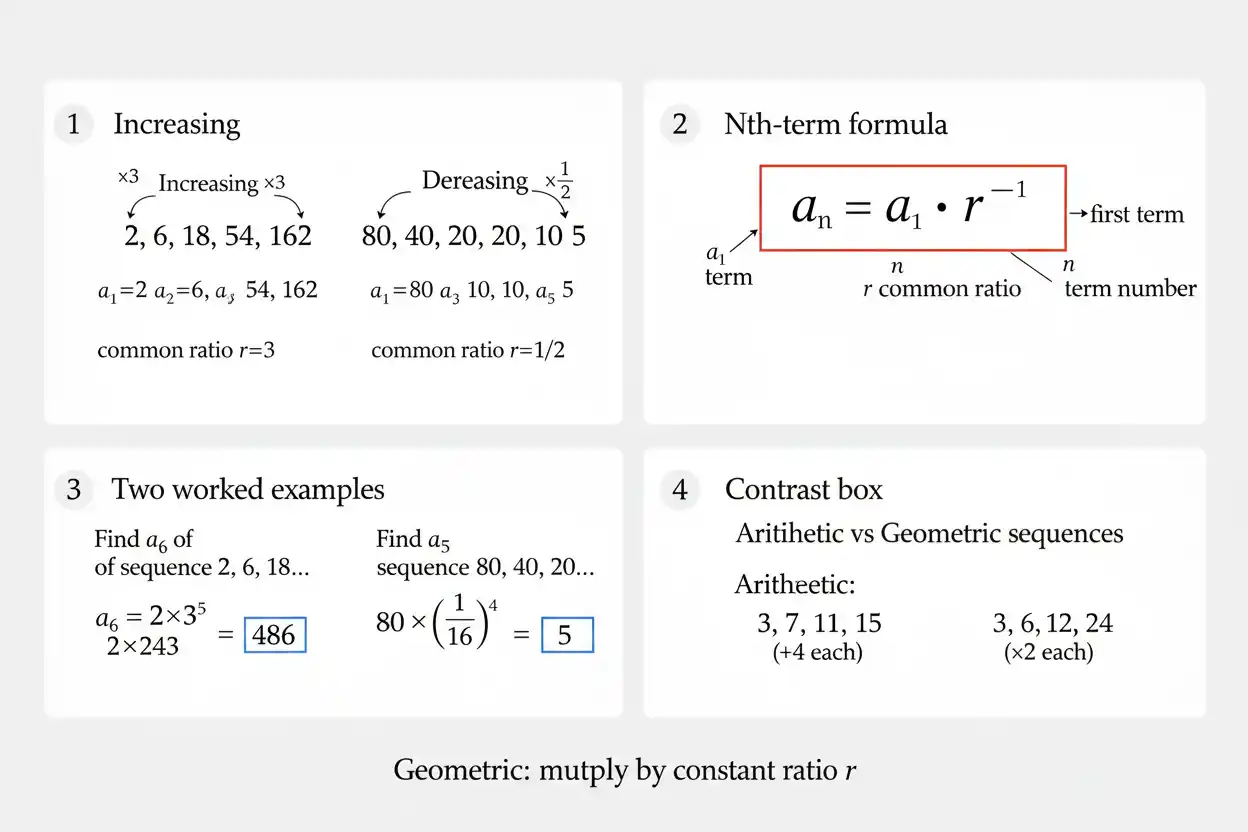

A geometric sequence is a sequence in which each term after the first is obtained by multiplying the preceding term by the same constant value, called the common ratio.
For example:
3, 6, 12, 24, 48, …
is geometric because each term is obtained by multiplying the previous term by:
2
Therefore:
Common ratio = 2
The nth term of a geometric sequence is:
aₙ = a₁ × r^(n – 1)
where:
aₙ = nth term
a₁ = first term
r = common ratio
n = term number
For the sequence:
3, 6, 12, 24, …
we have:
a₁ = 3
r = 2
So:
aₙ = 3 × 2^(n – 1)
This formula allows any term to be calculated directly without generating every preceding term.
What Is a Geometric Sequence?
A sequence is geometric when the ratio between consecutive nonzero terms remains constant.
For:
5, 15, 45, 135, …
calculate:
15 / 5 = 3
45 / 15 = 3
135 / 45 = 3
The ratio is always:
3
Therefore, the sequence is geometric.
Geometric sequences form an important part of arithmetic and number theory and appear in exponential growth, decay, finance, repeated scaling, probability, and mathematical modeling.
Geometric Sequence Formula
The explicit formula is:
aₙ = a₁ × r^(n – 1)
For example, suppose:
a₁ = 4
r = 3
Find the fifth term.
Use:
a₅ = 4 × 3^(5 – 1)
= 4 × 3⁴
Since:
3⁴ = 81
we obtain:
a₅ = 4 × 81
= 324
Therefore:
a₅ = 324
The powers in the formula follow the ordinary rules of exponents.
Why the Exponent Is n – 1
Start with the first term:
a₁
To reach the second term, multiply by r once:
a₂ = a₁r
To reach the third, multiply twice:
a₃ = a₁r²
Then:
a₄ = a₁r³
By the time you reach term n, the first term has been multiplied by the common ratio:
n – 1 times
Therefore:
aₙ = a₁r^(n-1)
Recursive Formula
A geometric sequence can also be defined recursively:
aₙ = r × aₙ₋₁
for:
n ≥ 2
together with the starting value a₁.
For example:
a₁ = 7
r = 2
Then:
a₂ = 2 × 7 = 14
a₃ = 2 × 14 = 28
a₄ = 2 × 28 = 56
The sequence is:
7, 14, 28, 56, …
The recursive formula generates the next term, while the explicit formula calculates a particular term directly.
Finding the Common Ratio
For consecutive nonzero terms:
r = aₙ / aₙ₋₁
For example:
8, 24, 72, 216, …
Calculate:
24 / 8 = 3
Therefore:
r = 3
Check another pair:
72 / 24 = 3
and:
216 / 72 = 3
The consistent ratio confirms that the sequence is geometric.
Example: Find the Common Ratio
Consider:
100, 50, 25, 12.5, …
Divide the second term by the first:
r = 50 / 100
r = 1/2
Check:
25 / 50 = 1/2
and:
12.5 / 25 = 1/2
Therefore:
Common ratio = 1/2
This sequence decreases because the magnitude of the ratio is below 1.
Positive Common Ratio Greater Than 1
If:
r > 1
and the first term is positive, the terms increase in magnitude.
For example:
2, 8, 32, 128, …
has:
r = 4
The explicit formula is:
aₙ = 2 × 4^(n – 1)
As n grows, the powers of 4 become increasingly large.
Common Ratio Between 0 and 1
If:
0 < r < 1
the terms decrease in magnitude toward zero.
For example:
80, 40, 20, 10, 5, …
has:
r = 1/2
The nth term is:
aₙ = 80(1/2)^(n – 1)
Each new term is half the previous value.
This type of pattern models repeated proportional decay.
Negative Common Ratio
A geometric sequence may have a negative common ratio.
Consider:
3, -6, 12, -24, 48, …
Calculate:
-6 / 3 = -2
12 / -6 = -2
Therefore:
r = -2
The explicit formula is:
aₙ = 3(-2)^(n – 1)
Because powers of a negative number alternate sign, the sequence alternates between positive and negative values.
Ratio Equal to 1
If:
r = 1
every term equals the first term.
For example:
7, 7, 7, 7, …
has:
r = 1
and:
aₙ = 7 × 1^(n – 1)
Since:
1^k = 1
for every integer k:
aₙ = 7
The sequence is constant but still geometric.
Ratio Equal to Zero
If:
r = 0
and:
a₁ ≠ 0
the sequence becomes:
a₁, 0, 0, 0, …
because:
a₂ = a₁ × 0 = 0
and every later term remains zero.
The usual consecutive-ratio calculation becomes problematic once dividing by a zero preceding term would be required, but the recursively defined sequence still follows repeated multiplication by zero.
Example: Find the Sixth Term
Consider:
5, 10, 20, 40, …
Here:
a₁ = 5
r = 2
Find:
a₆
Use:
a₆ = 5 × 2^(6 – 1)
= 5 × 2⁵
= 5 × 32
= 160
Therefore:
a₆ = 160
Check by continuing the sequence:
5, 10, 20, 40, 80, 160
The values agree.
Example: Find the Eighth Term
Suppose:
a₁ = 3
r = 1/2
Find:
a₈
Use:
a₈ = 3(1/2)^7
Since:
(1/2)^7 = 1/128
we obtain:
a₈ = 3/128
Therefore:
a₈ = 3/128
The sequence can contain fractional terms without losing its geometric structure.
Example With a Negative Ratio
Given:
4, -12, 36, -108, …
we have:
r = -3
Find the fifth term:
a₅ = 4(-3)^(5 – 1)
= 4(-3)^4
= 4 × 81
= 324
Therefore:
a₅ = 324
The even exponent makes the power positive.
Finding a Missing Term
Suppose:
6, ?, 54
forms a geometric sequence.
Let the common ratio be r.
Then:
6r² = 54
Divide:
r² = 9
Therefore:
r = 3 or r = -3
If:
r = 3
the middle term is:
6 × 3 = 18
giving:
6, 18, 54
If:
r = -3
the middle term is:
-18
giving:
6, -18, 54
So without an additional sign restriction, there are two possible real geometric sequences.
Geometric Mean Between Two Positive Numbers
If positive numbers a and b are the first and third terms of a three-term geometric sequence:
a, x, b
then:
x/a = b/x
Cross-multiply:
x² = ab
For positive terms:
x = √(ab)
This middle value is the geometric mean.
For example, between 4 and 36:
x = √(4 × 36)
= √144
= 12
So:
4, 12, 36
is geometric with common ratio:
3
Finding the First Term
Suppose:
a₆ = 486
and:
r = 3
Use:
aₙ = a₁r^(n-1)
So:
486 = a₁ × 3⁵
Since:
3⁵ = 243
we get:
486 = 243a₁
Divide:
a₁ = 2
Therefore:
First term = 2
Finding the Common Ratio From Two Known Terms
Suppose:
a₂ = 6
and:
a₅ = 162
Using the explicit formula:
a₂ = a₁r
and:
a₅ = a₁r⁴
Divide the equations:
a₅/a₂ = r³
Therefore:
162/6 = r³
27 = r³
So:
r = 3
Once r is known:
6 = a₁ × 3
Therefore:
a₁ = 2
The sequence begins:
2, 6, 18, 54, 162, …
Finding n From a Term
Suppose:
a₁ = 2
r = 3
and:
aₙ = 486
Use:
486 = 2 × 3^(n-1)
Divide by 2:
243 = 3^(n-1)
Since:
243 = 3⁵
we obtain:
n – 1 = 5
Therefore:
n = 6
When the powers are recognizable, no logarithm is needed.
Finding n When Powers Do Not Match Easily
Suppose:
a₁ = 5
r = 2
and you want to solve:
aₙ = 500
Then:
500 = 5 × 2^(n-1)
Divide:
100 = 2^(n-1)
Because 100 is not an exact integer power of 2, a logarithm can isolate the exponent:
n – 1 = ln(100) / ln(2)
So:
n ≈ 7.644
This means 500 is not itself a term at an integer position in the sequence.
The detailed mechanics of solving exponential equations belong to logarithms.
Geometric Sequence vs. Arithmetic Sequence
An arithmetic sequence changes by adding the same constant difference.
Example:
4, 7, 10, 13, …
The common difference is:
3
A geometric sequence changes by multiplying by the same constant ratio.
Example:
4, 12, 36, 108, …
The common ratio is:
3
The distinction is:
Arithmetic → constant difference
Geometric → constant ratio
Testing Whether a Sequence Is Geometric
Consider:
2, 8, 32, 128
Calculate consecutive ratios:
8/2 = 4
32/8 = 4
128/32 = 4
Because the ratio is constant:
the sequence is geometric
Now consider:
2, 6, 12, 20
Ratios are:
6/2 = 3
12/6 = 2
Since the ratios differ:
the sequence is not geometric
Geometric Sequence vs. Fibonacci Sequence
The Fibonacci sequence follows:
Fₙ = Fₙ₋₁ + Fₙ₋₂
For example:
1, 1, 2, 3, 5, 8, …
It does not have a constant ratio between consecutive terms.
A geometric sequence instead follows:
aₙ = r × aₙ₋₁
So the Fibonacci sequence is recursive through addition, while a geometric sequence is recursive through multiplication by a fixed constant.
Geometric Sequence vs. Harmonic Sequence
A harmonic sequence is defined through reciprocals of terms that form an arithmetic sequence.
For example:
1, 1/2, 1/3, 1/4, …
is harmonic but not geometric because its consecutive ratios are not constant:
(1/2)/1 = 1/2
but:
(1/3)/(1/2) = 2/3
Therefore:
1/2 ≠ 2/3
The two sequence types should not be confused simply because both may contain fractions.
Geometric Sequence vs. Geometric Series
A geometric sequence is a list of terms:
a₁, a₁r, a₁r², a₁r³, …
A geometric series is created by adding those terms:
a₁ + a₁r + a₁r² + a₁r³ + …
For example:
Sequence:
2, 6, 18, 54
Series:
2 + 6 + 18 + 54
The current page focuses on the sequence itself: its terms and common ratio. Summing those terms is the separate geometric-series intent.
Sum Is Not the Same as the nth Term
Suppose the sequence is:
3, 6, 12, 24
The fourth term is:
a₄ = 24
But the sum of the first four terms is:
3 + 6 + 12 + 24 = 45
These values answer different questions.
When a problem asks:
“Find the nth term”
use the geometric sequence formula.
When it asks:
“Find the sum”
a geometric-series formula may be appropriate.
Fractions in Geometric Sequences
A common ratio may itself be a fraction.
For example:
64, 16, 4, 1, 1/4, …
has:
r = 1/4
because:
16/64 = 1/4
and:
4/16 = 1/4
The formula is:
aₙ = 64(1/4)^(n-1)
Ordinary fraction operations can be used when evaluating such terms exactly.
Simplifying Fractional Terms
Suppose:
a₁ = 12
r = 2/3
Find:
a₄
Use:
a₄ = 12(2/3)^3
Calculate:
(2/3)^3 = 8/27
Therefore:
a₄ = 96/27
96/27 = 32/9
Therefore:
a₄ = 32/9
Common Ratio as a Percentage
A ratio can be expressed as a percentage of the previous term.
Suppose:
r = 3/4
Convert fractions to percent:
3/4 = 75%
Therefore each term is:
75% of the preceding term
The sequence decreases by:
25%
per step because:
100% – 75% = 25%
Growth Percentage vs. Common Ratio
Suppose:
r = 1.08
Each term is:
108%
of the previous term.
The growth rate is:
108% – 100% = 8%
So:
Common ratio = 1.08
corresponds to:
8% growth per period
The ratio itself should not be confused with the percentage increase.
Decay Percentage Example
Suppose:
r = 0.85
Each new term equals:
85%
of the preceding value.
The decrease per step is:
100% – 85% = 15%
Therefore:
r = 0.85
represents:
15% decay per period
Practical Example: Repeated Growth
Suppose an initial quantity is:
1,000
and it grows by:
5%
each period.
The multiplier is:
1 + 0.05 = 1.05
The sequence begins:
1,000
1,050
1,102.50
1,157.625
The nth term is:
aₙ = 1000(1.05)^(n-1)
This is geometric because the same factor 1.05 is applied repeatedly.
Practical Example: Repeated Depreciation
Suppose a value begins at:
20,000
and retains:
80%
of its previous value each period.
Then:
r = 0.8
The sequence is:
20,000
16,000
12,800
10,240
and so on.
The nth-term formula is:
aₙ = 20000(0.8)^(n-1)
The constant ratio represents repeated proportional decay.
Practical Example: Bacterial Doubling
Suppose an initial population contains:
500
organisms and doubles every interval.
Then:
r = 2
The counts form:
500, 1,000, 2,000, 4,000, …
The nth term is:
aₙ = 500 × 2^(n-1)
The model is geometric because every new value is the previous value multiplied by 2.
Practical Example: Bouncing Height
Suppose a ball reaches:
10 m
on its first recorded bounce and each later bounce reaches:
60%
of the previous height.
Then:
r = 0.6
The sequence is:
10, 6, 3.6, 2.16, …
The nth bounce height is:
aₙ = 10(0.6)^(n-1)
The values decrease toward zero but remain positive.
Geometric Sequence and Exponential Growth
The explicit formula:
aₙ = a₁r^(n-1)
contains the term number in the exponent.
This is why a geometric sequence is closely connected with exponential behavior.
If:
|r| > 1
magnitudes generally grow.
If:
0 < |r| < 1
magnitudes generally decay.
The exponents determine how repeated multiplication accumulates across sequence positions.
Geometric Sequence and GCF
The GCF of integer sequence terms can sometimes reveal shared integer structure, but it does not determine whether a sequence is geometric.
For example:
6, 18, 54, 162
is geometric because:
r = 3
These terms also share a GCF of 6.
By contrast:
6, 12, 18, 24
also share GCF 6 but are not geometric because the ratios are not constant.
GCF measures divisibility; a geometric sequence is defined by a constant ratio.
Geometric Sequence and Greatest Common Factor
The broader greatest common factor calculation may be applied to integer terms after they have been generated.
For example:
8, 24, 72
has:
GCF(8,24,72) = 8
But the sequence’s geometric property comes from:
24/8 = 72/24 = 3
The two concepts therefore describe different relationships among the same integers.
Does a Geometric Sequence Always Increase?
No.
A geometric sequence may increase, decrease, remain constant, alternate signs, or become zero depending on r.
Examples:
Increasing:
2, 6, 18, 54 with r = 3
Decreasing:
16, 8, 4, 2 with r = 1/2
Constant:
5, 5, 5, 5 with r = 1
Alternating:
2, -4, 8, -16 with r = -2
The phrase “geometric” describes the constant ratio, not the direction of the sequence.
Common Geometric Sequence Mistakes
One common mistake is looking for a constant difference instead of a constant ratio.
For:
3, 9, 27, 81
the differences are:
6, 18, 54
which are not constant.
But the ratios are:
3, 3, 3
so the sequence is geometric.
Another mistake is using:
aₙ = a₁r^n
instead of:
aₙ = a₁r^(n-1)
when the first term is indexed as a₁.
For:
n = 1
the correct formula gives:
a₁r⁰ = a₁
as required.
A third error is treating a 20% increase as:
r = 0.20
The correct multiplier is:
r = 1.20
because the new term contains 100% of the old value plus another 20%.
How to Check an nth-Term Answer
Suppose:
a₁ = 3
r = 2
and a calculation gives:
a₆ = 96
Check by generating the sequence:
3, 6, 12, 24, 48, 96
The sixth term is indeed:
96
You can also verify:
a₆ / a₅ = 96 / 48 = 2
which matches the stated common ratio.
How to Check Whether a Sequence Is Geometric
For nonzero consecutive terms, calculate several ratios.
Suppose:
81, 27, 9, 3, 1
Check:
27/81 = 1/3
9/27 = 1/3
3/9 = 1/3
1/3 = 1/3
The ratio is constant.
Therefore:
the sequence is geometric with r = 1/3
Frequently Asked Questions
What is a geometric sequence?
A geometric sequence is a sequence in which every term after the first is obtained by multiplying the preceding term by the same constant common ratio.
What is the geometric sequence formula?
The nth-term formula is:
aₙ = a₁r^(n-1)
How do you find the common ratio?
For consecutive nonzero terms:
r = aₙ/aₙ₋₁
Is 2, 6, 18, 54 a geometric sequence?
Yes.
6/2 = 3
18/6 = 3
54/18 = 3
Therefore:
r = 3
Is 3, 6, 9, 12 geometric?
No. It has a constant difference of 3, not a constant ratio. It is arithmetic rather than geometric.
Can a geometric sequence have fractions?
Yes. For example:
8, 4, 2, 1, 1/2, …
has:
r = 1/2
Can the common ratio be negative?
Yes.
For:
2, -6, 18, -54, …
the common ratio is:
-3
What happens when the common ratio is between 0 and 1?
For positive terms, the sequence decreases in magnitude toward zero.
Is a geometric sequence the same as a geometric series?
No. A geometric sequence is the ordered list of terms. A geometric series is the sum of geometric-sequence terms.
What is the difference between arithmetic and geometric sequences?
An arithmetic sequence has a constant difference. A geometric sequence has a constant ratio.
Can a geometric sequence model percentage growth?
Yes. A repeated growth rate g uses:
r = 1 + g
when g is written as a decimal.
For 5% growth:
r = 1.05
Can a geometric sequence model percentage decay?
Yes. A 20% decrease leaves 80% each period:
r = 0.80
Final Example
Consider the geometric sequence:
640, 320, 160, 80, …
First find the common ratio:
r = 320 / 640
= 1/2
So:
a₁ = 640
r = 1/2
The nth-term formula is:
aₙ = 640(1/2)^(n-1)
Find the seventh term:
a₇ = 640(1/2)^6
Since:
(1/2)^6 = 1/64
we get:
a₇ = 640 / 64
= 10
Therefore:
a₇ = 10
The sequence confirms the result:
640, 320, 160, 80, 40, 20, 10
The defining rule of a geometric sequence is constant multiplicative change:
aₙ = a₁r^(n-1)
Once the first term and common ratio are known, any term can be calculated directly.