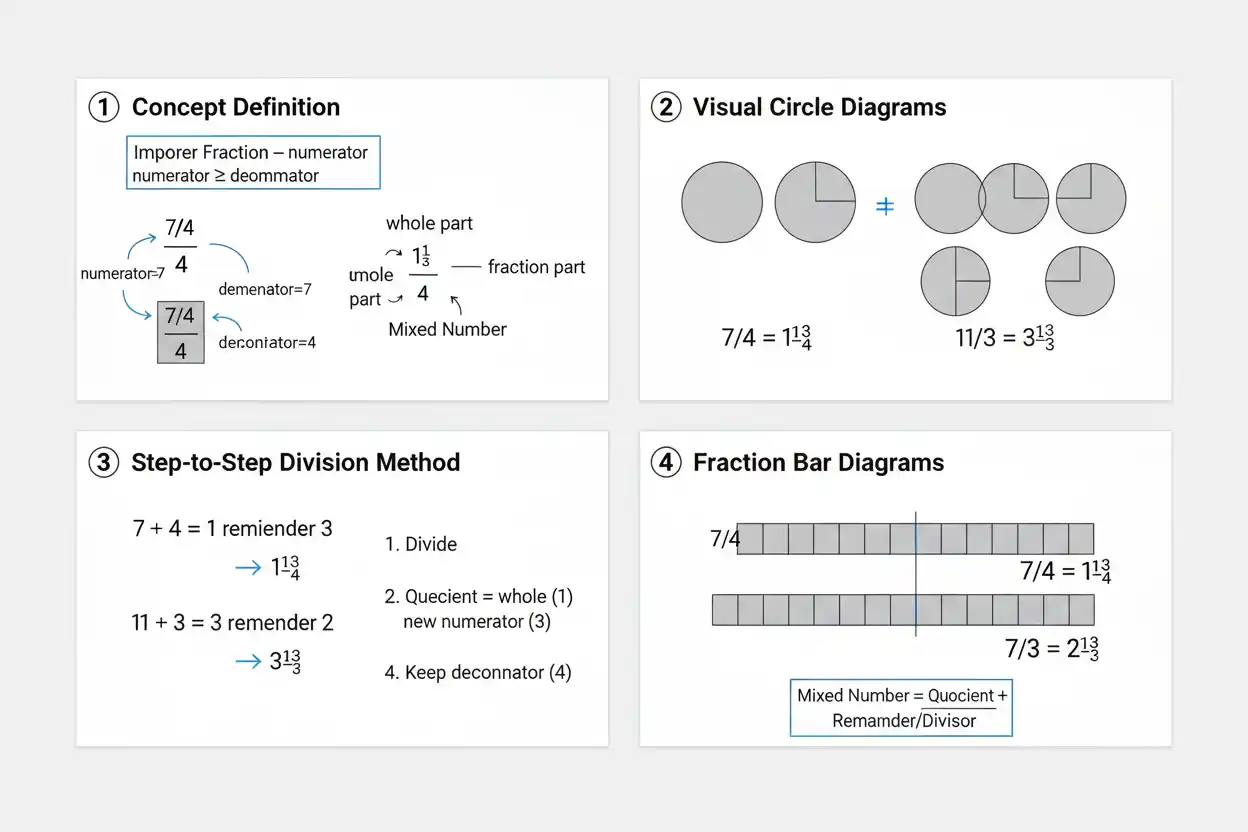

Improper fractions are fractions whose numerator is greater than or equal to the denominator when the denominator is positive. Their values are therefore at least 1 for nonnegative numerators.
Examples include:
5/4
7/3
9/9
13/5
For example:
7/4
means:
7 ÷ 4
which equals:
1 remainder 3
Therefore:
7/4 = 1 3/4
An improper fraction is not an incorrect fraction. It is often the most convenient form for multiplication, division, algebra, and other calculations.
What Is an Improper Fraction?
For a positive denominator b, a fraction:
a/b
is improper when:
a ≥ b
for nonnegative a.
Examples:
4/4
6/5
17/8
Their values are:
4/4 = 1
6/5 = 1.2
17/8 = 2.125
A fraction such as:
3/5
is a proper fraction because:
3 < 5
and its value lies between 0 and 1.
Improper Fraction Rule
For positive integers a and b:
a/b is improper when a ≥ b
The fraction can be converted to a mixed number by dividing:
a = bq + r
where:
q = whole-number part
r = remainder
Then:
a/b = q r/b
with:
0 ≤ r < b
This quotient-and-remainder relationship comes directly from division.
Example: Convert 11/4 to a Mixed Number
Divide:
11 ÷ 4 = 2 remainder 3
So:
11 = 4 × 2 + 3
Therefore:
11/4 = 2 + 3/4
or:
11/4 = 2 3/4
The quotient becomes the whole-number part, while the remainder remains over the original denominator.
Example: Convert 17/5
Divide:
17 ÷ 5 = 3 remainder 2
Therefore:
17 = 5 × 3 + 2
and:
17/5 = 3 2/5
So:
17/5 = 3 2/5
Example With No Remainder
Consider:
12/4
Divide:
12 ÷ 4 = 3
The remainder is zero.
Therefore:
12/4 = 3
A fraction whose numerator is exactly divisible by its denominator simplifies to a whole number rather than a mixed number with a nonzero fractional part.
Improper Fraction vs. Proper Fraction
A positive proper fraction satisfies:
numerator < denominator
Example:
3/8
Its value is:
0.375
An improper fraction satisfies:
numerator ≥ denominator
Example:
9/8
Its value is:
1.125
So the distinction depends on the relative sizes of the numerator and denominator.
Improper Fraction vs. Mixed Number
An improper fraction expresses the entire quantity as one numerator over one denominator:
11/4
A mixed number separates the value into a whole number and a proper fractional part:
2 3/4
These are exactly equivalent:
11/4 = 2 3/4
The two forms differ only in representation.
Why Improper Fractions Are Useful
Improper fractions are often easier than mixed numbers when performing calculations.
For example:
1 1/2 × 2 1/3
requires more care if the mixed numbers are used directly.
Convert:
1 1/2 = 3/2
2 1/3 = 7/3
Then:
3/2 × 7/3 = 7/2
The fraction operations become straightforward after conversion.
Converting a Mixed Number to an Improper Fraction
For:
w n/d
multiply the whole number w by denominator d, then add numerator n.
The formula is:
w n/d = (wd + n)/d
For example:
3 2/5
Calculate:
3 × 5 + 2
= 15 + 2
= 17
Therefore:
3 2/5 = 17/5
Why the Mixed-to-Improper Formula Works
Consider:
3 2/5
The whole-number portion is:
3 = 15/5
Add:
15/5 + 2/5
= 17/5
Therefore:
3 2/5 = 17/5
The denominator stays 5 because both components are being expressed in fifths.
Example: Convert 4 3/8
Use:
(4 × 8 + 3)/8
Calculate:
4 × 8 = 32
32 + 3 = 35
Therefore:
4 3/8 = 35/8
Check:
35 ÷ 8 = 4 remainder 3
which returns:
4 3/8
Example: Convert 7 5/6
Calculate:
7 × 6 + 5
= 42 + 5
= 47
Therefore:
7 5/6 = 47/6
The denominator remains:
6
Converting an Improper Fraction to a Mixed Number
To convert:
a/b
divide a by b.
Suppose:
29/6
Calculate:
29 ÷ 6 = 4 remainder 5
Therefore:
29/6 = 4 5/6
The denominator does not change because the leftover portion is still measured in sixths.
Example: Convert 52/9
Divide:
52 ÷ 9 = 5 remainder 7
because:
9 × 5 = 45
and:
52 – 45 = 7
Therefore:
52/9 = 5 7/9
Simplifying an Improper Fraction
Improper fractions can be reduced like any other fraction.
Consider:
18/12
The greatest common factor of 18 and 12 is:
6
Divide:
18 ÷ 6 = 3
12 ÷ 6 = 2
Therefore:
18/12 = 3/2
As a mixed number:
3/2 = 1 1/2
Simplification and mixed-number conversion are separate steps.
Example: Simplify 42/30
Find:
GCF(42,30) = 6
Then:
42/30 = 7/5
The simplified improper fraction is:
7/5
If desired:
7/5 = 1 2/5
The improper form is already fully valid and often preferable for further calculation.
Do Improper Fractions Have to Be Converted?
No.
For example:
13/4
is a complete exact answer.
It can also be written:
3 1/4
Neither form is inherently more mathematically correct.
Improper fractions are often preferable in equations and calculations because they behave as ordinary ratios without a separate whole-number part.
Mixed numbers may be more intuitive when describing measurements or quantities in everyday contexts.
Improper Fractions Equal to Whole Numbers
If the numerator is a multiple of the denominator, an improper fraction simplifies to an integer.
Examples:
8/4 = 2
15/5 = 3
36/9 = 4
The condition is:
numerator mod denominator = 0
In these cases, there is no remaining proper fractional part.
Adding Improper Fractions
Consider:
7/4 + 5/6
Find a common denominator.
The LCM of 4 and 6 is:
12
Convert:
7/4 = 21/12
5/6 = 10/12
Add:
21/12 + 10/12 = 31/12
Therefore:
7/4 + 5/6 = 31/12
As a mixed number:
31/12 = 2 7/12
The answer remains improper until conversion is requested or useful.
Subtracting Improper Fractions
Calculate:
11/6 – 7/4
Use denominator 12:
11/6 = 22/12
7/4 = 21/12
Subtract:
22/12 – 21/12 = 1/12
Therefore:
11/6 – 7/4 = 1/12
An operation involving two improper fractions can produce a proper fraction.
Multiplying Improper Fractions
Consider:
7/3 × 9/14
Before multiplying, simplify common factors.
Cancel:
7/14 = 1/2
and:
9/3 = 3
Then:
1 × 3 / 2
= 3/2
Therefore:
7/3 × 9/14 = 3/2
As a mixed number:
1 1/2
Dividing Improper Fractions
Calculate:
8/3 ÷ 10/7
Multiply by the reciprocal:
8/3 × 7/10
Simplify:
8/10 = 4/5
Then:
4 × 7 / (3 × 5)
= 28/15
Therefore:
8/3 ÷ 10/7 = 28/15
As a mixed number:
1 13/15
Improper Fractions With Negative Values
Signs require a little care because the usual “numerator greater than denominator” description assumes nonnegative fractions with positive denominators.
For example:
-7/4
has magnitude greater than 1:
|-7/4| = 7/4
and can be written:
-1 3/4
The fraction is often informally described as an improper negative fraction because its absolute numerator exceeds its positive denominator.
It is clearest to keep the denominator positive:
-7/4
rather than:
7/-4
Negative Mixed Number Conversion
Consider:
-2 1/3
This means the negative of:
2 1/3
Convert the magnitude:
2 1/3 = 7/3
Therefore:
-2 1/3 = -7/3
Care must be taken not to interpret the expression as:
-2 + 1/3
which would equal:
-5/3
The conventional mixed-number sign applies to the entire mixed number.
Improper Fractions and Integer Operations
The numerator and denominator are integers, so integer operations determine signs, multiplication, addition, and subtraction inside fraction calculations.
For example:
(-12)/(-5) = 12/5
because:
negative ÷ negative = positive
Similarly:
(-12)/5 = -12/5
The fraction structure does not change the ordinary sign rules.
Improper Fractions Are Rational Numbers
Every improper fraction:
a/b
with integers a and b ≠ 0 is a rational number.
For example:
17/5
is rational because it is a ratio of two integers.
Its decimal form is:
3.4
Similarly:
11/3 = 3.666…
The decimal may terminate or repeat, but the number remains rational.
Improper Fractions Are Not Irrational Numbers
An irrational number cannot be expressed exactly as:
a/b
for integers a and nonzero b.
Therefore an exact improper fraction is always rational, never irrational.
For example:
7/4
is rational.
But:
√2
is irrational and cannot be represented exactly by any improper fraction of integers.
A fraction such as:
1414/1000
may approximate √2, but it is not exactly equal to it.
Improper Fractions and Decimal Conversion
To convert an improper fraction to decimal form, divide numerator by denominator.
For:
13/8
calculate:
13 ÷ 8 = 1.625
Therefore:
13/8 = 1.625
For:
10/3
the result repeats:
10/3 = 3.333…
The fraction remains exact even when its decimal expansion is nonterminating.
Decimal to Improper Fraction
A decimal greater than 1 can often be converted directly to an improper fraction.
For example:
2.75
Write:
275/100
Simplify:
275/100 = 11/4
Therefore:
2.75 = 11/4
The detailed reverse conversion is covered by decimal to fraction.
Improper Fractions to Percent
An improper fraction converts to a percentage using:
Percentage = fraction × 100%
For example:
5/4 × 100%
= 125%
Therefore:
5/4 = 125%
A percentage greater than 100% is expected because the fraction itself is greater than 1.
The dedicated fraction to percent page covers the conversion procedure in detail.
Example: 7/5 as a Percent
Calculate:
7/5 = 1.4
Then:
1.4 × 100% = 140%
Therefore:
7/5 = 140%
The fraction, decimal, mixed-number, and percentage forms all represent the same value:
7/5 = 1 2/5 = 1.4 = 140%
Improper Fractions in Ratios
Suppose two quantities are compared as:
7:4
The corresponding quotient is:
7/4
which is an improper fraction.
This simply means the first quantity is:
1.75 times
the second.
Improper fractions therefore appear naturally whenever one compared quantity exceeds another.
Improper Fractions in Measurement
Suppose a board measures:
9/4 meters
Convert:
9 ÷ 4 = 2 remainder 1
Therefore:
9/4 m = 2 1/4 m
In a practical measurement, the mixed form may be easier to interpret, while the improper form may be easier to use in calculations.
Improper Fractions in Algebra
Suppose:
x = 15/4
The improper fraction is often preferable to:
x = 3 3/4
because algebraic operations are usually simpler with one fraction bar.
For example:
2x = 2 × 15/4
Simplify:
30/4 = 15/2
The calculation remains compact.
Improper Fractions in a Harmonic Sequence
Terms in a harmonic sequence are determined by the arithmetic behavior of their reciprocals.
Whether an individual term is proper or improper is a separate issue.
For example, if reciprocal terms are:
1/2, 1, 3/2, 2, …
their reciprocals are:
2, 1, 2/3, 1/2, …
The first value:
2 = 2/1
can be viewed as an improper fraction.
The sequence is harmonic because the reciprocal sequence has constant difference, not because of the proper/improper classification of individual terms.
Improper Fractions and Geometric Sequences
A geometric sequence may also contain improper fractions.
For example:
3/2, 3, 6, 12, …
has common ratio:
2
The first term:
3/2
is improper.
Its classification as an improper fraction says nothing about whether the sequence is geometric; the sequence property comes from the constant ratio.
Improper Fractions and Hexadecimal
Hexadecimal changes how numbers are represented, but it does not change the underlying fraction relationship.
For example:
31/16
is an improper fraction in decimal integer notation.
Its value is:
1 + 15/16
and since:
15 = F₁₆
the same numerical value can be written in hexadecimal positional notation as:
1.F₁₆
The fraction remains a rational value regardless of the numeral system used to express its components or result.
Simplifying Before Converting to a Mixed Number
Suppose:
24/18
You could immediately divide:
24 ÷ 18 = 1 remainder 6
giving:
1 6/18
But the fractional part is not simplified.
Instead, first reduce:
24/18 = 4/3
Then:
4/3 = 1 1/3
Therefore:
24/18 = 1 1/3
This produces the final mixed number in simplest form.
Converting First, Then Simplifying
The reverse order can also work.
For:
42/30
divide:
42 ÷ 30 = 1 remainder 12
So:
42/30 = 1 12/30
Simplify:
12/30 = 2/5
Therefore:
42/30 = 1 2/5
Both routes produce the same result.
Improper Fraction and Floor Value
An improper fraction can be separated into its whole part using the floor function when the value is nonnegative.
For example:
17/5 = 3.4
Then:
floor(17/5) = 3
The whole-number portion is 3.
The remainder calculation gives:
17 – 5 × 3 = 2
so:
17/5 = 3 2/5
The dedicated floor and ceiling functions page treats those integer-boundary functions more broadly.
Counting Whole Units in an Improper Fraction
Suppose:
23/6
The number of complete sixth-sized groups that make whole units is determined through division:
23 ÷ 6 = 3 remainder 5
So there are:
3 complete wholes
and:
5/6
remaining.
Therefore:
23/6 = 3 5/6
This interpretation makes the mixed-number conversion visually intuitive.
Common Mistake: Adding Numerator and Denominator
To convert:
7/4
into a mixed number, do not calculate:
7 + 4
or:
7 – 4
Instead divide:
7 ÷ 4 = 1 remainder 3
Therefore:
7/4 = 1 3/4
Common Mistake: Changing the Denominator
When:
17/5 = 3 remainder 2
the fractional remainder is:
2/5
not:
2/3
and not:
2/17
The original denominator remains unchanged.
Therefore:
17/5 = 3 2/5
Common Mistake: Treating Improper Fractions as Invalid
An improper fraction such as:
19/7
is already a valid exact number.
There is no mathematical requirement to rewrite it as:
2 5/7
unless the context calls for mixed-number notation.
In many calculations, 19/7 is actually the simpler form to use.
Common Mistake: Incorrect Mixed-to-Improper Conversion
For:
3 2/5
a common error is:
(3 + 2)/5 = 5/5
The correct calculation is:
(3 × 5 + 2)/5
= 17/5
The whole number represents three complete groups of five fifths:
3 = 15/5
Then the additional two fifths make:
17/5
Common Mistake: Forgetting to Simplify
Consider:
18/12
Converting immediately gives:
1 6/12
But:
6/12 = 1/2
Therefore the simplest mixed form is:
1 1/2
Similarly, the simplest improper form is:
3/2
How to Check an Improper-to-Mixed Conversion
Suppose:
23/7 = 3 2/7
Convert the mixed number back:
3 × 7 + 2
= 21 + 2
= 23
Place over the denominator:
23/7
The original improper fraction is recovered.
How to Check a Mixed-to-Improper Conversion
Suppose:
4 5/6 = 29/6
Divide:
29 ÷ 6 = 4 remainder 5
This reproduces:
4 5/6
Therefore the conversion is correct.
Frequently Asked Questions
What is an improper fraction?
An improper fraction has a numerator greater than or equal to its positive denominator.
Examples include:
5/4, 7/3, 9/9
Is 4/4 an improper fraction?
Yes, under the usual definition because:
numerator = denominator
and:
4/4 = 1
Is an improper fraction wrong?
No. Improper fractions are valid exact numerical representations and are often easier to use in calculations than mixed numbers.
How do you convert an improper fraction to a mixed number?
Divide the numerator by the denominator. The quotient becomes the whole-number part and the remainder becomes the new numerator over the original denominator.
What is 7/4 as a mixed number?
7 ÷ 4 = 1 remainder 3
Therefore:
7/4 = 1 3/4
What is 11/3 as a mixed number?
11 ÷ 3 = 3 remainder 2
Therefore:
11/3 = 3 2/3
How do you convert a mixed number to an improper fraction?
Use:
(whole number × denominator + numerator) / denominator
What is 2 3/5 as an improper fraction?
(2 × 5 + 3)/5
= 13/5
Can an improper fraction simplify to a whole number?
Yes.
For example:
20/5 = 4
Can an improper fraction be negative?
Yes. A value such as -7/4 is commonly treated as a negative improper fraction because its magnitude exceeds 1.
Are improper fractions rational numbers?
Yes. Every fraction of integers with nonzero denominator is rational.
Are improper fractions easier than mixed numbers for calculations?
Often, yes. Multiplication, division, addition, and algebra generally work more directly with improper fractions.
Final Example
Convert:
58/12
to simplest improper form and mixed-number form.
First simplify.
Find:
GCF(58,12) = 2
Divide:
58 ÷ 2 = 29
12 ÷ 2 = 6
Therefore:
58/12 = 29/6
Now convert 29/6 to a mixed number.
Divide:
29 ÷ 6 = 4 remainder 5
Therefore:
29/6 = 4 5/6
So:
58/12 = 29/6 = 4 5/6
The essential rule is simple: an improper fraction represents one or more whole units as a single fraction. Use division to separate those whole units when a mixed number is useful, and use multiplication plus addition to convert a mixed number back into an improper fraction.