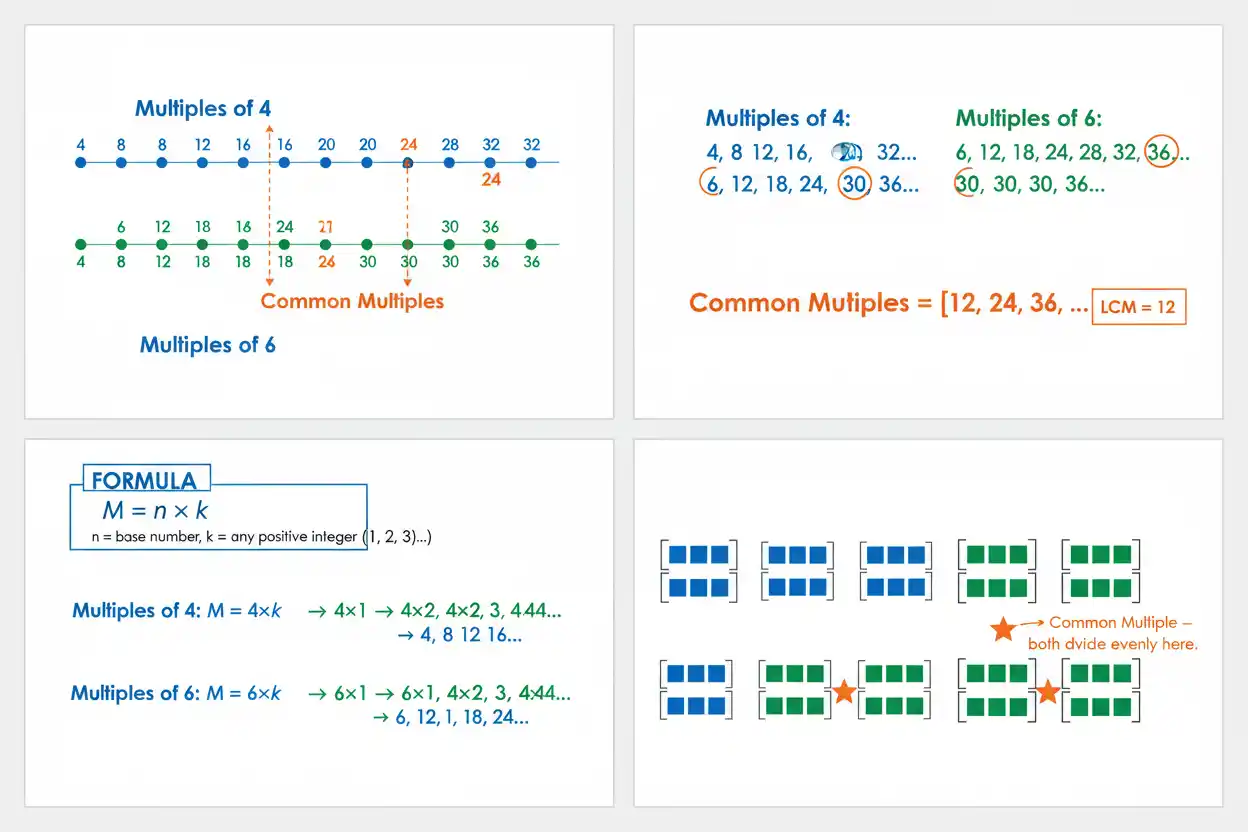

Multiples of a number are values produced by multiplying that number by integers. For example, positive multiples of 5 are:
5, 10, 15, 20, 25, 30, …
because:
5 × 1 = 5
5 × 2 = 10
5 × 3 = 15
and so on.
The general formula is:
M = n × k
where:
n = the original number
k = an integer
M = a multiple of n
For example:
7 × 8 = 56
so:
56 is a multiple of 7
Multiples are fundamental in arithmetic and number theory and are used in divisibility, common multiples, least common multiples, fractions, repeating schedules, sequences, and modular arithmetic.
What Is a Multiple?
An integer M is a multiple of an integer n when there is some integer k such that:
M = nk
For example:
36 = 9 × 4
Therefore:
36 is a multiple of 9
Likewise:
-36 = 9 × (-4)
so negative multiples also exist.
In elementary problems, “multiples” often refers primarily to positive multiples unless the context includes zero and negative integers.
First Multiples of a Number
The first positive multiples of 3 are:
3, 6, 9, 12, 15, 18, 21, …
The first positive multiples of 8 are:
8, 16, 24, 32, 40, 48, …
The first positive multiples of 12 are:
12, 24, 36, 48, 60, 72, …
Each list continues indefinitely.
Formula for the kth Multiple
If you want the kth positive multiple of positive integer n:
Mₖ = nk
For example, the 15th positive multiple of 7 is:
M₁₅ = 7 × 15
= 105
Therefore:
The 15th positive multiple of 7 is 105
This is a simple number sequence with constant difference n.
Multiples Form an Arithmetic Sequence
Positive multiples of n are:
n, 2n, 3n, 4n, …
The difference between consecutive terms is always:
n
For example:
6, 12, 18, 24, 30, …
has differences:
6, 6, 6, 6, …
Therefore the positive multiples of a fixed integer form an arithmetic sequence.
The nth term is:
aₙ = n × d
when d is the number whose multiples are being listed and indexing begins with the first positive multiple.
Multiples of 2
Positive multiples of 2 are:
2, 4, 6, 8, 10, 12, …
These are exactly the positive even integers.
For any integer k:
2k
is even.
This gives a direct algebraic definition of evenness.
Multiples of 3
The positive multiples of 3 are:
3, 6, 9, 12, 15, 18, 21, …
A number is a multiple of 3 exactly when it is divisible by 3.
For example:
57 ÷ 3 = 19
so:
57 is a multiple of 3
The divisibility rules can often identify multiples without performing full division.
Multiples of 5
Positive multiples of 5 are:
5, 10, 15, 20, 25, 30, …
In decimal notation, a positive integer is divisible by 5 when its final digit is:
0 or 5
Therefore:
65
is a multiple of 5, while:
67
is not.
Multiples of 10
Positive multiples of 10 include:
10, 20, 30, 40, 50, …
In decimal notation, every integer multiple of 10 ends in:
0
For example:
270 = 10 × 27
so 270 is a multiple of 10.
Zero Is a Multiple
Zero is a multiple of every integer because:
n × 0 = 0
Therefore:
0 is a multiple of n
for every integer n.
For example:
7 × 0 = 0
so zero is a multiple of 7.
However, when listing positive multiples, zero is excluded because:
0 is not positive.
Every Number Is a Multiple of Itself
For any integer n:
n = n × 1
Therefore:
n is a multiple of itself
For example:
14 = 14 × 1
so 14 is a multiple of 14.
Every Integer Is a Multiple of 1
For any integer n:
n = 1 × n
Therefore every integer is a multiple of 1.
Examples:
7 = 1 × 7
-20 = 1 × (-20)
0 = 1 × 0
So the set of multiples of 1 is the entire set of integers.
Positive and Negative Multiples
If positive and negative integer multipliers are allowed, multiples of 4 include:
…, -16, -12, -8, -4, 0, 4, 8, 12, 16, …
because each value can be written:
4k
for some integer k.
Positive-multiple lists usually show only:
4, 8, 12, 16, …
but the broader integer definition includes both signs and zero.
Multiples vs. Factors
Factors and multiples describe inverse divisibility relationships.
If:
24 = 6 × 4
then:
24 is a multiple of 6
and:
6 is a factor of 24
A positive integer has finitely many positive factors but infinitely many positive multiples.
For example, 6 has factors:
1, 2, 3, 6
but multiples:
6, 12, 18, 24, 30, …
continuing forever.
How to Check Whether a Number Is a Multiple
To determine whether M is a multiple of n, divide:
M ÷ n
If the quotient is an integer with remainder zero, M is a multiple of n.
For example, test whether:
156
is a multiple of 12.
Calculate:
156 ÷ 12 = 13
Since 13 is an integer:
156 is a multiple of 12
Example: Is 145 a Multiple of 6?
Divide:
145 ÷ 6 = 24 remainder 1
Since the remainder is not zero:
145 is not a multiple of 6
In modular notation:
145 mod 6 = 1
A multiple would need:
145 mod 6 = 0
Multiples and Modular Arithmetic
The relationship is especially concise in modular arithmetic.
An integer M is a multiple of n exactly when:
M ≡ 0 (mod n)
For example:
84 mod 7 = 0
Therefore:
84 is a multiple of 7
Likewise:
85 mod 7 = 1
so 85 is not.
Multiples and Congruence
If two integers differ by a multiple of n, they are congruent modulo n.
For example:
38 – 3 = 35
and:
35 = 5 × 7
Therefore:
38 ≡ 3 (mod 5)
The difference being a multiple of the modulus is precisely what creates modular equivalence.
Common Multiples
A common multiple of two or more numbers is a number that is a multiple of every number in the group.
Consider:
4 and 6
Multiples of 4:
4, 8, 12, 16, 20, 24, …
Multiples of 6:
6, 12, 18, 24, 30, …
Common multiples include:
12, 24, 36, 48, …
There are infinitely many positive common multiples.
Least Common Multiple
The smallest positive common multiple is the least common multiple.
For:
4 and 6
the first shared positive multiple is:
12
Therefore:
LCM(4,6) = 12
The dedicated least common multiple page covers systematic calculation methods, while the shorter LCM page focuses on the core concept.
Example: Common Multiples of 6 and 8
Multiples of 6:
6, 12, 18, 24, 30, 36, 42, 48, …
Multiples of 8:
8, 16, 24, 32, 40, 48, …
Shared values begin:
24, 48, 72, …
Therefore:
24 is the least positive common multiple
and every positive common multiple is itself a multiple of:
24
Multiples of an LCM
If:
L = LCM(a,b)
then every positive common multiple of a and b is a positive multiple of L.
For example:
LCM(6,8) = 24
Common multiples are:
24, 48, 72, 96, …
which can be written:
24 × 1
24 × 2
24 × 3
24 × 4
This gives a compact description of the complete common-multiple set.
Multiples and Prime Numbers
A prime number has exactly two positive factors, but it still has infinitely many positive multiples.
For prime 7:
7, 14, 21, 28, 35, …
are all multiples.
Primality restricts the number’s factors, not its number of multiples.
Multiples and Composite Numbers
A composite number also has infinitely many multiples.
For example, 12 is composite and its positive multiples are:
12, 24, 36, 48, 60, …
The difference between prime and composite numbers concerns their factors, not whether they generate a multiple sequence.
Multiples and Prime Factorization
Prime factorization provides a structural way to recognize many multiples.
Suppose:
12 = 2² × 3
Any integer multiple of 12 must contain at least those factors after multiplication by an integer.
For example:
60 = 2² × 3 × 5
so:
12 divides 60
and:
60 = 12 × 5
Therefore 60 is a multiple of 12.
Multiples and Divisibility Rules
Divisibility tests are essentially fast methods for recognizing multiples.
For example, a number is a multiple of 9 exactly when it is divisible by 9.
Consider:
5,832
Digit sum:
5 + 8 + 3 + 2 = 18
Since:
18
is a multiple of 9:
5,832
is also divisible by 9.
Indeed:
5,832 ÷ 9 = 648
So:
5,832 is a multiple of 9
Multiples in Fraction Operations
Common multiples are important in fraction operations because denominators must be matched for addition and subtraction.
Consider:
1/6 + 1/8
A common denominator must be a common multiple of:
6 and 8
Possible choices include:
24, 48, 72, …
The least convenient choice is:
24
Then:
1/6 = 4/24
1/8 = 3/24
so:
1/6 + 1/8 = 7/24
Multiples and Mixed Numbers
Mixed numbers may need common denominators when added or subtracted.
For example:
2 1/6 + 1 1/4
The denominators are:
6 and 4
Common multiples include:
12, 24, 36, …
The least common denominator is:
12
Convert:
1/6 = 2/12
1/4 = 3/12
Therefore:
2 1/6 + 1 1/4 = 3 5/12
Multiples support the denominator conversion without changing either fractional value.
Multiples and Number Sequences
The positive multiples of any fixed positive integer create a regular number sequence.
For example, multiples of 9:
9, 18, 27, 36, 45, …
have nth-term formula:
aₙ = 9n
The sequence has constant difference:
9
So multiple lists are one of the simplest examples of arithmetic sequences.
Find the 100th Multiple
Find the 100th positive multiple of 13.
Use:
Mₖ = nk
Substitute:
M₁₀₀ = 13 × 100
= 1,300
Therefore:
The 100th positive multiple of 13 is 1,300
No need to list the preceding 99 values.
Which Multiple Is 168 of 12?
Suppose:
168 = 12k
Solve:
k = 168/12
= 14
Therefore:
168 is the 14th positive multiple of 12
This is the inverse question to calculating 12 × k.
Multiples Between Two Limits
Suppose you need multiples of 7 between 20 and 50.
The positive multiples of 7 nearby are:
7, 14, 21, 28, 35, 42, 49, 56
Restrict to the interval:
21, 28, 35, 42, 49
Therefore there are:
5 multiples of 7 between 20 and 50 inclusive
Counting Multiples Up to n
The number of positive multiples of positive integer d that are at most N is:
floor(N/d)
For example, count positive multiples of 6 up to 100:
floor(100/6)
Since:
100/6 ≈ 16.666…
we get:
floor(100/6) = 16
Therefore there are:
16 positive multiples of 6 from 1 through 100
The largest is:
6 × 16 = 96
Counting Multiples in an Interval
To count multiples of positive integer d from A through B, inclusive, one useful formula is:
floor(B/d) – floor((A-1)/d)
For example, count multiples of 5 from 23 through 87.
Up to 87:
floor(87/5) = 17
Up to 22:
floor(22/5) = 4
Subtract:
17 – 4 = 13
Therefore:
There are 13 multiples of 5 from 23 through 87
Multiples and Floor Functions
The counting formula naturally uses the floor and ceiling functions.
For:
N = 250
and:
d = 12
calculate:
floor(250/12)
Since:
12 × 20 = 240
and:
12 × 21 = 252
there are:
20 positive multiples of 12 not exceeding 250
Common Multiples in Repeating Schedules
Suppose one event repeats every:
8 days
and another every:
12 days
The first event occurs after:
8,16,24,32,…
days.
The second occurs after:
12,24,36,…
days.
Their common occurrence times are common multiples:
24,48,72,…
So if both happen today, they next coincide after:
24 days
Multiples in Clock and Cycle Problems
Suppose a process repeats every 15 minutes.
Its repeat times after the start are:
15,30,45,60,75,…
These are multiples of 15.
If another process repeats every 20 minutes, simultaneous repetitions occur at common multiples of 15 and 20:
60,120,180,…
The first simultaneous repeat is their LCM.
Multiples and Modular Inverses
The modular inverse condition:
ax ≡ 1 (mod n)
means:
ax – 1
is a multiple of n.
For example:
3 × 5 – 1 = 14
and:
14 = 7 × 2
Therefore:
3 × 5 ≡ 1 (mod 7)
so:
5
is the inverse of 3 modulo 7.
Multiples therefore help express why modular congruence works.
Multiples and Nth Roots
Nth roots answer a different type of relationship.
For example:
3³ = 27
means:
∛27 = 3
The fact that:
27
is also a multiple of 3:
27 = 3 × 9
does not make multiplication and root extraction the same operation.
Some numbers can simultaneously have useful power and multiple relationships, but the tests are distinct.
Multiples and Powers
A power can also be a multiple of its base when integer exponents are positive.
For example:
5³ = 125
and:
125 = 5 × 25
so 125 is a multiple of 5.
More generally, for positive integer n and integer k ≥ 1:
n^k = n × n^(k-1)
Therefore:
n^k is a multiple of n
Multiples and Factorials
For positive integer n, the factorial:
n!
contains every integer from 1 through n as a factor.
Therefore, for:
1 ≤ k ≤ n
n! is a multiple of k.
For example:
6! = 720
so 720 is a multiple of:
1,2,3,4,5,6
This is one reason factorials have strong divisibility properties.
Multiples of Zero
The expression:
0 × k
always equals:
0
So zero’s integer multiples produce only:
0
This differs from a nonzero integer, which produces infinitely many distinct multiples.
For example:
Multiples of 0 = {0}
under the standard integer-product definition.
Is Every Number a Multiple of Zero?
No.
For a nonzero integer a, there is no integer k satisfying:
a = 0 × k
because:
0 × k = 0
for every k.
Therefore:
Only zero is a multiple of zero
while zero itself is a multiple of every integer.
These two statements are easy to confuse.
Negative Multiples
Multiples can be negative.
For example:
-24
is a multiple of 6 because:
-24 = 6 × (-4)
Likewise:
24
is a multiple of -6 because:
24 = (-6)(-4)
Whether a problem lists negative multiples depends on context.
Are Decimal Values Multiples?
In elementary integer arithmetic, the term multiple normally refers to integer products.
For example:
18
is a multiple of 6 because:
18 = 6 × 3
Although:
9 = 6 × 1.5
the multiplier 1.5 is not an integer, so 9 is not called an integer multiple of 6.
This integer requirement is essential.
Are Mixed Numbers Multiples?
A mixed number is generally not considered an integer multiple unless its total value happens to be an integer multiple.
For example:
2 1/2 = 2.5
is not an integer multiple of 2.
But:
3 2/2
simplifies to:
4
and 4 is a multiple of 2.
Always simplify the numerical value before classifying it.
Common Mistake: Confusing Multiples With Factors
For 6:
Factors:
1,2,3,6
Multiples:
6,12,18,24,30,…
A factor divides 6.
A multiple is divisible by 6.
The two relationships point in opposite directions.
Common Mistake: Stopping a Multiple List Permanently
A nonzero integer has infinitely many integer multiples.
For example:
7,14,21,28,…
never ends.
An exercise may request the “first five multiples,” but that does not mean only five multiples exist.
Common Mistake: Forgetting Zero
If integer multiples are being considered broadly:
0
is a multiple of every integer.
If the problem asks specifically for positive multiples, then zero should not be included.
The wording determines whether zero belongs in the requested list.
Common Mistake: Assuming the Product Is Always the LCM
For:
6 and 8
the product is:
48
but their least common multiple is:
24
because:
24 = 6 × 4
and:
24 = 8 × 3
Common factors allow a common multiple smaller than the raw product.
Common Mistake: Using a Noninteger Multiplier
To prove that M is an integer multiple of n, the relationship:
M = nk
must use an integer k.
For example:
15 = 6 × 2.5
does not make 15 an integer multiple of 6.
The quotient:
15/6 = 2.5
is not an integer.
How to Check a Multiple
Suppose someone claims:
234 is a multiple of 18.
Divide:
234 ÷ 18 = 13
Since the quotient is an integer:
234 is a multiple of 18
Equivalently:
234 = 18 × 13
or:
234 mod 18 = 0
All three statements express the same divisibility relationship.
How to Check a Common Multiple
Suppose:
120
is claimed to be a common multiple of:
8,10,12
Check:
120 ÷ 8 = 15
120 ÷ 10 = 12
120 ÷ 12 = 10
Every quotient is an integer.
Therefore:
120 is a common multiple of 8, 10, and 12
It is also their least common multiple.
Frequently Asked Questions
What are multiples?
Multiples of a number are values obtained by multiplying that number by integers.
What is the formula for a multiple?
M = nk
where k is an integer.
What are the first five multiples of 4?
4, 8, 12, 16, 20
What are the first five multiples of 7?
7, 14, 21, 28, 35
Is zero a multiple of every number?
Yes.
n × 0 = 0
for every integer n.
Is every number a multiple of itself?
Yes.
n × 1 = n
What is the difference between factors and multiples?
A factor divides a number exactly. A multiple is produced by multiplying the number by an integer.
How do you know whether one number is a multiple of another?
Divide. If the quotient is an integer with remainder zero, the first number is a multiple of the second.
What is a common multiple?
A common multiple is a number divisible by every integer being compared.
What is the least common multiple?
It is the smallest positive common multiple.
Are multiples infinite?
Every nonzero integer has infinitely many distinct integer multiples.
Can multiples be negative?
Yes, if negative integer multipliers are included.
Are multiples a number sequence?
The positive multiples of a fixed positive integer form an arithmetic number sequence with constant difference equal to that integer.
Final Example
Find all positive multiples of:
12
that are at most:
100
Use:
Mₖ = 12k
Determine the largest possible k:
k ≤ 100/12
Since:
100/12 ≈ 8.333…
the largest integer k is:
8
Therefore the multiples are:
12 × 1 = 12
12 × 2 = 24
12 × 3 = 36
12 × 4 = 48
12 × 5 = 60
12 × 6 = 72
12 × 7 = 84
12 × 8 = 96
So:
12, 24, 36, 48, 60, 72, 84, 96
are all the positive multiples of 12 up to 100.
There are:
floor(100/12) = 8
such multiples.
The defining rule is straightforward:
M = n × k
with integer k. If one integer can be expressed as another multiplied by an integer, it is a multiple of that number.