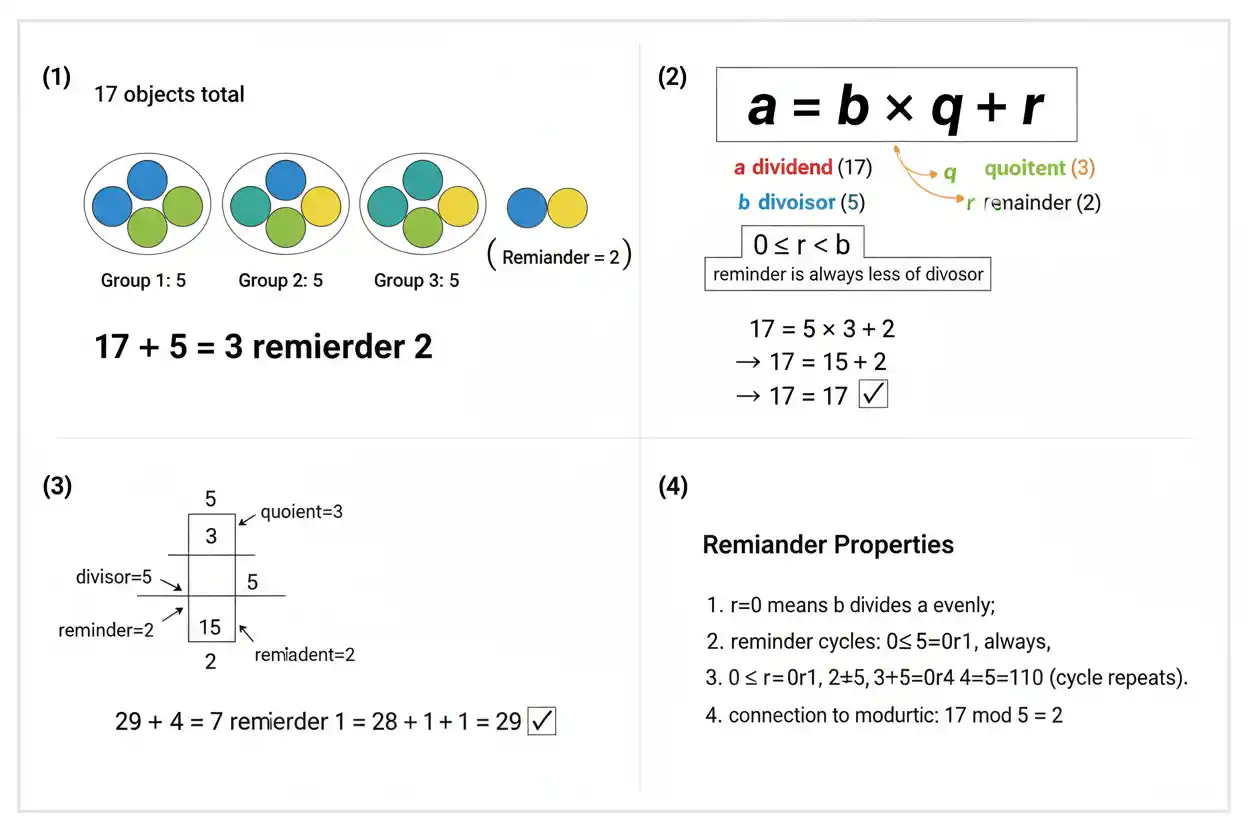
Remainders are the amounts left over after integer division when the dividend is not divided exactly by the divisor.
For positive divisor b, the division algorithm is:
a = bq + r
where:
a = dividendb = divisorq = integer quotientr = remainder
with:
0 ≤ r < b
For example:
17 ÷ 5
gives:
quotient = 3
remainder = 2
because:
17 = 5 × 3 + 2
So:
17 ÷ 5 = 3 remainder 2
The remainder must always be smaller than the positive divisor.
What Is a Remainder?
A remainder is what remains after removing as many complete groups of the divisor as possible.
Suppose:
23 objects
are divided into groups of:
4
Five complete groups use:
4 × 5 = 20
Objects left:
23 – 20 = 3
Therefore:
23 ÷ 4 = 5 remainder 3
The corresponding equation is:
23 = 4(5) + 3
Remainder Formula
For integer dividend a and positive integer divisor b:
a = bq + r
with:
0 ≤ r < b
Solving for the remainder gives:
r = a – bq
where q is the integer quotient chosen so that the remainder satisfies the required range.
Quotient and Remainder
Consider:
38 ÷ 7
The largest multiple of 7 not exceeding 38 is:
7 × 5 = 35
Therefore:
q = 5
and:
r = 38 – 35
= 3
So:
38 = 7 × 5 + 3
and:
38 ÷ 7 = 5 R3
Exact Division
If the dividend is exactly divisible by the divisor, the remainder is zero.
For example:
42 ÷ 7 = 6
because:
42 = 7 × 6 + 0
Therefore:
Remainder = 0
A zero remainder means the divisor is a factor of the dividend.
Remainder Must Be Smaller Than the Divisor
Suppose someone writes:
23 = 4 × 4 + 7
The equation is numerically true:
16 + 7 = 23
but:
7 ≥ 4
so 7 is not the standard remainder.
Another complete group of 4 can be extracted:
7 = 4 + 3
giving:
23 = 4 × 5 + 3
Therefore the correct remainder is:
3
Division Algorithm
For any integer a and positive integer b, there are unique integers q and r such that:
a = bq + r
and:
0 ≤ r < b
This uniqueness means the standard quotient and remainder are determined once the dividend and positive divisor are specified.
Example: 100 ÷ 9
Find the largest multiple of 9 not exceeding 100:
9 × 11 = 99
Subtract:
100 – 99 = 1
Therefore:
100 = 9 × 11 + 1
So:
100 ÷ 9 = 11 remainder 1
Example: 250 ÷ 12
Find:
12 × 20 = 240
Subtract:
250 – 240 = 10
Therefore:
250 = 12 × 20 + 10
So:
250 ÷ 12 = 20 R10
Since:
10 < 12
the remainder is valid.
Example: 1,000 ÷ 16
Calculate:
16 × 62 = 992
Subtract:
1,000 – 992 = 8
Therefore:
1,000 = 16 × 62 + 8
So:
1,000 ÷ 16 = 62 remainder 8
Remainders and Long Division
Long division provides a systematic procedure for finding a quotient and remainder when mental division is inconvenient.
For example:
347 ÷ 12
Long division gives:
quotient = 28
because:
12 × 28 = 336
Subtract:
347 – 336 = 11
Therefore:
347 ÷ 12 = 28 R11
The remainder is the final leftover after all complete divisor groups are removed.
Remainders and Division
The broader division relationship can be written:
Dividend = Divisor × Quotient + Remainder
This gives:
a = bq + r
When:
r = 0
division is exact.
When:
r > 0
the quotient alone does not represent the exact fractional value of the division.
Convert a Remainder to a Fraction
Suppose:
17 ÷ 5 = 3 R2
The remainder can be written as a fraction of the divisor:
2/5
Therefore:
17/5 = 3 + 2/5
= 3 2/5
So:
17 ÷ 5 = 3 R2 = 3 2/5 = 3.4
The quotient-and-remainder form, mixed-number form, and decimal form describe the same division in different ways.
Remainders and Rational Numbers
The exact value of a non-exact integer division is often a rational number.
For:
29 ÷ 4
quotient-remainder form:
7 R1
Fraction form:
29/4
Mixed-number form:
7 1/4
Decimal:
7.25
Thus the remainder connects integer division to fractions and rational values.
Remainders and Ratios
The ratios framework interprets division as comparison.
For:
17 ÷ 5
the exact quotient is represented by ratio:
17:5
or:
17/5
The quotient-and-remainder representation is:
3 R2
while the exact ratio value is:
3 + 2/5
The remainder identifies the fractional part after complete groups have been counted.
Remainder-to-Divisor Ratio
If:
a = bq + r
then:
a/b = q + r/b
For example:
31 = 6 × 5 + 1
Divide everything by 6:
31/6 = 5 + 1/6
The remainder contributes:
r/b
to the exact quotient.
This relationship links integer remainders to the numerical ratio of dividend to divisor.
Remainders and Real Numbers
All integer remainders are integers, and integers belong to the real numbers.
For a positive divisor b, the remainder lies in:
0, 1, 2, …, b-1
So if dividing by 5, the only possible standard remainders are:
0,1,2,3,4
All are real numbers, though quotient-and-remainder division itself is primarily an integer concept.
Possible Remainders
When dividing by a positive integer n, the possible remainders are:
0 through n-1
For division by 2:
0 or 1
For division by 3:
0,1,2
For division by 7:
0,1,2,3,4,5,6
A remainder equal to the divisor is never valid because it would form another complete divisor group.
Even and Odd Numbers From Remainders
Every integer divided by 2 has remainder:
0
or:
1
If:
n mod 2 = 0
the integer is even.
If:
n mod 2 = 1
for nonnegative integers under the standard convention, it is odd.
Equivalently:
even → n = 2q
odd → n = 2q + 1
Remainders therefore give a concise way to classify parity.
Divisibility and Remainders
A number a is divisible by positive integer b exactly when:
remainder = 0
For example:
84 ÷ 7 = 12 R0
Therefore:
7 divides 84.
But:
85 ÷ 7 = 12 R1
so 7 does not divide 85.
This is the underlying idea behind many divisibility rules.
Remainder Notation With mod
The remainder of integer division is often written using mod.
For example:
17 mod 5 = 2
because:
17 = 5 × 3 + 2
Likewise:
29 mod 4 = 1
and:
42 mod 7 = 0
This connects ordinary remainders with modular arithmetic.
Congruence and Equal Remainders
Two integers are congruent modulo n when they leave the same remainder upon division by positive n.
For example:
17 mod 5 = 2
and:
32 mod 5 = 2
Therefore:
17 ≡ 32 (mod 5)
Their difference:
32 – 17 = 15
is divisible by:
5
Remainder Cycles
Remainders often repeat in cycles.
Consider consecutive nonnegative integers modulo 4:
0 mod 4 = 0
1 mod 4 = 1
2 mod 4 = 2
3 mod 4 = 3
4 mod 4 = 0
5 mod 4 = 1
The pattern repeats:
0,1,2,3,0,1,2,3,…
This cyclic behavior is central to modular calculations.
Last Digit as a Remainder
The last decimal digit of a nonnegative integer is its remainder modulo:
10
For example:
347 mod 10 = 7
Therefore the last digit is:
7
Similarly:
5,829 mod 10 = 9
The final digit captures the remainder after division by 10.
Last Two Digits
The last two decimal digits correspond to the remainder modulo:
100
For example:
12,347 mod 100 = 47
Likewise:
8,005 mod 100 = 5
which can be displayed as:
05
when treating the result as a two-digit ending.
Digital Clocks and Remainders
A 12-hour clock uses cyclic arithmetic.
Suppose the current hour is:
10
and 5 hours pass.
Ordinary addition gives:
15
Reduce modulo 12:
15 mod 12 = 3
Therefore the clock shows:
3
The repeated cycle arises because hours are interpreted through remainders.
Days of the Week
Days repeat every:
7
days.
If an event occurs:
100 days
after a Monday, find:
100 mod 7
Since:
7 × 14 = 98
remainder:
2
Move two days after Monday:
Tuesday → Wednesday
Therefore the event occurs on:
Wednesday
Remainders in Grouping Problems
Suppose:
53 people
are placed into groups of:
8
Calculate:
53 ÷ 8
Since:
8 × 6 = 48
remainder:
5
Therefore:
6 complete groups can be formed, with 5 people left over
The practical meaning of the remainder depends on the quantities involved.
Containers and Remainders
Suppose:
102 items
are packed into boxes holding:
12 items each.
Calculate:
102 ÷ 12
= 8 R6
Therefore:
8 complete boxes
can be filled, with:
6 items
remaining.
If every item must be packed, a ninth box is needed even though it will not be full.
This illustrates the difference between remainder and required container count.
Remainders and Floor
For positive divisor b and integer a, the quotient in Euclidean division can be written:
q = floor(a/b)
Then:
r = a – b floor(a/b)
For example:
a = 23
b = 5
Then:
floor(23/5) = floor(4.6)
= 4
So:
r = 23 – 5(4)
= 3
The floor and ceiling functions provide a compact formula for quotient-and-remainder calculations.
Example Using the Remainder Formula
Find the remainder of:
94 ÷ 11
Calculate:
q = floor(94/11)
Since:
94/11 ≈ 8.545
we get:
q = 8
Then:
r = 94 – 11(8)
= 94 – 88
= 6
Therefore:
94 mod 11 = 6
Negative Dividends
For negative integers, remainder conventions must be stated clearly.
Using the Euclidean convention with positive divisor b:
0 ≤ r < b
Consider:
-17 ÷ 5
We need:
-17 = 5q + r
with:
0 ≤ r < 5
Choose:
q = -4
Then:
5(-4) = -20
and:
-17 = -20 + 3
Therefore:
-17 = 5(-4) + 3
so the Euclidean remainder is:
3
Why Negative Remainders Can Differ Between Systems
Some programming languages and calculators define % using truncated division rather than Euclidean division.
Under another convention, a negative dividend may produce:
-17 % 5 = -2
instead of:
3
Both can arise from different quotient rules.
For mathematical Euclidean division with positive divisor, this page uses:
0 ≤ r < b
so:
-17 mod 5 = 3
When software behavior matters, check the system’s remainder definition.
Negative Divisors
The cleanest standard division-algorithm statement assumes:
b > 0
If a divisor is negative, the problem can usually be rewritten using its positive magnitude before interpreting the Euclidean remainder.
This avoids ambiguity about the allowed remainder range.
Remainder of a Smaller Positive Number
If:
0 ≤ a < b
then dividing a by b gives quotient:
0
and remainder:
a
For example:
4 ÷ 9
gives:
0 R4
because:
4 = 9(0) + 4
Therefore:
4 mod 9 = 4
Remainder When Dividing by 1
Every integer is divisible by 1.
Therefore:
a mod 1 = 0
For example:
357 = 1 × 357 + 0
So:
357 mod 1 = 0
There is only one possible remainder when dividing by 1:
0
Remainder When Dividend Equals Divisor
If:
a = b > 0
then:
a ÷ b = 1
exactly.
Therefore:
a mod a = 0
For example:
17 mod 17 = 0
Remainders of Sums
For integer arithmetic:
(a+b) mod n
can be found from the individual remainders.
If:
a mod n = r₁
and:
b mod n = r₂
then:
(a+b) mod n = (r₁+r₂) mod n
For example:
38 mod 7 = 3
25 mod 7 = 4
Then:
38 + 25 = 63
and:
(3+4) mod 7 = 0
Indeed:
63 mod 7 = 0
Remainders of Products
Similarly:
(ab) mod n = [(a mod n)(b mod n)] mod n
For example:
17 mod 5 = 2
13 mod 5 = 3
Multiply remainders:
2 × 3 = 6
Then:
6 mod 5 = 1
Check directly:
17 × 13 = 221
221 mod 5 = 1
The results agree.
Powers and Remainder Patterns
Powers often produce repeating remainder cycles.
Consider powers of 2 modulo 5:
2¹ mod 5 = 2
2² mod 5 = 4
2³ mod 5 = 3
2⁴ mod 5 = 1
2⁵ mod 5 = 2
The cycle:
2,4,3,1
repeats every four exponents.
This allows large-power remainders to be found without calculating the full power.
Example: Remainder of 2¹⁰⁰ ÷ 5
The powers of 2 modulo 5 repeat with period:
4
Calculate:
100 mod 4 = 0
Therefore use the fourth position of the cycle:
1
Hence:
2¹⁰⁰ mod 5 = 1
No expansion of 2¹⁰⁰ is necessary.
Rounding Is Not the Same as Remainder Division
Rounding rules approximate numerical values to a selected place or precision.
Remainders describe exact leftover amounts after integer division.
For example:
17/5 = 3.4
Rounded to the nearest integer:
3
But quotient-and-remainder form is:
3 R2
The value 2 is not produced by rounding; it is the exact leftover after forming three complete groups of five.
Roots and Remainders Are Different Operations
The mapped roots topic reverses exponentiation.
For example:
√25 = 5
Remainder division instead asks:
a = bq + r
For example:
25 ÷ 6 = 4 R1
A root identifies a base whose power gives a value; a remainder identifies the leftover after integer division.
The two operations serve separate mathematical purposes.
Remainders and Perfect Divisibility
If:
a mod b = 0
then:
b
is a factor of:
a
For example:
144 mod 12 = 0
Therefore:
12 divides 144 exactly.
If:
144 mod 10 = 4
then 10 is not a factor of 144.
Remainders and Prime Testing
A candidate integer n is composite if some tested prime p gives:
n mod p = 0
For example:
221 mod 13 = 0
Therefore:
13
is a factor of 221.
Indeed:
221 = 13 × 17
Remainder testing is therefore fundamental to checking divisibility and primality.
Common Mistake: Allowing the Remainder to Equal the Divisor
For divisor:
6
valid remainders are:
0,1,2,3,4,5
A claimed remainder:
6
means another full group of 6 can be extracted.
Therefore it is not in standard form.
Common Mistake: Confusing Remainder With Decimal Part
For:
17 ÷ 5
the remainder is:
2
The decimal part of the exact quotient:
3.4
is:
0.4
They are connected by:
2/5 = 0.4
but they are not numerically the same quantity.
Common Mistake: Forgetting the Quotient Is an Integer
In quotient-and-remainder division:
a = bq + r
the quotient q is an integer.
If ordinary decimal division is allowed, the exact quotient already absorbs the remainder as a fraction.
For example:
17/5 = 3.4
The quotient-and-remainder form instead uses:
q = 3
r = 2
Common Mistake: Using the Wrong Multiple
For:
47 ÷ 6
you might notice:
6 × 7 = 42
and:
6 × 8 = 48
Since 48 exceeds 47, the quotient is:
7
not 8.
Remainder:
47 – 42 = 5
Therefore:
47 ÷ 6 = 7 R5
Common Mistake: Treating Negative % Results as Universal
Different software systems can assign different signs to remainders involving negative integers.
For mathematical work, state or identify the convention.
With positive divisor and Euclidean remainder:
0 ≤ r < b
the result is uniquely defined.
How to Check a Remainder Answer
Suppose:
73 ÷ 8 = 9 R1
Check:
Divisor × Quotient + Remainder
= 8 × 9 + 1
= 72 + 1
= 73
Then confirm:
0 ≤ 1 < 8
Both conditions hold.
Therefore the answer is correct.
Frequently Asked Questions
What is a remainder?
A remainder is the amount left after a dividend is divided into the maximum possible number of complete divisor groups.
What is the remainder formula?
For positive divisor b:
a = bq + r
with:
0 ≤ r < b
How do you calculate a remainder?
Find the largest suitable multiple of the positive divisor, then subtract it from the dividend.
What is the remainder when 17 is divided by 5?
2
because:
17 = 5 × 3 + 2
What is the remainder of 100 ÷ 9?
1
What is 29 mod 4?
1
Can a remainder equal the divisor?
No. A standard remainder must be smaller than the positive divisor.
Can a remainder be zero?
Yes. A zero remainder means the division is exact.
What are the possible remainders when dividing by 5?
0,1,2,3,4
What is a mod 1?
For every integer a:
a mod 1 = 0
Is remainder the same as modulo?
Modulo arithmetic uses remainder classes. In elementary positive-integer cases, a mod b is commonly the remainder from dividing a by b.
What is the remainder of a negative number?
It depends on the convention. Under Euclidean division with positive divisor b, the remainder satisfies:
0 ≤ r < b
How do you verify a quotient and remainder?
Check:
Dividend = Divisor × Quotient + Remainder
and verify that the remainder lies in the required range.
Final Example
Find the quotient and remainder when:
1,237
is divided by:
29
Estimate multiples:
29 × 40 = 1,160
Remaining:
1,237 – 1,160 = 77
Two more groups of 29 use:
58
So:
29 × 42 = 1,218
Subtract:
1,237 – 1,218 = 19
Therefore:
quotient = 42
remainder = 19
Write:
1,237 = 29 × 42 + 19
Check the remainder condition:
0 ≤ 19 < 29
Therefore:
1,237 ÷ 29 = 42 remainder 19
The essential rule for positive divisor b is:
a = bq + r, with 0 ≤ r < b
That single relationship explains integer leftovers, exact divisibility, modulo notation, cyclic patterns, and the connection between whole-number division and fractional quotients.